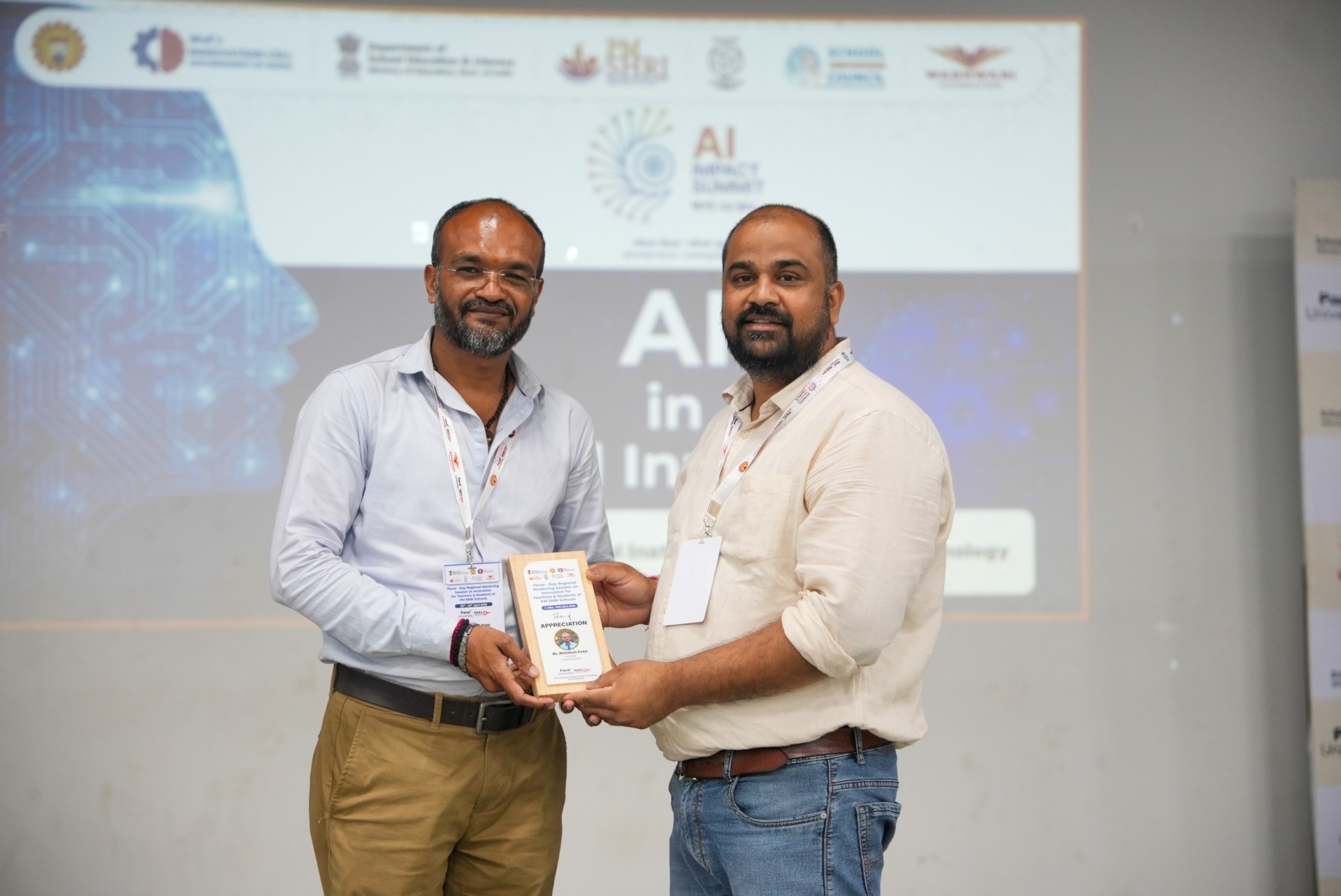
The innovation pipeline of India’s Lakshya 2047 vision of Viksit Bharat cannot be built by training students alone. It requires training the people who teach them.
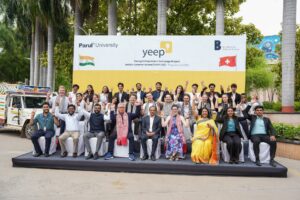
When the PM SHRI Regional Mentoring Session at Parul University convened from 28 to 30 April 2026, the participant manifest read 66 students and 66 teachers. The one-to-one ratio was not accidental. The Ministry of Education’s Innovation Cell, AICTE, and the Wadhwani Foundation had designed the programme on the operating principle that an innovation classroom in any PM SHRI School, JNV, or KV requires two things: students with raw ideas and teachers equipped to develop those ideas into ventures. The teacher dimension of the programme is what the National Education Policy 2020 calls faculty readiness and what the broader policy framework refers to as the structural foundation of any innovation curriculum.
The entire 20-member jury panel comprised Dr. Arvind Deshmukh, Ms. Anbumathi M, Mr. Parth Devariya, Mr. Hardik Kharva (Centre Head, VSS, PIERC), Ms. Sonal Sudani (Incubation Manager, PIERC), and Mr. Umang Panchal (Assistant Professor, PIET) and Mr Anup Chaudhary (Incubation Manager), Mr Umang Panchal, Mrs Sonal Sudani (PIERC), Mr. Hardik Kharwa, Ms. Sujaya Bhattacharjee, Mr. Himansu Das, Ms. Vanshika Muchhara, Dr. Partkumar Sapariya, Dr. Bhavin Dhanavade, Dr. Prashant Khanna, Dr. Sneha Soni, Dr. Saurabh Parmar, Ms. Kajol Patel, Mr. Vivek Joshi, Ms. Riddhi Mehta, and Mr. Omkamal Vashi.
The pedagogical transition: from chalk and board to design thinking mentor
Conventional school teaching in India operates on a model defined by curriculum delivery, examination preparation, and standardised assessment. Innovation mentorship requires a different posture entirely.
Mr. Pradeep Dhage holds the position of Assistant Innovation Director at the Ministry of Education’s Innovation Cell. What he said on Day 1, standing at the inaugural ceremony, landed more as a challenge than a welcome speech.
The teachers in that room were not there to sit through a lecture. That was his point. This was a working platform, something you do rather than something you watch. And the methods on offer here, out-of-the-box thinking, design thinking, prototype-based teaching, were built specifically to carry teaching past the limits of chalk and board.
Then he got to the difficult part, the part nobody in the room could pretend was comfortable. A teacher stops being the source. No longer the one who knows everything and passes it down from the front. That whole arrangement is finished. In its place comes the facilitator, the person whose real skill is asking a question sharp enough that the student walks off and finds the answer without being handed it. Easy to say from a stage and super hard to do after 15 years of teaching the opposite way.
The shift breaks into 4 parts.
- Delivering content becomes facilitating questions: Earlier, a teacher gave out the problem and waited for the solution. Now the teacher asks the questions that let a student dig out their own problem, the genuine one, the thing that matters to that particular student.
- Judging a single right answer becomes giving iterative feedback: First attempts at innovation fail. They are meant to. Which means the teacher has to make peace with work that gets better draft after draft instead of work that meets some fixed standard right away.
- The four walls stop being the limit: Design thinking pushes students out to speak with actual people in their communities, and supervising that, coordinating it, is a completely different job from managing an activity inside class.
- One subject stops being sufficient: A single student idea might pull physics, biology, economics, and design thinking into the same project at the same moment. A teacher trained in one of those has to learn how to back work that runs through all of them.
The Wadhwani Foundation curriculum for teacher capacity-building
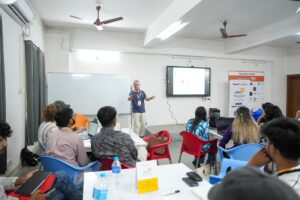
The Wadhwani Foundation operates one of India’s most structured curricula for teacher capacity-building in entrepreneurship and design thinking. Dr Arvind Deshmukh, Master Trainer at the Wadhwani Foundation, and Ms. Anbumathi M, Innovation Venture Catalyst at the Foundation, delivered the substantive teacher training content across all three days of the Parul University programme. The 5-stage design thinking framework and User-Payer-Influencer-Regulator audience tree that the students learned were taught simultaneously to the teachers, but with an additional layer: how to teach this material to students who have never encountered it before. The teacher-training layer covered:
- How to introduce design thinking to students who think solutions before problems: The most common reflex; teachers learned to redirect through structured questioning rather than direct correction.
- How to facilitate empathy interviews: Teachers learned the structure of customer-discovery conversations and how to coach students through their first attempts at conducting them.
- How to manage ideation sessions without filtering too early: The cognitive discipline of separating ideation from logic application is unfamiliar to most teachers; the training built it explicitly.
- How to evaluate prototypes when there is no right answer: Innovation work is judged on multiple competing dimensions; teachers learned the rubric that operates across feasibility, desirability, and viability.
- How to handle student disappointment with prototype feedback: Negative test results from real users feel like personal failure to many students; teachers learned to reframe the feedback as data.
Government initiative alignment: NEP 2020, NISHTHA, and Samagra Shiksha
The teacher-training dimension of the Regional Mentoring Session operationalised three government frameworks simultaneously. The National Education Policy 2020 mandate on faculty readiness establishes that NEP 2020 implementation in schools depends on teacher capability across design thinking, innovation, and entrepreneurship. The NISHTHA programme (National Initiative for School Heads’ and Teachers’ Holistic Advancement), administered through NCERT, provides the national framework for teacher capacity-building. The state-level Samagra Shiksha infrastructure, represented at the valedictory by Ms. Shilpa Patel, Secretary at the State Project Office in Gandhinagar, provides the operational connection between the central teacher-training framework and Gujarat’s school-level implementation. Mr. Ramesh Gorecha, lecturer at the District Institute of Education and Training (DIET) Gujarat, attended Day 1 as the representative of the institutional teacher-training pipeline that feeds the state’s school system. DIETs operate as the foundational teacher-training infrastructure across Indian states.
Voices from the teacher floor: feedback that shapes future programme editions
At the valedictory ceremony on Day 3, teachers were given the floor for open feedback. Three distinct voices captured what the programme had produced and what the next edition needed to address.
The first teacher reflected with visible emotion on the invisibility of innovation platforms to grassroots educators in rural and tribal Gujarat. Her statement is reproduced as it appeared in the programme documentation:
I am a teacher. I didn’t know that there was such a platform, and that we could create such a good opportunity for students. There are many youths who have ideas. I want this platform to be open for them too, so that their ideas can move in a good direction.
A teacher participant at the Day 3 valedictory ceremony!
The observation surfaces a structural reality in Indian school education. Innovation programme awareness concentrates in urban schools with strong administrative connections to AICTE and the Ministry of Education. Teachers in rural schools, tribal-belt JNVs, and remote districts often discover these platforms only when they are personally selected as participants. Her implicit request was that the programme infrastructure expand its outreach to teachers who do not yet know it exists.
A second teacher raised the scaling concern that has substantive implications for the national innovation pipeline. With the current programme format allowing only one student and one teacher per school, the transformative reach of each edition is structurally capped. He urged AICTE and the Ministry of Education to consider expanding the per-school participant ceiling, suggesting that even ten students per school could dramatically multiply innovation outcomes at the national level.
A third teacher offered constructive feedback on programme scheduling. Date changes during the planning cycle have, in some cases, required schools to substitute their originally nominated student participants. She suggested that greater advance notice and stability in scheduling timelines would better serve both schools and the programme’s intent.
The teachers' immediate role in the programme: classroom mentorship in real time
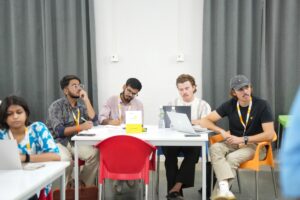
Teachers did not attend the programme as passive observers. Across the three days, they operated as embedded mentors to the students from their own schools. When students presented their problem statements on Day 1 (Mohammad’s low field production, the JNV student’s school bag weight issue, the KNV Anand student’s network tower issue), the teachers from those schools were present, supporting, and refining the framing. When students built prototypes on Day 2 alongside Mr. Mithilesh Patel’s 9-step idea-to-startup framework and Mr. Parth Devariya’s AI demonstrations their teachers were learning the same material in real time, equipping themselves to continue the work in their classrooms after the programme concluded.
The pedagogical model was explicit. Day 3 demonstrated this most visibly. When Shubham Kumar Sahu of JNV Kutch presented his Suraksha Driver system to the jury, he credited his school teachers and mentors for supporting the project. When the Vasava-Rathva team from PMC Model School Selamba presented their Anti-Distraction Car System, they specifically named their teacher, Navin Sir, for the technical assistance in assembling the prototype hardware. When Rathva Jyotiben Vikeshbhai of PM Shri GLRS Sai Devgadh Baria presented her Garbage Recycling Electricity Generator, she credited her school’s science project programme and teacher consultations. Each named credit was not ceremonial. It was an operational acknowledgement of the role the teacher-mentorship layer had played in moving the innovation from idea to pitch.
The rural and tribal-belt teacher representation
The 66 participating teachers were drawn from PM SHRI Schools, JNVs, and KVs across the Gujarat region, with a significant concentration from rural and tribal-belt districts. Jawahar Navodaya Vidyalayas are specifically mandated under the Government of India scheme to serve rural students, with substantial representation from Scheduled Castes, Scheduled Tribes, and other educationally disadvantaged communities. Teachers from JNV Tapi, JNV Mahisagar, JNV Surendranagar, JNV Kutch, JNV Banaskantha, and JNV Surat (all tribal-belt or rural-majority districts in Gujarat) attended the programme alongside their students. The teacher participation pattern aligns directly with the broader Atmanirbhar Bharat and Ministry of Tribal Affairs priorities on extending innovation and entrepreneurship infrastructure into rural and tribal India.
Beyond the three days: what teachers carry back to their classrooms
The structural lesson of the programme is that what happens in the three days at Parul University matters less than what happens in the 360 days that follow.
Each participating teacher returns to a classroom of 30 to 60 students. If the design thinking framework, the audience tree, and the prototype-development discipline take hold in even a single innovation-focused classroom per teacher, the reach of the April 2026 programme expands from 66 students directly trained to several thousand students reached indirectly across the following academic year. Ms Anbumathi M articulated this multiplier explicitly in her valedictory address. She praised the participating teachers for their attentive engagement throughout the sessions and asked them to carry the spirit back to their schools, making innovation a classroom culture and a source of submissions for the SIC portal project. The portal supports unlimited project submissions, designating every participating teacher as an institutional ambassador for the School Innovation Council framework across their school’s full student body.
Use AI as a supporting agent. AI is not everything.
Ms Anbumathi M, in her valedictory address, spoke about what teachers should carry into their classrooms about the boundary between AI tools and authentic human innovation
FAQs
How many teachers participated in the PM SHRI RMS at Parul University?
66 teachers participated in a 3-day RMS (Regional Mentoring Session) at Parul University. From 28th to 30th April 2026, 66 students actively participated. This student-teacher ratio was a choice made by the Ministry of Education’s Innovation Cell, AICTE, & Wadhwani Foundation. Students from PM SHRI Schools, JNVs & KVs across Gujarat, hailing mainly from rural & tribal belt districts!
What is the pedagogical transition the PM SHRI RMS programme builds in teachers?
The PM SHIR RMS, held at Parul University, trains teachers across a designed navigation - conventional practices to community-engaged design thinking, from subject-based guidelines to mentorship at all levels. This particular transition was executed via the Wadhwani Foundation, the curriculum was exclusively delivered by Dr Arvind & Ms Anbumathi M, wherein it specifically covers 5 stages of the design framework!
How does the teacher dimension align with NEP 2020 and NISHTHA?
The teacher-training dimension of the PM SHRI RMS programme operationalises three government frameworks simultaneously. The National Education Policy 2020 mandates faculty readiness as the foundation of innovation curriculum delivery in schools. The NISHTHA programme (National Initiative for School Heads' and Teachers' Holistic Advancement), administered through NCERT, provides the national framework for teacher capacity-building, including innovation and entrepreneurship competencies. Samagra Shiksha provides the state-level operational infrastructure, with the Gujarat State Project Office under Secretary Ms. Shilpa Patel coordinating teacher development across the state's school system. District Institutes of Education and Training (DIETs) serve as the foundational teacher-training infrastructure, with Mr. Ramesh Gorecha attending the Day 1 inauguration as a DIET Gujarat representative.
What feedback did teachers give at the valedictory ceremony?
Three distinct teacher voices captured the programme's reception at the Day 3 valedictory. The first teacher reflected on the invisibility of innovation platforms to grassroots rural educators, noting that her own knowledge of such opportunities depended on personal selection rather than systemic outreach. The second teacher raised the scaling concern that the current one-student-one-teacher-per-school format structurally caps the programme's reach, suggesting that even ten students per school could dramatically multiply national outcomes. The third teacher offered constructive feedback on scheduling, noting that mid-cycle date changes had forced some schools to substitute originally nominated participants. Mr. Jay Sudani, CEO of PIERC, responded with an explicit institutional commitment for future editions, including air-conditioned accommodation for visiting teachers.
How do teachers participate in the student innovation work during the programme?
Teachers operated as embedded mentors throughout the three-day programme rather than as passive observers. On Day 1, teachers supported their students through the design thinking workshops and problem statement fine-tuning sessions, refining the framing of their students' raw observations. On Day 2, teachers participated alongside their students in Mr. Mithilesh Patel's 9-step idea-to-startup framework and Mr. Parth Devariya's AI demonstrations, equipping themselves to continue the work in their classrooms after the programme. On Day 3, the named student innovators credited their teachers explicitly during the final pitch presentations, with Shubham Kumar Sahu (JNV Kutch) acknowledging his teachers and mentors, Vasava Divyesh and Rathva Bhavesh (PMC Model School Selamba) naming Navin Sir for the prototype hardware assembly, and Rathva Jyotiben Vikeshbhai (PM Shri GLRS Sai Devgadh Baria) citing her school's science project programme.
What is the multiplier effect of training 66 teachers in innovation mentorship?
The multiplier effect of the teacher-training dimension operates on a simple structural logic. Each participating teacher returns to a classroom of 30 to 60 students. If the design thinking framework, the audience tree, and the prototype-development discipline are embedded in even one innovation-focused classroom per teacher, the reach of the April 2026 programme expands from 66 students directly trained to several thousand students reached indirectly across the following academic year. The School Innovation Council portal supports unlimited project submissions, allowing each participating teacher to serve as an institutional ambassador for the SIC framework to their school's entire student body. Ms. Anbumathi M's valedictory framing of teachers as the ones who must carry the spirit back to their schools captures the structural intent.