Most school students arrive at entrepreneurship through the same instinctive door. They think of a solution, then look for a problem it might solve. The Wadhwani Foundation‘s framework reverses the direction.
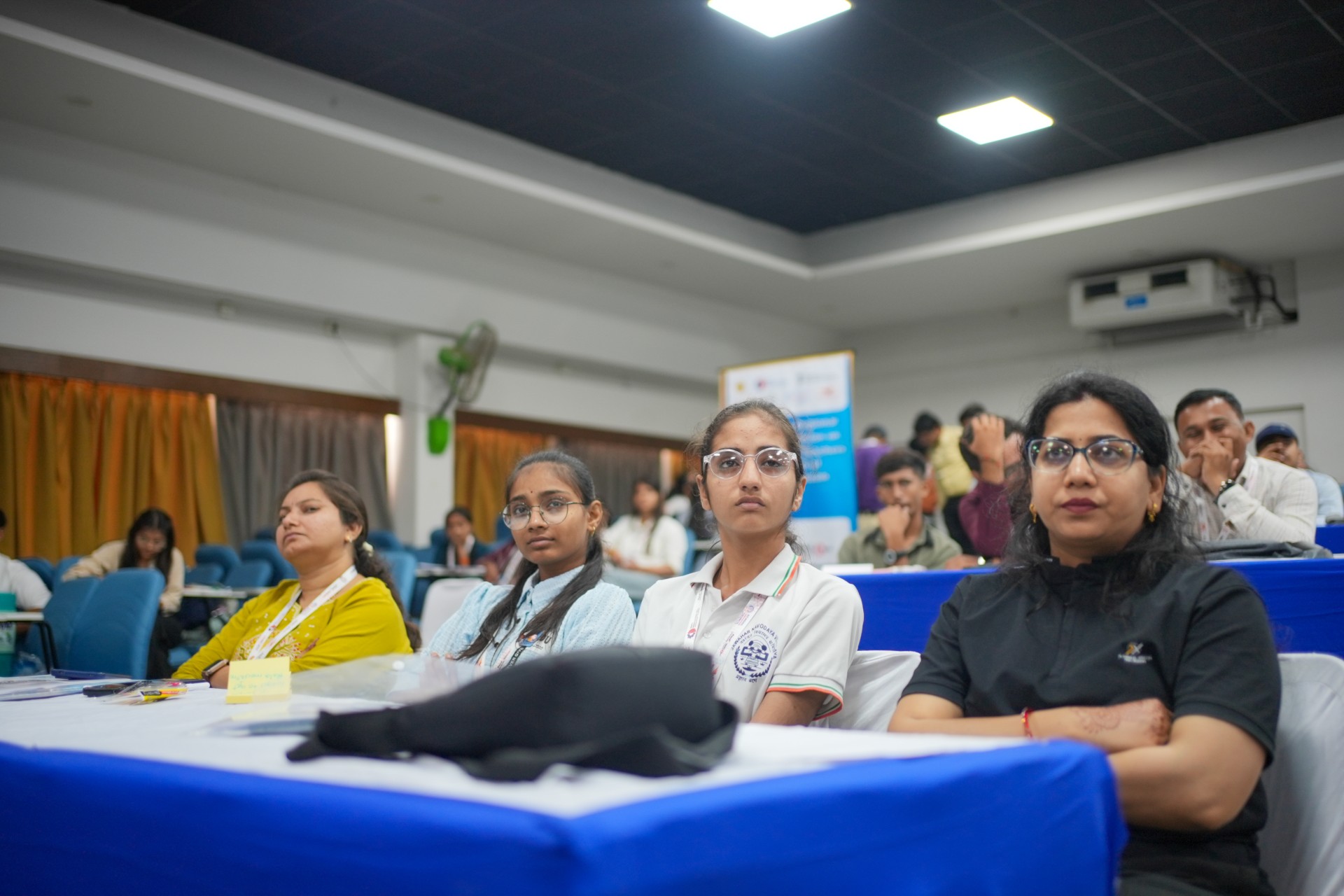
The morning of 28 April 2026 at the Hospital Auditorium, Parul University, opened with what Dr. Arvind Deshmukh framed as the simplest and most important reversal in any innovator’s thinking: the problem must come first, not the solution. The session was conducted under the joint authority of the Ministry of Education’s Innovation Cell, AICTE, and the Wadhwani Foundation, with PIERC operating as the AICTE Nodal Centre. The methodology was built on the established Wadhwani Foundation design thinking curriculum that operates across India’s National Education Policy 2020 innovation-focused initiatives.
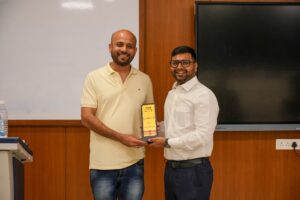
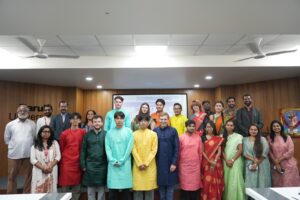
The entire 20-member jury panel comprised Dr. Arvind Deshmukh, Ms. Anbumathi M, Mr. Parth Devariya, Mr. Hardik Kharva (Centre Head, VSS, PIERC), Ms. Sonal Sudani (Incubation Manager, PIERC), and Mr. Umang Panchal (Assistant Professor, PIET) and Mr Anup Chaudhary (Incubation Manager), Mr Umang Panchal, Mrs Sonal Sudani (PIERC), Mr. Hardik Kharwa, Ms. Sujaya Bhattacharjee, Mr. Himansu Das, Ms. Vanshika Muchhara, Dr. Partkumar Sapariya, Dr. Bhavin Dhanavade, Dr. Prashant Khanna, Dr. Sneha Soni, Dr. Saurabh Parmar, Ms. Kajol Patel, Mr. Vivek Joshi, Ms. Riddhi Mehta, and Mr. Omkamal Vashi.
AI for School Innovation – Mr. Parth Devariya on Building Applications without Coding!
Who is an entrepreneur: the framing that began the programme
Dr. Arvind Deshmukh opened with a question, not a definition. Who is an entrepreneur?
A student named Bajrang answered first: anybody who starts something and creates jobs for others. The answer was correct but partial. A student named Farhan then offered a more precise definition: those who identify a problem and create a solution for it. Dr Deshmukh agreed with Farhan’s framing and used it to anchor the entire three-day curriculum. The discipline he wanted to embed in the participants was specific:
- Find the problem first: Not the solution. Not the technology. Not the business model. The problem.
- Use a stethoscope, not a prescription: Like a doctor, the entrepreneur diagnoses before they prescribe.
- The customer is in pain: A customer pays for a solution only when the solution addresses suffering they actually experience.
- Ideas first, logic later: In ideation, suspend critical filtering; bring out hundreds of crazy ideas before applying logic to select the best.
- Iterate without ego: Design thinking is iterative. Negative feedback on a prototype is data, not personal criticism.
Product-centric versus customer-centric: the Adipurush and Lalo case study
To make the abstract concept concrete, Dr. Deshmukh used two contemporary Indian films as case study material. The first, Adipurush, was made with a production budget of approximately Rs. 600 crore and underperformed dramatically at the box office. The second, the Gujarati-language film Lalo, was made with a production budget of approximately Rs. 50 lakh and earned approximately Rs. 150 crore in revenue. The difference between the two films, in his analysis, was not budget or technical scale. It was the orientation of the creative process.
Adipurush operated on a product-centric model. The producers created what they believed should be a successful film and then attempted to convince the audience to accept the product. Lalo operated on a customer-centric model. The makers understood the cultural sensibilities, emotional registers, and storytelling expectations of the Gujarati audience and built a film that resonated with what the audience actually wanted. The framework generalises directly into entrepreneurship:
- Product-centric approach: Build first, sell second, hope the market accepts the product. High marketing spend follows because the product carries no inherent demand pull. Most products built this way fail.
- Customer-centric approach: Understand the customer’s pain, design the solution around the pain, and let the product’s relevance pull the customer in. Lower marketing spend required because relevance does the work.
The 5-stage design thinking framework
The Wadhwani Foundation design thinking methodology operates across five iterative stages. Each stage builds on the previous one, but the process can loop backwards whenever the data demands it.
- Stage 1: Empathy (Samanubhuti). Step into the customer’s shoes and feel their pain directly. Direct interaction is the primary tool; analysis and observation are secondary. Distinguish empathy (feeling the pain and actively helping) from sympathy (pitying from a distance).
- Stage 2: Define (Problem Statement Fine-Tuning). Convert unstructured customer interaction data into a precise problem statement. Apply root cause analysis to identify the underlying source of the problem rather than its surface symptoms. Beware wicked problems, structural challenges like poverty that recur because their root causes are not addressed.
- Stage 3: Ideation (Udbhavna). Generate hundreds of ideas without filtering. Ideas first, logic later. No idea is too absurd at this stage; the human colony on the Moon example illustrates that today’s impossibility is tomorrow’s reasonable proposal.
- Stage 4: Prototype. Build a small-scale, rudimentary version of the chosen idea. Like a clay model of a BMW before manufacturing the actual car, the prototype allows identification of merits and disadvantages without consuming the resources required for full production.
- Stage 5: Test. Present the prototype to the actual customer for feedback. Negative feedback is not failure; it is information that feeds into the next iteration. Continue iterating until the customer says What a matter, the recognition signal that the solution has reached resonance. If you wish to master how this entire framework works, enrol on B.Tech CSE program of Parul University and master it at all the levels!
Fine-tuning the problem statement: the afternoon workshop
The afternoon session began with a deliberate energy reset. A video of a dancing bear played on the main screen, and every participant was instructed to stand up and dance freely. Hierarchy was suspended for the duration of the warm-up.
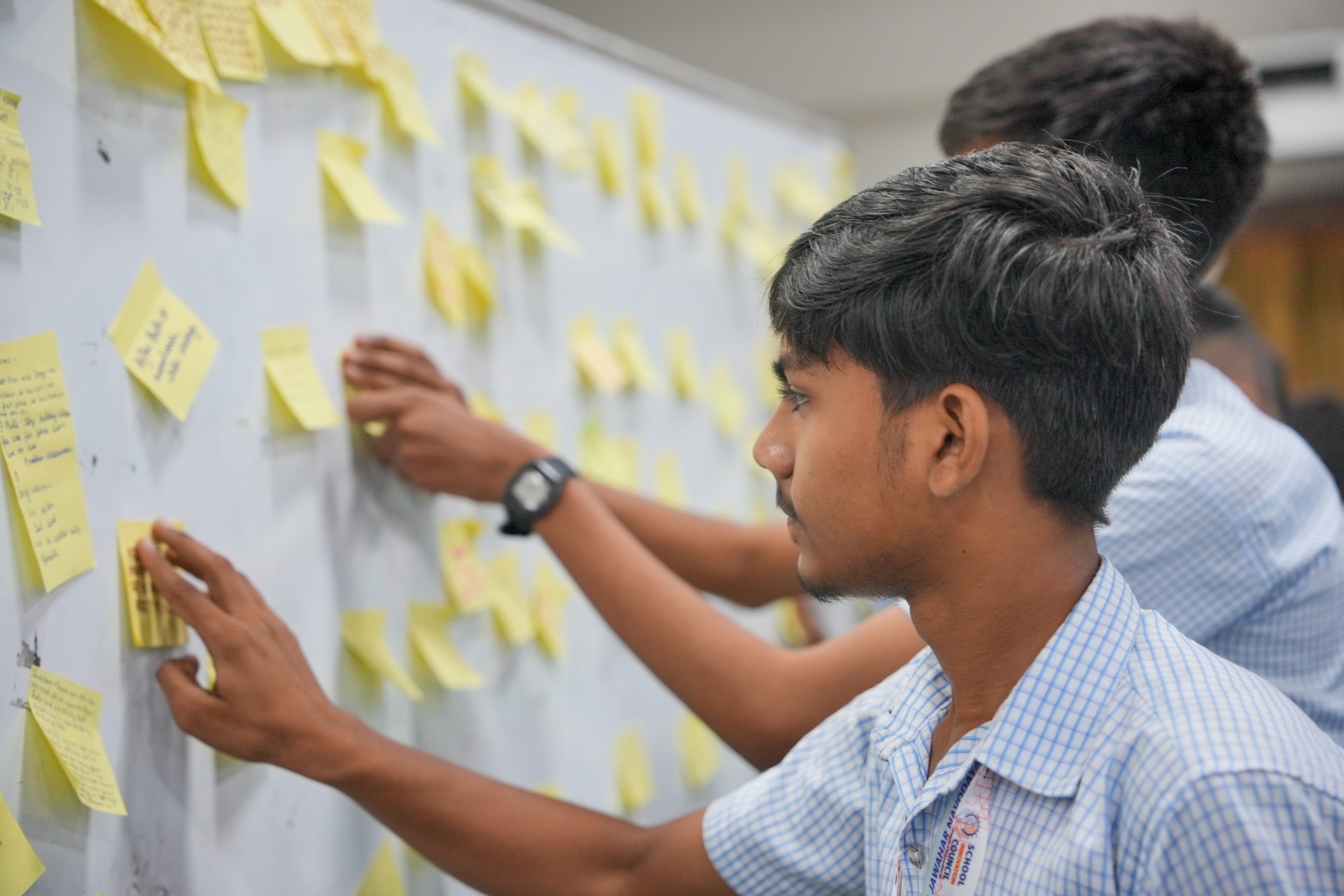
The purpose of the warm-up was structural, not decorative. Innovation requires risk-taking and vulnerability, which require the dissolution of the social hierarchy in the room. With principals and students dancing together in front of the same screen, the mental architecture of the session was reset for the harder work that followed. The mentors then introduced the central instruction: focus only on finding the problem. Do not focus on the solution, the technology, or commercial viability. Find a real problem that someone (a friend, a family member, a community member, the student themselves) actually experiences. Students were called to the stage to articulate problem statements they had observed:
- Mohammad: “There is low production in my fields.”
- Another participant: “People who live near water bodies often suffer from fungal infections.”
- A student on cold-weather routines: “In winters, I am not able to wake up early.”
- A participant on a daily school burden: “My school bag weighs a lot.”
- Student from KNV Anand: “The network towers are too old in my area, the network crashes, and I am not able to watch videos.”
Until you understand the problem, you will not be able to find the solution. (Jab tak aap samasya ko nahi samjhenge, tab tak aap samadhan nahi nikal payenge.)
Dr. Arvind Deshmukh, master trainer at the Wadhwani Foundation, on the foundational principle of design thinking
The Paper Walk activity: constraints as innovation drivers
Each participant received a single A4 paper and was asked to walk through it while keeping the border intact.
The instruction sounded impossible. The room fell briefly silent as students assessed the task. Then experimentation began. Folding, cutting, stretching. Multiple students independently arrived at the correct method: a series of alternating cuts inward from both edges of the paper, creating a large expandable loop through which a person could step. The activity demonstrated something more important than the puzzle’s solution:
- Constraints drive creativity: The instruction to preserve the border is identical in structure to real-world budget, material, and time constraints. Innovation is what happens when creative thinking operates within constraint.
- Solutions are democratic: Multiple students arrived at the correct method independently. The lesson the mentor articulated afterwards was direct: if you can find the problem, you can find the solution; every other person around you is as clueless as you are.
- Self-direction matters: No teacher answered. Students worked alone, in pairs, in groups, each setting their own pace. The Paper Walk modelled the autonomy that real innovation requires.
Ms Anbumathi M's journey and the User-Payer-Influencer-Regulator audience tree
Ms. Anbumathi M’s late-afternoon session converted the design thinking framework into a working business analysis tool. Her own background carried evidential weight. She studied mechanical engineering, did not know English until she was 18, failed 21 interviews during her college placement cycle, and was offered her first job not as an engineer but as a door-to-door vacuum cleaner salesperson at Eureka Forbes. The lesson she extracted from that vacuum cleaner job became the framework she taught at PM SHRI RMS.
The lesson was visible in the door-to-door dynamic. The mother of the household opened the door. The mother used the vacuum cleaner. But the mother could not buy the vacuum cleaner. Only the husband could authorise the purchase. Ms. Anbumathi had to learn that the person who uses the product is often not the person who pays for it. The framework she now teaches generalises this insight into a four-branch audience tree:
- The User (Core Audience): The person who actually interacts with the product daily. Their experience drives functional design choices.
- The Payer (Extended Audience): The person with the authority and resources to purchase the product. Their decision drives commercial design choices and pricing strategy.
- The Influencer (Extended Audience): The person who neither uses nor pays but whose recommendation drives the purchase. For consumer products, this includes friends, YouTubers, retailers, and social media voices.
- The Regulator (Extended Audience): The government agency or regulatory body that determines whether the product can legally exist in the market. For AI products, this includes the Digital Personal Data Protection Act, 2023. For medical devices, this includes the Central Drugs Standard Control Organisation.
The framework was demonstrated through a 100-rupee app simulation that exposed early-adopter identification.
Ms. Anbumathi asked the class to raise their hands if they would download a free educational app. Most hands went up. She then announced the app would cost Rs. 100. Of the 50 students, only 10 to 12 hands remained raised. The exercise demonstrated, in real-time, the difference between expressed interest and actual purchase commitment. Of 50 self-declared interested users, only 10 to 12 were genuine early adopters. The lesson she articulated for the class was direct: target only the people willing to pay you; ignore the people who said they wanted your product but would not pay for it. If you wish to master how such techno-creative frameworks are executed at all levels, enrol on Parul University’s B.Tech in Artificial Intelligence program!
Case studies: the Bulk Waste Management problem and the David case
Two case studies anchored the audience-tree framework in real-world business design.
The Bulk Waste Management case (2020 pandemic period) traced Ms Anbumathi’s discovery that municipal corporations were withdrawing waste collection services from bulk waste generators (hotels, hospitals, marriage halls, etc.). Rather than building a digital app from her office, she approached the president of the marriage hall owner association directly. In a single meeting, she discovered that the hall owners were already paying Rs. 800 per pickup (Rs. 200 to a garbage collector, Rs. 300 to a cleaner, Rs. 300 to a night watchman) under the table. Competing private waste collection services were quoting Rs. 1,500. Her business model had to enter the market at the Rs. 800 price point that the customers were already paying.
The David case (a 21-year-old patient with a spinal injury) introduced the corollary that sometimes a problem appears solved on the surface, but the existing solutions fail at the level of human behaviour. Mechanical bathing devices existed in the market for paralysed patients. They were priced beyond family budgets, impractical for cramped homes, and (in David’s case) culturally unacceptable because of the dignity issue of being bathed in front of a sister-in-law. Innovation in this domain did not require new technology. It required understanding why existing solutions failed.
Government initiative alignment: NEP 2020 and the school innovation pipeline
The methodology Dr. Deshmukh and Ms. Anbumathi taught at PM SHRI RMS aligns directly with the National Education Policy 2020 mandate to integrate design thinking, problem-solving, and entrepreneurship into school education. The School Innovation Council framework operates as the implementation vehicle for this NEP 2020 mandate, with the Wadhwani Foundation curriculum providing the structured content. The PIERC, as the Nodal Centre at Parul University, carried operational responsibility for the April 2026 programme.
PM SHRI Regional Mentoring Session at Parul University maps the broader Lakshya 2047 vision of Viksit Bharat that this school-level design thinking work feeds into.
FAQs
What is the 5-stage design thinking framework taught at PM SHRI RMS?
The 5-stage design thinking framework taught at PM SHRI RMS by Dr. Arvind Deshmukh and Ms. Anbumathi M of the Wadhwani Foundation operates as follows: Stage 1 is Empathy, stepping into the customer's pain through direct interaction. Stage 2 is Define, converting unstructured customer data into a precise problem statement through root cause analysis. Stage 3 is Ideation, generating hundreds of ideas without filtering. Stage 4 is Prototype, building a small-scale rudimentary version of the chosen idea. Stage 5 is Test, presenting the prototype to actual customers for feedback that informs the next iteration. The process is iterative; teams loop back to earlier stages whenever customer feedback demands.
Who are Dr. Arvind Deshmukh and Ms. Anbumathi M?
Dr. Arvind Deshmukh is the Founder and Principal Consultant at Deshmukh Global Management Solutions and serves as Master Trainer at the Wadhwani Foundation. Ms. Anbumathi M is the Founder of Carbon 6 Venture Studio and Resources Lifescience and serves as Innovation Venture Catalyst and Design Thinking Expert at the Wadhwani Foundation. Together, they anchored the intellectual content of the Three-Day Regional Mentoring Session at Parul University from 28 to 30 April 2026, leading the morning Design Thinking Foundations session, the afternoon Fine-Tuning the Problem Statement workshop, the late-afternoon Innovation Initiatives of DoSEL session, and serving as primary jury members for the Day 3 student pitch evaluations.
What is the User-Payer-Influencer-Regulator audience tree?
The User-Payer-Influencer-Regulator audience tree is the four-branch framework Ms. Anbumathi M taught at PM SHRI RMS for identifying the complete stakeholder set around any product or service. The User (Core Audience) is the person who interacts with the product daily. The Payer (Extended Audience) is the person with the authority and resources to purchase. The Influencer (Extended Audience) is the person whose recommendation drives the purchase decision. The Regulator (Extended Audience) is the government agency or regulatory body determining the product's legal market access. The framework was demonstrated through case studies, including a kid's toy (user: child, payer: parents, influencer: TV ads, regulator: child safety standards) and a gaming laptop (user: student, payer: parents, influencer: YouTubers, regulator: consumer electronics standards).
How does the design thinking framework align with NEP 2020?
The National Education Policy 2020 mandates the integration of design thinking, problem-solving, and entrepreneurship into school education across India. The Wadhwani Foundation curriculum taught at PM SHRI RMS operates as a structured implementation of this NEP 2020 mandate. The framework integrates with the broader School Innovation Council (SIC) initiative under the Ministry of Education's Innovation Cell, which provides Rs. 3.75 crore in government funding and up to Rs. 1.5 lakh per student team for Student Innovation Practice prototype development. The methodology aligns with the broader Atmanirbhar Bharat, Startup India, and Lakshya 2047 vision of Viksit Bharat priorities by building entrepreneurial capability in the school-going generation that will lead India to Viksit Bharat by 2047.
What was the Paper Walk activity at PM SHRI RMS?
The Paper Walk activity was a structured exercise during the afternoon Fine-Tuning the Problem Statement workshop at PM SHRI RMS on 28 April 2026. Each participant received a single A4 paper and was asked to walk through it while keeping the border intact. The apparently impossible task was solved by multiple students through a series of alternating cuts inward from both edges of the paper, creating a large expandable loop through which a person could step. The activity demonstrated three principles: constraints drive creativity, solutions are democratically accessible to anyone who applies sustained thinking, and self-directed experimentation produces innovation more reliably than teacher-directed instruction.
What case studies did Ms. Anbumathi M present at the PM SHRI RMS programme?
Ms. Anbumathi M presented three primary case studies during her sessions. First, the vacuum cleaner door-to-door experience at Eureka Forbes, which surfaced the user-versus-payer distinction. Second, the 2020 Bulk Waste Management business design case, which demonstrated how customer interviews (with marriage hall association presidents) revealed the actual Rs. 800 willingness-to-pay price point versus the Rs. 1,500 competing private quote. Third, the case of a 21-year-old patient, David, with a spinal injury, demonstrated that existing solutions can fail not because of technology gaps but because of human behaviour and dignity factors. She also presented simple-innovation visual examples, including a colour-coded thermometer for elderly users, revolving cylindrical fridge trays, two-lamp flashlights for path-and-foot illumination, and miniature staplers for button repair on travel.