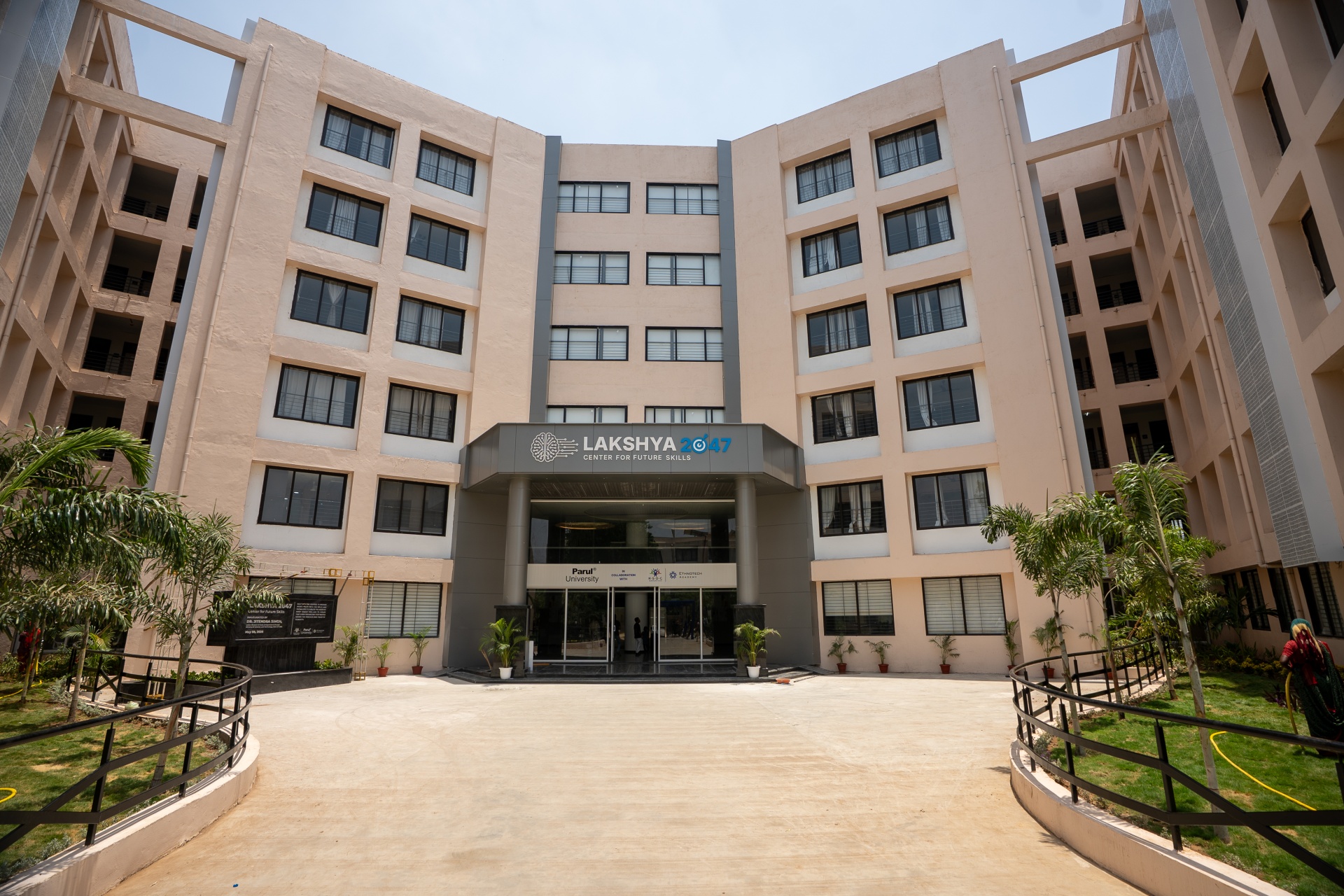
Lakshya 2047 at Parul University is structurally part of a national initiative. The NSDC Centre for Future Skills (CFS) model is currently active across 11 institutions in India and has already trained over 50,000 candidates through global certification programmes integrated into existing university curricula. Parul University is the first such Centre for Future Skills in Gujarat under this NSDC framework, delivered jointly with Ethnotech Academy as NSDC’s project partner.
“The launch of the first Centre for Future Skills in Gujarat is an important step as we move towards building a Viksit Bharat. With this, the model is now active across 11 institutions and have already trained over 50,000+ candidates. What makes this different from others is the global certification it offers with training combined with learnings and extra curriculum.” – Mr. Nitin Kapoor, Vice President, National Skill Development Corporation (NSDC)
“CFS has been very effective in bringing elite global certification programs to the doorstep of colleges at the most affordable cost. We are committed to bridging the gap between academics and industry by creating globally skilled, innovation-driven professionals.” – Dr. Kiran Rajanna, CEO, Ethnotech Academy
The day's two inaugurations: Lakshya 2047 and the Pragya cadaveric extension
The event started in the afternoon with the inauguration of Lakshya 2047 at 2:15 pm. This will be a two-floor building built for fifteen specialised labs. It’s structured for operational facilities rather than a display center. Each lab is functional and has professional-grade fittings of the equipment and supervised by faculty with domain expertise.
The second inauguration extended Pragya, the Advanced Skills and Simulation Centre on the third floor of the Parul Institute of Medical Sciences and Research, with a new cadaveric centre. The full Pragya structure with its eleven simulation units is documented in Pragya at Parul University: 16,000 sq ft, 11 simulation units.
- Lakshya 2047: Gujarat’s first NSDC Centre for Future Skills, fifteen labs across two floors, inaugurated at 2:15 pm on 8 May 2026.
- Partnership: National Skill Development Corporation (NSDC) with Ethnotech Academy as a project partner.
- National scale: 11 institutions active under the NSDC CFS model, 50,000+ candidates trained.
- Pragya cadaveric extension: anatomical training capability added to the existing 16,000 sq ft, 11-unit simulation centre.
- Student interaction: ninety Udhampur-constituency students in a dedicated half-hour session.
Vasudhaiva Kutumbakam: the design philosophy behind Lakshya 2047
The center Lakshya 2047 at the university comprises a globe as a visual design, which represents the Indian principle of Vasudhaiva Kutumbakam, meaning the world is one family. The choice frames the facility not only as a technical-skill-training environment but as an ethical-development anchor. The combination of advanced global technology with rooted Indian values is presented as central to the Centre’s institutional identity.
“It is another step in creating a future-ready ecosystem, which combines innovations and ethics.” – Dr Devanshu Patel, President, Parul University
Why Lakshya 2047 matters: the Viksit Bharat 2047 connection
Lakshya is a goal for 2047, when India will be completing its hundredth anniversary of independence. Also, the target year of the Viksit Bharat is 2047. The operational window, Amrit Kaal, is from 2022 to 2047. A national vision led by Prime Minister Narendra Modi and his government.
“Lakshya 2047 is not only contemporary but also very futuristic. The age of isolation is over, and you can’t leave everything to the government. No successful country does that, whichever the party, whichever the government. Now that this government, particularly after Prime Minister Modi has taken over, is very open to the private sector because we realise that if we have to move on from where we are, we cannot move in isolation.” – Dr Jitendra Singh, Union Minister of State (I/C), Science and Technology and Earth Sciences
The areas integrated inside the building are related to high growth and national vision. The building has robotics; drone technology; sensor research and nanomaterials; cloud computing; augmented and virtual reality; iOS development; industrial automation; chip design; networking and cybersecurity; and precision and digital fabrication. The broader question of what counts as a future skill is examined in the future skills India 2047 debate.
Also Check: Micro and Nano Research & Development Center at Parul University.
The lab structure at Lakshya 2047: NSDC Lab Ecosystem and AICTE AVPL/IDEA Lab Zone
Lakshya 2047 at Parul University is organised across two distinct structural ecosystems. The NSDC Lab Ecosystem houses ten global-technology-vendor laboratories delivering certification-aligned training. The AICTE AVPL/IDEA Lab Zone is the AICTE-supported fabrication, prototyping, and research environment for experiential learning.
- NSDC Lab Ecosystem (10 labs): NVIDIA Lab (AI and GPU computing), Cisco Lab (networking and cybersecurity), ABB Lab (industrial automation), AR/VR Lab (Apple Vision Pro and Meta Quest), ANSYS Lab (engineering simulation), Adobe Lab (creative design), Autodesk Lab (CAD), VLSI Lab (chip design), AWS Lab (cloud computing), Apple Lab (iOS development).
- AICTE AVPL/IDEA Lab Zone: drone training areas with RPTO curriculum, fabrication centres with industrial 3D printers and CNC equipment, material synthesis labs, teamwork spaces.
- Research laboratories: Mind Lab, Centre of Excellence in Sensor Technology with 30+ disclosed patent applications, Special Integrated Facilities Idea Lab supported by AICTE.
- Auxiliary teaching laboratories: PLC and SCADA Lab (twelve working process models), Home Automation Lab (IoT), Cambridge Lab (communication training).
The Centre of Excellence in Sensor Technology, with more than thirty disclosed patent applications and instruments including the Metrohm Dropsens 220BT and the Autolab PGSTAT204N potentiostat, anchors the research dimension. The deep dive is in the Center of Excellence in Sensor Technology. The lab sits in scope-adjacency to the Micro Nano Research and Development Center (MNRDC), where SEM, XRD, and AFM characterisation services are housed.
Pragya: where Parul University's medical students train before patients
The visit then moved to Pragya, on the third floor of the Parul Institute of Medical Sciences and Research. Pragya covers 16,000 square feet and houses eleven simulation units, each fitted with high-fidelity manikins and task trainers. The ATLAS and i-Simulate platforms allow instructors to run dynamic clinical scenarios responding to learner interventions.
Walking the chief guest through the facility, Dr Geetika Madan Patel noted that the simulation hardware in Pragya is imported, because comparable equipment is not currently manufactured in India. The students who train here pursue the MBBS programme at the Parul Institute of Medical Sciences and Research, with trauma, obstetric, cardiac, surgical, and ICU rotations all anchored to the centre.
“Bohet jald shruyat hogi yaha bhi.” – Dr Jitendra Singh, response to Dr Geetika Madan Patel on imported simulation hardware
The neurosurgery demonstration: a 2 cm cranial channel and a robotic exoscope
Inside Pragya, Dr. Iype Cherian, Director of Neurosciences at Parul University, introduced a neurosurgical demonstration unlike anything else in the day’s programme. The technique allows complete cranial access through a 2-centimeter minimally invasive channel, with a robotic exoscope navigating to the operative field without the line-of-sight constraints that conventional neurosurgical access imposes.
Dr. Singh, himself an MBBS from Stanley Medical College, Chennai and an MD from AIIMS, New Delhi, asked precisely the right question: how wide is the channel. The full demonstration is documented in the robotic exoscope neurosurgery deep dive.
The student innovation that made the Apple India top 350
During the Apple Lab segment of the walkthrough, a faculty mentor drew attention to a Computer Science student at Parul University who had developed a mobile application addressing digital eye strain. The application is an interactive eye-movement game designed to reduce dry-eye symptoms through targeted exercises with real-time visual feedback. It was recognised among Apple’s top 350 apps in a national competition.
The behaviour pattern is structurally supported by PIERC, the university’s start-up incubator with 254 incubated startups and ₹40 crore plus in revenue generated.
Check Out: How a Parul University CSE student’s eye-health app ranked among Apple India’s top 350.
Ninety students from Udhampur, one homecoming in Vadodara
After the lab walkthrough, Dr. Singh entered the seminar hall in the Lakshya 2047 building to find ninety students from Jammu and Kashmir in traditional attire. All ninety were studying at Parul University. All ninety were from his Udhampur constituency.
“Sir, excitement isliye bhi thi kyuki kabhi one on one mulakat nhi hui. Aur mai bahut rural area se aata hoon, aur aapki vajah se mera area aaj duniya aur bharat ke nakshe mein visible hai. Mere ghar tak road bhi aapki vajhe se pahunchi hai.” – Akshay Kumar, student from Udhampur constituency, on the road that reached his rural home
The full interaction is documented: ninety students from Udhampur, one minister, and a homecoming in Vadodara.
Government schemes Dr Singh told Parul University students they could apply to
In his address at the Medical Auditorium, Dr. Singh used a substantial portion of the speech to walk students through the schemes and programs available to them through the Department of Science and Technology.
- ANRF: Anusandhan National Research Foundation, the apex research-funding body.
- PURSE: Promotion of University Research and Scientific Excellence.
- FIST: Fund for Improvement of S&T Infrastructure.
- NIDHI: National Initiative for Developing and Harnessing Innovation.
- INSPIRE-MANAK: school-level competitive initiative from Class 9.
- Vigyan Jyoti: girls from Class 9 mentored for aptitude in science.
- WISE-KIRAN / CURIE: schemes for women researchers and women’s universities.
- SAIF / SATHI / STUTI: sophisticated analytical instrumentation and training infrastructure programs.
Dr. Singh disclosed that the National Quantum Mission has already completed 1,000 kilometres of secure quantum communication against an eight-year target of 2,000 kilometers. India’s startup count has grown to over 2 lakh, and India has crossed 1 lakh patents. Coverage via Press Information Bureau.
FAQs
Is Lakshya 2047 at Parul University an NSDC initiative?
Yes. Lakshya 2047 at Parul University is established in partnership with the National Skill Development Corporation (NSDC), under the Ministry of Skill Development and Entrepreneurship, and Ethnotech Academy as NSDC's project partner. It is the first NSDC Centre for Future Skills in Gujarat. The NSDC CFS model is currently active across 11 institutions in India and has trained over 50,000 candidates.
What did Dr Jitendra Singh inaugurate at Parul University on 8 May 2026?
Dr. Jitendra Singh inaugurated two facilities at Parul University, Vadodara on 8 May 2026: Lakshya 2047, the new Center for Future Skills established in partnership with NSDC and Ethnotech Academy, housing fifteen advanced laboratories across two floors; and a new cadaveric extension to Pragya, the Advanced Skills and Simulation Center at the Parul Institute of Medical Sciences and Research.
What labs are inside Lakshya 2047 at Parul University?
Lakshya 2047 at Parul University houses fifteen laboratories organised into three structural groups. The NSDC Lab Ecosystem includes the NVIDIA Lab, Cisco Lab, ABB Lab, AR/VR Lab, ANSYS Lab, Adobe Lab, Autodesk Lab, VLSI Lab, AWS Lab, and Apple Lab. The AICTE AVPL/IDEA Lab Zone covers drone training, fabrication, material synthesis, and teamwork spaces. Research laboratories include the Mind Lab, the Centre of Excellence in Sensor Technology, and the Special Integrated Facilities Idea Lab supported by AICTE.
How many students from Udhampur constituency study at Parul University?
At least ninety students from Dr Jitendra Singh's Udhampur Lok Sabha constituency in Jammu and Kashmir were present at the dedicated interaction session with the minister at Parul University on 8 May 2026.
What is the accreditation of Parul University?
Parul University holds NAAC A++ accreditation at a 3.55 CGPA, is a Category 1 University with Grant of Graded Autonomy, and is notified as a Centre of Excellence by the Government of Gujarat. Parul University is placed in the QS World University Rankings 1001-1100 band (Asia 2026) and holds a NIRF Top 50 Innovations Ranking. Its R&D Centre is recognised by the Department of Scientific and Industrial Research (DSIR).
Who is Dr. Jitendra Singh?
Dr. Jitendra Singh Rana is a politician and Indian physician who is part of the current ruling party in India. He is the 18th Minister of Science and Technology. He holds six ministerial portfolios in science, technology, and earth sciences. He visited Parul University to inaugurate Lakshya 2047 alongside Dr. Devanshu Patel and Dr. Parul Patel.