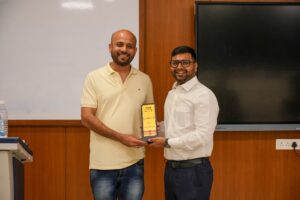
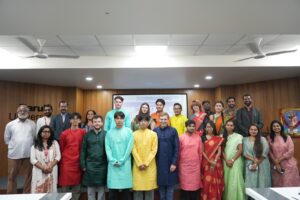
The event was held on 1st and 2nd May 2026 at the Faculty of Engineering and Technology at Parul University, which held its 8th edition. The international conference on engineering and technology received 406 registered research papers, which shows an increase from 256 papers in 2025 and 152 papers in 2024. The topic of the conference was creating a smart and advanced technology backed by sustainability. The dean of the faculty, Dr. Swapnil Parikh, at the university reported during the start of the event that almost 90% of the selected paper authors confirmed their attendance.
Roughly 70% of presenters attended in person, while 30% presented online. The session also focused on generative AI, agentic AI, and other related areas.
The International Speakers
PiCET 2026 was anchored on four major keynote addresses, each delivered by an internationally recognised researcher or industry leader. Together the four speakers covered photonics, artificial intelligence, cybersecurity, and the future of higher education in the age of AI.
Prof. Sulaiman Wadi Harun: Photonics for Sustainable Development
Prof. Sulaiman Wadi Harun, faculty at the Electric Engineering Department, University of Malaya, Kuala Lumpur, delivered the day-one keynote on Photonics for Sustainable Development, Ultra-Fast Lasers and Optical Microfiber Technologies. Prof. Harun has authored more than 1,400 publications and accumulated more than 22,000 citations with an h-index above 64. His work has shaped modern optical communication and sensing technology globally. The full deep-dive is in the dedicated article on Prof. Harun’s photonics keynote.
Prof. Deepak Garg: AI, the Golden Age, and the End of Mediocrity
Prof. Deepak Garg, Vice Chancellor of SR University, Hyderabad, delivered the keynote on artificial intelligence for first-year B.Tech engineering students at the South Seminar Hall on day one. Prof. Garg has trained over one million students in artificial intelligence and is one of India’s most recognised practitioners in the field. The full deep-dive is in the dedicated article on Prof. Garg’s keynote.
Prof. Ashutosh Dhar Dwivedi: Rethinking Digital Security
Prof. Ashutosh Dhar Dwivedi, faculty at Aalborg University, Denmark, delivered the day-one virtual keynote on Rethinking Digital Security: Integrating Authentication, Encryption, and Quantum Security. Prof. Dwivedi completed his PhD from the Polish Academy of Sciences in Warsaw on the cryptanalysis of lightweight cryptography, with subsequent research appointments at the University of Waterloo, the Technical University of Denmark, and Copenhagen Business School before joining Aalborg. The full deep-dive is in the dedicated article on Prof. Dwivedi’s keynote.
Mr. Aravind Voruganti: Reimagining Universities in the Age of AI
Mr. Aravind Voruganti, Co-Founder and CEO of 1Works, delivered the day-two keynote for Parul University faculty on Reimagining Universities in the Age of AI. Mr. Voruganti is the lead architect of the brAIn platform, described as the first institutional intelligence platform built for higher education. He holds an MBA in International Business from Liverpool Business School with specialised education in blockchain and finance from IIIT Hyderabad and the New York Institute of Finance. The full deep-dive is in the dedicated article on Mr. Voruganti’s keynote.
Inauguration: five dignitaries, five different framings of the conference theme
The inauguration ceremony of PiCET 2026 brought together five dignitaries who framed the conference theme from five distinct vantage points. Dr. Swapnil Parikh, Dean of FET, reported the conference’s structural growth. Dr. K. N. Madhusudan, Provost of Parul University, addressed sustainability and interdisciplinary thinking. Sri Sairam Santram, Guest of Honour and Chief Information Security Officer at Aventure Corporation USA-India, addressed algorithmic engineering and non-human identities. Prof. Dr. Raj Shekharam Pillai, Chief Guest and Advisor at Jio Institute with prior service as Chairman of the University Grants Commission, addressed traditional knowledge and the National Education Policy. Dr. Geetika Madan Patel, Vice President at Parul University, addressed the technology paradox and the environmental cost of climate-control infrastructure. The complete inauguration coverage is in the PiCET 2026 inauguration deep-dive.
Conference structure: 39 technical sessions, four research tracks
Across the two days, 29 of 39 planned technical sessions were held on day one, with the remaining sessions completed on day two. Sessions ran both in-person at the Central Auditorium, the CV Raman Building, and across the conference venues, and online via Google Meet for participants joining remotely. The technical paper presentations included papers from doctoral scholars, master’s students, undergraduate researchers, and faculty members, with external evaluators from institutions including CHARUSAT participating in the assessment process.
PiCET 2026 was organised across four major research tracks.
- Track 1, Networking, Cybersecurity, Cognitive Intelligence: research in secure communications and intelligent computing methods.
- Track 2, Computing, Data Science, Intelligent Systems: data analytics, machine learning, and applied intelligent systems.
- Track 3, Sustainable Interdisciplinary Applications: sustainability-focused engineering research across disciplines.
- Track 4, Artificial Intelligence and Machine Learning: AI architectures, supervised and unsupervised learning, and applied AI.
The technical paper presentations across the four tracks included work on DC microgrid fault detection, multimodal financial forecasting, explainable AI for student performance, image captioning with feature fusion, satellite video moving object detection, AI-driven civilian safety portals during armed conflict, web form accessibility for users with dyslexia, streamflow forecasting using deep recurrent neural networks, and no-code machine learning frameworks.
Scale and growth
PiCET has grown structurally across its eight editions. Earlier editions collectively contributed twenty-one sessions, with more than 1,150 papers submitted and 354 accepted, drawing more than 750 participants. The 2026 edition exceeded these benchmarks within a single year, with 406 registered papers, 39 planned sessions, and over 1,000 participants across the two days.
- Paper registrations 2024:
- Paper registrations 2025:
- Paper registrations 2026: 406, with approximately 90 percent of selected authors confirming attendance.
- Mode of attendance: approximately 70 percent of presenters in person, 30 percent online.
- Pre-conference workshops: three workshops on Generative AI, AI Agents, and Design Innovations, held the day before the main conference.
Sponsors and industry partners
PiCET 2026 was supported by a structured network of sponsors and industry partners. Kanan International was the Gold Category sponsor. MSH Ventures LLP was the Silver Category sponsor. In-kind sponsors included SVR Robotics, FIS Software Private Limited, Khodiyar e-Solutions Private Limited, and Tecmo Innovations Private Limited. Industry partners included CyberNGo, Forenzy, and OneWorks. The sponsor recognition segment of the inauguration acknowledged that the conference scale would not have been feasible without this support.
Why PiCET 2026 matters for Parul University's research positioning
PiCET sits within a broader institutional positioning of Parul University as a research-intensive institution. The university holds NAAC A++ accreditation at a 3.55 CGPA, documented in the Foundation Day account, and is a Category 1 University with Grant of Graded Autonomy. Recent infrastructure additions include the Lakshya 2047 Centre for Future Skills, Gujarat’s first NSDC Centre for Future Skills, inaugurated by Union Minister Dr Jitendra Singh on 8 May 2026, just six days after PiCET 2026 closed. Dr Geetika Madan Patel, Vice President of Parul University, announced the upcoming Centre for Future Skills launch during her presidential address at the PiCET inauguration.
The combination of an annual international conference at the scale of PiCET 2026, the Lakshya 2047 fifteen-laboratory infrastructure, the DSIR-recognised R&D Centre, and the Stanford-Elsevier ranked top 2 percent scientists on the faculty creates a research ecosystem that students entering the B.Tech in Computer Science Engineering, the B.Tech in AI and Machine Learning, the B.Tech in Information Technology, the B.Tech in Electronics and Communication Engineering, and the Ph.D. in Engineering and Technology programmes can access from their first semester onwards.
Check Out: Faculty of Engineering and Technology at Parul University, programmes that prepare you for all the new tracks of research.
FAQs
What is PiCET 2026?
PiCET 2026 is the 8th edition of the Parul University International Conference on Engineering and Technology, held on 1 and 2 May 2026 at Parul University, Vadodara. The conference theme was Innovations in Computing: Smart, Sustainable, and Emerging Technologies. PiCET is organised annually by the Faculty of Engineering and Technology at Parul University. The 2026 edition received 406 registered research papers and featured 39 technical sessions across four research tracks, four international keynote addresses, three pre-conference workshops, and a hybrid (in-person and online) format.
Who were the keynote speakers at PiCET 2026?
PiCET 2026 featured four major keynote speakers. Prof. Sulaiman Wadi Harun (University of Malaya) delivered the day-one keynote on Photonics for Sustainable Development. Prof. Deepak Garg (Vice Chancellor, SR University Hyderabad) delivered the day-one keynote for first-year B.Tech students on artificial intelligence. Prof. Ashutosh Dhar Dwivedi (Aalborg University, Denmark) delivered the day-one virtual keynote on Rethinking Digital Security. Mr. Aravind Voruganti (Co-Founder and CEO, 1Works) delivered the day-two keynote on Reimagining Universities in the Age of AI.
How many research papers were presented at PiCET 2026?
PiCET 2026 received 406 registered research papers, a sharp increase from 256 papers in 2025 and 152 papers in 2024. Approximately 90 percent of selected paper authors confirmed their attendance. The conference was structured as 39 technical sessions across four research tracks: Networking, Cybersecurity, and Cognitive Intelligence; Computing, Data Science, and Intelligent Systems; Sustainable Interdisciplinary Applications; and Artificial Intelligence and Machine Learning. Roughly 70 percent of presenters attended in person while 30 percent presented online through the hybrid format.
Where was PiCET 2026 held?
PiCET 2026 was held at the Parul University campus in Vadodara, Gujarat, India, on 1 and 2 May 2026. Sessions ran across multiple venues including the Central Auditorium in A-Block, the South Seminar Hall in the Admin Block, the CV Raman Building, and online via Google Meet for hybrid participants. Parul University is located at P.O. Limda, Tal. Waghodia, Dist. Vadodara, Gujarat 391760, and holds NAAC A++ accreditation at a 3.55 CGPA.
Which Parul University programmes feed into research opportunities at conferences like PiCET?
The B.Tech in Computer Science Engineering, B.Tech in AI and Machine Learning, B.Tech in Information Technology, B.Tech in Electronics and Communication Engineering, B.Tech in Cyber Security, and B.Tech in Electronics (VLSI Design) at Parul University all feed students into research participation at PiCET. The M.Tech programmes in CSE and ECE, and the Ph.D. in Engineering and Technology, anchor doctoral-level research contributions. Students access the Faculty of Engineering and Technology research infrastructure, the new Lakshya 2047 Centre for Future Skills, and the DSIR-recognised R&D Centre.