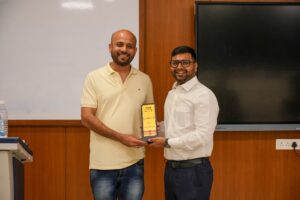
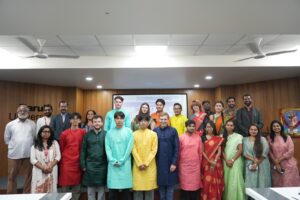
The inauguration ceremony of PiCET 2026, the 8th Parul University International Conference on Engineering and Technology, took place on the morning of 1 May 2026 at the Faculty of Engineering and Technology, Parul University. Five dignitaries occupied the dais. The opening followed the conventional structure of Indian academic inaugurations: an institutional video, a ceremonial lamp lighting accompanied by the Saraswati hymn, the formal welcome, and the speeches that followed. What was unconventional, and what gave the ceremony its substance, was the deliberate diversity of perspectives the speakers brought.
Dr. Swapnil Parikh, Dean of the Faculty of Engineering and Technology, opened with the structural and statistical view. Dr. K. N. Madhusudan, Provost of Parul University, brought the philosophy of sustainable computing. Sri Sairam Santram, Guest of Honour and Chief Information Security Officer at Aventure Corporation USA-India, brought a quarter-century of frontline cybersecurity experience. Prof. Dr. Raj Shekharam Pillai, Chief Guest, Advisor at Jio Institute, and former Chairman of the University Grants Commission, brought the policy and traditional-knowledge view. Dr. Geetika Madan Patel, Vice President of Parul University, closed with a working medical professional’s account of what she called the technology paradox.
Dr. Swapnil Parikh, Dean of FET: the institutional growth report
Dr. Swapnil Parikh, Dean of the Faculty of Engineering and Technology at Parul University, opened the inauguration with the structural report on PiCET 2026. He acknowledged the conveners, co-conveners, executive committee members, organising team, directors, heads of department, vice-principals, and the faculty and student volunteers who had built the conference. He reflected on the conference as a defining feature of the academic calendar of FET, an annual flagship that has anchored research activity for eight consecutive editions.
This time we have an overwhelming response with registration of 406 papers. Given that there were 152 and 256 paper registrations in 2024 and 2025 respectively, despite the seemingly ominous trend of continuous annual growth.
Dr. Swapnil Parikh, Dean of the Faculty of Engineering and Technology, Parul University
Dr. Parikh placed particular emphasis on the acceptance and confirmation rate. Selection policy norms required the conference to keep accepted papers between 30 and 33 percent of total registrations. From the accepted papers, approximately 90 percent of authors confirmed their attendance. He noted that this 90 percent number demonstrates two things at once: the conference’s trustworthiness as a research venue, and the research community’s interest in being present at PiCET specifically. He also acknowledged the positive feedback received from the three pre-conference workshops held the day before, on Generative AI, AI Agents, and Design Innovations.
Check Out: Faculty of Engineering and Technology at Parul University, programes that prepare you for all the new track of researches.
Dr. K. N. Madhusudan, Provost: sustainability and system thinking
Dr. K. N. Madhusudan, Provost of Parul University, opened with a reflection on the conference theme and what the term sustainability means in the present moment. He observed that sustainability, long recognised as a critical pursuit, has taken on new dimensions in the realm of computing. He named three categories of emerging technology that are reshaping how the digital future will look: artificial intelligence-based optimisation, IoT integration with edge computing for processing data at its source, and neuromorphic computing as a route to energy-efficient processing modelled on the brain itself.
New technologies have emerged in the recent past: optimisation using AI, dealing with data at the source itself like IoT integrated with edge computing, and new approaches of neuromorphic computing, which is again looking for energy-efficient technologies, probably mimicking how the brain is computing.
Dr. K. N. Madhusudan, Provost, Parul University
Dr. Madhusudan’s central argument was a structural one. The era of siloed engineering, where mechanical engineers worked on machines, civil engineers worked on infrastructure, and electronics engineers worked on circuits, has ended. Contemporary problems, particularly those related to sustainability and climate, cannot be decomposed into independent components and solved in isolation. Optimising one part of a complex system, he argued, often creates disturbances elsewhere in the system. The remedy is system thinking.
That is precisely why we need to look at it in a way of system thinking so that we create a sustainable and integrated solution.
Dr. K. N. Madhusudan, Provost, Parul University
He closed his address with a structural argument about AI and employment. The popular fear that AI will eliminate jobs, in his view, is overstated. AI will create new jobs for engineers who know how to build, operate, and control AI systems. The implication for students is direct. Students studying AI at the university level cannot stop at learning basic AI usage. They must learn full AI development and the methods by which AI systems can be supervised, controlled, and governed.
Also Read: Prof. Sulaiman Wadi Harun on ulta-fast lasers and future of sustainable development
Sri Sairam Santram, Guest of Honour: invisible technology and 45 billion non-human identities
Sri Sairam Santram, Chief Information Security Officer at Aventure Corporation USA-India, brought twenty-five years of frontline cybersecurity experience to the stage. His address was structured for the student audience specifically, with a direct, performance-oriented style that pushed the technical content into the daily lived experience of the room.
He opened with the framing that modern technology is, by its nature, invisible. Where earlier engineering produced tangible outputs (bridges, chairs, desks), contemporary technology shapes human behaviour, perception, and emotion without the user noticing. Every day, the technologies in use are quietly capturing, manipulating, or influencing what users buy, see, hear, know, and feel.
Every day, the technologies that you are using are invisible. What you buy, what you see, what you hear, what you know, and what emotions you are going through: everything is being captured or being manipulated or you are being influenced with that.
Sri Sairam Santram, Chief Information Security Officer, Aventure Corporation USA-India
Sri Sairam used a scenario the students immediately recognised. A 10 PM intention to watch one YouTube video. A 2 AM realisation that hours have disappeared. The audience response was uniform recognition. He used this to make a sharper point: the inability to stop scrolling is not a personal discipline failure but a deliberate algorithmic engineering outcome, designed to compete with and override the user’s own rational faculties.
It is the algorithmic engineering competing with your brain power or the nervous system.
Sri Sairam Santram
He shifted to ChatGPT use among the students. The audience acknowledged using it for assignments, vivas, and last-minute submissions. His response was sharp.
If ChatGPT is doing everything, what are you doing then?
Sri Sairam Santram
He moved into a forward projection on cybersecurity. By the end of 2026, he cited, approximately 45 billion non-human identities will exist in the world: chatbots, AI agents, APIs, and multi-agent systems. He framed this as eight times the total human workforce of the world, both a security challenge and a structural opportunity for engineering students entering the field. He explained the danger of autonomous multi-agent systems that can make decisions and operate physical infrastructure including drones without continuous human oversight. He maintained that the central engineering challenge of the coming decade is the development of systems that constrain autonomous machines from acting beyond designed boundaries
Idea, innovation, impact. I congratulate and thank all the engineers who are in this room who are going to be building the next generation technologies and solutions.
Sri Sairam Santram, closing his address
Prof. Dr. Raj Shekharam Pillai, Chief Guest: knowledge, traditional intelligence, and artificial intelligence
Prof. Dr. Raj Shekharam Pillai, currently Advisor at Jio Institute and with prior service as Chairman and Vice Chairman of the University Grants Commission, Vice Chancellor of Indira Gandhi National Open University, and Vice Chancellor of multiple other Indian universities, brought more than five decades of higher education leadership to the stage. He opened with characteristic understatement, noting that he had been a university teacher since 1971 and continued to teach at the current stage of his career.
He acknowledged the institutional history of Parul University. The institution originated as a medical and homeopathic college founded in 1993 by the late Dr. J. K. Patel and evolved into a comprehensive multidisciplinary university by 2009. It now houses 70,000 plus students across 39 institutions, with programmes from near-primary level through doctoral and postdoctoral studies. The institutional history is documented in the Foundation Day account of Dr Parul Patel and the NAAC A++ trajectory.
This is a university. A place where whatever is under the sun has a home.
Sri Prof. Dr. Raj Shekharam Pillai, Chief Guest
The central argument of Prof. Pillai’s address concerned the purpose of education. Knowledge and skills are what universities impart. That substance becomes meaningful only when applied to the enhancement of human and ecosystem wellbeing. He drew attention to the depth of traditional knowledge that ordinary people in India possess, in agriculture, food preservation, seed preservation, and childcare, that often exceeds what the formally educated population holds. He urged the use of AI and data-driven tools to document, assess, and certify this traditional knowledge through formal frameworks including the Assessment and Certification of Prior Learning, a UN-backed programme also endorsed under India’s National Education Policy
Artificial intelligence is very important, but you should not forget your natural stupidity.
Sri Prof. Dr. Raj Shekharam Pillai
Prof. Pillai used the phrase not as criticism but as a reminder. Human intuition, judgment, and humility remain irreplaceable. The creators of AI are themselves human beings who must never lose sight of the human dimension of the technology they build. He established connections between Nobel Prize history and the eventual real-world impact of scientific discoveries, noting that NMR spectroscopy received international recognition only after its application to medical imaging through the MRI machine. Scientific progress, in his framing, should be measured by impact on human existence and dignity rather than by technological sophistication alone. He endorsed the triple helix model of collaboration between private universities, public research institutions, and industry as the most effective framework for generating research with real-world impact.
Dr. Geetika Madan Patel, Vice President: the technology paradox
Dr. Geetika Madan Patel, Vice President (Quality, Research, and Health Sciences) at Parul University, closed the inauguration with an address she framed as a non-engineer’s reflection rather than technical guidance. She acknowledged the extended duration of the inauguration and noted with characteristic candour that audience attention spans had compressed from thirty minutes to ten seconds in the AI era. She introduced the upcoming launch of the Centre for Future Skills, planned for the week following PiCET 2026, aimed at equipping students with capabilities aligned with market and industry demands. The Centre was subsequently inaugurated as Lakshya 2047, Gujarat’s first NSDC Centre for Future Skills, by Union Minister Dr Jitendra Singh on 8 May 2026.
The most striking section of Dr. Patel’s address was a worked illustration from her own clinical domain. She traced the evolution of anaesthesia technology across twenty years: from manual bag-and-mask ventilation, to machine-assisted ventilation, to smart workstations with mechanised drug delivery, to current-generation AI-enabled anaesthesia workstations that assess a patient’s complete medical profile, predict optimal drug dosages, and monitor all vital parameters in real time. The clinical outcome, she said, has been a dramatic reduction in the risk of overdose, a previously documented cause of mortality in operation theatres.
These AI-enabled workstations cost 25,000 as compared to 40,000 for the older manual models, yet deliver far greater precision, efficiency, and better outcomes for the patient.
Sri Dr. Geetika Madan Patel, Vice President, Parul University
She then introduced the concept she named the technology paradox. The same technological capability that improves human comfort can carry hidden environmental costs that the user never sees. She walked through two examples. Hydrofluorocarbons used in air conditioning systems carry a global warming potential 400 to 500 times greater than that of carbon dioxide. Sulfur hexafluoride, used in electrical substations including those that charge electric vehicles, carries a global warming potential 24,000 times that of carbon dioxide.
We are using electric vehicles to control vehicular emissions, and we are using electricity to charge the batteries of these electric vehicles, and then we are using this gas which carries 24,000 times more global warming potential as compared to CO2 to use this electricity for the electric vehicles.
Sri Dr. Geetika Madan Patel
Her conclusion was a call to responsible innovation. Research, in her framing, cannot stop at delivering comfort. It has to actively focus on leaving the planet habitable for future generations. She closed with a familiar ecological line that landed with renewed weight in the engineering context.
We have not inherited the planet from our ancestors; we have borrowed it from our children.
Sri Dr. Geetika Madan Patel
She closed by observing with satisfaction that the majority of papers submitted to PiCET 2026 fell under the sustainability track, which she read as a sign of the collective conscience of the research community.
Conference proceedings released and sponsors felicitated
Following the five dignitaries’ addresses, the inauguration moved through the ceremonial digital release of the PiCET 2026 conference proceedings, accompanied by a video presentation on the academic significance of conference proceedings publication. Conference papers represent the formal addition of research to the body of academic literature and become accessible to the broader academic community through the publication.
The inauguration closed with the felicitation of sponsors and industry partners. Kanan International (Gold Category), MSH Ventures LLP (Silver Category), and in-kind sponsors including SVR Robotics, FIS Software Private Limited, Khodiyar e-Solutions Private Limited, and Tecmo Innovations Private Limited received formal recognition. Industry partners including CyberNGo, Forenzy, and OneWorks were acknowledged for their contributions bridging academic research and industry application.
FAQs
Who inaugurated PiCET 2026 at Parul University?
The PiCET 2026 inauguration on 1 May 2026 was conducted by five dignitaries on stage. Dr. Swapnil Parikh, Dean of the Faculty of Engineering and Technology at Parul University, opened with the conference growth report. Dr. K. N. Madhusudan, Provost of Parul University, addressed sustainability and system thinking. Sri Sairam Santram, Guest of Honour and Chief Information Security Officer at Aventure Corporation USA-India, delivered the cybersecurity address. Prof. Dr. Raj Shekharam Pillai, Chief Guest, Advisor at Jio Institute, and former Chairman of the University Grants Commission, gave the keynote on knowledge and traditional intelligence. Dr. Geetika Madan Patel, Vice President of Parul University, closed with the technology paradox address.
What did Sri Sairam Santram say about non-human identities at PiCET 2026?
Sri Sairam Santram, Chief Information Security Officer at Aventure Corporation USA-India, told Parul University students at the PiCET 2026 inauguration that approximately 45 billion non-human identities (chatbots, AI agents, APIs, and multi-agent systems) will exist in the world by the end of 2026. He framed this as eight times the global human workforce, presenting it as both a structural cybersecurity challenge and a career opportunity for engineering students entering the field. He warned that autonomous multi-agent systems capable of operating physical infrastructure including drones without human oversight constitute the central engineering challenge of the coming decade.
Who is Prof. Dr. Raj Shekharam Pillai?
Prof. Dr. Raj Shekharam Pillai is the Chief Guest who delivered the keynote address at the PiCET 2026 inauguration at Parul University. He is currently Advisor at Jio Institute and has more than five decades of experience in higher education, scientific research, and academic administration. He has served as Chairman and Vice Chairman of the University Grants Commission (UGC), Vice Chancellor of Indira Gandhi National Open University, and Vice Chancellor of several other prestigious Indian universities. He has been a university teacher since 1971 and continues to teach. His specialisations include science, chemistry, and education policy.
What is the technology paradox Dr. Geetika Madan Patel described at PiCET 2026?
Dr. Geetika Madan Patel, Vice President of Parul University, described the technology paradox at the PiCET 2026 inauguration as the situation where the same technological capability that improves human comfort carries hidden environmental costs the user never sees. She illustrated this with two examples: hydrofluorocarbons used in air conditioning systems carry a global warming potential 400 to 500 times that of carbon dioxide, and sulfur hexafluoride used in electrical substations carries a global warming potential 24,000 times that of carbon dioxide. The paradox, in her framing, is that electric vehicles deployed to control vehicular emissions are charged by electricity routed through substations using a gas vastly more environmentally damaging than the emissions the EVs were meant to eliminate.
What is the Centre for Future Skills mentioned at the PiCET 2026 inauguration?
During her presidential address at the PiCET 2026 inauguration, Dr. Geetika Madan Patel announced that the Centre for Future Skills would launch the following week at Parul University. The Centre was subsequently inaugurated as Lakshya 2047, Gujarat's first NSDC Centre for Future Skills, by Union Minister Dr Jitendra Singh on 8 May 2026, just six days after PiCET 2026 closed. Lakshya 2047 is a fifteen-laboratory facility established in partnership with the National Skill Development Corporation (NSDC) and Ethnotech Academy, integrating global certification programmes with hands-on practical learning into the existing engineering curriculum at Parul University.