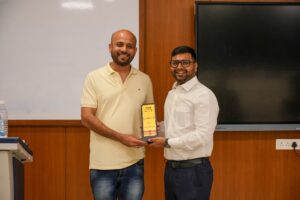
On 1 May 2026 at 2:00 PM in the Central Auditorium of A-Block at Parul University, Prof. Sulaiman Wadi Harun, faculty at the Electric Engineering Department of the University of Malaya in Kuala Lumpur, delivered the PiCET 2026 keynote on Photonics for Sustainable Development, Ultra-Fast Lasers and Optical Microfiber Technologies. The session was introduced by anchor Mr. Vishal, who walked the audience through Prof. Harun’s academic footprint: more than 1,400 publications, more than 22,000 citations, an h-index above 64, and an i10-index of 647. His research has shaped contemporary optical communication and sensing technology worldwide.
Prof. Harun opened with a brief introduction to the University of Malaya itself, established in 1905 originally as a medical college, later separated from the National University of Singapore. The institution today operates across a 922-acre campus with more than 2,800 academic staff, 9,000 undergraduate students, and 8,000 postgraduate students, including 40 percent international student enrolment. It is a broad-based research-intensive university with 14 faculties, 77 undergraduate programmes, and a QS World University Ranking of 60 in 2024.
The first photonic revolution and the ruby laser
The technical content of the keynote began with the first photonic revolution. The first working laser, the ruby laser, was demonstrated by Theodore Maiman on 16 May 1960. The theoretical foundation, however, traces back nearly half a century earlier. Albert Einstein’s 1916 paper introduced the concept of stimulated emission, the physical mechanism that makes laser action possible. The gap between Einstein’s theoretical insight and the working demonstration was approximately 44 years.
Prof. Harun walked the audience through the physics of the ruby laser. Ruby is a crystal of aluminium oxide containing chromium ions. When green and blue light at specific wavelengths is absorbed by the chromium ions, the ions transition to an excited state and subsequently relax to the ground state through stimulated emission, producing red light at 694.3 nanometres. UNESCO has declared 16 May the International Day of Light to commemorate the original ruby laser demonstration.
We see the discovery of laser has led tremendous benefit, especially for the telecommunication industry. We have very fast internet now because of the development of photonic or after the first demonstrations of the laser.
Sri Prof. Sulaiman Wadi Harun, University of Malaya
Beyond telecommunications, photonics now operates across precision surgery, nanosurgery, tattoo removal, optical microscopy systems, and camera technologies. Prof. Harun predicted that within the next several years, photonic systems will play a central role in nuclear fusion energy generation, where high-power laser pulses are used to compress and heat fuel pellets to fusion conditions.
Also Read: 8th Parul University International Conference on Engineering and Technology
Optical fibre and the architecture of long-distance light transmission
The telecommunication application of photonics required two foundational inventions: the laser diode and the optical fibre. The first laser diode was demonstrated in 1962. The concept of optical fibre for long-distance transmission was proposed by Charles Kao in 1966, work for which Kao subsequently received the Nobel Prize in Physics. The development of optical fibre cables now makes communication possible across 10,000 kilometres and beyond.
Prof. Harun walked through the engineering reality of fibre transmission losses. Every 100 kilometres of conventional optical fibre, the signal suffers approximately 20 decibels of attenuation, which corresponds to roughly 99 percent loss of light intensity. He noted that ongoing research aims to reduce this to 0.2 decibels per kilometre over the next five to six years, a hundred-fold improvement that would fundamentally change the economics of optical communication.
Optical fibre is made from silica glass, which is derived from sand, one of the most abundant materials on Earth. Prof. Harun called optical fibre one of the most consequential engineering gifts of the twentieth century. Students entering the B.Tech in Electronics and Communication Engineering at Parul University study fibre optics, optical communication systems, and the photonics foundations Prof. Harun’s career was built on.
Erbium-doped fibre amplifiers and DWDM
The breakthrough that made global high-speed internet practical was the erbium-doped fibre amplifier. Erbium ions, when doped into silica fibre and pumped with light at 980 nanometres, produce amplified light at 1.5 micrometres through stimulated emission. The amplifier means that signals can be boosted along the transmission path without needing to convert the optical signal back to electronic form, which had been the previous bottleneck.
This amplifier capability enabled Dense Wavelength Division Multiplexing, or DWDM, where hundreds of independent data channels at slightly different wavelengths travel simultaneously through a single optical fibre. The result is the global high-speed internet infrastructure that billions of people use daily. Prof. Harun observed that demand for internet bandwidth continues to double approximately every two years, and researchers are now exploring new approaches including multimodal transmission, photonic crystal fibres, and few-mode fibres to meet future capacity demands.
Check Out: Faculty of Engineering and Technology at Parul University, programmes that prepare you for all the new tracks of research.
Dopant materials and the physics of fibre laser efficiency
The second photonic revolution has been the rise of fibre lasers built from doped optical fibre. The cost of all photonic components has reduced dramatically as a result of telecommunication industry investments, making fibre laser systems accessible across applications well beyond telecommunications. The choice of dopant material determines the emission wavelength and the efficiency of the laser.
- Erbium-doped fibres: emit around 1.5 micrometres, achieve roughly 40 percent efficiency, used for telecommunications.
- Thulium-doped fibres: emit at 2 micrometres, approach 90 percent efficiency, used for medical applications including nanosurgery and precision surgery.
- Ytterbium-doped fibres: emit near 1 micrometre, achieve the highest efficiency at 95 percent, used for high-power industrial laser applications.
The efficiency differences are explained by quantum defect heating. When the pump wavelength and the emission wavelength are very close in energy, the energy difference is small and less is lost as heat. Ytterbium achieves the highest efficiency because its pump and emission wavelengths are exceptionally close.
Ultra-short pulse lasers and the femtosecond regime
One of the most technically dense sections of the keynote concerned ultra-short pulse lasers in ring cavity configurations. A fibre laser incorporating a saturable absorber, which is often fabricated from a nanomaterial such as graphene, can generate optical pulses as brief as 152 femtoseconds. A femtosecond is one quadrillionth of a second.
The peak power of such pulses reaches the kilowatt range even when the average laser output power is only a few milliwatts. The reason is geometric. If the same total energy is compressed into a pulse a million times shorter than a microsecond pulse, the instantaneous power during that pulse is correspondingly higher. Prof. Harun compared the temporal sharpness of the pulse to the spatial sharpness of a knife edge, where precise and nanosurgical procedures benefit from the sharpest possible cutting tool.
He also discussed continuous-wave high-power fibre lasers for industrial applications including welding and metal cutting, which use double-clad fibre laser architectures. Photonic crystal fibres, a newer category of optical fibre, can guide light not only through total internal reflection but also through engineered photonic band gaps. Mid-infrared lasers are used for nanosurgery and precision surgery because their wavelengths can selectively interact with biological tissue while avoiding damage to surrounding structures. The glass that supports mid-infrared transmission is itself fragile, with the cost of a single piece approaching $10,000 and the material so soft that the slightest human touch can damage it.
Optical microfibers and nanofibers: confining light at the wavelength scale
The second principal topic of the keynote, and the area in which Prof. Harun’s research group has made substantial contributions, is the science and engineering of optical microfibers and nanofibers. Standard optical fibres have a cladding diameter of 125 micrometres and a core diameter of approximately 9 micrometres. This geometry is optimised for long-distance signal transmission. It is not optimised for sensitivity, compactness, or the exploitation of new physical phenomena at smaller scales.
The concept of tapering optical fibres down to micrometre and nanometre dimensions is not new. The technique of flame-drawn fibre tapering was first demonstrated in 1887. The technique has attracted renewed scientific interest in recent decades because of the remarkable properties that emerge at small scales. When the fibre diameter approaches the wavelength of the guided light, the physics of light guidance changes dramatically. The fibre core becomes so small that a large fraction of the optical field propagates outside the physical boundary of the fibre as an evanescent field.
This externally propagating field is highly sensitive to environmental conditions. Small changes in refractive index, temperature, mechanical strain, or the presence of chemical or biological substances all change the way light propagates through the fibre. Microfibers therefore become extraordinarily powerful sensing elements. Prof. Harun listed the principal categories under active research: glass microfibers, polymer nanowires, semiconductor nanowires, and metal nanowires.
- Single-mode guidance: the fraction of optical power confined inside the fibre core is calibrated by the geometry.
- Low optical propagation loss: carefully fabricated microfibers maintain low loss over working lengths.
- Strong evanescent field: a large fraction of the optical field extends outside the physical fibre boundary.
- High nonlinearity: the small cross-sectional area concentrates optical power, enabling nonlinear effects at modest input powers.
Fabrication: a butane flame and inexpensive components
Prof. Harun described the fabrication of microfibers with characteristic directness. The most common technique is to heat a section of standard optical fibre with a flame or a resistive heater, while simultaneously pulling the fibre from both ends. As the glass softens, the fibre narrows uniformly. The tapered waist can reach diameters of 500 nanometres or even as small as 100 nanometres.
In his laboratory, the heat source is a butane flame, the same gas used for cooking. The complete fabrication setup is built from inexpensive, readily available components. Prof. Harun framed this as evidence that great science does not require extravagant resources, a point that landed with particular weight given the cost-conscious context of Indian engineering education.
Using nanoprobe manipulators, Prof. Harun’s research group has built microfibers into a remarkable variety of photonic devices: Mach-Zehnder interferometers, microknot resonators, microcoil resonators, whispering gallery mode resonators, and optical couplers. Each structure exploits the unique properties of microfibers in different ways. Parul University’s M.Tech in Electronics and Communication Engineering and the Ph.D. in Engineering and Technology prepare students for exactly this kind of microfabrication and characterisation research.
Microfiber temperature sensors and the 1,200°C ceiling
One of the most practically significant applications Prof. Harun discussed is the microfiber-based temperature sensor. Conventional fibre Bragg grating sensors, the standard tool for distributed temperature measurement, begin to degrade above approximately 300 degrees Celsius. Microfiber devices, by contrast, can withstand temperatures up to 1,200 degrees Celsius, which is the softening point of silica glass itself.
This makes microfiber temperature sensors uniquely suited for high-temperature industrial environments such as steel manufacturing, where conventional sensors simply fail. Prof. Harun’s experimental work has demonstrated linear correlation between optical wavelength shift and temperature up to 800 degrees Celsius, a result of considerable practical industrial significance.
Optical conveyor belts, supercontinuum sources, and the path forward
One of the more intellectually striking sections of the keynote concerned the use of the microfiber evanescent field for purposes beyond simple sensing. Because the optical field extends significantly outside the fibre boundary, it creates a gradient force in the immediate vicinity of the fibre surface. This gradient force can attract and trap dielectric nanoparticles, biological cells, viruses, and bacteria. By controlling the direction of light propagation through the microfiber, the trapped particles can be steered along the fibre, creating effectively an optical conveyor belt at the nanoscale. The implications for biomedical research, drug delivery, and the manipulation of biological specimens are substantial.
The high optical power density inside microfibers due to the extremely small cross-sectional area also drives nonlinear optical effects: Raman scattering, Rayleigh scattering, cross-phase modulation, and self-phase modulation. These nonlinear effects can be harnessed to generate supercontinuum radiation, which is broadband and spectrally coherent light spanning hundreds of nanometres, with applications across imaging, spectroscopy, and medical diagnostics.
Prof. Harun closed the keynote with a forward-looking perspective on where microfiber photonics is moving. Present-day microfibers are predominantly silica glass. Research is actively exploring semiconducting materials such as zinc oxide, plasmonic metals such as silver, and various polymers, each with different optical properties and fabrication challenges. The interdisciplinary reach of the field now extends into quantum optics, atom optics, plasmonics, nonlinear photonics, and biomedical engineering. Microfibers are being investigated as efficient interfaces between atomic quantum systems and optical networks, and for applications in holography, optical tweezers, lab-on-fibre sensing platforms, and photonic integrated circuits.
He emphasised that photonics is increasingly recognised as a key enabling technology for sustainable development. Laser welding is cleaner and more precise than arc welding. Mid-infrared laser surgery is more targeted and less damaging than conventional scalpel-based procedures. Fusion energy, which promises essentially limitless clean power, depends critically on high-power laser systems to ignite the fuel plasma. In each of these domains, photonics is not peripheral. It is central.
Also Read: Prof. Deepak Garg on the End of Mediocrity and the Golden Age for Problem Solvers
FAQs
Who is Prof. Sulaiman Wadi Harun?
Prof. Sulaiman Wadi Harun is a faculty member at the Electric Engineering Department of the University of Malaya in Kuala Lumpur, Malaysia, and one of the most published researchers in modern optical engineering. He has authored more than 1,400 publications, accumulated more than 22,000 citations, and holds an h-index above 64 and an i10-index of 647. His research areas include saturable absorbers, graphene-based photonic devices, ultra-fast lasers, optical microfiber technology, and photonic sensors. He delivered the day-one keynote at PiCET 2026 at Parul University on 1 May 2026.
What is an optical microfiber and why is it important?
An optical microfiber is a tapered section of optical fibre with a waist diameter at the micrometre or nanometre scale, much smaller than the 125-micrometre cladding diameter of standard optical fibre. When the fibre diameter approaches the wavelength of the guided light, a large fraction of the optical field propagates outside the physical fibre boundary as an evanescent field. This externally propagating field is highly sensitive to environmental conditions including refractive index, temperature, mechanical strain, and the presence of chemical or biological substances. Optical microfibers are therefore extraordinarily powerful sensing elements and are used for high-temperature industrial sensing, biosensing, optical particle manipulation, and the generation of nonlinear optical effects.
What is the difference between erbium, thulium, and ytterbium fibre lasers?
Erbium-doped, thulium-doped, and ytterbium-doped fibre lasers are differentiated by the dopant ion in the fibre core, the emission wavelength, the operating efficiency, and the principal applications. Erbium-doped fibres emit around 1.5 micrometres and achieve roughly 40 percent efficiency, used primarily for telecommunications. Thulium-doped fibres emit at 2 micrometres and approach 90 percent efficiency, used for medical applications including nanosurgery and precision surgery. Ytterbium-doped fibres emit near 1 micrometre and achieve the highest efficiency at 95 percent, used for high-power industrial laser applications including welding and cutting. The efficiency differences are explained by quantum defect heating, where pump and emission wavelengths closer in energy minimise energy loss as heat.
What is a femtosecond pulse laser and what is it used for?
A femtosecond pulse laser produces optical pulses with duration as brief as a few hundred femtoseconds, where one femtosecond is one quadrillionth of a second. Such pulses are generated by fibre lasers incorporating saturable absorbers, often fabricated from nanomaterials such as graphene. Prof. Sulaiman Wadi Harun reported pulses as brief as 152 femtoseconds during his PiCET 2026 keynote. The peak power of such pulses reaches the kilowatt range even when average laser power is only a few milliwatts. Femtosecond pulse lasers are used for precision surgical applications including nanosurgery and ophthalmology, for industrial precision machining, and for high-speed optical imaging and spectroscopy.
Which Parul University programmes feed into careers in photonics and optical engineering?
The B.Tech in Electronics and Communication Engineering is the primary entry pathway into photonics and optical engineering careers, with the curriculum covering fibre optics, optical communication systems, and the photonics foundations Prof. Sulaiman Wadi Harun's keynote was built on. The B.Tech in Electronics with VLSI Design specialisation feeds students into the semiconductor and integrated photonics intersection. The M.Tech in Electronics and Communication Engineering and the Ph.D. in Engineering and Technology at Parul University anchor postgraduate and doctoral research in fibre optics, microfabrication, and optical sensor research.