The standard AR/VR Lab deep-dive treats the equipment list. This companion article covers the distinctive features and cross-faculty applications that distinguish the lab from typical university VR facilities, including a piece of hardware most Indian university AR/VR labs do not have.
This article supplements the AR/VR Lab deep-dive inside Parul University’s Lakshya 2047 Centre for Future Skills, inaugurated by Union Minister Dr. Jitendra Singh on 8 May 2026. This article covers the headsets, the GoPro Teleport cameras, the green screens, Unity and Unreal engines, and the certification pathway. It will even cover the distinctive features that make the lab structurally different from typical Indian university VR facilities: the omnidirectional treadmill, the two-radar tracking infrastructure for full-body capture, the green room for 3D model testing, and specialised cross-faculty applications spanning medical VR surgery training and civil and architectural cost-savings.
The omnidirectional treadmill: physical-movement-to-game translation
Most VR labs limit student movement to whatever space is available around the headset. The omnidirectional treadmill inverts this constraint by letting students walk or run physically while their character moves correspondingly in the virtual environment.
- What the equipment does. The omnidirectional treadmill lets a user walk or run in order to make their character do the same thing in the game or simulation. The ‘omnidirectional’ specification means movement is not constrained to forward and backwards like a conventional treadmill; the user can move in any direction while the treadmill compensates to keep them in physical position.
- Why this is distinctive. The lab demonstrates that technology has been incorporated at the physical level, not just as a screen in front of a student’s face. This is operationally different from typical VR setups where movement is either restricted to a small physical area, simulated through controller inputs, or compensated by teleportation mechanics. The omnidirectional treadmill provides true physical-movement-to-virtual-movement translation.
- Educational and research applications. Game development students can design and test movement mechanics with the full physical-input dimension. Training simulation developers can build experiences where physical exertion, walking pace, and movement patterns matter operationally (firefighter training, military training, athletic training, accessibility research). Research-track students can study human-computer interaction and spatial cognition with a quality of physical immersion that most labs cannot provide.
- Why this matters for graduates’ employability. Hardware experience with omnidirectional locomotion is a distinctive line item on a resume. Companies building location-based VR experiences, fitness VR products, training simulation companies, and the broader immersive technology employer pool actively value graduates with hands-on experience using equipment of this type.
Two radar tracking systems for real-time body capture
- What the equipment does. Two radar systems track the movements of the student’s body and project them into the virtual world in real time. When the student stands in the tracking zone, the radars capture their position and movement, which is then projected as a corresponding model inside the virtual environment.
- Why two radars rather than one? Multi-radar tracking improves accuracy and coverage. Single-radar systems have blind spots where the radar’s field of view does not reach. Two-radar systems can cover blind spots and triangulate positions more accurately than single-radar systems can.
- Connection to the green room. The two radar systems work in combination with the green room setup. The green room provides the visual chroma-key compositing environment; the radars provide the spatial tracking that locates the student within the green room. Together, they enable real-time generation of virtual representations where the student’s actual physical movement drives the avatar’s movement.
- Cross-application capability. The same tracking infrastructure that supports game development supports motion capture work for film and animation, sports analytics research, biomechanics research, and rehabilitation research, where precise tracking of physical movement matters.
The green room as 3D model testing environment
Green screens are common in VR labs. A dedicated green room with integrated radar tracking and treadmill infrastructure is less common.
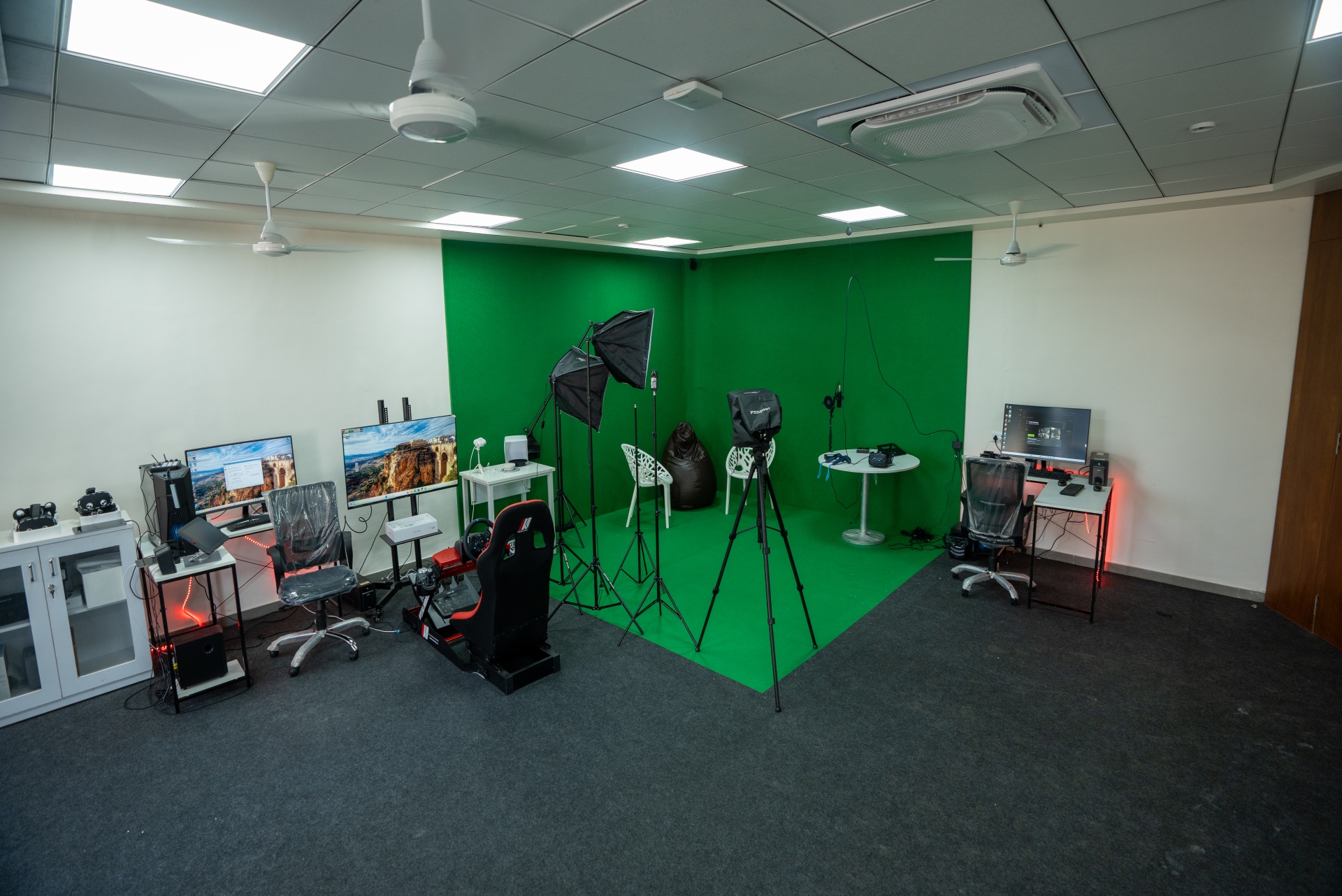
- Operational design. The green room is the largest component of the laboratory, configured specifically as a testing environment for student projects. The dedicated room, rather than a temporary green screen, is what distinguishes the setup.
- 3D model testing workflow. Student projects (games, simulations, immersive applications) are tested inside the green room with the radar tracking and treadmill infrastructure integrated. Students experience their own projects with their physical body translated into the virtual environment, which is fundamentally different from testing on a screen alone.
- Iterative design feedback. Seeing your own body replicated by a computer model is thrilling and engaging for students. Beyond engagement, the embodied feedback accelerates design iteration. Movement that feels natural to the avatar in screen-only testing often feels wrong when the student’s physical movement drives it. The discrepancy is invisible without the green room setup.
Cross-faculty application 1: Medical VR surgery training
Medical training has historically required cadavers, supervised live operations, and simulation manikins. VR-based surgery training adds a fourth modality that addresses the limitations of the first three.
- How the lab supports medical VR. The lab can create a room where a model of any patient can be placed for practice. Surgeons and medical students can perform procedures on virtual patients without human risk, mistake consequences, or the resource limitations of cadaver-based training.
- Educational economics. Cadaveric training is constrained by cadaver availability, ethical sourcing, and the single-use nature of each cadaver. Live operation supervision is constrained by scheduling, faculty availability, and the difficulty of supervising error recovery without putting patients at risk. Simulation manikin training is constrained by hardware availability and the static nature of most manikins. VR surgery training is reusable, ethically uncomplicated, and supports both standard and unusual patient anatomies (which manikins cannot easily replicate).
- Cross-lab integration.
- Career pathways. Medical VR specialists, surgical training developers, clinical simulation engineers, medical technology product managers, and the broader healthcare technology workforce that translates between clinical practice and immersive technology development. If you’re passionate about AR/VR, then delay not and enrol in Parul University’s Diploma in AR & VR (Augmented and Virtual Reality) program!
Cross-faculty application 2: Civil engineering and architecture cost-savings
Architecture and civil engineering education has traditionally relied on physical model-making for building visualisation. VR-based visualisation replaces or supplements this with substantial cost and time savings.
- The cost-savings argument. Students do not need to create models out of plastics or spend large amounts of money in the process. They can create an entire massive skyscraper in 3D format and physically walk through the virtual hallway. The shift from physical to virtual reduces material cost (plastics, foamboard, paint, mounting infrastructure), reduces storage cost (large physical models require physical storage), and reduces transport cost (physical models do not travel easily to client meetings).
- Quality dimensions VR adds. Virtual walkthroughs let students and clients experience scale, proportion, and spatial relationships that physical models cannot convey at human-occupiable scale. A physical model of a skyscraper is necessarily a miniature; the VR version is full-scale and walkable.
- Client-facing application. Beyond educational use, the VR walkthrough capability is directly applicable to client presentations in actual architectural practice. Architecture students who develop competence with VR-based building visualisation are positioned for design firms that have moved to VR-first client engagement workflows.
- Real estate marketing extension. The same VR walkthrough capability supports the real estate marketing application mentioned in the broader AR/VR Lab: letting buyers tour apartments through VR before construction is complete. The cost-savings argument for educational architecture transfers directly to commercial real estate marketing.
Cross-faculty application 3: Computer Science and AI integration
- Code-to-virtual-experience translation. Computer Science and AI students write the code that makes the simulations work. They are responsible for the functioning of the virtual environment, the integration of AI into characters, and the broader software engineering that VR applications depend on.
- AI character integration. Beyond standard game and simulation development, AI students work on incorporating AI behaviour into virtual characters, including NPC behaviour, dialogue systems, and adaptive character responses that distinguish modern interactive applications.
- Cross-lab compute integration.
- Educational pairing. The AR/VR Lab is positioned where classroom theory in C++ and C# meets practical implementation. Students see how their coded commands result in a virtual car moving or a virtual entity jumping, which converts abstract programming knowledge into operational fluency.
Cross-faculty application 4: Diploma students and PhD research
- Diploma-level engagement. Diploma holders can learn AR/VR fundamentals quickly and earn immediately through freelance work or employment at the entry level. The accessibility of the technology, combined with the lab’s hands-on training approach, makes Diploma-level engagement productive.
- PhD-level engagement. PhD scholars use the GPU compute capacity and radar tracking infrastructure to conduct advanced research in human-computer interaction and spatial computing. The research-grade equipment access at the AR/VR Lab supports doctoral work in immersive technology, cognitive science applications of VR, and the broader research frontier that depends on production-quality immersive infrastructure.
- Tier-appropriate access. Diploma, undergraduate, postgraduate, and PhD students all access the AR/VR Lab at appropriate technical depth. The cross-tier access is structural rather than restricted, which is unusual for advanced research equipment at Indian universities.
Why these advanced features matter for graduate competitive positioning
Hands-on experience with distinctive immersive infrastructure is a differentiator in immersive technology hiring conversations.
Hiring conversations at Meta, Apple, Google, and the broader immersive technology employer pool increasingly screen for hands-on experience with production-quality immersive hardware. Resume line items like ‘omnidirectional locomotion infrastructure’ and ‘multi-radar full-body tracking’ are differentiators because most candidates from most universities cannot list them. Graduates from Parul University’s AR/VR Lab can. The Meta AR Developer Professional certification combined with the distinctive hardware experience is what positions Lakshya 2047 AR/VR graduates as candidates that immersive technology employers actively recruit.
Beyond direct immersive technology careers, the cross-faculty applications open careers that bridge between immersive technology and other sectors. Medical VR surgery training, architectural VR walkthroughs, civil engineering visualisation, real estate 3D visualisation entrepreneurship, training simulation development, and the broader applied immersive technology workforce all hire graduates who can translate between immersive capability and sector-specific application. The Non-Traditional Careers article treats several of these non-traditional pathways in detail.
FAQs
What is an omnidirectional treadmill and why does Parul University's AR/VR Lab include one?
An omnidirectional treadmill is a piece of hardware that lets a user walk or run in any direction while the treadmill compensates to keep them in physical position. This enables true physical-movement-to-virtual-movement translation, where the user's actual walking, running, or directional movement drives their character or avatar in the virtual environment. Most Indian university VR labs do not include omnidirectional treadmills because they are specialised equipment. Parul University's inclusion of one is what enables the physical-level technology integration that distinguishes the AR/VR Lab from typical VR labs that limit users to standing in place or controlling movement through joystick inputs.
How does the two-radar tracking system work and what does it enable?
Two radar systems track the movements of the user's body and project them into the virtual environment in real time. The dual-radar configuration improves tracking accuracy and coverage compared to single-radar systems by covering blind spots and enabling position triangulation. When combined with the green room infrastructure and the omnidirectional treadmill, the system enables real-time generation of virtual avatars where the user's actual physical movement drives the avatar's movement at production quality. This capability supports game development, motion capture work for film and animation, sports analytics research, biomechanics research, and rehabilitation research where precise tracking of physical movement matters.
How does the AR/VR Lab support medical and surgical training applications?
The lab can create virtual rooms where a model of any patient can be placed for practice. Surgeons and medical students perform procedures on virtual patients without human risk, mistake consequences, or the resource limitations of cadaver-based training. Cadaveric training is constrained by cadaver availability and the single-use nature of each cadaver. VR surgery training is reusable, ethically uncomplicated, and supports both standard and unusual patient anatomies. The medical VR work pairs with the Cadaveric Centre inaugurated alongside Lakshya 2047 on 8 May 2026 and the Advanced Medical Simulation facility. The three facilities cover the full spectrum of modern medical training infrastructure, including cadaveric, simulation manikin, and VR-based modalities.
How do civil engineering and architecture students benefit from VR visualisation in cost terms?
Students do not need to create physical models out of plastics or spend large amounts of money in the process. They can create an entire massive skyscraper in 3D format and physically walk through the virtual hallway. The shift from physical to virtual reduces material cost (plastics, foamboard, paint, mounting infrastructure), reduces storage cost (large physical models require physical storage space), and reduces transport cost (physical models do not travel easily to client meetings). Beyond cost, VR walkthroughs add quality dimensions that physical models cannot match: full-scale walkable buildings rather than miniatures, accurate spatial relationships, and the embodied experience of moving through a designed space. The capability extends to commercial architecture practice and real estate marketing, where VR walkthroughs are increasingly standard for client engagement.
Which Parul University programmes specifically benefit from the AR/VR Lab's cross-faculty applications?
Multiple programmes engage the lab's specialised applications. Medical programmes, including MBBS and Nursing, engage in medical VR surgery training. Civil Engineering and Architecture programmes engage in architectural visualisation and skyscraper walkthrough applications. B.Tech in Computer Science and AI/ML programmes engage in the code-to-virtual-experience integration and AI character work. Design programmes engage in immersive design work. Diploma and PhD students access the lab for tier-appropriate work, including foundational AR/VR fundamentals at the Diploma level and human-computer interaction research at the PhD level.