Hofstede’s six dimensions and Edward Hall’s context theory provide foundational frameworks for cross-cultural business understanding but are not sufficient for operational decision-making. Managers walking into a specific meeting in a specific country need more granular guidance than dimensional analysis alone provides. The 10-dimension framework extends the foundational frameworks toward operational applicability.
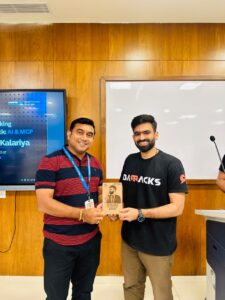
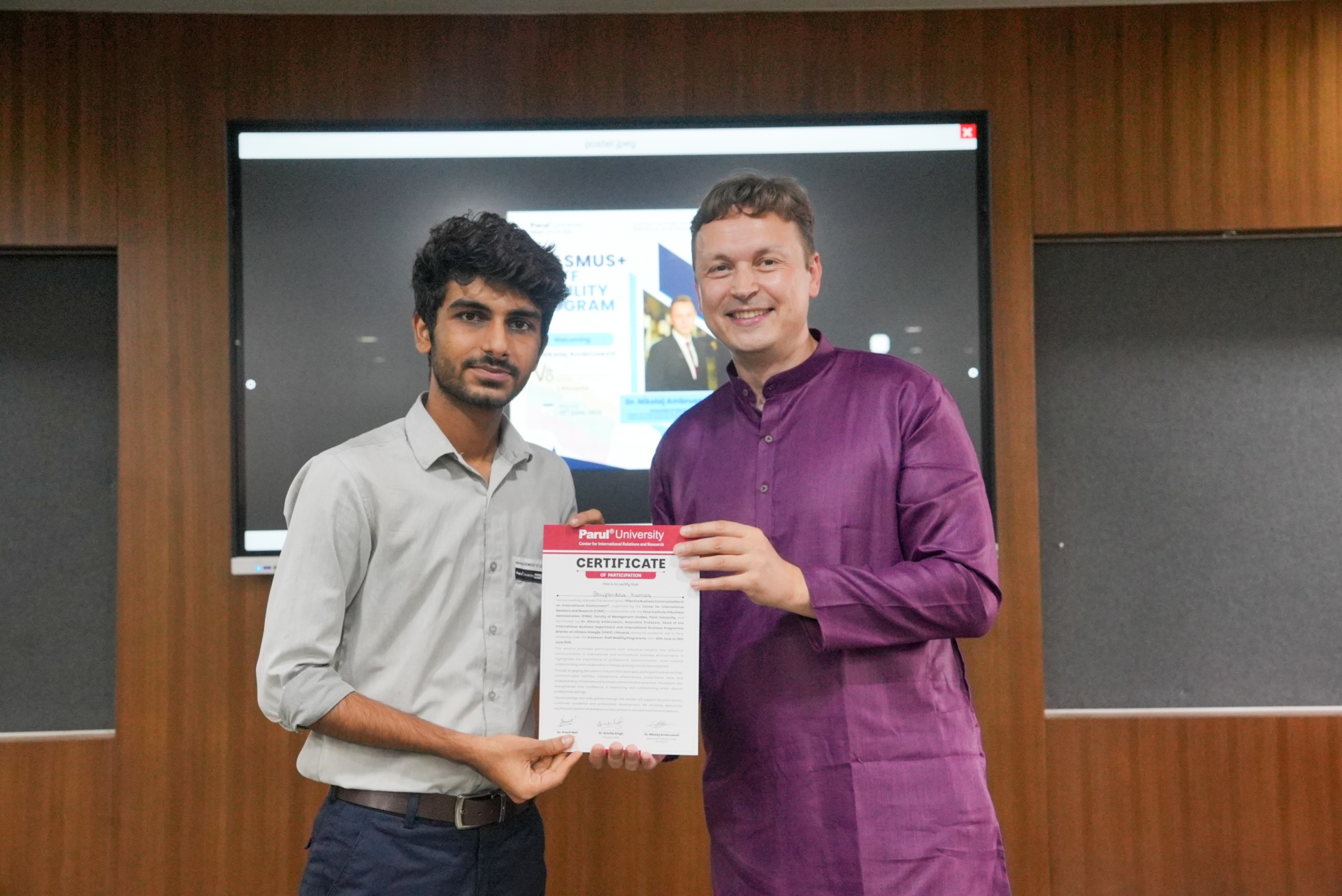
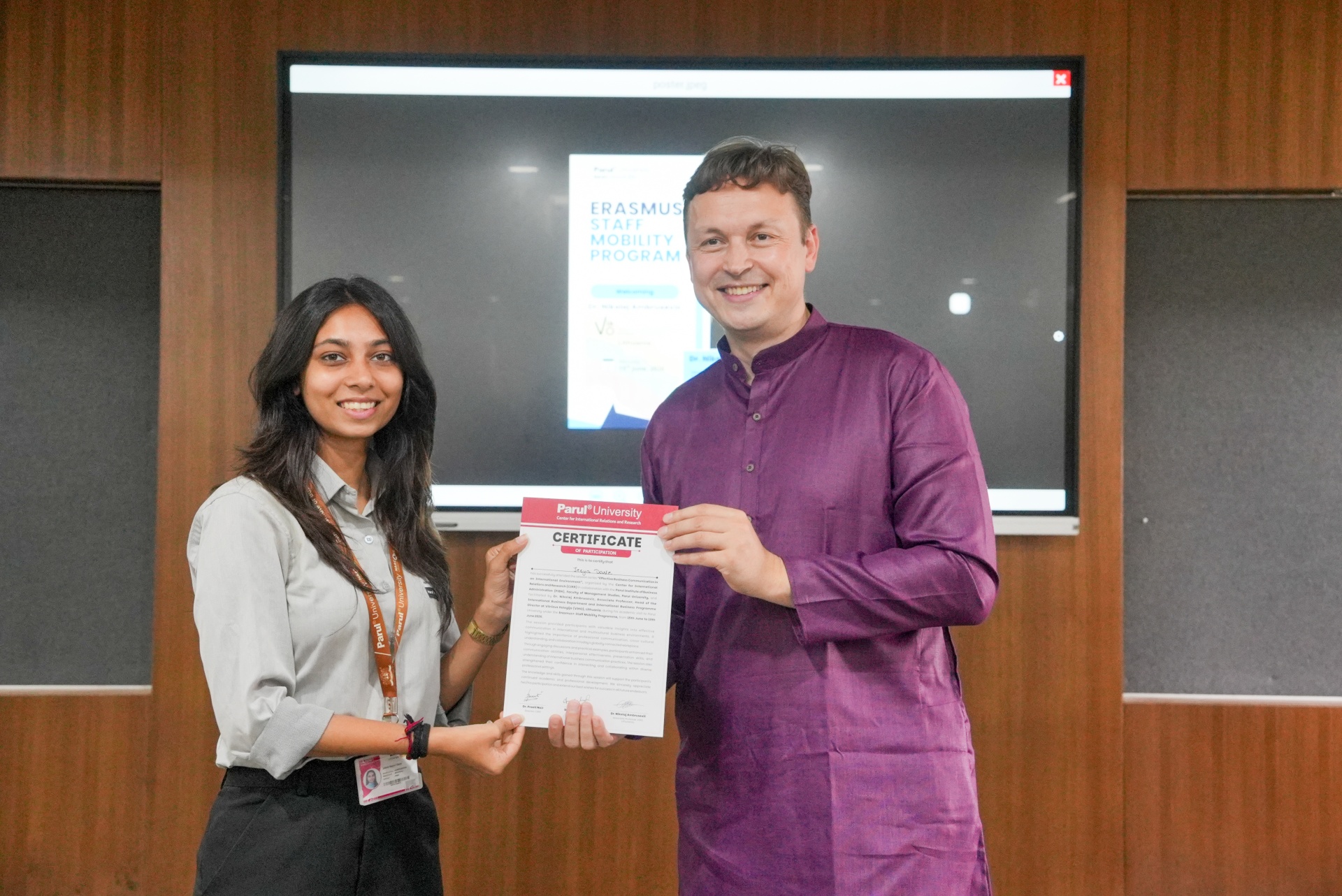
On 17th June 2026, the third day of the four-day session was observed at PIBA at Parul University. The session was taken by Dr. Nikolaj Ambrusevic from Vilniaus Kolegija, where the topics of cultural stereotypes and their influence on intercultural business communication were discussed. The session covered 10 different aspects and frameworks that differentiate the cultures across operationally relevant axes, along with country-specific profiles for Germany, Japan, China, India, France, Italy, and Brazil.
This article documents the framework and the country applications. The institutional context is documented in the companion article on the PIBA-Vilniaus Kolegija Erasmus+ partnership, the foundational frameworks behind the 10 dimensions are documented in the companion article on intercultural business communication frameworks; and the application to negotiation is treated in the article on cross-cultural negotiation.
Why one framework isn't enough: from Hofstede to the 10-dimension model
The case for extending beyond Hofstede’s six dimensions rests on operational granularity. A manager preparing for Tokyo does not benefit primarily from knowing Japan ranks high on long-term orientation; they benefit from knowing decisions typically involve nemawashi (consulting at all levels) and ringi-sho (universal consensus), and that rushing is not just ineffective but offensive.
The 10 dimensions are not categories cultures sit neatly within. Each culture sits somewhere between two extremes along each axis, and the position often defies easy classification. The framework’s value is that it makes systematic comparison possible while preserving complexity simple categorical schemes flatten.
Communication, working style, and discussion patterns: dimensions 1 to 3
The first three dimensions concern how interaction itself unfolds. They navigate the way meetings, conversations, and written exchanges will flow in a way that managers understand that it is foreign rather than seeing it as familiar.
- Direct Vs. Indirect Communication: In indirect communication, one is beating around the bush, it focuses on saving face and addresses the issues through sides instead of pointing it out. While direct communication is straight-to-the-point talk that is comfortable with criticism and considers disagreements openly. Greek business culture exemplifies indirect communication: enormous value on personal relationships, written communication treated as impersonal, and face-saving central. Walking into a Greek meeting expecting blunt email-based communication is a significant misstep.
- Formal Vs. Informal Working Style. Formal cultures prefer business attire, surnames and titles, closed offices, and structured speech. Informal cultures use casual dress, first names, and open-plan offices. France, Germany, Russia, and Lithuania tend formal. The UK, USA, Canada, and Netherlands lean informal. The distinction extends into language: many European languages carry formal and informal versions of you (French tu and vous) with social weight beyond literal meaning.
- Fast-Moving Vs. Slow and Measured Discussion Style. Fast-moving cultures interrupt frequently, talk quickly, and treat silence as awkward. While slow-paced discussions rarely interrupt and create less chaos, put silence as an important factor. The stressful situations occur when an informal colleague expects quick conversational exchanges without meetings or structure. The clash is about cultural expectations regarding time, formality, and spontaneity.
Business attitudes, leadership, and relationship orientation: dimensions 4 to 6
Dimensions four through six concern how organisations relate to change, authority, and interpersonal trust, shaping the deeper architecture of how work gets done.
- Progressive versus Traditional Business Attitude. Progressive cultures embrace change, new technology, and fresh talent. Traditional cultures require change grounded in existing practice, prefer tried solutions, and value loyal staff. Neither is inherently superior. In Japan, parts of India, and sections of the UK, the position that innovation cannot be hurried reflects a considered worldview rather than resistance to progress.
- Flat versus Vertical Leadership Style. Flat cultures communicate directly across levels, decide as a community, and rely on two-way feedback. Vertical cultures communicate through hierarchy, defer to leader decisions, and use top-down feedback. In British and American culture, you are only as good as your last job, worth tied to recent performance. In Asian and Russian cultures, respect for seniority and age is granted almost automatically. The two frameworks rest on different understandings of what earns authority.
- Relationship-Oriented versus Task-Oriented Business Relationships. Relationship-oriented cultures invest in personal connections and will not work with people they do not trust. Task-oriented cultures focus on the job, start small and scale on results, and keep business and friendship separate. Dr. Ambrusevic posed: to what extent would you sacrifice a relationship to get the job done? The question has no universal answer, and that is the point.
Decision-making, time, and work-life balance: dimensions 7 to 10
The final four dimensions concern how decisions are made, how time is treated, and how the boundary between work and personal life is structured.
- Individualistic versus Collective Decision-Making. Individualistic cultures are risk-taking, decide first and persuade after, and hold individuals accountable. Collective cultures are risk-averse, seek consensus, clear decisions with senior management, and hold the group accountable. German, British, Dutch, American, Canadian, Australian, and New Zealand managers tend individual at middle-management. Asia-Pacific is far more collective. The tension creates serious friction in cross-border partnerships.
- Facts versus Instincts as Decision Basis. Fact-based cultures rely on data, separate personal connections from professional judgment, and enter agreements independent of hospitality. Instinct-based cultures trust intuition, regard personal connections as decision factors, and accompany agreements with hospitality. A South American telecom case: choosing between European and American partners for a maintenance contract, the Americans offered a technically superior system at a lower price after three days in the capital. The Europeans spent three weeks across the country visiting local teams. The South American company chose the Europeans, not for price or product, but for the relationship built. Instinct outweighed facts.
- Scheduled versus Flexible Attitude to Time. Time-conscious cultures are punctual, clock-driven, and expect meetings to begin and end on time. Flexible cultures are relaxed, often late, guided by activity rather than the clock. Marilyn Monroe, American (a scheduled culture) but famous for keeping everyone waiting, was offered as the type case of a scheduled-culture person with flexible-culture habits.
- Live to Work versus Work to Live Balance. Live-to-work cultures expect overtime, admire taking work home, tolerate out-of-hours contact, and treat weekend working as normal. Work-to-live cultures consider overtime unusual and weekend working exceptional. Norwegian employees work approximately 1,400 hours per year, substantially fewer than Nordic neighbours; Norway carries one of the highest GDP-per-hour-worked rates globally. Sweden’s six-hour working day at companies including Toyota’s Gothenburg centres produced happier staff and increased profits. Japanese workers going on holiday often apologise to colleagues for the burden their absence creates.
Country profiles: ways to success, ways to failure, icebreakers, icebergs
Country profiles bridge dimensional analysis and operational guidance. The Day 3 session structured each country as four categories: ways to success, ways to failure, icebreakers (safe conversation topics), and icebergs (topics to avoid at all costs).
- Rewards productivity, punctuality, openness, and respect for hierarchy. Icebreakers include European affairs and football. Icebergs include Germany’s role in the Second World War.
- Calls for patience above all. Relationships must be built slowly and trust earned through sustained work. Nemawashi (consulting at all levels before a decision) and ringi-sho (universal consensus) mean decisions take time. Rushing a Japanese counterpart is not just ineffective but offensive. Icebreakers include silence, Japanese culture, food, and baseball. Icebergs include causing someone to lose face, criticising Japanese companies, and speaking loudly or gesticulating extravagantly.
- Prizes sincerity above all. The concept of reciprocity is central to relationship-building. An important linguistic nuance: in Chinese business communication, yes does not mean I agree, it means I hear you. A Chinese counterpart may say yes, it isn’t where a British person would say no, it isn’t. The implication for business communication is significant: always verify what is actually being said rather than treating verbal yes as agreement.
- Rewards relationship-building, face-to-face interaction, and cultural sensitivity. Being relaxed about time and schedules is important, as is building basic understanding of India’s diverse religions and dietary customs. Icebergs include being patronising about India’s colonial past, showing impatience when things do not happen on a Western timescale, and failing to adapt to local business customs.
- A culture of formality, intellectual engagement, and deep pride. Introductions use both first and last names, with Monsieur or Madame as default address. French professionals expect probing questions and interruptions as engagement, not rudeness. Icebergs include statements on gender, race, or religion, and attempts to rush a French decision-maker.
- Places reciprocal trust at the centre of business culture. Negotiations are often lengthy and hierarchy matters; final decisions are often centralised. Being expressive, sociable, and willing to schedule long informal meals are hallmarks of successful Italian business relationships.
- Appearance matters. Brazilians are fashion-conscious, and dressing well is a mark of respect and professionalism. Relationships are warm and personal, and being expressive and genuine is valued.
Cultural stereotypes: formation, value, and danger
Country profiles operate close to stereotype territory. A stereotype is not simply knowledge about a group; it is a set of characteristics applied to a social category, assigning the same traits to all members. The word originated in printing, referring to a solid plate reproducing the same image without variation. Stereotypes are efficient but static.
Stereotypes form in three stages: Leveling reduces complexity to a small number of well-known features. Sharpening amplifies those features beyond their actual prominence. Assimilation makes the stereotype the lens through which every new encounter is filtered.
The Bargons and Rutrians exercise illustrated this. The Bargons live in warm sunny Bargonia, peaceful and rice-eating. The Rutrians live in cold windy Rutriya, described as quarrelsome and unproductive. Students were asked to draw each culture. By the time the drawings emerged (serene sun-drenched Bargons, chaotic storm-battered Rutrians), the trap had sprung: an entire culture had been imagined, visualised, and judged from a handful of sentences. The warmth of the sun became a proxy for the goodness of the people. The cold of the rain became a proxy for their failures.
Stereotyped thinking serves a cognitive purpose: faster reaction in unfamiliar situations. The disadvantages are serious: stereotypes generate prejudice, limit attributed behaviour, and create self-fulfilling dynamics. The recommended approach is not abandoning cultural knowledge but cultivating cultural curiosity, treating every individual as more than the sum of their cultural background.
Also Read: Skills that matter to keep up with the real world, learn them at Parul University.
FAQs
What are the 10 cultural dimensions that shape international business?
The 10 cultural dimensions framework extends Hofstede's six dimensions toward operational applicability. There are ten dimensions that cover direct vs. indirect communication, formal vs. informal working style, fast vs. slow discussion styles, progressive vs. traditional business attitude, flat vs. vertical leadership, relationship-oriented vs. task-oriented relationships, individualistic vs. collective decision-making, facts vs. instincts as decision basis, scheduled vs. flexible attitude to time, and live to work vs. work to live balance. Each dimension represents a spectrum rather than a binary category. The framework was taught at PIBA Parul University with country applications across Germany, Japan, China, India, France, Italy, and Brazil.
What are nemawashi and ringi-sho, and why do they matter for business with Japan?
Nemawashi and ringi-sho are foundational concepts in Japanese business decision-making. Nemawashi refers to consulting at all levels before a decision is formally proposed, building broad informal agreement so the formal proposal encounters no resistance. Ringi-sho refers to pursuing universal consensus through a circulating proposal document reviewed and approved by stakeholders at each level. Together they produce a process prioritising consensus over speed. The implication for cross-border business: rushing a Japanese counterpart is not just ineffective but offensive, because rushing violates the cultural premise that decisions worth making are worth building consensus around. Patience is the operative virtue when working with Japanese partners; trust must be earned through sustained work.
How do cultural stereotypes form, and how should business professionals navigate them?
Cultural stereotypes form through three stages: Leveling reduces complexity to a small number of well-known features. Sharpening amplifies those features beyond their actual prominence. Assimilation makes the stereotype the lens through which every new encounter is filtered. The advantage is cognitive efficiency: faster reaction in unfamiliar contexts with an initial framework. The disadvantages are serious: stereotypes generate prejudice based on category membership, limit attributed behaviour, and can create self-fulfilling dynamics. The recommended approach is not to abandon cultural knowledge but to cultivate cultural curiosity, treating cultural frameworks as starting points subject to revision.
Why do work-life balance differences across cultures matter for business careers?
Work-life balance differences shape both the experience of working across cultures and strategic decisions about where to base international operations. Live-to-work cultures expect overtime and treat weekend working as normal. Work-to-live cultures consider overtime unusual and weekend working exceptional. The differences have measurable productivity implications. Norway, with employees working approximately 1,400 hours per year, carries one of the highest GDP-per-hour-worked rates globally. Sweden's six-hour working day at Toyota's Gothenburg centres produced happier staff and increased profits. The implication: working less can produce better outcomes when supported by appropriate frameworks; imposing live-to-work expectations on work-to-live cultures often damages productivity.