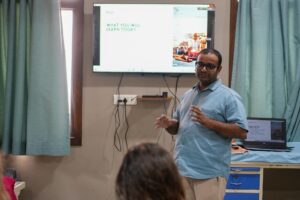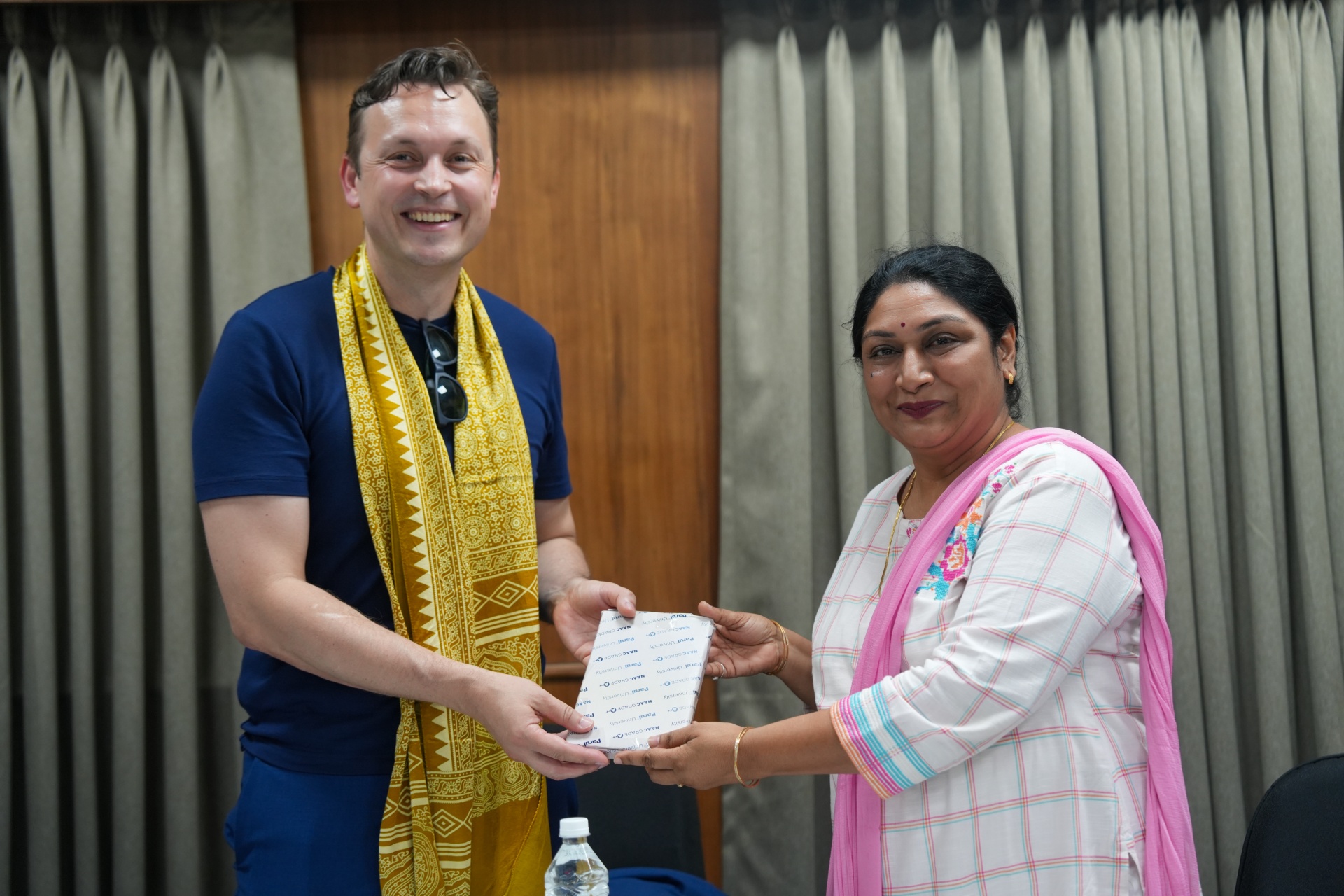
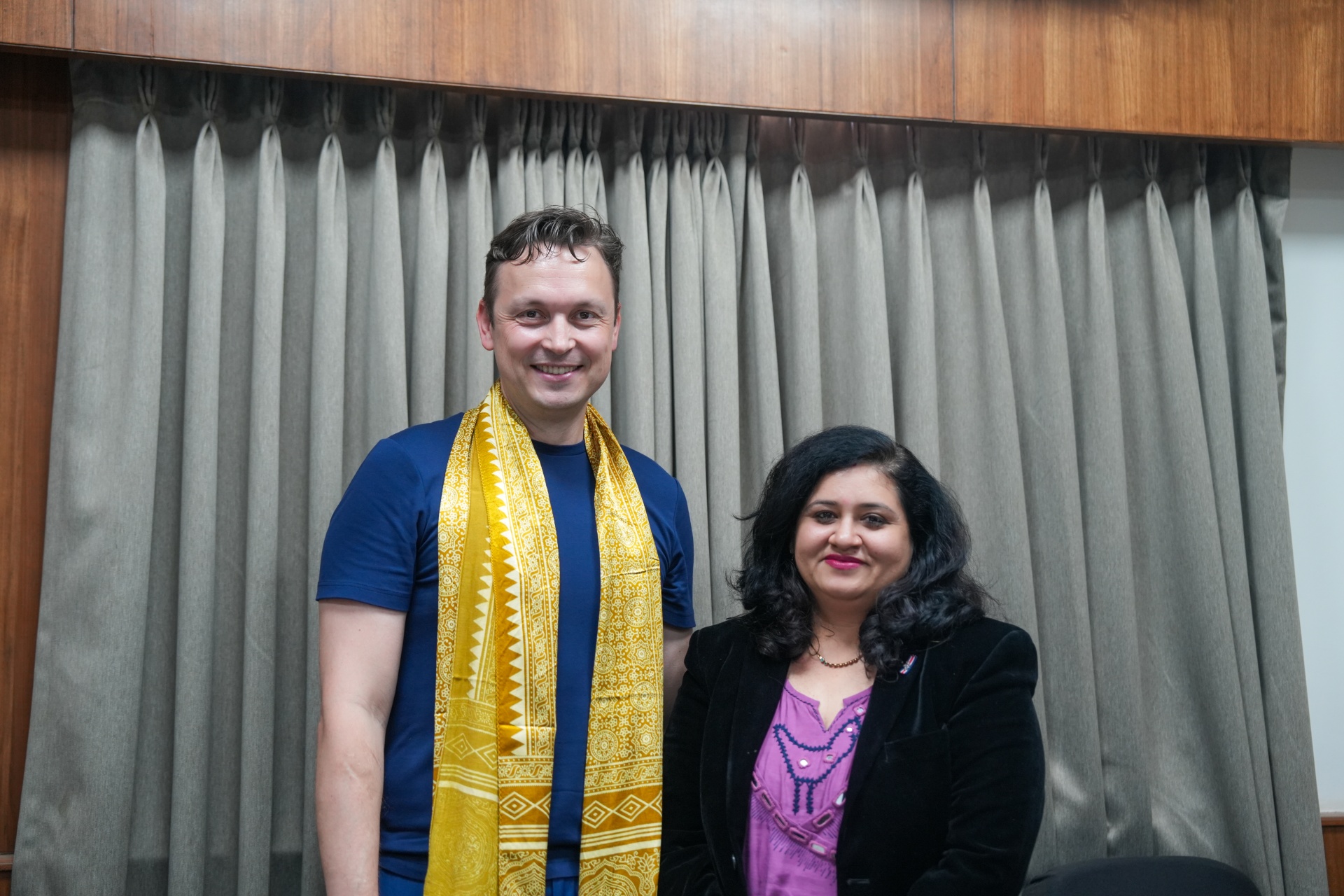
Centre for International Relations and Research (CIRR) – Imagine a foreign professor teaching conceptual domains is altogether a different experience for the Indian students. That’s what happened in these 4 days, from 15th to 18th June 2026: the PIBA – Parul Institute of Business Administration invited and hosted Dr. Nikolaj Ambrusevic from the Vilniaus Kolegija from Lithuania for a 4-day Erasmus+ Staff Mobility Program. This exclusive program was an experience for MBA students as it covered global-level business communication, a clear classification of culture, stereotypes and negotiation in business, and communication etiquette. This article covers all the details of this program, wherein each day is briefly explained in intercultural communication frameworks, the 10 different dimensions of global business , and the coreness of cross-cultural negotiation.
Why staff mobility programmes matter for MBA education
The strongest argument for foreign-faculty engagement in MBA programmes is structural rather than ornamental. MBA graduates increasingly work for multinational companies on teams whose members operate from different cultural frameworks. The capability to navigate this complexity requires sustained exposure to faculty who carry different cultural assumptions into the classroom and can articulate those assumptions in ways students recognise as foreign rather than familiar.
The Erasmus+ Programme, funded by the European Union, supports exactly this kind of structured exchange. Its Staff Mobility component allows faculty from European partner institutions to teach at host universities for short intensive periods, producing substantive academic engagement rather than ceremonial visits.
PIBA’s hosting of Dr. Nikolaj Ambrusevic for four full days sits within this framework. The programme was not a single keynote or a short demonstration session. It was four sequential days of structured teaching across distinct conceptual domains, each day approximately two to two-and-a-half hours of direct engagement, with interactive activities, country case studies, and live role-play exercises distributed across the sessions. The programme architecture matched what serious European universities provide for their own MBA students, delivered to PIBA students in their own institutional setting. The broader Erasmus+ programme framework provides the institutional infrastructure that makes this kind of exchange operationally possible.
The Vilniaus Kolegija connection: Lithuania and the Parul University partnership
Vilniaus Kolegija, formally Vilniaus Kolegija / Higher Education Institution, is an applied-sciences institution based in Vilnius, the capital of Lithuania. Dr. Ambrusevic offered specific institutional details during the opening session that establish the scale of the partner institution. Approximately 5,600 people are associated with the institution across its academic and administrative functions, with significant numbers of international students, including a notable Polish cohort. The institution operates through 10 faculties and 7 dormitories, with one dormitory specifically designated for international students.
Three full academic programmes are taught entirely in English, with four English-taught programmes housed within the Faculty of International Business specifically. The Faculty of Business Management operates with approximately 1,500 students and 18 academic staff members, an undergraduate-focused unit with collaborative degree offerings that produce graduates with diplomas from multiple partner institutions.
- Creativity and Business Innovation programme. A flagship undergraduate offering through which graduates immediately receive three distinct diplomas from partner institutions in Ukraine, Portugal, and Estonia. The triple-diploma structure is unusual and reflects Vilniaus Kolegija’s deep integration into the European higher education ecosystem.
- International Business A dual-diploma offering with a partner institution in Finland. According to Dr. Ambrusevic, the programme ranks among the top ten most popular student programmes globally within the comparable category.
- Student leadership and research infrastructure. Students at Vilniaus Kolegija engage through ambassador programmes, an autonomous student council, a scientific society, and a national journal that publishes student research articles. The infrastructure supports both leadership development and academic publishing experience at the undergraduate stage.
- Sports and international integration. The Physical Education and Sports Centre supports basketball and volleyball at a competitive level, alongside a cricket team established two years ago specifically at the request of an Indian student, and now hosting an annual cricket tournament. The institutional responsiveness to international student interest reflects how the partnership with Parul University fits a broader pattern of engagement with Indian students.
Vilnius itself, the city in which the institution is based, is approximately 5,000 kilometres from India and holds the distinction of housing the largest old town in the eastern part of the world. Dr. Ambrusevic noted a linguistic curiosity that the Lithuanian language carries structural similarities to Sanskrit, with words like the numeral for two pronounced almost identically in both languages, an unexpected connection across the geographical distance separating the two institutions.
Who is Dr. Nikolaj Ambrusevic, and what made the four-day programme substantive
Dr. Nikolaj Ambrusevic teaches intercultural business communication at Vilniaus Kolegija and brought to the PIBA programme a particular pedagogical orientation that distinguishes it from conventional management lectures. The programme was interactive throughout, with students engaged as active participants rather than passive recipients across all four days.
The interactive infrastructure included the Folder Experiment on Day 1, which demonstrated the dominance of intonation over content in interpersonal communication; cognitive priming exercises that showed how conversational structure shapes thought patterns; Kahoot-based knowledge assessments that tested cultural framework understanding; volunteer-driven sender-receiver dynamics exercises; Wordwall-hosted cultural dimensions tests where students discovered their own cultural profiles aligned with countries different from their own; the Bargons and Rutrians stereotype-formation exercise; and a live buyer-seller negotiation role-play on Day 4.
What made the programme particularly substantive was the cultural respect Dr. Ambrusevic demonstrated in real time. During an interactive exchange with a student on Day 3, he responded with Aabhar, the Gujarati word for gratitude, an unprompted gesture that demonstrated the very principle the programme was teaching.
The interactions also included a heartfelt acknowledgement of Devika Nair, an Indian international student at Vilniaus Kolegija, who Dr. Ambrusevic described as the real spirit of the international group for her work bridging cultural gaps between cohorts. The substantive engagement with students at Parul University reflected the pedagogical position the programme itself was teaching: cultural competence begins before the first PowerPoint slide, in the preparation, in the willingness to show up to someone else’s world having made an effort.
The four-day arc: from communication mechanics to negotiation strategy
The programme architecture moved students from foundational communication mechanics through cultural classification frameworks to applied negotiation strategy across four sequential days. Each day built on the previous day’s concepts rather than treating each session as independent, producing a cumulative framework that students could apply to actual cross-cultural business situations by the end of the programme.
- Day 1 (15 June 2026): Contemporary approaches to intercultural business communication. The opening day established communication theory through demonstration. The Folder Experiment showed content accounts for approximately 10 per cent of interpersonal impact, with intonation and body language carrying the dominant share. Masaru Emoto’s water crystal experiments framed the physical impact of language. Volunteer-driven exercises demonstrated how listening behaviour shapes speaking quality.
- Day 2 (16 June 2026): Classification of cultures. Day 2 introduced theoretical frameworks behind cultural classification. Hofstede’s six cultural dimensions provided the primary framework for country comparisons across individualism, power distance, uncertainty avoidance, motivation, long-term orientation, and indulgence. Edward Hall’s high-context versus low-context theory and Chronemics (cultural time perception) completed the framework. Business culture archetypes (Village Market, Oiled Machine, Centralised Family, Candidate Tribe) contextualised these in operational terms.
- Day 3 (17 June 2026): Cultural stereotypes and intercultural business communication. Day 3 expanded the framework to a 10-dimension model differentiating cultures across communication style, working style, discussion style, business attitude, leadership, business relationships, decision-making style, basis for decisions, attitude to time, and work-life balance. Country profiles covered Germany, Japan, China, India, France, Italy, and Brazil with specific icebreakers and icebergs for each. The session closed with stereotype formation theory and the Bargons and Rutrians exercise.
- Day 4 (18 June 2026): International business etiquette and negotiation. Day 4 applied the cultural framework to negotiation specifically. The 5C’s Model (Cultural Knowledge, Behaviour, Values and Attitudes, Preferences, Adaptation) structured the cultural intelligence framework. Gesteland‘s four-criteria classification and Moore and Woodrow’s negotiation approaches built the negotiation methodology. BATNA, ZOPA, and reservation points provided the operational mechanics. The Jason Wright and Mr. Moto case study illustrated task-oriented versus relationship-oriented negotiation dynamics in practice.
What PIBA students take away from international faculty engagement
The substantive question for prospective MBA students evaluating PIBA is what programmes of this kind develop in students that conventional curriculum coverage does not. The answer operates at three levels.
- First, exposure to faculty operating from a different cultural framework develops the capability to recognise one’s own assumptions as assumptions rather than universal truths. This is difficult to develop through textbooks alone because textbooks are typically written from within a framework that goes unmarked. Foreign faculty make the framework visible by speaking from outside it.
- Second, structured intensive programmes spanning multiple days develop the capability to integrate concepts across domains. A standalone Hofstede lecture teaches the dimensions. A four-day programme connecting communication theory to dimensions to country application to negotiation teaches the integration. Integration capability distinguishes managers who apply frameworks to unfamiliar situations from those who only recognise frameworks when told they apply.
- Third, programmes built around interactive activities (the Folder Experiment, the cognitive priming exercises, the Cultural Dimensions Test where students discovered their own profiles aligned with unexpected countries, the buyer-seller role-play) produce experiential learning that students can recall and apply long after the programme ends. The PIBA-Vilniaus Kolegija Erasmus+ engagement sits within Parul University’s broader Faculty of Management Studies infrastructure that supports this kind of substantive international engagement regularly.
FAQs
What is the Erasmus+ Staff Mobility Program at PIBA Parul University?
The Erasmus+ Staff Mobility Program is an exchange of international faculty wherein professors from European institutions visit and teach students of PIBA for a particular time frame. This program is an academic exchange between European and partner-led institutes. As hosted by PIBA, Dr. Nikolaj Ambrusevic came for 4 days to teach cross-border business communication, international negotiations and etiquette. This was attended by MBA students from PIBA!
Who is Dr. Nikolaj Ambrusevic and what does he teach?
Dr. Nikolaj Ambrusevic teaches intercultural business communication at Vilniaus Kolegija, a Higher Education Institution based in Vilnius, the capital of Lithuania. His academic specialisation covers cultural dimensions in international business, communication frameworks including Hofstede and Edward Hall theory, cross-cultural negotiation methodology, and applied case-study work in international business etiquette. He delivered a four-day intensive programme at Parul Institute of Business Administration from 15 to 18 June 2026 as part of the Erasmus+ Staff Mobility Program. His pedagogical approach is highly interactive, integrating Kahoot-based knowledge assessments, cultural dimensions tests via Wordwall, demonstrative experiments including the Folder Experiment and cognitive priming exercises, and live role-play activities across his sessions.
What is Vilniaus Kolegija, and what is its connection to Parul University?
Vilniaus Kolegija is an applied-sciences Higher Education Institution based in Vilnius, the capital of Lithuania. It serves approximately 5,600 people across academic and administrative functions, operates through 10 faculties and 7 dormitories, and offers three full academic programmes taught entirely in English alongside four English-taught programmes within its Faculty of International Business specifically. Its flagship offerings include the Creativity and Business Innovation programme (triple-diploma with partner institutions in Ukraine, Portugal, and Estonia) and the International Business programme (dual-diploma with a partner institution in Finland). Vilniaus Kolegija partners with Parul University through the Erasmus+ Programme, with the June 2026 visit by Dr. Nikolaj Ambrusevic representing one expression of this partnership. The two institutions share an interest in international student exchange, with Vilniaus Kolegija having established a cricket team specifically at the request of an Indian student.
What did the four-day Erasmus+ programme at PIBA cover?
The four-day programme covered distinct but cumulative content domains across its sequential days. Day 1 (15 June 2026) introduced contemporary approaches to intercultural business communication, including the verbal-versus-non-verbal split, the Folder Experiment demonstrating the dominance of intonation over content, cognitive priming exercises, and Masaru Emoto's water crystal experiments framing the physical impact of language. Day 2 (16 June 2026) presented the classification of cultures using Geert Hofstede's six cultural dimensions, Edward Hall's high-context and low-context theory, Chronemics (cultural perception of time), and business culture archetypes. Day 3 (17 June 2026) introduced a 10-dimensional cultural model with country profiles for Germany, Japan, China, India, France, Italy, and Brazil, alongside stereotype formation theory. Day 4 (18 June 2026) applied the cultural framework to international business etiquette and negotiation through the 5C's Model, Gesteland's four-criteria classification, Moore and Woodrow's negotiation approaches, BATNA and ZOPA mechanics, and the Jason Wright and Mr. Moto case study.