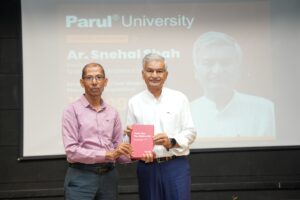
Every year, hundreds of thousands of Indian students board flights to study in countries they have never lived in. The scale of that decision, and what drives it, was the subject of research presented at Parul University‘s international conference on inclusive growth. The numbers it cited make the question unavoidable.
The Numbers Behind India's Study-Abroad Wave
The study put the imbalance in blunt terms. It cited roughly 1.36 million Indian students studying abroad at present, against about 191,000 foreign students studying in India. That is close to seven Indians leaving for every one international student arriving. As with all conference figures, this is the presenter’s cited data, not an independent count, but the direction is not in dispute.
The imbalance is not just a vanity metric. It represents talent, tuition, and future taxpayers flowing outward, and it raises a fair question about what those students are looking for that they do not believe they can find at home.
The Cost of the Imbalance
Seven students leaving for every one arriving is not a neutral statistic. It represents tuition paid to foreign institutions, talent that often settles where it trains, and future taxpayers building careers abroad. For a country investing heavily in higher education, an outflow of this scale is a signal that the market is voting with its feet, and that the reasons deserve a serious answer rather than a defensive one.
There is a fair counter-argument. Students who train abroad often bring skills, networks, and capital back, so mobility is not pure loss. But that return is not guaranteed, and it does nothing for the student who wanted a strong option at home and could not find one. The imbalance is best read not as a crisis to be blocked but as demand to be met.
The Four Reasons Students Leave
Drawing on prior research, the study identified four factors that consistently drive the choice to study overseas.
- Quality of education: students seek institutions with strong reputations, respected faculty, and a qualification that carries weight internationally.
- Career opportunities: an overseas degree is treated as an investment expected to return internships and well-paid work.
- Support services: safe, clean accommodation and responsive student services weigh heavily on the decision.
- Cultural diversity: the pull of living among different nationalities and adopting a new lifestyle is real, not incidental.
“Students do not just select a country; they select quality, opportunity, experience, and a future for themselves.” – Mr. Lakshya, presenter
Read together, the four factors describe a single expectation: that education should convert into a life, not just a certificate. Quality and career opportunity are the measurable half; support services and cultural exposure are the lived half. A student comparing options is really asking whether one place can deliver both, and the honest answer for most Indian institutions has historically been partial. That is what is now changing.
What Would Make India a Destination, Not Just a Source
The presenter’s conclusion was constructive rather than resigned. If Indian universities improve on the same four factors, quality, career outcomes, student support, and genuine international exposure, India can compete for students rather than only exporting them. The problem is specific, which means the solution is too.
That reframes the issue for a prospective student weighing an expensive overseas degree against options at home. The real question is not India or abroad. It is whether an Indian institution can deliver the four things students actually cross oceans for.
It also reframes it for the country. Retaining students is not about restricting the exits. It is about closing the quality gap that makes the exits attractive, at the institutions students can actually reach. A handful of elite campuses were never the issue. The issue is whether the broad middle of Indian higher education can offer reputation, outcomes, support, and global exposure at once, because that is where most students study.
Global Exposure Without Leaving India
This is where the abstract debate meets a concrete option. A university that builds international structures into an Indian campus offers a third path: global exposure without the full cost and dislocation of relocating.
Parul University’s global ecosystem is built for exactly that. It runs partnerships with more than 120 foreign universities, hosts over 6,000 international students on campus, and offers semester exchanges, global internships, and pathway programmes. It became the first private university in India to establish a Centre of Excellence with seven New Zealand universities, and runs an entrepreneurship exchange with a Swiss university of applied sciences. Under the internationalisation goals that Indian higher education policy now encourages, that model lets a student build a global profile while staying anchored at home.
- 120+ partner universities across the Americas, Europe, and Asia.
- 6,000+ international students on campus, so cross-cultural exposure is local, not hypothetical.
- Global programmes including semester exchange, summer school, and global internships.
- 800+ students have taken part in global programmes, backed by more than 2 crore rupees in global-exposure scholarships.
- 3 crore rupees in European Union funding supports a capacity-building project, and an entrepreneurship exchange runs with Bern University of Applied Sciences, Switzerland.
- Partner countries span the USA, UK, Canada, Australia, New Zealand, much of Europe, and Japan, South Korea, Thailand, Malaysia, and Vietnam in Asia.
The point is not that studying abroad is wrong. For many students it is the right call. The point is that the four reasons behind the decision can increasingly be met without a one-way ticket, and that is a genuinely new option for the 1.36 million weighing it.
The forms this exposure takes are specific, not vague. Parul University runs semester exchanges, summer schools, pathway programmes, visiting-professor tracks, an international week, global internships, and a Young Entrepreneur Exchange Project hosted with a Swiss university. Its Centre of Excellence with seven New Zealand universities is built for co-teaching and collaborative research, not only student swaps, which means the international content reaches the classroom itself and not just the students who travel.
Questions to Ask Before You Choose
If an overseas degree is an investment, it deserves the scrutiny of one. A few questions separate a considered choice from an expensive assumption.
- Does the qualification carry recognition in the country where you plan to work, not only where you study?
- What are the actual post-study work rights, and how recently have they changed?
- What is the total cost including living, and how does it compare with a domestic degree that has international components?
- Does the institution have genuine industry links for internships, or a brochure promise?
- Can you get comparable global exposure at home through exchange or partnership programmes first?
A student who can answer these has done the real work of the decision. The answers, increasingly, do not all point in the same direction, which is the healthiest sign for Indian higher education in years.
Studying Abroad as an Investment: How to Decide
The research framed an overseas degree as an investment, which is the right way to weigh it. An investment is judged by return, cost, and risk, not by prestige alone.
- Return: does the specific programme abroad open career doors a strong Indian programme with global partnerships would not?
- Cost: tuition, living, and relocation abroad against a domestic degree that offers exchange semesters and global internships at a fraction of the price.
- Risk: immigration, job-market, and settling-in uncertainty abroad against a known environment at home.
For some students the answer still points abroad, and that is a legitimate choice. For many, a domestic university with genuine international structures now clears the same bar at lower cost and risk, which is exactly the option the study’s four factors were pointing toward.
Also Read: Is Parul University a Good Choice for Commerce and Finance?
FAQs
How many Indian students study abroad?
Research presented at a Parul University conference cited roughly 1.36 million Indian students studying abroad, against about 191,000 foreign students in India, close to seven outbound students for every inbound one. The figure is the presenter's cited data drawn from prior research.
Why do Indian students study abroad?
The research identified four main reasons: quality of education and internationally respected qualifications, career and internship opportunities, strong student support services, and cultural diversity. Students treat an overseas degree as an investment in a future, not just a course.
Can you get international exposure without leaving India?
Yes. Universities with strong global structures offer exchange semesters, global internships, foreign partnerships, and large international student communities on campus. Parul University, for example, partners with more than 120 foreign universities and hosts over 6,000 international students, allowing global exposure from an Indian base.