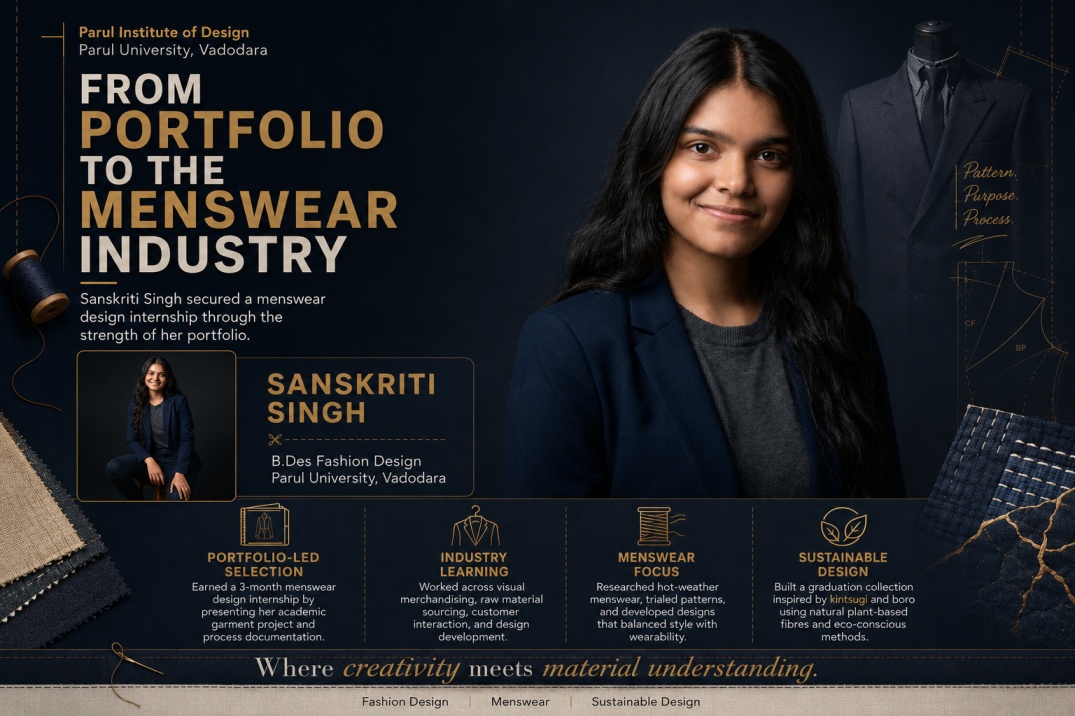
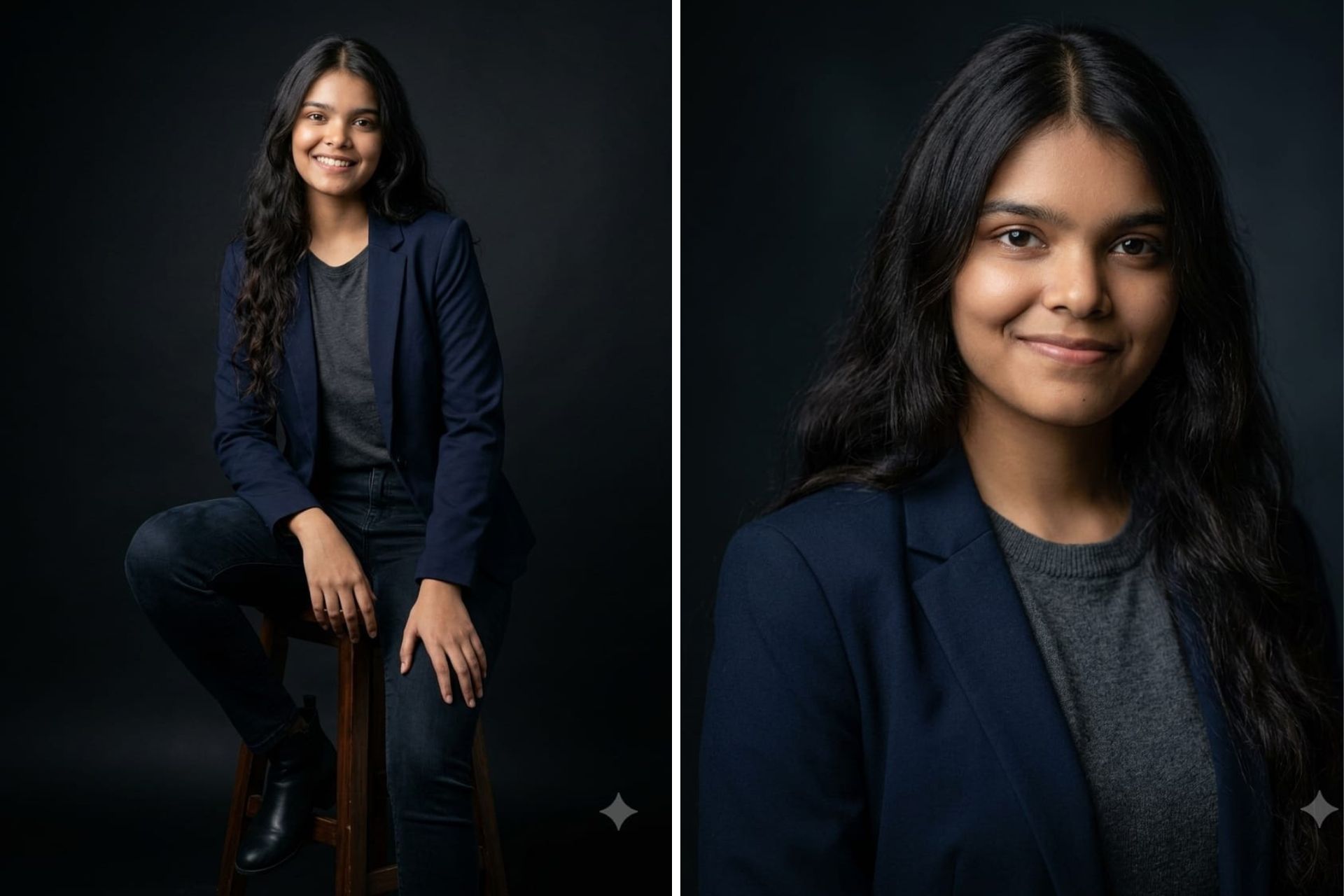
Sanskriti Singh went for her internship interview without relying only on a resume. She brought her last academic garment project, spread out the documentation, and walked the business owners through every step of how she had made it. Seeing her progress and work, the role was offered to her on the spot. That is a line she consistently repeats in her story: a fashion design student who takes initiative, builds proof of her ability, and puts it in front of the people who can act on it.
The B.Des. Fashion Design student, Sankriti Singh, from Parul University, has a very ordinary journey. Her love for fashion designing began when she started buying clothes along with her skills of being able to sketch and draw, which turned out to be a clear professional vision. Her ambitions led her to follow the major international luxury houses closely, studying how they operate. What distinguishes her is not a single dramatic placement but a consistent habit of driving her own progress.
This sits alongside other documented outcomes from the Faculty of Design at Parul University, including Simran Singh’s Pre-Placement Offer at Arvind, Prernakumari Patel’s Bloodline Pact collection, Khushi Dehade at Mix Bunch, and Dipali Gupta at Zebein.
The interview: a portfolio that spoke for itself
Sanskriti’s internship did not arrive by luck. She secured a three-month position at a design house on the strength of her work, and the mechanism was direct. At the interview, she used her last academic garment project as proof of skill, bringing all the project documentation and explaining each step of its creation to the business owners. They were impressed enough to offer her the position immediately.
This is a lesson worth extracting for any design student: a strong, well-documented portfolio is the single most persuasive thing a young designer can carry into a room. Sanskriti’s academic project at Parul Institute of Design was substantial enough to function as that proof, and her ability to explain her process, not just show the result, is what closed the interview. The work was made in the classroom; the initiative to present it that way was hers.
Learning the whole business, not just design
The role was not narrow. Running a design house involves many jobs at once, and Sanskriti was given several duties simultaneously rather than a single task. She handled visual merchandising, visited markets to source raw materials, and dealt directly with customers. Her mornings began with arranging the store’s presentation, she managed fabric colouring processes, and in whatever time remained she focused on her core work of designing.
The breadth taught her fast. She learned to operate the commercial side of a fashion business and to solve problems as they appeared, which is exactly the kind of range that a classroom, focused on one discipline at a time, cannot fully build. For a student headed toward the fashion industry, understanding merchandising, sourcing, and customer interaction alongside design is what separates a hire who can only sketch from one who can contribute across a business.
The menswear challenge, and how she solved it
The main creative brief she was given was demanding: a full collection of men’s shirts for hot-weather conditions, focused on one specific customer group and one season. Menswear was unfamiliar territory. Where womenswear leaves room for the unusual, menswear demands logical, wearable, acceptable design, and her early ideas were repeatedly rejected by the management.
The hardest part was reading her customers. The store served a wide age range, from men in their mid-twenties to older gentlemen, and that gap made their preferences difficult to pin down. Sanskriti did not give up when her first ideas failed. She ran extensive research on her own time, studying fashion shows and past designs, and with feedback from experienced colleagues she learned the mindset of her clients and how to design pieces that would actually sell. She made many trial pieces to find the right patterns and construction. The self-directed research, done on her own initiative to close a gap the classroom had not covered, is what turned early rejection into a working collection.
The most overlooked skill: the science of fabric
Asked what students most often overlook, Sanskriti’s answer was specific and technical: in-depth scientific knowledge of natural fabrics. Most young students pour their energy into beautiful sketches on paper and never analyse the actual material, and she considers that a serious gap.
Knowing the texture of a fabric, how it drapes on the body, and how it reacts to dyeing is, in her view, non-negotiable. Without that grounding in materials, even the most beautiful sketch becomes useless on a real industrial floor. It is a mature insight for a student to hold, and it reflects a designer who has already understood that fashion is built from material reality, not just visual ideas.
The graduation collection: kintsugi, boro, and finding value in imperfection
Sanskriti’s final graduation project was both conceptually ambitious and environmentally conscious. The entire collection used eco-friendly practices and natural plant-based fibres, and its philosophy drew from an Eastern idea of finding perfection within imperfection. She studied two traditional restoration techniques and translated them into fashion.
- The gold-repair philosophy. An ancient technique of repairing broken ceramics with metallic fluid, where instead of hiding the damage, the reflective repair makes the crack visible and increases the value of the object. Sanskriti carried this idea into garments finished with golden detailing along seams that looked torn and rejoined.
- The mending tradition. An ancient technique of strengthening torn and ragged cloth by stitching rather than discarding it, extending a garment’s life instead of wasting it. She combined this with the gold-repair idea into a new fabric approach: modern garments that appeared ripped and then stitched back together with golden detail.
The collection translated a genuine philosophy into wearable form and was well received, confirming her ability to turn abstract ideas into clothing. Building a sustainability-driven collection from natural fibres, on a coherent conceptual foundation, is exactly the kind of work the fashion industry increasingly values as it moves toward responsible design.
Also Read: Journey of Pooja Patil from final year to AI assistant print designer.
Choosing her own next step
After her internship, Sanskriti made a deliberate choice rather than settling. She left the design-house role to pursue a Master’s degree, deciding that advancing her education was the right next move for the international career she is aiming at. It was a self-directed decision, consistent with the rest of her story: she took the internship on her own terms, learned what she needed, and moved on when a bigger goal called for it.
Her ambition is unambiguous. She wants to work internationally for a global luxury brand, moving through the corridors of Europe’s leading fashion houses. She knows the level of recognition that requires is not easily attained, and she is undeterred. The Master’s is a step toward it, chosen because it serves the plan, not because it was the default path.
What her story tells prospective students
Sanskriti’s route is a case study in student agency. The academic project that won her the internship was built at Parul Institute of Design, and faculty mentorship supported her throughout, but the decisions that moved her forward, presenting her portfolio the way she did, researching menswear on her own time, choosing a Master’s for a global goal, were hers. For a self-driven student, that combination of institutional platform and personal initiative is what a design education is for.
For students who plan to build something of their own, there is a cell at the university, PIERC (Parul Innovation and Entrepreneurship Research Center), that supports entrepreneurship. The cell has supported 254 startups based across different domains, including fashion and lifestyle. Parul University holds NAAC A++ accreditation at a CGPA of 3.55, Category 1 status with Grant of Graded Autonomy, and ranks 6th in India for SDG 5 (Gender Equality) and 7th in India for SDG 4 (Quality Education) in the Times Higher Education Sustainability Impact Ratings 2026.