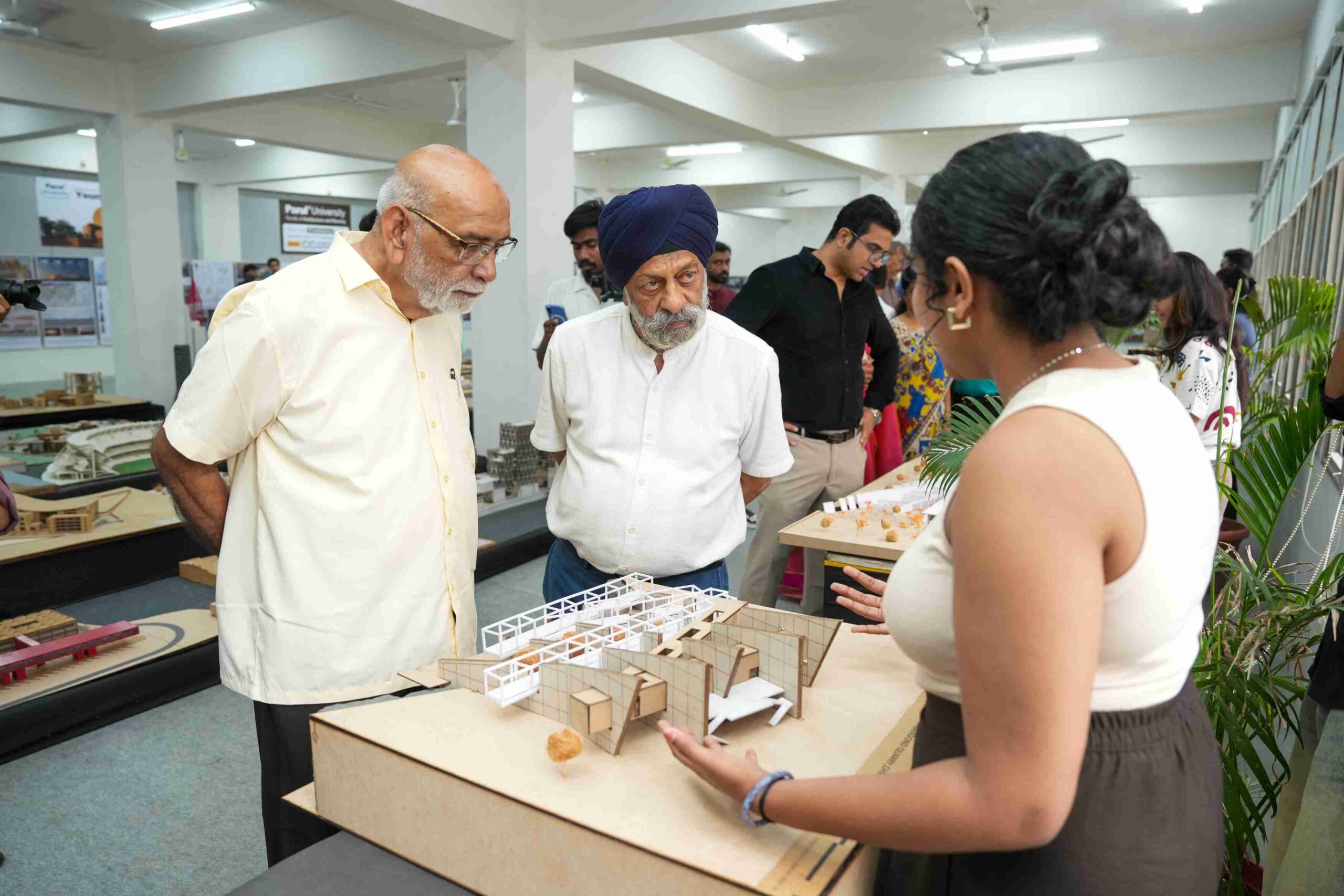
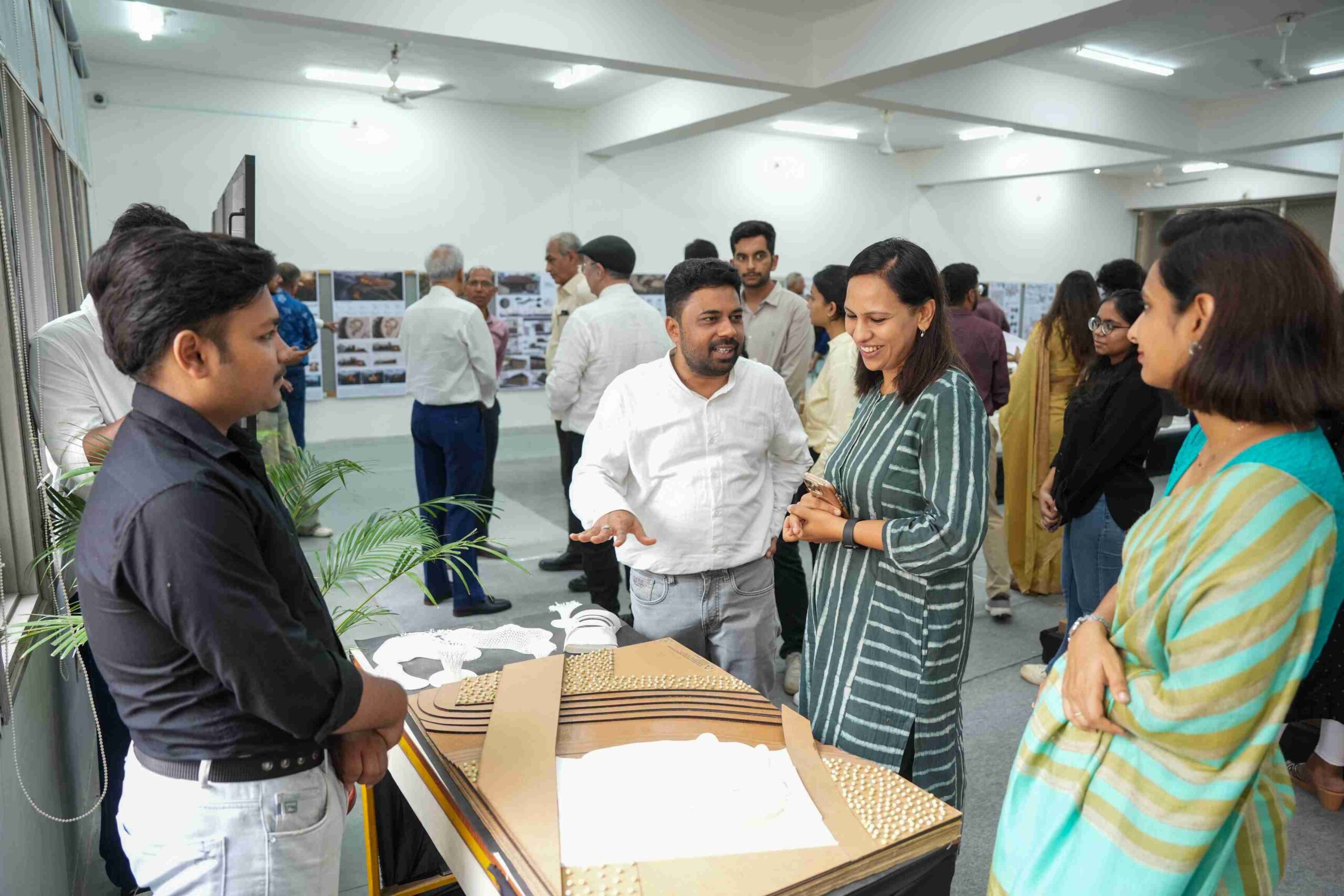
Most guest lectures are highlight reels. Ar. Siddharth Majumdar of the practice ARCOP chose the opposite at the Young Ideas session hosted by the Faculty of Architecture and Planning at Parul University. He presented two major projects that his firm did not win, deliberately, so that students could see exactly what a professional career contains, including the parts a portfolio never shows.
“Architecture is an occupation characterised by both accomplishment and disappointment.” – Siddharth Majumdar, ARCOP
Two Designs That Were Never Built
Siddharth Majumdar walked students through two demanding competition entries, both developed in full, both unsuccessful.
- IIM Calcutta: a campus proposal on a long-established, water-bound city site with almost no room to build outward. To preserve open ground, ARCOP’s hostel blocks rose to seventeen and eighteen storeys, a solution the institute appreciated, and the team answered extremely detailed requirements, down to classroom seating, with a complete master plan addressing structure and sustainability. It was not awarded to the firm.
- A Bangalore campus: developed with the same thoroughness against an equally specific brief, and, like Calcutta, not won.
The IIM Calcutta case is worth sitting with. The campus was long-established and hemmed in by water bodies, with a mix of older and newer buildings and almost no ground left to build on. ARCOP’s response, pushing hostel blocks to seventeen and eighteen storeys precisely to keep the ground open, was the kind of disciplined, constraint-driven thinking a jury might be expected to reward. The competition also demanded structural and sustainability proposals alongside the architecture, addressing the water-bound site through passive and active strategies, and the team delivered complete responses on every front. The project still went elsewhere.
Presenting two unrealised projects rather than successes was the whole point. It is a more useful preparation than any success story, because it teaches resilience before the disappointment arrives rather than after.
Designing Futuristic Spaces – A Look Inside Parul University’s Architecture Exhibition!
Why Good Work Still Loses!
The harder lesson was why a thorough, honest design can still fail to win. A client judges a proposal through a lens the designer cannot fully see, structural, financial, aesthetic, and often subjective priorities that were never stated. An architect can do everything right by the standards of the craft and still lose, because the work is judged by criteria outside the work itself.
Siddharth Majumdar framed this not as cynicism but as realism. The architect’s job is to approach every design honestly and completely, knowing the outcome is not entirely in their hands, and to keep the quality of the work independent of whether any single client says yes.
There is a professional maturity in this that students rarely hear. Early in a career, a lost competition can feel like a verdict on one’s ability. Siddharth Majumdar’s framing reassigns it: a loss is often a mismatch between an honest design and a client’s private priorities, not proof the work was poor. Holding that distinction is what lets an architect submit the next entry with the same conviction rather than shrinking the work to guess at a jury’s taste, which is how good architects slowly become mediocre ones.
“An architect can do everything right by the standards of the craft and still lose the commission.”
Mistakes Are the Curriculum
His honesty about rejection sat alongside a related lesson from the other architects at the event: that error is not failure but instruction. Snehal Shah told the same students that his command of the hardest elements, intricate roofs and expansive courtyards, came from good mistakes made on earlier projects, and described his practice as an empirical chain where each project builds on the tested experience of the last.
Put together, the message is consistent. A design may not be realised, and a technique may not work the first time, but neither is wasted. Both add to a repository of practical knowledge that no textbook holds and only practice can build.
This reframing is what separates a durable career from a fragile one. An architect who counts only built projects as worthwhile will be crushed by an industry where much of the best work is never realised. One who counts every honest attempt as learning, built or not, keeps improving through the losses. Siddharth Majumdar’s decision to show unbuilt work was, in effect, a demonstration of that mindset: he was treating two rejections as material worth teaching from, which is exactly the resilience he wanted students to leave with.
The Patience the Work Demands
The students carried the same truth from the other side of it. Pratham Vani, a seventh-semester architecture student who guided visitors through the exhibition that accompanied the sessions, was candid about the cost of the discipline. He spoke of staying up for three nights on a project only to be scolded for the work regardless, and of how frustration has to be met with patience and continued creativity.
His route into the field was not straight either. From Indore, Pratham had prepared for engineering entrances and originally applied to Parul University for a B.Tech, switching to architecture only after his father repeatedly urged him toward something creative. Once committed, he entered five competitions from college to national level within a few years. The point is that the discipline rewards persistence over certainty, and that a student unsure at the start can still find their footing.
He lived the patience lesson too. Scolded during a fifth-semester jury for not engaging deeply enough with his own design concepts, he spent his entire two-week Diwali vacation redoing the whole submission from scratch and presenting it again. That willingness to start over is not a footnote to architectural training. It is the training.
What Students Should Take From This?
The through-line across Siddharth Majumdar’s losses and the students’ late nights is a single discipline: keep the quality of the work independent of the outcome. A design judged by criteria you cannot see may still not win, and a jury may still scold three nights of effort, but neither changes whether the work was good, and neither is wasted if it sharpened the next attempt.
That is a more durable foundation for a career than the expectation of constant success. A student who internalises it early is protected against the disappointments that make others quit, and free to keep improving regardless of who says yes. It is also, quietly, the most useful thing a guest speaker can leave behind.
So, Is Architecture Worth It?
The honest answer the session offered is conditional. Architecture rewards those who love the craft enough to survive its disappointments and frustrates those who expected only applause. Patience is not a nice-to-have; it is the entry fee. Whether you aspire to design iconic buildings through the Bachelor of Architecture (B.Arch) programme or shape smarter, more sustainable cities with the Master of Planning, Parul University provides the knowledge, creativity, and industry exposure to help you succeed.
For those who have it, the reward is a career of genuine creative meaning, the freedom to shape how people live, work, and gather. But that reward is earned on the far side of the unbuilt projects and the hard juries, not before them. A student who hears only the awards and none of the losses cannot make that trade knowingly. Siddharth Majumdar made sure the students at Parul University heard both, which is the fairest preparation a speaker can offer.
What that honesty gives a prospective student is a fair choice, made with both the glamour and the grind in view. That a school puts a speaker like Siddharth Majumdar in front of students, showing them the losses rather than only the wins, is itself a mark of a serious architecture education rather than a marketing one. The craft behind the resilience is examined further in companion pieces on climate-responsive design by Ar. Charanjit Singh Shah and architecture as human experience by Yatin Pandya.
FAQs
Who is Siddharth Majumdar, the architect?
Siddharth Majumdar is an architect with the practice ARCOP. At Parul University's Young Ideas session he presented two major competition designs, for campuses at IIM Calcutta and Bangalore, that his firm did not win, using them to give students an honest view of professional practice.
Is architecture a good career?
Architecture can be deeply rewarding for those who love the craft, but it demands patience and a tolerance for disappointment. As Siddharth Majumdar explained at Parul University, the profession combines accomplishment with rejection, including strong designs that are never built and competitions lost despite thorough work.
Why do good architectural designs not always get built?
Because clients judge proposals through structural, financial, and often unstated subjective criteria that the designer cannot fully see. A design can be thorough and honest by the standards of the craft and still lose a competition, which is why Majumdar urges architects to keep the quality of their work independent of any single outcome.