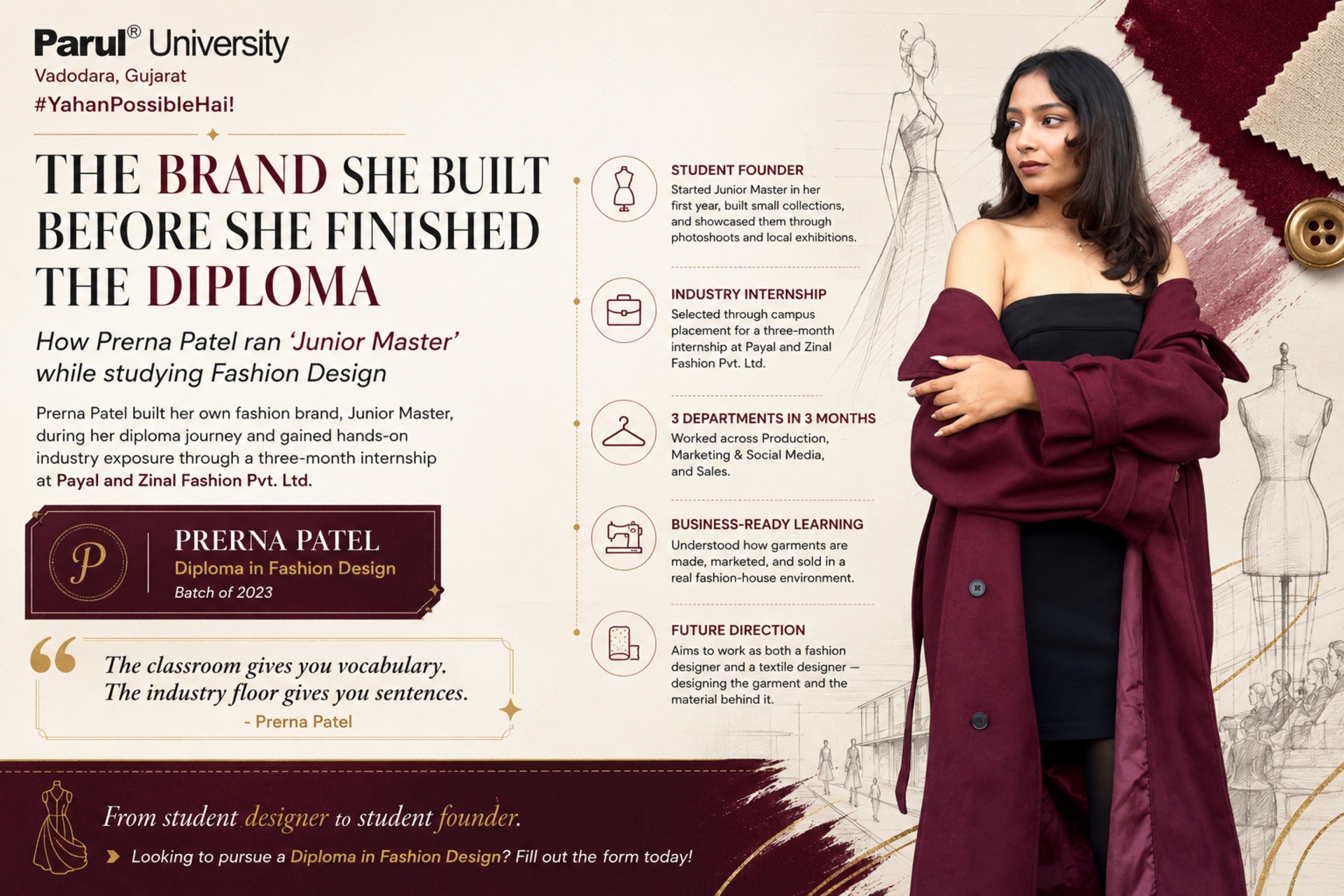
Prernakumari Bharatkumar Patel started a fashion brand in the first year of her diploma. It was not an assignment or a university project. She created a small collection, arranged a photo shoot, shared it online, and then took it to local exhibitions where people could experience the brand in person. Three years later, Junior Master remains small, but it has grown significantly from where it began, developing alongside everything else she was learning at Parul Institute of Design.
Junior Master is the part of Prerna’s story that does not appear in a placement record, yet it explains where she is headed. Alongside her brand, a three-month internship at Payal and Zinal Fashion Pvt. Ltd. gave her practical exposure inside a fashion house across three departments. Together, the brand and the internship helped her understand different domains of fashion, including how garments are produced at scale, how they reach the market, and how a business operates from the backend.
Payal and Zinal: Three Departments in Three Months
The internship came through Parul University’s Training and Placement Cell, a campus-arranged opportunity that involved a formal interview process. Prerna was selected along with two other students, and over three months she rotated through three departments, spending approximately one month in each. She spent the majority of her time in production.
- Production: In the production department, Prerna’s role extended far beyond a single job responsibility. She spent her days quality-checking videos and assessing fabrics before they reached the cutting table, ensuring that nothing substandard moved forward. She packed finished garments herself, took client measurements manually, and by the end of May had also taken responsibility for financial coordination within the production unit.
- Marketing and Social Media: The department Prerna initially expected to matter least to her ended up changing her perspective. She realised that marketing acts as the bridge between what a brand creates and the people who need to discover it. She even appeared on camera as one of the faces of Payal and Zinal’s Valentine’s and Galentine’s promotional campaign reel, experiencing a different kind of confidence that required multiple retakes and a new form of creative expression.
- Sales: The sales department introduced her to the customer-facing side of fashion, where a finished garment reaches the person willing to purchase it and where a brand must communicate its value effectively.
Her own summary of the internship captures its value clearly: the classroom gives you vocabulary, while the industry floor gives you sentences. Sketching, research, and technical foundations came from the diploma. Understanding how a fashion house operates every day, including marketing, financial coordination, and responding to real design briefs, came only from being present on the floor.
Junior Master: A Brand Built In Parallel With A Diploma
At the start of the diploma, Prerna decided to build something of her own. Her family supported her decision, understanding that if she was entering the field, she could begin a business, take a small step, and allow it to grow into bigger opportunities. She created a small collection, organised a photoshoot, and shared it without a marketing team or platform strategy, relying only on the willingness to present her work.
Exhibitions came next. She signed up to showcase her collections at local exhibitions where people could experience the brand in person, and her name began to reach more people. Junior Master grew alongside the three years she spent developing her technical skills. Every technique she learned, every fashion show she volunteered at, and every garment she quality-checked at Payal and Zinal contributed back to the brand and the designer she was becoming.
A student managing a working brand while completing a diploma follows both the placement path and the entrepreneurship path simultaneously. This reflects the approach Parul University aims to develop: a business-ready mindset that allows students to create their own opportunities while also building professional careers. The entrepreneurship ecosystem supporting this vision includes PIERC, the Parul Innovation and Entrepreneurship Research Centre, which has supported 254 startups whose ventures collectively contribute over Rs 40 crore in revenue and more than Rs 20 crore in drawn funding, with Startup Studios across Vadodara, Surat, Ahmedabad, and Rajkot. For students like Prerna who aspire to become entrepreneurs, Parul University provides an ecosystem that encourages innovation and venture creation. This culture is also reflected in the journeys of other student founders featured through the Young Entrepreneurs Summit.
The Ambition: Designing The Fabric, Not Just The Garment
Prerna’s five-year plan is more ambitious than becoming a fashion designer in the conventional sense. She wants to design both the garment and the material it is made from, working as a textile designer as well as a fashion designer across the entire value chain rather than stopping at the final stitch.
Most designers do not enter the field intending to work with the fabric itself. Prerna has already begun moving in that direction.
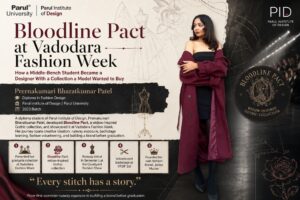
Junior Master was already running. Bloodline Pact had walked at Vadodara Fashion Week. The internship at Payal and Zinal was underway. Each experience has pushed her toward the same integrated vision: not just creating garments, but understanding and shaping the materials from which those garments are built.
The Advice That Changed A Friend's Course
When asked what she would tell a first-semester student who loves fashion but cannot imagine a career in it, Prerna shared a real experience from her own journey. A friend of hers was studying interior design but had a strong passion for fashion and was, at that time, even better than Prerna at sketching, styling, and mandala work. However, she had chosen interior design because her family believed fashion had limited scope and fewer opportunities compared to a field connected with architecture and construction.
The friend’s parents later visited the campus and asked Prerna directly about the career possibilities in fashion. Her response was informational rather than motivational. She explained that fashion includes far more areas than many people realise: textile design, fabric development, production management, retail, brand building, styling, content creation, costume design, and several other career paths.
The friend eventually moved from interior design to fashion. The lesson Prerna draws from the experience is relevant for anyone considering the field: the scope of fashion is much larger than a single perspective can reveal, and the real question is not whether a career exists in fashion, but which career path within it is the right fit.
Two Paths From The Same Diploma
Prerna’s three years produced a diploma, a final collection at Vadodara Fashion Week, a three-month internship across three departments of a working fashion house, a first-semester runway experience, a backstage role at VFDF 3.0, an appearance in a brand’s promotional campaign, and a running brand of her own. Placement and entrepreneurship were never competing choices for her. She pursued both paths simultaneously from the same campus.
Prerna’s journey also reflects the opportunities that Parul University creates beyond the classroom. Backed by NAAC A++ accreditation with a CGPA of 3.55, Category 1 status with Graded Autonomy, a place in the QS World University Rankings Asia 2026 (1001–1100 band), a NIRF Top 50 ranking for Innovation, 7th in India and joint 46th worldwide for SDG 4 (Quality Education) in the Times Higher Education Sustainability Impact Rankings 2026, and recognition as the Best University in Placements by ASSOCHAM for three consecutive years, the university continues to provide students with an environment to innovate, gain industry exposure, and pursue entrepreneurial ambitions.
Also read: How Parul Institute of Design Helped Paridhi Kara with Internships.
FAQs
What is Junior Master and how did a student build it during a diploma?
Junior Master is the fashion brand Prernakumari Bharatkumar Patel has run since the start of her first year of the Diploma in Fashion Design at Parul Institute of Design. It was not a course assignment. She began with a small collection, arranged a photo shoot, posted it, and then showcased collections at local exhibitions where people encountered the brand in person and her name began to travel. The brand grew across the same three years she spent building her technical skills, with every semester of learning feeding back into it. This reflects Parul University's stated goal of building a business-ready mindset alongside placement. The entrepreneurship infrastructure supporting student founders includes PIERC, the Parul Innovation and Entrepreneurship Research Centre, which has supported 254 startups collectively drawing over Rs 20 crore in funding and generating over Rs 40 crore in revenue, with Startup Studios across Vadodara, Surat, Ahmedabad, and Rajkot.
What did Prernakumari Patel's internship at Payal and Zinal involve?
Prernakumari Bharatkumar Patel's internship at Payal and Zinal Fashion Pvt. Ltd. came through Parul University's placement cell as a campus-arranged opportunity, with selection by formal interview alongside two other students. Over three months she rotated through three departments. In production, where she spent the most time, she handled quality-checking videos, fabric quality assessment, packing final garments, taking client measurements, and the final financial coordination of the production unit by the end of May. In marketing and social media, she learned that marketing bridges what a brand makes and the people who need to know it exists, and she appeared as an on-camera face in the brand's Valentine's and Galentine's promotional campaign reel. In sales, she gained the customer-facing view of how a garment reaches a paying customer. Her summary: the classroom gives vocabulary, the industry floor gives sentences.
Does a fashion diploma support entrepreneurship as well as placement?
Yes. Prernakumari Bharatkumar Patel's experience at Parul Institute of Design shows both paths running together. She pursued placement-linked opportunities, including a campus-arranged internship at Payal and Zinal, while simultaneously running her own fashion brand, Junior Master, from her first year. Parul University's stated mission extends beyond securing a placement toward building a business-ready mindset that equips students to build their own ventures and scale at their own pace. This is backed by PIERC, the Parul Innovation and Entrepreneurship Research Centre, which has incubated and supported 254 startups that have drawn over Rs 20 crore in funding and generated over Rs 40 crore in revenue, operating Startup Studios across four cities and running the annual Vadodara Startup Festival that connects founders with investors. For a fashion student, this means the option to join an established brand or build an independent label, or, as in Prerna's case, to do both at once.
What career directions exist in fashion beyond becoming a designer?
Fashion offers far more career directions than garment design alone. Based on Prernakumari Bharatkumar Patel's own account, the field includes textile design, fabric development, production management, retail, brand building, styling, content creation, and costume, among others. Her own ambition is to work as both a fashion designer and a textile designer, designing the material as well as the garment, which sits at both ends of the fashion value chain. Her internship at Payal and Zinal also exposed her to production, marketing and social media, and sales as distinct professional tracks within a single fashion house. The Diploma in Fashion Design at Parul Institute of Design, alongside its BDes and Master's programmes, prepares students across this range rather than for garment design alone, and the platforms and internships attached to the programme help students find which direction fits.