
Not every placement story turns on a single dramatic breakthrough. Some are built slowly, out of small decisions made with discipline across four years of real pressure. Yash Machhi belongs firmly to the second category, which is precisely what makes it worth reading.
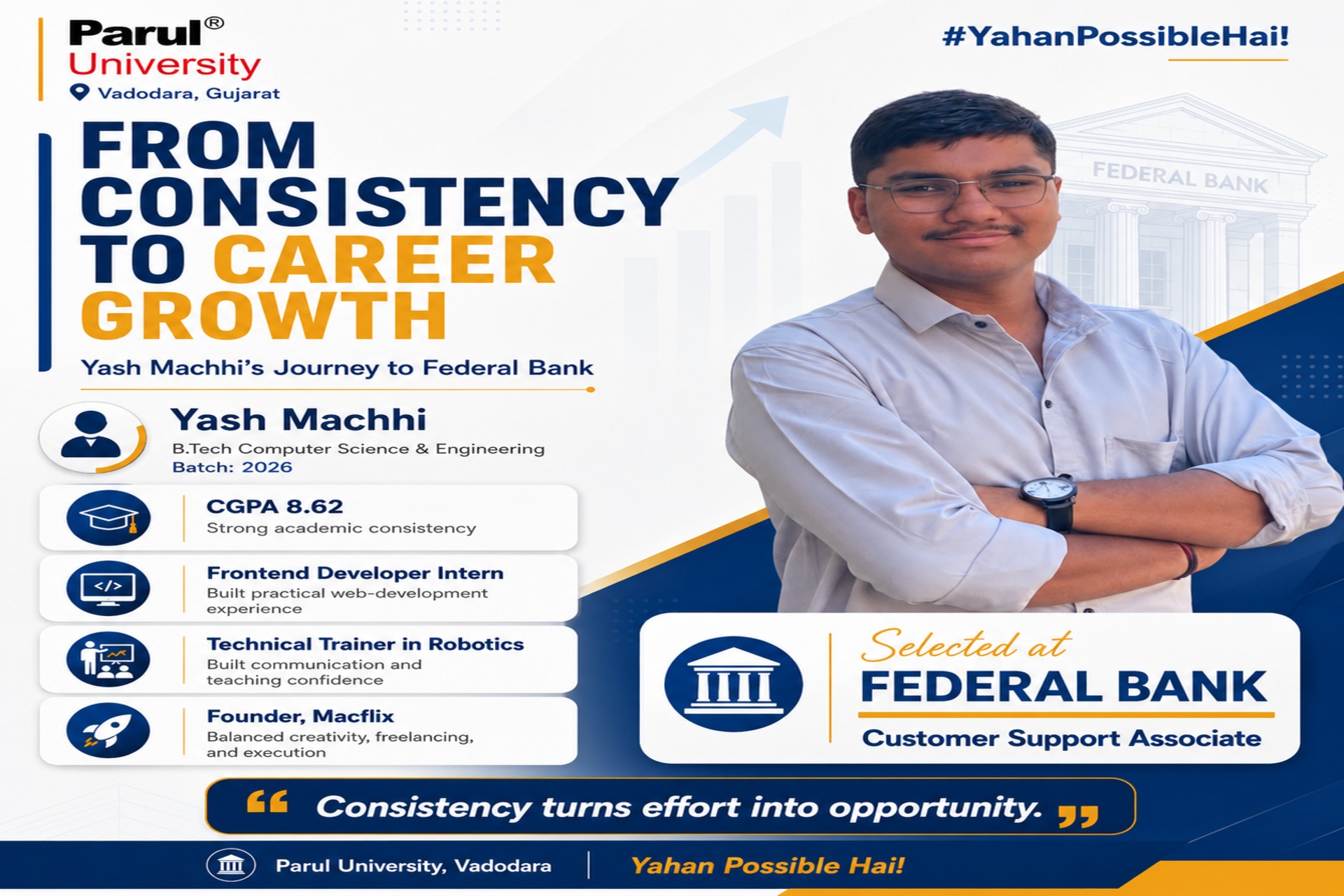
A B.Tech Computer Science and engineering student at Parul University in the batch of 2026, he graduated with a CGPA of 8.62 while working as a frontend developer, a technical trainer, a graphic designer, a video editor, a freelancer, and a business owner. At times all in the same week. He secured a campus placement as a customer support associate at Federal Bank through a three-stage selection process, and arrived at it having already absorbed more of what professional life demands than most students encounter before graduating.
The word he returns to in his own account is consistency. It is the most honest word available. What his four years demonstrate is not exceptional talent aimed in one direction, but sustained effort in several directions at once and the discipline to keep all of them moving.
Who Is Yash Machhi
He arrived with the foundation most first-year engineering students share: some exposure to HTML and C, genuine curiosity, and no clear map of where it led. What set his first year apart was that the exploration was active rather than passive. He moved through CSS, JavaScript, and C++ looking for the thing that belonged to him, and found two.
- Programme: B.Tech Computer Science and Engineering, Batch of 2026, Parul University, Vadodara.
- Academic record: CGPA 8.62, maintained across four years of parallel commitments.
- Placement: Customer Support Associate at Federal Bank, through a three-stage campus process.
- Built alongside: Two internships, a freelance venture called Macflix, and projects including RoboMitra and TechCirculo.
The two things were web development and visual design. Most computer science students anchor to a single lane and treat creative skills as a hobby. He treated graphic design and video editing as parallel technical competencies, which made him capable of delivering a complete product rather than one component of it.
“Alongside coding, I also discovered my passion for graphic designing and video editing, which allowed me to combine creativity with technology.” – Yash Machhi
The First Internship: Learning What Clean Code Means
His first formal test came at VarCode, where he joined as a frontend developer intern after a mentor suggested he apply. He built responsive websites in HTML, CSS, and JavaScript, implemented user-friendly interfaces, and worked inside the standards of a professional development environment for the first time.
“It was the first time I experienced how classroom knowledge could be transformed into real-world solutions.” – Yash Machhi
Clean code is not only a technical standard. It is a professional one. The gap between code that works and code that is clean is the gap between a student solving a problem and a developer handling work. Learning that distinction in a first internship is a genuine advantage, and it is the kind of lesson a campus cannot manufacture in a classroom because it requires real stakes and real feedback.
Teaching Robotics to Schoolchildren, and What It Taught Him
If VarCode showed him what professional development looked like, his internship at RobocodeVeda as a technical trainer taught him something harder to quantify. He worked with students from Classes 6 to 12 across multiple schools, teaching programming, robotics, and logical thinking, running workshops, mentoring individually, and preparing examinations and learning materials.
“Teaching students from Classes 6 to 12 completely changed my perspective.” – Yash Machhi
The change is specific. When you explain a concept to a ten-year-old, you cannot hide behind jargon. You cannot gesture at a principle without explaining it. You cannot move on until the student has genuinely understood, because a student who has not understood cannot do the next thing. That requirement, to explain clearly and completely at a pace another person can follow, is among the highest communication skills a professional environment demands. It is also the one most technical students find hardest, because technical training rewards correctness over clarity.
The deepest form of learning turned out to be teaching. It also turned out to be the placement preparation he never planned.
Macflix: Running a Business While Earning a Degree
A parallel track was developing all along. His interest in design and digital content grew until it became something he could offer commercially, and he founded Macflix, a venture providing graphic design, video editing, websites, and social media solutions to clients.
Calling it a business is accurate but understates what running it during an engineering degree requires. A business means clients. Clients mean deadlines. Deadlines mean the work gets done regardless of whether an assignment is due, or a family commitment has pulled attention elsewhere, or the energy simply is not there.
“Working with clients helped me understand branding, communication, deadlines, and the importance of delivering quality work consistently.” – Yash Machhi
These are the lessons placement programmes try to teach in structured sessions, and they stick hardest when learned under real conditions with real consequences. He was not learning time management in a workshop. He was managing time because the alternative was failing a client who had paid him. He also carried financial pressure through these years, and Macflix was not a project he dabbled in when time allowed. It was, in part, a necessity he turned into a platform for building skills.
The Projects That Built Confidence
Alongside the internships and the venture, he built projects that required applying technical knowledge to problems worth solving, among them RoboMitra and TechCirculo. In a placement profile, projects serve a precise function: a CGPA tells an employer how a student performs in assessments, while a project tells them what the student does with the rest of their time.
“These projects strengthened my confidence and motivated me to continue learning emerging technologies.” – Yash Machhi
Confidence, in a technical context, is not a soft skill. It is the willingness to attempt something without certainty you can finish, and to keep working when the difficulty reveals itself. Students who only tackle problems they can already solve confirm competence they already have. The projects that change a student are the ones that demand more than they currently know.
The Three-Stage Federal Bank Selection Process
The Federal Bank process ran through three rounds, each testing a different dimension of the candidate.
- Online assessment: The entry filter, covering aptitude and technical knowledge, a format he had met often enough to approach with composure.
- Group discussion: The round he names as the most challenging, demanding confidence, clarity, and communication in a competitive room.
- Personal interview: The final round, testing depth and composure under direct questioning.
“Among all the rounds, I found the group discussion to be the most challenging because it required confidence, clarity of thought, and effective communication in a competitive environment.” – Yash Machhi
What carried him through was not practice in group discussions. It was two years of standing in front of classrooms at RobocodeVeda, explaining robotics and programming to students watching him for clarity rather than complexity. Someone who has held the attention of a room of twelve-year-olds does not find a discussion among peers unfamiliar territory.
“My experience as a Technical Trainer had already taught me how to communicate confidently and present my ideas clearly.” – Yash Machhi
This is the clearest example in his journey of how experience compounds. The teaching role had looked, at the time, like a way to gain experience. It turned out to be preparation for the hardest part of the placement process, years before that process existed.
Also Read: How Impact Training Helps Students of Parul University?
How the Training and Placement Cell Fits In
Running behind every phase is the Parul University Training and Placement Cell, which he names precisely: continuous guidance, organised placement drives, and training sessions. Each is more specific than it sounds. Continuous guidance means preparation was not a sprint begun a semester before graduation, so the format of an aptitude test or the depth of a technical interview arrived as something rehearsed rather than a surprise.
Organised placement drives meant companies came to campus. For a student already managing a business, two internships, and financial pressure, the difference between a recruiter arriving on campus and having to find the market independently is not an administrative detail. It is a meaningful reduction in the cost of accessing opportunity.
The mock interviews mattered most directly. A student who has been evaluated in real time in a mock setting arrives at the real interview with a different composure than one who prepared alone. The Federal Bank process ended in a personal interview. The mock sessions were the rehearsal for it.
The Daily Mathematics of Four Years
The most honest line in his account is that balancing everything was never easy. It helps to see what everything meant. College from morning to evening. Then internship responsibilities. Then freelancing work for Macflix. Then project development. Then placement preparation. Then self-study. Alongside family responsibilities and financial pressure.
“Managing multiple responsibilities together required discipline and careful planning. It was hard for me.” – Yash Machhi
A CGPA of 8.62 across that period is not a number produced by favourable conditions. It is a number defended under unfavourable ones. He writes openly about rejections and self-doubt, without naming companies or rounds, because the pattern is universal and only the response matters.
“Every setback became an opportunity to improve instead of a reason to stop.” – Yash Machhi
What Actually Made the Difference
The easy answer is communication, and his own account supports it. The accurate answer is layered. His communication was strong because of two years of teaching. His teaching was strong because he had genuinely internalised the concepts he explained. His technical foundation was strong because he had applied it in real projects and real client work rather than only in coursework. His composure came from mock interviews and from working to real deadlines. His CGPA reflected the discipline holding all of it together.
That is the difference between a candidate who prepares for an interview and a candidate who arrives at one already having become the person the interview is trying to identify.
“Success is not about doing one thing perfectly but about staying consistent even when life becomes demanding.” – Yash Machhi
A Placement Is a Beginning, Not a Destination
Yash Machhi describes the Federal Bank offer as a start rather than an endpoint, and the evidence supports him. Macflix continues. The skills in frontend development, graphic design, video editing, and digital media that he built across four years do not expire because a campus offer arrived. They are the foundation of a professional identity broader and more versatile than any single role can contain.
That is the mindset Parul University aims to build. The stated mission goes beyond securing a role: it is to develop a business-ready outlook that lets a graduate carve their own path and scale at their own pace. Yash embodies both halves of it at once, an employee with an offer letter and a business owner with clients, which is the same pattern seen in other placement journeys across the university. The company name on the offer is the first visible result of a trajectory that was already in motion years earlier.
His message to the students who follow reaches for instruction rather than inspiration. He does not tell them that passion will carry them or that self-belief opens doors. He tells them to start with what they have and keep moving, because the movement is the work.
“Never underestimate the power of consistency. You do not need to know everything from the beginning. Start with whatever knowledge you have, stay curious, keep learning, accept failures as lessons, and continue improving yourself every single day.” – Yash Machhi
Frequently Asked Questions
Who is Yash Machhi?
Yash Machhi is a B.Tech Computer Science and Engineering student at Parul University, Vadodara, from the Batch of 2026, with a CGPA of 8.62. He interned as a frontend developer and a technical trainer, founded a design and digital media venture called Macflix, and was placed as a Customer Support Associate at Federal Bank through campus recruitment.
How can a student balance internships, freelancing, and studies?
Through discipline and prioritisation under real consequences. Yash Machhi attended college through the day, then handled internship responsibilities, freelance client work, project development, placement preparation, and self-study, while maintaining a CGPA of 8.62. He describes it plainly as hard, and credits careful planning rather than easy conditions.
How do you prepare for a group discussion round?
A group discussion tests confidence, clarity of thought, and communication in a competitive setting rather than technical knowledge. Yash Machhi found it the hardest round in the Federal Bank process, and credits two years of teaching programming and robotics to school students for the ability to present ideas clearly under pressure.
What does the Training and Placement Cell at Parul University provide?
It provides continuous guidance across the degree, organises campus placement drives so recruiters come to students, and conducts training sessions including aptitude preparation, resume building, and mock interviews. Yash Machhi credits the mock interview sessions directly for his composure in the Federal Bank personal interview round.
Can you run a business while studying engineering?
Yes, though it demands real discipline. Yash Machhi ran Macflix, offering graphic design, video editing, websites, and social media services to paying clients, throughout his B.Tech at Parul University. He describes learning branding, communication, and deadline management through client work rather than in a classroom.