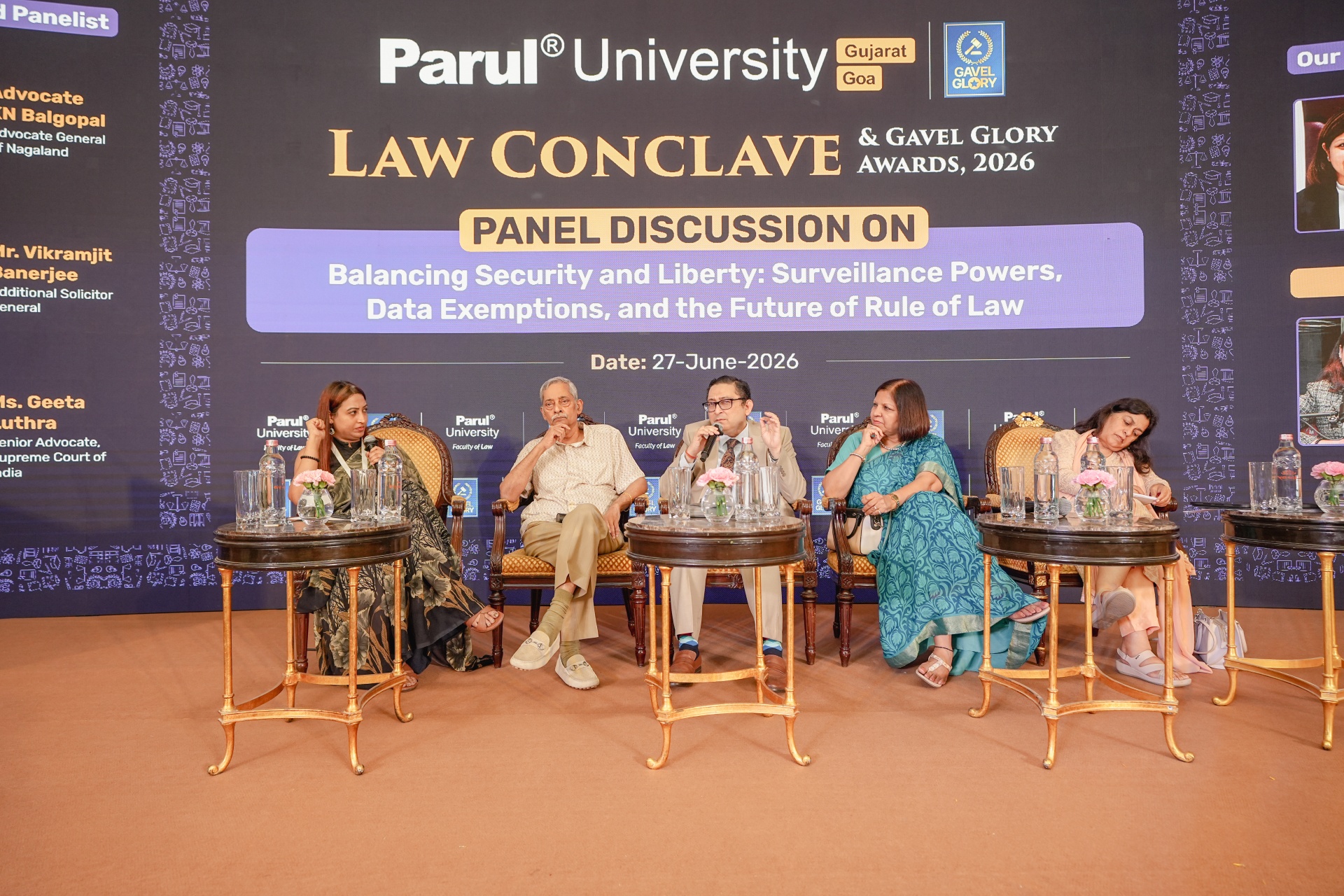

As the discussion started, everyone shared their opinions. Ms. Bhumika Indulia, the Director & Editor-in-Chief of the Bar Bulletin, initiated the discussion that was designed to divide the room. She said – What would Dr B.R. Ambedkar think about facial recognition, AI, surveillance, metadata collection, and digital profiling? What would concern him the most?
The top panellist at Parul University’s PU Law Conclave 2026 reverted their views in 3 different directions. The panel welcomed Mr. Vikramjit Banerjee – Additional Solicitor General of India, Ms. Geeta Luthra – Senior Advocate of the Supreme Court, Mr. K.N. Balgopal – Advocate General of Nagaland, and Ms. Rekha Palli – Former judge of the Delhi High Court.
The Main Question
Mr. K.N. Balgopal answered as a critic of unchecked power. India deploys a great many surveillance technologies, he observed, and most are not yet properly governed by law.
Facial recognition isn’t meant for identifying a face. It purely captures movement, voice, behaviour, and personal details of a digital profile. All the information, such as photographs and other needed details, is gathered at railway stations, bus stands, airports, and many public places. But the real concern is – the difficulty begins after collection, not during the collection!
He talked about a specific worry. Authorities may accumulate information about an individual over years rather than acting on it, building a large digital record that can later be deployed against that person. Where such power operates without checks, it can reach political belief and democratic participation. Data, in his framing, is merely fact. The harm lies in its use.
Mr Vikramjit Banerjee took the opposite view. He suggested that he would likely have regarded technology positively rather than fearfully, because he believed constitutional and social progress came through modern ideas and scientific advances.
Here, the concerning question is whether to reject AI & Surveillance or how to use them for the benefit of the citizens? On the technology front, he argued that it’s neither constitutional nor unconstitutional. Each government requires power for law & order, criminal investigation, national security, and public services. They all must operate under legality & accountability. He denied that the intention of privacy & security are core opposites. He said, citizens want sheer protection from terrorism, fraud and cyberattacks. The real task is not to choose but to enact laws to balance.
“Data is merely fact. The constitutional harm lies in what is done with it, and by whom, and unchecked.”
The Puttaswamy Test and Its Limits!
Ms. Geeta Luthra grounded the discussion in doctrine. The Supreme Court’s judgment in Justice K.S. Puttaswamy established privacy as an essential part of the right to life and personal liberty under Article 21. But she was careful about what that judgment does not do. It does not bar the state from collecting or using personal information. It requires that where the state affects privacy, it must act under proper law, for a valid purpose, and no further than necessary.
That triad, legality, necessity, and proportionality, recurred through every answer on the panel, from all three speakers. It is the operative test, and the disagreement was never about the test itself. It was about whether India currently satisfies it.
Ms. Geeta Luthra also observed how the content of privacy has changed. It once meant physical documents and private correspondence. It now encompasses online messages, digital identity, bank transactions, location data, and behavioural patterns. Technology gathers such material at a scale and speed that law struggles to match, which places a corresponding weight on the courts.
PU Law Conclave 2026 – Bhumika Induliya’s experience on LinkedIn!
The Exemptions Fight!
The panel then turned to the provision that most troubles privacy lawyers: the exemptions available to government agencies under the Digital Personal Data Protection Act, 2023, administered within the framework of the Ministry of Electronics and Information Technology.
Mr. Vikramjit Banerjee argued that exemptions are not inherently unconstitutional. Every democracy grants the government limited powers to protect national security, public order, defence, and sovereignty. Fundamental rights admit reasonable restrictions. The question is not whether exemptions exist but whether they satisfy legality, necessity, and proportionality, and whether courts can review their exercise. Where they do, exemptions do not violate the right to privacy. Where powers are used unfairly or excessively, judicial review is available.
Mr. K.N. Balgopal accepted the need for such powers and drew the line elsewhere. Every exemption under the Act, he argued, must be read carefully, because the Constitution exists precisely to protect people from the misuse of governmental power. Citizens should not forfeit privacy merely because technology has made collection easy. Parliament should legislate narrow and clearly defined exemptions, and courts should examine closely whether those powers are exercised properly.
Ms. Geeta Luthra reframed the question. The constitutional issue is not whether the government has exemptions, but whether adequate safeguards exist to prevent their misuse. Every democracy carves out exceptions for national security and law enforcement. Those powers must remain bounded. Independent oversight, judicial review, and transparent procedure are what keep an exemption from becoming a licence.
India in 2047!
The moderator posed a harder hypothetical. If by 2047 every transaction is monitored, every movement traceable, and every digital interaction recorded, would such a future fulfil the constitutional promise of justice, liberty, equality, and dignity, or betray it?
Mr. K.N. Balgopal answered that India’s future should not be measured by how much technology it develops but by how well it protects constitutional values. Strong institutions, independent courts, a fair legal system, and transparent government are the protections. Democracy survives only where people trust that their rights hold as technology grows.
Mr. Vikramjit Banerjee declined the premise that such a future would be unconstitutional in itself. If transactions and communications are digitally recorded, what matters is whether the collection and use of that information is lawful, transparent, bounded, and independently supervised. The Constitution does not instruct the country to halt technology.
It requires technology to operate within democratic limits, and its greatest safeguard is the rule of law: however advanced surveillance becomes, government must act within constitutional bounds, public authorities must answer for their actions, and citizens must have remedies.
Ms. Geeta Luthra warned against letting technology become a democracy’s identity. A country should not be judged by how much information it can extract from its people, but by how well it protects their dignity and freedom while using it. Constitutional values must guide technology, not the reverse. Without transparency, accountability, and judicial scrutiny, even sophisticated technology will not earn public trust.
What Gives Them Hope
Asked what most concerns them and what gives them hope, the panel converged at last. Mr. K.N. Balgopal named the rapid expansion of state power and surveillance tooling as his central worry, and independent courts, active lawyers, and alert citizens as his reassurance. Mr. Vikramjit Banerjee found his hope in the Constitution’s demonstrated capacity to absorb seventy years of social and technological change. Ms. Geeta Luthra argued that the Constitution’s strength lies in its values rather than its age, and placed her hope in law students willing to engage difficult constitutional questions responsibly, a view echoed in the conclave’s panel on AI in arbitration, where senior practitioners insisted that responsibility for technology always rests with the professional who wields it.
PU Law Conclave 2026 – Rajesh Kumar Singh’s post on LinkedIn!
FAQs
Is the right to privacy absolute in India?
No. The Supreme Court in Justice K.S. Puttaswamy recognised privacy as part of the right to life and personal liberty under Article 21, but panellists at Parul University's Law Conclave 2026 emphasised that it is not absolute. State action affecting privacy must satisfy legality, necessity, and proportionality: a proper law, a valid purpose, and no greater intrusion than required.
Are the DPDP Act's government exemptions unconstitutional?
The panel disagreed. The Additional Solicitor General argued that exemptions are not inherently unconstitutional, as every democracy grants limited powers for national security and public order, provided they meet legality, necessity, and proportionality and remain subject to judicial review. Others argued exemptions must be narrowly drafted, with independent oversight and transparency to prevent misuse.
What is the legality, necessity, and proportionality test?
It is the standard for assessing whether state action restricting privacy is constitutional. The restriction must be authorised by a proper law, pursue a legitimate state objective, and go no further than necessary to achieve it. Every speaker on the constitutional panel at Law Conclave 2026 applied this test.
Why is facial recognition a constitutional concern?
Because it does more than identify a face. As the Advocate General of Nagaland explained at the conclave, facial recognition can capture movement, voice, behaviour, and personal detail, building a complete digital profile. Where such data is retained over years without clear rules, it can later be used against an individual, affecting freedom and political participation.