
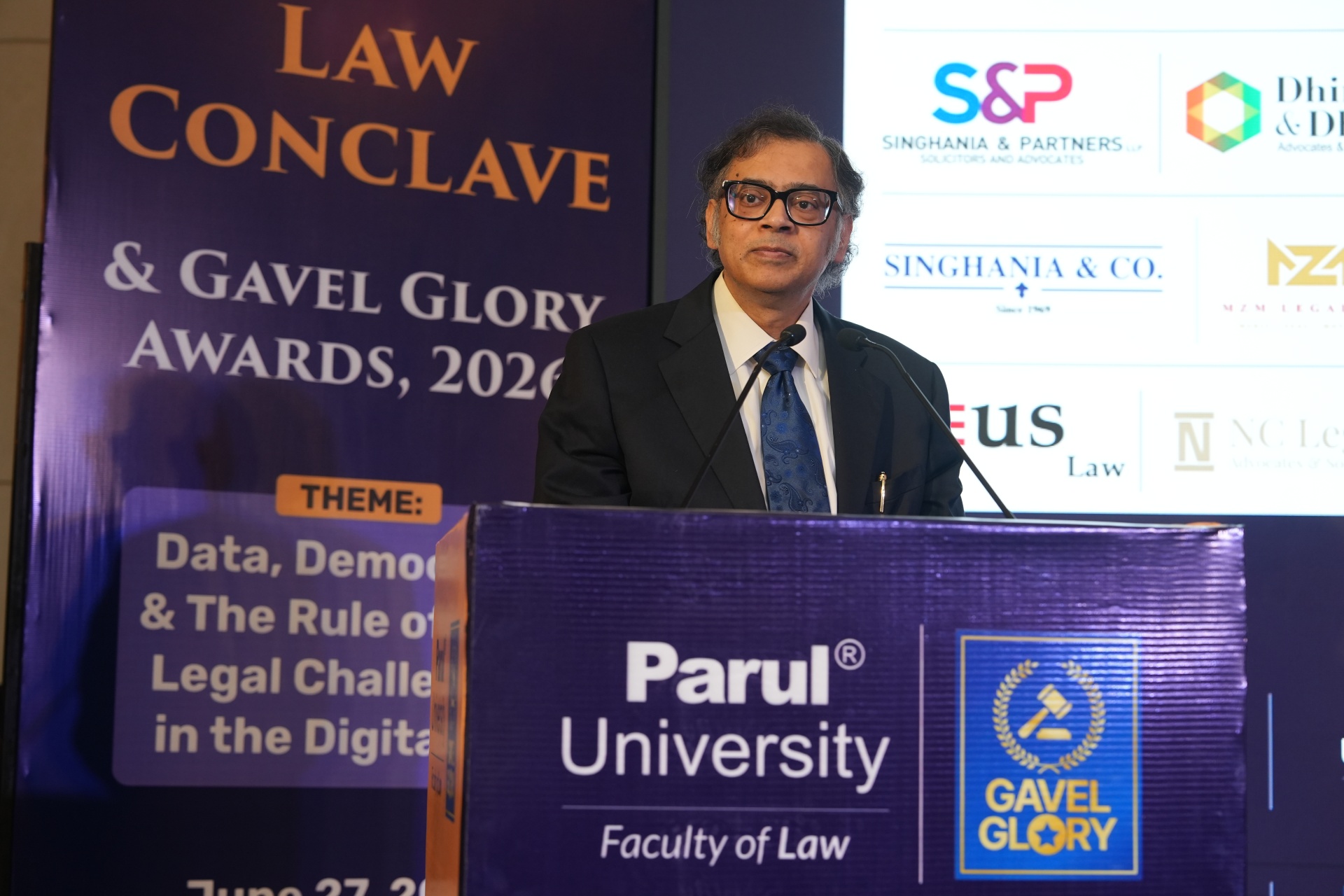
Justice D.N. Ray of the Gujarat High Court began, as good advocates often do, with a definition. The word conclave, he explained, is built from two Latin roots: con, meaning together in a room, and clavis, meaning key. It is the same word used for the process by which a pope is elected. The purpose of a conclave is to join hands in search of the key to problems that appear unresolvable.
Then, taking the podium late in the day at Parul Institute of Law‘s Law Conclave 2026 after several dense sessions, he described himself with some humour as a middle-order batsman joining the game at the eleventh hour, reaching for Kapil Dev and Imran Khan as all-rounders who came in to finish the innings. The lightness did not last.
Six Words From 1968
Stanley Kubrick‘s 1968 film, adapted from Arthur C. Clarke‘s novel, in which a computer named HAL 9000 controls a spacecraft and stops accepting human commands. He recalled the moment the astronaut said: Hal, open the pod bay doors. And the machine does not comply!
Those six words, and everything that follows from them, are the reason a room full of judges and lawyers had assembled to discuss the digital era. A machine had been given authority, and a human being, holding every legal and moral right to command it, discovered that authority does not return simply because it is demanded back. His conviction admitted no ambiguity.
“First and foremost, I think that as human beings on this planet, we must never give up territory. We must not seed territory to artificial intelligence.” – Hon’ble Mr. Justice D.N. Ray, High Court of Gujarat
AI, in his account, is an auxiliary and a tool. It cannot be granted the right to dominate the human will. Nor is it a remedy for human foolishness. A machine cannot correct bad judgment; it can only execute it faster.
The distinction matters because most anxiety about artificial intelligence imagines a machine that wants something. Justice D.N. Ray was warning about something more mundane and more likely: a machine that wants nothing at all, executing faithfully, while the humans who should have been deciding have quietly stopped.
We Borrow the Earth From Our Children
Justice D.N. Ray then made an argument rarely heard in technology law, drawn from environmental jurisprudence. Decisions about computers and technology are intergenerational. They bind people who cannot yet object.
He drew the parallel deliberately. Over the past hundred years, humanity has produced a great many things to increase its comfort, largely oblivious to the environmental damage accumulating alongside. It took global conferences such as the Rio Summit and the Brundtland Commission‘s report Our Common Future to establish the idea of sustainable development, and with it the recognition that each generation borrows the Earth from those who come after.
Privacy works the same way. Once a generation surrenders its right to privacy, and once technology advances on that surrender, no later generation can reverse the decision. Every action must therefore be weighed with care, because the people who will live with the consequences are not in the room to be consulted.
“A transcript records what a witness said. Only a judge can see whether the witness was telling the truth.”
What a Transcript Cannot Capture
Where the law is concerned, Justice D.N. Ray was categorical: AI must be nothing but a servant. He was entirely willing to concede its usefulness. It can help prepare a legal draft, locate a precedent, or offer a suggestion. What he would never do is delegate his cognitive function to a computer or an application.
His illustration was the finest argument of the day, because it was so ordinary. Picture a sessions court, and a witness speaking from the witness box. An AI system can convert every sound that leaves the witness’s mouth into text and produce a transcript admissible as evidence. What the transcript cannot record is human behaviour.
A human judge watches the witness. Only a human judge can observe what happens in that moment and determine whether the person is lying or telling the truth. Empathy and mercy are human faculties, and they shape both how a lawyer pleads and how justice is finally administered. No machine can supply them.
This is the same boundary drawn from another direction by Justice Maulik Jitendra Shelat’s address on AI in the courtroom, which held that AI cannot assess credibility or balance competing constitutional values, and by Senior Advocate Vivek Kohli on the arbitration panel, who argued that AI must function as a slave and never a master.
A Tool, and Nothing More
There is a temptation, when a judge invokes science fiction, to treat the argument as rhetorical decoration. Justice D.N. Ray’s use of HAL was for analytical work. The horror of the scene is not that the machine is malevolent. It is that the machine is doing exactly what it was designed to do, and that its designer’s intentions have become irrelevant to the person now depending on it.
Applied to law, that is a precise description of automated decision-making. A system trained on past cases will reproduce the logic of past cases. It will do so faithfully, at speed, and without any capacity to recognise the case in front of it as the one where the pattern should break. Justice D.N. Ray’s insistence that AI is an auxiliary is therefore not technophobia. It is a claim about what kind of thing a machine is, and what kind of thing a judgment is.
Frankenstein and the Responsibility of Making Things
Justice D.N. Ray closed his argument where technology ethics began: with Mary Shelley‘s novel of 1818, in which Victor Frankenstein creates a monster, and the question arises whether a thing should be made simply because it can be.
He grounded it in the obvious modern case. Humanity built rockets to reach space and uses the same invention to fire missiles across borders. Every invention generates reactions well beyond its intended purpose. With AI and comparable innovations, ordinary people have become laboratory subjects for corporations, supplying information about how an invention is used every time they touch a phone or an operating system. Responsibility for a creation, therefore, cannot end at its creation, because no one knows what it will later be used for. The question Shelley posed in 1818, whether a thing should be made simply because it can be, has not been answered in two centuries, and it is now being asked at a scale she could not have imagined.
His conclusion returned to the human mind. AI cannot comprehend the complexity of human situations in decision-making. It cannot determine when a judge should show compassion. It can hand a judge an old rule or a precedent, which a human mind may deliberately set aside to make the new law a situation demands. When a door is shut in a person’s face, that person looks for another way out of the room. That particular cleverness built and sustained civilisation, and Justice D.N. Ray left the conclave with a single instruction: let us not let technology have what was invented only to serve us. Inspired already? If you’re looking to bring change at the intersection of AI & Law, you must enrol on Parul Institute of Law’s BA LLB, BBA LLB, and LLM programmes.
PU Law Conclave 2026 – Rajesh Kumar Singh’s post on LinkedIn!
FAQs
Who is Justice D.N. Ray?
Justice D.N. Ray is a judge of the High Court of Gujarat. He delivered an address at Parul Institute of Law's Law Conclave 2026, arguing that artificial intelligence must remain a tool and never be permitted to dominate human will.
Why can't AI determine whether a witness is telling the truth?
Because a transcript records words, not behaviour. Justice D.N. Ray explained at Parul University's Law Conclave that an AI system can convert a witness's speech into an admissible transcript, but only a human judge can observe the witness and assess whether they are lying or truthful. Empathy and mercy, he argued, are human faculties that shape justice.
What does it mean that AI should be a servant, not a master?
It means AI should assist with tasks such as drafting, locating precedent, and offering suggestions, while never assuming the cognitive or decision-making function of the human professional. Justice D.N. Ray stated that he would never delegate his cognitive functions to a computer program.
Why are technology decisions described as intergenerational?
Because they bind people who cannot yet object. Justice D.N. Ray compared technology to environmental damage, noting that sustainable development established the principle that each generation borrows the Earth from those who come after. Once a generation surrenders privacy and technology advances upon that surrender, no later generation can reverse the decision.