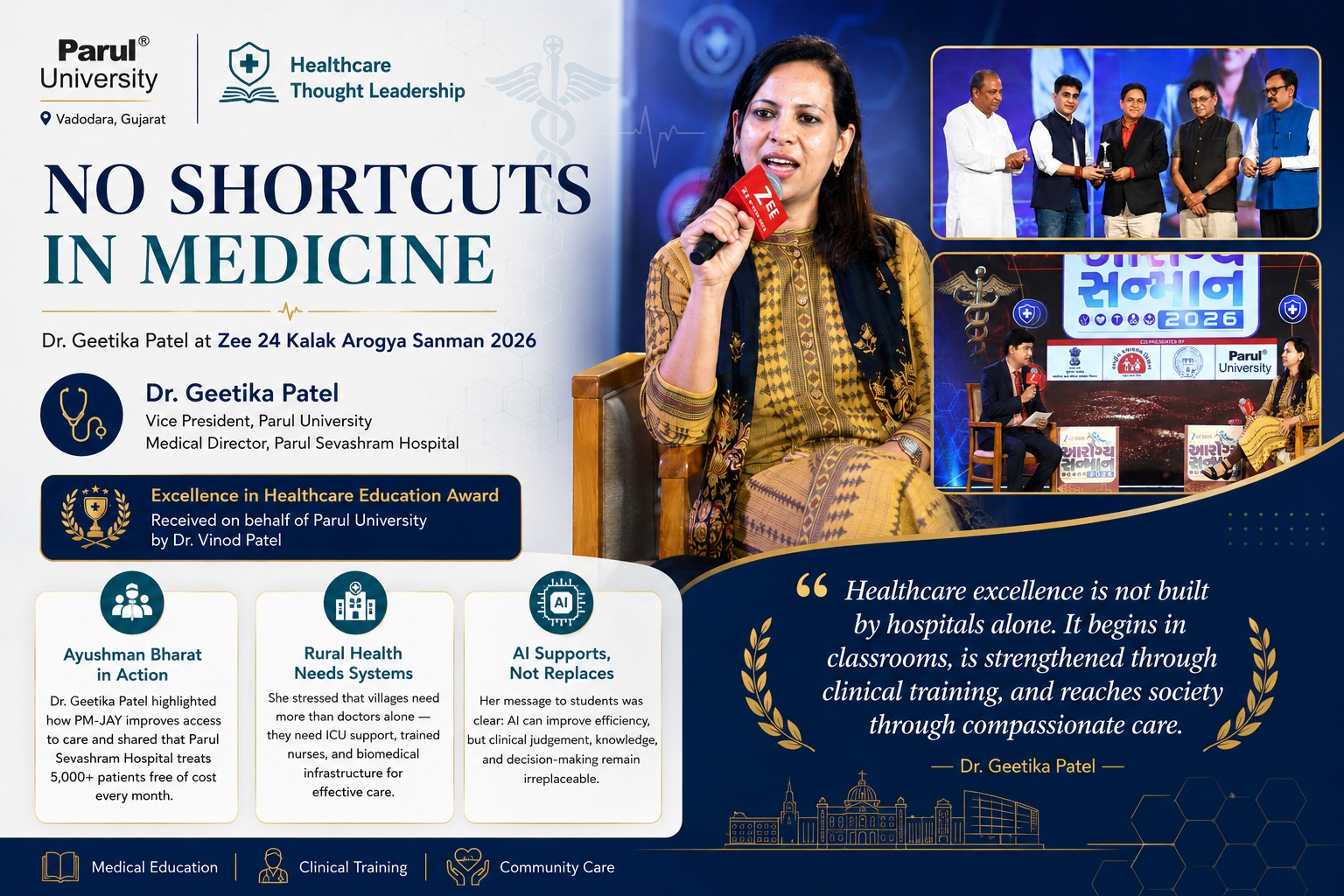
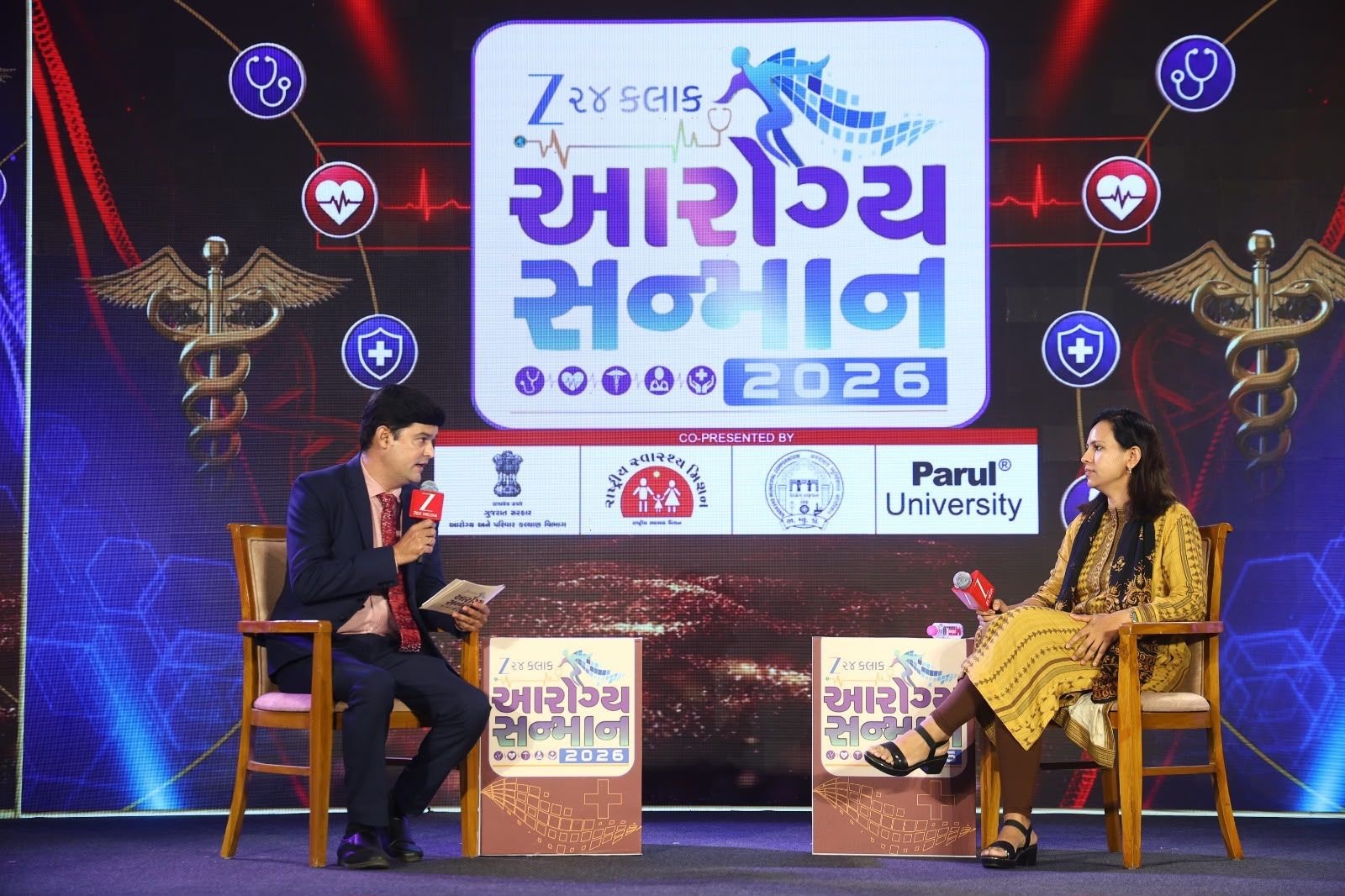
Vice President of Parul University and Medical Director of Parul Sevashram Hospital, Dr. Geetika Madan Patel, appeared as a key panellist on Zee 24 Kalak’s show Arogya Sanman 2026. The discussion ranged from Indian healthcare and health policy to clinical realities, drawing on her experience of both running a hospital and treating patients alongside her administrative responsibilities.
Her address covered the impact of the Ayushman Bharat Scheme, the expansion of medical education seats, the challenges that continue to affect rural healthcare, and the growing role of artificial intelligence in medical education. What connected these themes was a single insistence: that access, prevention, and hard-earned clinical judgement matter more than any shortcut.
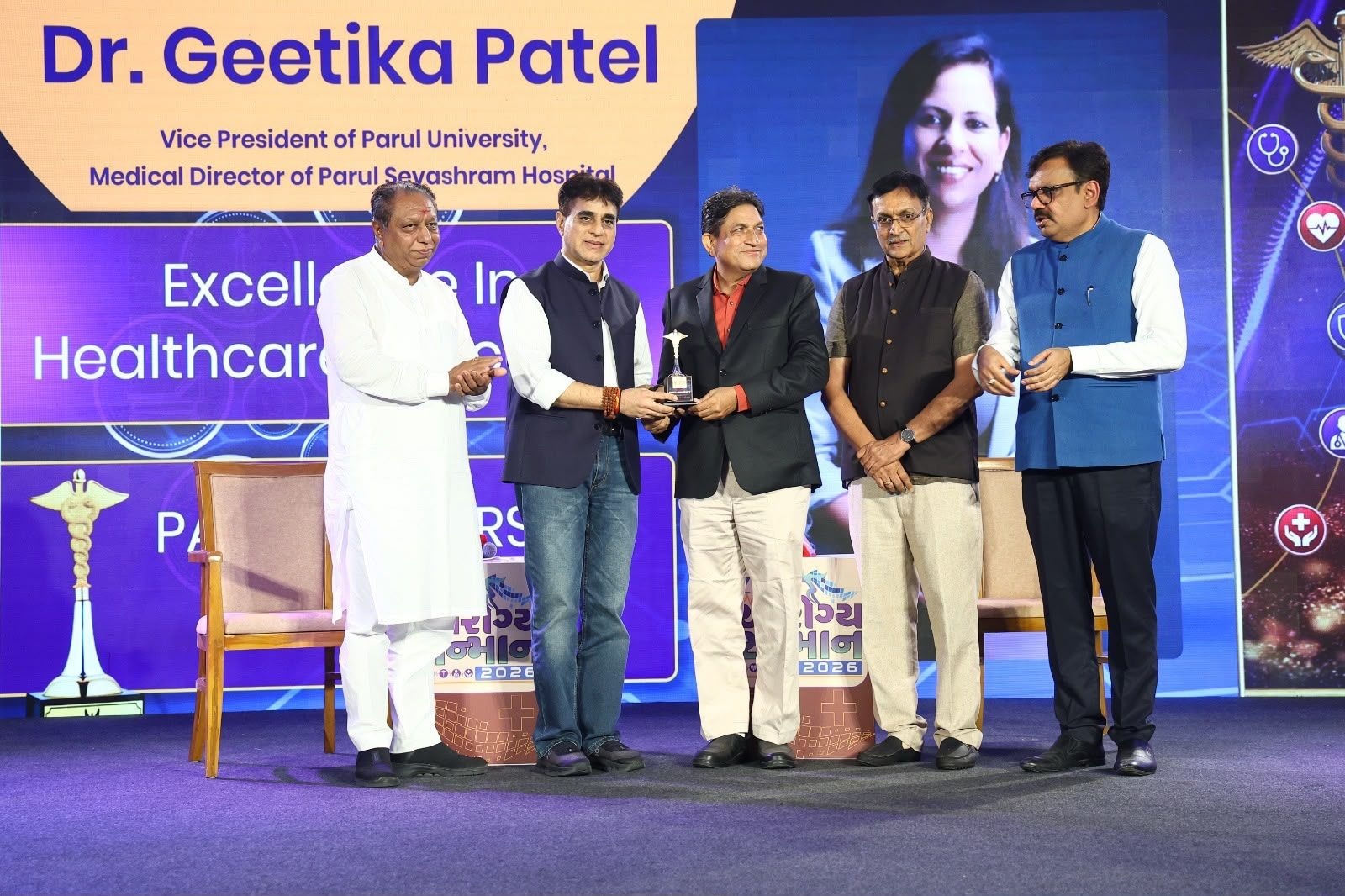
The same event also honoured Parul University with the Excellence in Healthcare Education Award, a recognition discussed in detail below.
The account that follows presents her principal observations as she made them during the panel. The figures are reported as she stated them from the perspective of a medical director.
Parul University Honoured with the Excellence in Healthcare Education Award
The conclave was also the occasion for a recognition. At the Zee 24 Kalak Arogya Sanman 2026, Parul University was honoured with the Excellence in Healthcare Education Award, received on behalf of the university by Dr. Vinod Patel, Member of the Board of Governors.
Dr. Geetika Patel used the platform to explain how Parul University, together with Parul Sevashram Hospital, is building an integrated healthcare ecosystem rather than a collection of separate institutions. Her perspective placed the classroom, the clinic, and the community on a single continuum.
“Healthcare excellence is not built by hospitals alone. It begins in classrooms, is strengthened through clinical training, and reaches society through compassionate care.” – Dr. Geetika Patel
That continuum extends through quality medical education, hands-on clinical exposure, research and innovation, and advanced healthcare infrastructure. The Faculty of Medicine at Parul University, its simulation laboratories, and Parul Sevashram Hospital together reflect the collective work of faculty members, healthcare professionals, researchers, and students in advancing both medical education and patient care.
She described the responsibility that accompanies such recognition as extending beyond education alone: to nurture compassionate healthcare leaders who can transform lives, strengthen communities, and respond to the changing needs of healthcare.
Also Read: Dr. Komal Patel of Parul University Honoured at Mahasamman 2026.
The Largest Healthcare Scheme: Ayushman Bharat
As the session proceeded, Dr. Geetika Madan Patel discussed the Ayushman Bharat Pradhan Mantri Jan Arogya Yojana (PM-JAY) as one of the world’s largest public health insurance schemes, covering nearly 40% of India’s population, approximately 50 crore people. The scheme is administered by the National Health Authority, whose official PM-JAY portal she recommended for checking eligibility and locating empanelled hospitals.
To illustrate what that coverage means in practice, she recounted a case from Parul Sevashram Hospital.
“A child born in Parul Sevashram Hospital after five to six IVF attempts had a heart problem. The cost of surgery in private hospitals was impossible for middle-class parents to afford, and there was a long waiting list in the government hospital. Under PM-JAY, the child’s complex surgery was performed completely free of cost, and he recovered well and went home in good health. At Parul Sevashram Hospital, we treat more than 5,000 patients free of cost every month, which includes such critical cases.” – Dr. Geetika Patel
She also addressed a common concern: why a beneficiary’s PM-JAY card does not always work at every private hospital. The reason, she explained, is that empanelment under the scheme is voluntary. Hospitals choose whether to participate, and many smaller hospitals register only for selected treatments. Her practical advice followed from this.
- Check before you travel: If you plan to seek treatment away from home, use the official PM-JAY portal or helpline to confirm whether a hospital is empanelled and which treatments it provides before visiting.
- Look for the mandatory board: Every empanelled hospital is required to display a PM-JAY information board at its entrance.
Empanelment is voluntary. Knowing which hospital covers which treatment is the difference between a card that works and one that does not.
Dr. Geetika Patel on the Doctor Gap Between India's Cities and Its Villages
Dr. Geetika Patel then turned to the geographical inequality in the distribution of doctors across India. She referred to the World Health Organization benchmark of one doctor for every 1,000 people and noted that India’s national average has improved to approximately one doctor for every 800 to 900 people, bringing it close to that benchmark. The national average, she argued, conceals the real challenge.
She illustrated the disparity by comparing urban and rural areas. In many cities, there is roughly one doctor for every 300 people, whereas in several rural regions the ratio can be as high as one doctor for nearly 12,000 people. The problem, she said, is not the national average but the unequal distribution of healthcare professionals.
Her solution extended beyond simply posting more doctors to villages. In rural healthcare, she argued, the presence of a doctor alone is not enough. What is required is an entire healthcare ecosystem that enables effective treatment.
- Intensive care capacity: ICU beds and ventilators so that critically ill patients can receive treatment closer to home.
- Technical staff: Biomedical engineers to install, maintain, and service medical equipment.
- Nursing staff: Skilled nursing professionals who provide the clinical support essential for effective patient care.
She also encouraged the private healthcare sector to expand into tier-3 and tier-4 cities instead of concentrating primarily in metropolitan centres, so that specialist medical services become accessible to communities that currently travel the farthest for treatment.
Why Rising Cardiac Arrests Among Young Indians Worry a Medical Director
Dr. Geetika Patel expressed concern over the rising incidence of cardiac arrests and heart attacks among young people. These events, she stressed, are rarely as sudden as they appear. The body often gives warning signs well in advance, and the greater danger lies in ignoring them.
“We spend thousands of rupees at the salon to take care of our outer appearance, but we do not go to the hospital for preventive health check-ups.” – Dr. Geetika Patel
From that observation, she advanced a broader policy argument. Health insurance and schemes such as Ayushman Bharat currently cover predominantly post-admission medical expenses. If annual preventive health check-ups for families were also included within such coverage, she argued, more people would undergo regular screening. This would increase the likelihood of detecting chronic conditions, including cancer, at an early stage when treatment is more effective. Better preventive care, she suggested, would improve health outcomes while reducing the long-term financial burden on both families and the public healthcare system.
Heart attacks in the young are seldom sudden. The warning signs often come early; the preventive check-ups do not.
The Danger of Diagnosing Yourself With Google and AI
With smartphones, easy internet access, and the growing use of artificial intelligence, many people have begun relying on online tools for self-diagnosis instead of consulting a doctor. Dr. Geetika Patel cautioned against this practice, noting that people increasingly use such platforms not only to identify illnesses but also to decide which medicines to purchase without professional medical advice.
She illustrated the problem with a simple example. A search for a headache may generate dozens of possible explanations, ranging from the common cold and migraine to a brain tumour. Without clinical context, such information can be misleading rather than helpful.
She explained that AI tools and online symptom checkers can only respond to the information they are given. When a patient provides incomplete details or describes symptoms inaccurately, the response is shaped by that incomplete input. Two risks then arise: unnecessary anxiety caused by serious but unlikely possibilities, or the opposite, dismissing a genuine medical condition as something minor.
Dr. Patel also pointed out that these tools themselves generally include a disclaimer advising users to consult a qualified physician. She encouraged people to pay attention to those warnings and avoid self-medication based solely on online information.
The tool can help inform a conversation with a physician; it cannot replace a medical diagnosis.
Discussion on Should Indian Students Study MBBS Abroad?
When asked why many Indian students choose to pursue an MBBS degree abroad, Dr. Geetika Madan Patel identified two primary reasons and one important consequence that students and families often underestimate.
Merit and NEET: In India, admission to MBBS programmes is based on merit through the NEET examination. Students who are unable to secure a medical seat through this process often explore opportunities to study abroad.
Cost of medical education: Pursuing an MBBS in countries such as Russia, Ukraine, or China may cost less than studying at many private medical colleges in India.
She also explained what follows after obtaining a foreign medical degree. Graduates who wish to practise medicine in India must qualify the licensing requirements prescribed by the National Medical Commission, including the Foreign Medical Graduate Examination (FMGE) or the National Exit Test (NExT), as applicable, and complete the required internship in India.
She further observed that medical training often extends beyond the basic MBBS degree. Many doctors pursue postgraduate specialisation and super-specialisation before entering independent practice, meaning the journey from admission to practising as a specialist can extend to eight to ten years.
Her point was not to discourage students from studying medicine abroad but to encourage families to consider the complete pathway before making that decision. The lower tuition cost of a foreign medical degree should be weighed alongside the licensing examinations, internship requirements, and the time needed before practising medicine in India.
Use AI to Increase Efficiency; It Does Not Replace Intelligence
Dr. Geetika Patel concluded with a message directed at medical students, bringing together her earlier observations on shortcuts, self-diagnosis, and the importance of clinical judgement.
“There is no such thing as a shortcut, especially in the medical field. When you have a patient in the ICU or emergency room, fighting between life and death, you will not have time to open an AI tool or a search engine. At that critical point, your knowledge and decision-making power, gained through five and a half to eight years of hard work, will save the patient’s life. AI is there to increase your efficiency, not to replace your intelligence.” – Dr. Geetika Patel
It was a fitting conclusion to the discussion. Public healthcare schemes such as Ayushman Bharat expand access to medical treatment, equitable distribution of doctors and healthcare infrastructure determines who receives timely care, and preventive healthcare reduces the need for emergency intervention in the first place. Yet when a patient reaches the ICU or emergency room, none of these can replace the judgement of a well-trained clinician. That, she argued, remains the one capability that cannot be searched for or automated.
Frequently Asked Questions
Can We Use Ayushman Bharat to cover private hospital treatment?
Dr. Geetika Madan Patel at the Zee 24 Kalak's show Arogya Sanman 2026 shared that the Ayushman Bharat Card can be used for selective private hospital treatments, not for all. Empanelment under PM-JAY is voluntary, so hospitals choose whether to join, and some register only for certain treatments. Patients should confirm a hospital's empanelment and covered treatments on the official PM-JAY portal or helpline before travelling and look for the scheme board that empanelled hospitals must display at the entrance.
What is the ratio of doctors to the population in India?
Dr. Geetika Patel at the conclave gave stats from the WHO norm of one doctor per 1000 people and said India's national average had reached roughly one per 800 to 900. She said that by her account many cities have one doctor per 300 people, while some villages get to one doctor fer 12,000 patients, which shows a sharp inequality and shortage.
Is it safe to diagnose yourself using AI or Google?
Dr. Geetika Patel advised against it. She noted that asking an AI tool about a symptom such as a headache can return everything from a common cold to a brain tumour and that incomplete information produces misleading answers, leaving patients either frightened or falsely reassured. AI tools carry disclaimers advising users to consult a doctor. They can support a conversation with a physician but cannot replace a proper diagnosis and prescription.
Is studying MBBS abroad worth it for Indian students?
Dr. Geetika Patel noted that students who do not secure a domestic seat through NEET often go abroad and that an MBBS in countries such as Russia, Ukraine or China can cost less than an Indian private college. She cautioned about the timeline: a foreign graduate must clear a licensing examination such as the FMGE or the National Exit Test, both under the National Medical Commission, and complete an internship in India, which can extend a five-and-a-half-year course to eight or ten years before independent practice.
Who is Dr. Geetika Patel?
Dr. Geetika Madan Patel is the Vice President of Parul University and the Medical Director of Parul Sevashram Hospital. A leader in education and healthcare, she speaks on health policy and medical education and was a key panellist at the Zee 24 Kalak Arogya Sanman 2026, where she addressed Ayushman Bharat, rural healthcare, preventive medicine and the role of AI.
Did Parul University receive an award at the Zee 24 Kalak Arogya Sanman 2026?
Yes. Parul University was honoured with the Excellence in Healthcare Education award at the Zee 24 Kalak Arogya Sanman 2026. The award was received on behalf of the university by Dr. Vinod Patel, Member of the Board of Governors, and recognises the university's integrated approach to healthcare across medical education, clinical training, research and patient care alongside Parul Sevashram Hospital.


