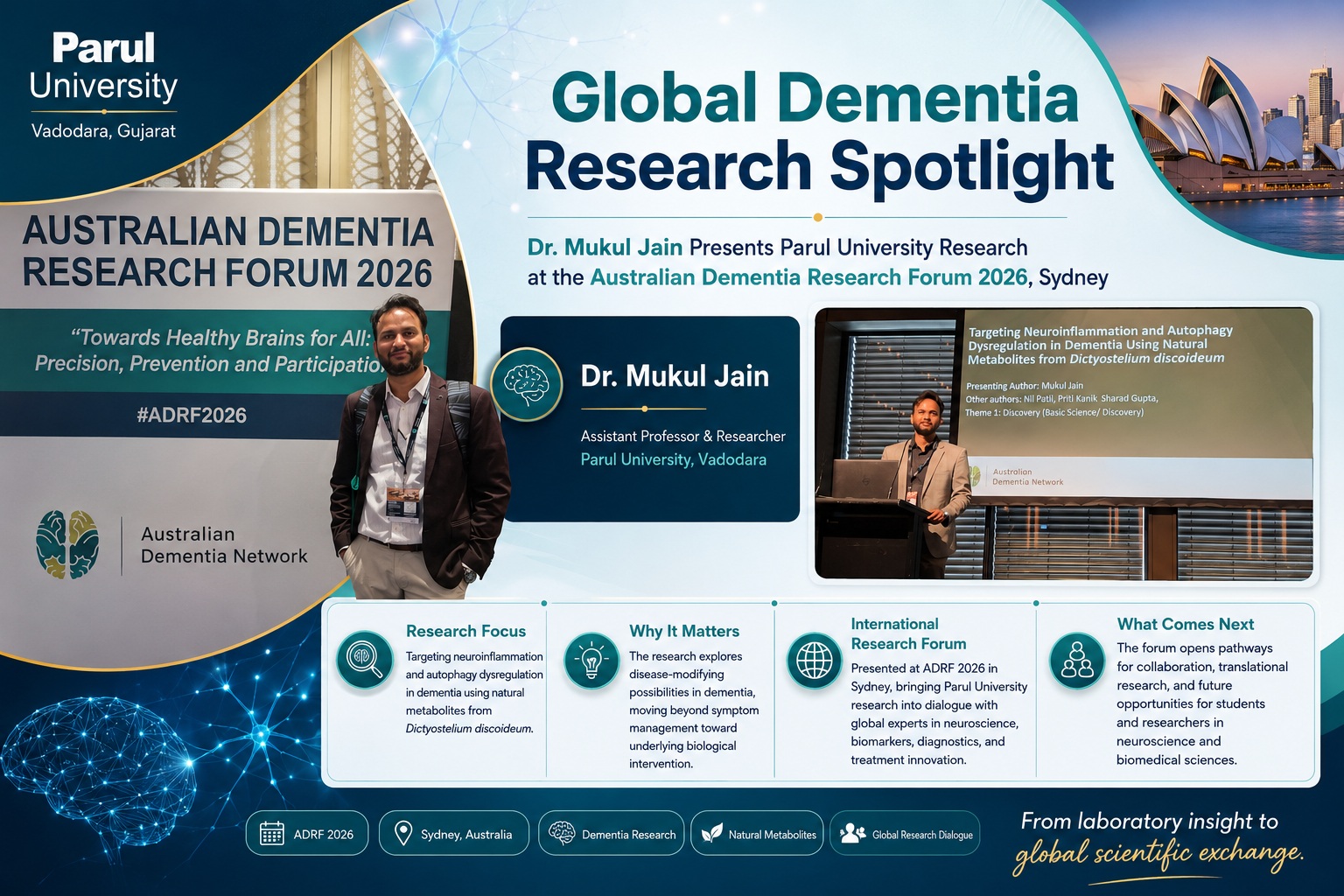
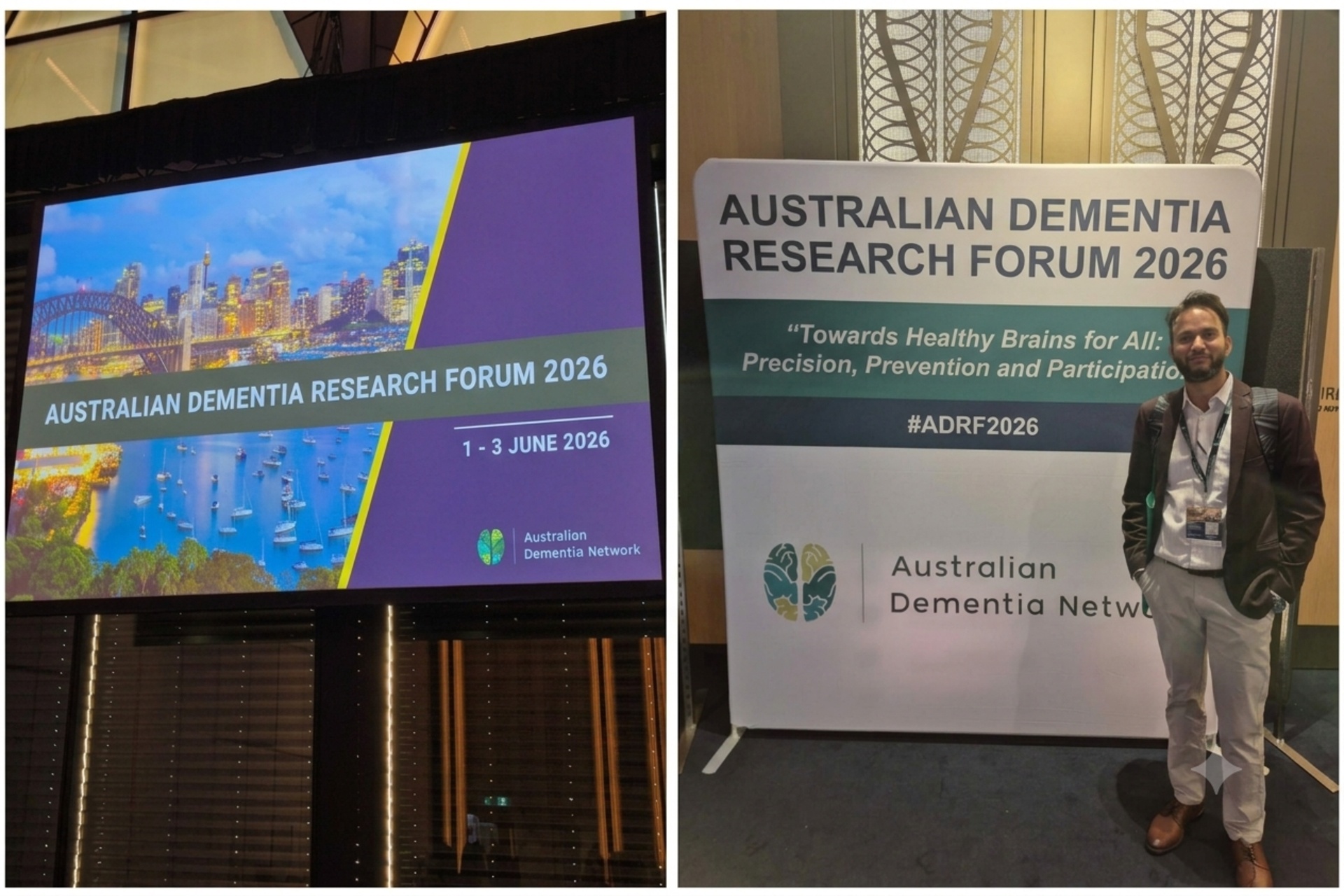
Most dementia drugs available today do one thing: they temporarily relieve symptoms. None can stop or reverse the progression of the disease. That gap, between managing dementia and modifying its course, is the challenge Dr. Mukul Jain has spent nearly five years investigating. In June 2026, that work took him to Sydney, where he represented Parul University at the Australian Dementia Research Forum 2026, held from 1st to 3rd June. There, he presented research on an unexpected source of potential therapeutic compounds: natural metabolites derived from Dictyostelium discoideum, a soil-dwelling amoeba.
Dr. Mukul Jain, Assistant Professor and Researcher at Parul University, presented his findings before neuroscientists, clinicians, biomarker specialists, and dementia researchers from across the Asia-Pacific region, placing the university’s research on an international scientific platform. The title of his presentation was Targeting Neuroinflammation and Autophagy Dysregulation in Dementia Using Natural Metabolites from Dictyostelium discoideum. The ambition behind the research, however, extends beyond a single study toward developing new therapeutic approaches for neurodegenerative diseases.
This presentation forms part of Parul University’s broader research ecosystem. The university’s research community includes seven scientists recognised among the Stanford-Elsevier global top 2% of researchers. Related work in natural compounds, nanomedicine, and advanced biomedical research is also carried out through the university’s research centres, including the Parul University research ecosystem.
Why dementia is such a hard problem to solve
Dementia is not a single disease but a group of conditions caused by damage to brain cells that progressively affects memory, reasoning, communication, and the ability to perform everyday activities. As brain cells lose their ability to communicate effectively, patients may experience memory loss, confusion, language difficulties, impaired judgement, and changes in behaviour.
The condition presents an increasing public health challenge because it often leaves patients dependent on long-term care. As life expectancy rises across the world, the number of people living with dementia continues to grow, placing greater pressure on healthcare systems. The burden is particularly significant in developing countries, where many rural regions lack specialist neurologists, advanced diagnostic technologies, and the healthcare infrastructure required for early detection and management. In India, for example, access to imaging technologies such as MRI and PET scans remains limited in many underserved areas.
It is against this backdrop that Dr. Mukul Jain’s research becomes relevant. His work addresses the urgency created by three converging realities: the growing prevalence of dementia, an ageing global population, and the current limitations of available treatments, which largely manage symptoms without altering the underlying progression of the disease.
The idea: two broken biological processes, one unusual source
Dr. Mukul Jain‘s research focuses on two biological processes that become disrupted in dementia. Understanding these mechanisms helps explain why his work differs from conventional treatments, which primarily aim to relieve symptoms rather than alter the underlying disease.
- Neuroinflammation: Inflammation in the brain is normally a protective response that helps defend against infection and injury. With ageing and disease, however, this response can become chronic. Persistent neuroinflammation damages neurons, accelerates cognitive decline, and contributes to the progression of dementia. Dr. Jain’s research aims to identify compounds that can regulate this abnormal inflammatory response rather than merely treat its consequences.
- Autophagy dysregulation: Autophagy is the natural cellular process that removes damaged proteins and dysfunctional cell components, helping maintain healthy neurons. When this process becomes impaired, toxic proteins accumulate within brain cells, a defining feature of many neurodegenerative disorders. Restoring normal autophagy may help neurons clear these harmful deposits and improve cellular health.
The distinctive aspect of Dr. Jain’s work lies in where he searches for potential therapeutic compounds. Dictyostelium discoideum is a soil-dwelling social amoeba widely used as a model organism in cell biology because of the insights it provides into cellular communication and development. The natural metabolites produced by this organism have shown potential, in Dr. Jain’s research, to reduce harmful neuroinflammation, support neuronal survival, and restore cellular balance within the brain. The project represents an interdisciplinary approach at the intersection of natural-products chemistry, cellular biology, and modern neuroscience.
Why natural metabolites, and why this matters for drug discovery
Naturally occurring molecules have a long history as sources of therapeutic compounds, and scientists continue to study them for two reasons: the sheer diversity of their biological activity and the safety profile that many natural molecules offer. Dr. Jain’s work fits this tradition while pointing it at one of the hardest targets in medicine. The metabolites he studies are being examined for their capacity to intervene in the inflammation and autophagy pathways that drive neurodegeneration, rather than merely masking the symptoms those pathways produce.
The distinction between disease-modifying and symptom-managing therapy is the whole point. A symptom-managing drug can make a patient’s day better without changing where the disease is heading. A disease-modifying therapy aims to slow, halt, or alter the progression itself. There are currently no disease-modifying drugs for dementia in routine clinical use, which is precisely why work targeting the underlying biological mechanisms, however early-stage, matters. Dr. Jain is candid that more research is needed, but the direction, natural metabolites acting on defined molecular pathways, is one of the more promising frontiers in the field.
From JNU to Five Years of Work: The Research Journey
The foundation of Dr. Mukul Jain’s research was laid during his doctoral studies at the Jawaharlal Nehru University (JNU), where he began investigating the biological mechanisms and biomedical applications that would ultimately lead him to study Dictyostelium discoideum and its natural metabolites. Over nearly five years, he developed this research into a body of work aimed at exploring potential therapeutic strategies for dementia.
The project draws upon multiple scientific disciplines, including neuroscience, molecular biology, pharmacology, and therapeutic development. Bringing these fields together enabled Dr. Jain to study dementia from several complementary perspectives rather than through a single disciplinary lens.
The journey to presenting at the Australian Dementia Research Forum was marked by the challenges common to long-term scientific research. Failed experiments, methodological refinements, funding constraints, and limited resources each demanded careful analysis, persistence, and repeated iteration. Those years of sustained work ultimately culminated in findings that were presented to the international dementia research community in Sydney.
What ADRF 2026 offered: a global forum for a global problem
The Australian Dementia Research Forum is regarded as one of the leading scientific conferences dedicated to dementia research in the Asia-Pacific region. The 2026 edition brought together neuroscientists, clinicians, healthcare professionals, policymakers, and industry representatives to discuss advances in early diagnosis, biomarker discovery, neuroimaging, treatment innovation, patient care, healthcare policy, and emerging technologies. For Dr. Mukul Jain, the forum provided an opportunity to present his research, receive feedback from international experts, and engage with the latest developments in dementia science.
- Early detection as a priority: A recurring theme throughout the forum was the importance of diagnosing dementia before significant cognitive decline occurs. Earlier detection improves the prospects for intervention and quality of life, making it a natural complement to disease-modifying therapies that aim to slow or alter disease progression.
- Biomarkers, neuroimaging, and artificial intelligence: Researchers presented advances in biomarker-based testing, brain imaging technologies, and AI-assisted diagnostic tools, highlighting how these innovations may reshape dementia diagnosis in the years ahead.
- Digital health and precision medicine: Considerable attention was given to digital health technologies, precision medicine, and personalised treatment strategies that use individual patient data to tailor care rather than relying on a one-size-fits-all approach.
- Dementia care in India and other developing nations: Discussions also examined the challenges of diagnosing and managing dementia in regions where advanced technologies such as MRI and PET imaging remain limited, particularly in rural areas. Speakers emphasised the need for affordable diagnostic approaches and healthcare systems adapted to local realities.
From presentation to collaboration
The value of an international scientific conference lies not only in presenting research but also in the collaborations that emerge afterwards. For Dr. Mukul Jain, participation in ADRF 2026 created opportunities for future international partnerships in therapeutic research, biomarker development, cross-population studies, and dementia diagnostics. Such collaborations can lead to joint publications, collaborative research grants, researcher exchanges, and interdisciplinary projects that enable scientific progress beyond the capabilities of any single laboratory.
These international connections also create opportunities for students at Parul University. Collaborative research networks can open pathways for internships, student exchange programmes, joint research projects, and postgraduate opportunities with institutions around the world. Dr. Jain actively encourages students interested in neuroscience, biotechnology, healthcare, and biomedical sciences to participate in research, and engagements such as ADRF demonstrate how a faculty member’s international scientific collaborations can translate into broader academic and research opportunities for the university community.
The support behind the work
Dr. Mukul Jain is clear that his research has been shaped by collaboration as much as individual effort. He acknowledges the guidance of Prof. Sharad Gupta of IIT Gandhinagar, the contributions of PhD scholar Nil Patil at Parul University, and the support of fellow research collaborators. He also credits Parul University, research funding agencies, and academic networks for enabling both the research itself and his participation in international scientific conferences.
This collaborative environment is supported by Parul University’s broader research ecosystem. The university has secured Rs. 58.31 crore in government-funded research across 315 funded projects, operates a DSIR-recognised Research and Development Centre, and houses the Micro Nano Research and Development Center, approved by the Industries Commissionerate of Gujarat. It also provides institutional support for conference participation, publication in high-impact journals, and Article Processing Charges (APCs), helping researchers disseminate their work internationally.
For researchers pursuing long-term scientific challenges such as disease-modifying therapies for dementia, this institutional support can be critical. Sustained funding, research infrastructure, academic mentorship, and opportunities for international engagement enable complex research programmes to progress over many years rather than stall before reaching meaningful outcomes.
Where the work goes next
Looking ahead, Dr. Mukul Jain plans to deepen his research in therapeutics, neurobiology, biomarkers, and the underlying mechanisms of neurodegenerative diseases. His objective is to validate promising therapeutic leads, strengthen international research collaborations, and gradually translate laboratory discoveries into approaches that can improve dementia care in clinical practice.
Alongside advancing scientific understanding, Dr. Jain aims to develop accessible approaches to dementia management and increase public awareness of the condition, with particular attention to rural communities where specialised dementia care and diagnostic services remain limited.
That combination of frontier biomedical research and a commitment to equitable healthcare gives the work significance beyond the laboratory. Parul University is ranked among the Top 10 universities in India for SDG 3 (Good Health and Well-Being) in the Times Higher Education Sustainability Impact Ratings 2026. Research focused on improving access to dementia diagnosis and care in underserved communities aligns closely with the health-equity goals reflected in that recognition. The university is also ranked 7th in India and joint 46th globally for SDG 4 (Quality Education), with a Quality Education score of 81.1.
FAQs
Who is the assistant professor of Parul University, and what did he present at ADRF 2026?
Dr. Mukul Jain is the Assistant Professor who represented Parul University at ADRF 2026, where his research topic focused on neuroscience, neurodegenerative diseases, and therapy development. He presented his research at the Australian Dementia Research Forum ADRF 2026, in Sydney, Australia from 1st to 3rd June 2026. The title of the research was ‘Targeting Neuroinflammation and Autophagy Dysregulation in Dementia Using Natural Metabolities from Dictystelium Discoideum.’ His research examines two biological processes that are reasons for causinng dementia, chronic neuroinflammation and autophagy dysregulation, and explores whether natural metabolites from Dictyostelium discoideum, a soil-dwelling amoeba, can help control these pathways. His approach pursues disease-modifying therapy that alters the course of dementia, rather than the symptom management that current dementia drugs provide. His research journey began during his doctoral studies at Jawaharlal Nehru University (JNU) and spans close to seven years.
What is the significance of using Dictyostelium discoideum metabolites for dementia?
Dictyostelium discoideum is a soil-dwelling social amoeba long valued in cell biology as a model organism for understanding cellular communication and development. In Dr Mukul Jain's research, the metabolites it produces are studied for biological properties that may counter damaging brain inflammation, support neuron survival, and help restore cellular balance. The significance lies in the approach: rather than masking dementia symptoms, these natural metabolites are being examined for their capacity to intervene in the underlying biological pathways, neuroinflammation and autophagy dysregulation, that drive neurodegeneration. Naturally occurring molecules have a long history as sources of therapeutic compounds, valued for their diverse biological activity and favourable safety profiles. Combining natural-products research with modern neuroscience represents one of the more promising frontiers in the search for disease-modifying dementia therapy, though Dr Jain is clear that further research is required.
What is the difference between disease-modifying and symptom-managing dementia treatment?
Symptom-managing treatments reduce or ease the symptoms of dementia, such as memory difficulty or behavioural changes, without altering the progression of the disease. A patient may feel better for a period, but the disease continues on its underlying course. Disease-modifying therapy aims to slow, halt, or change the progression of the disease itself by targeting the biological mechanisms that cause it. Currently, there are no disease-modifying drugs for dementia in routine clinical use, which is the central motivation behind Dr Mukul Jain's research at Parul University. His work targets two mechanisms of neurodegeneration, chronic neuroinflammation and autophagy dysregulation, using natural metabolites from Dictyostelium discoideum, with the goal of protecting neurons from degeneration rather than only managing the symptoms that degeneration produces. This focus on disease modification is why the research, even at an early stage, addresses one of the most significant open problems in dementia medicine.
How does Parul University support research like this?
Parul University's research infrastructure supports long-term, frontier research through several mechanisms. Funding includes Rs 58.31 crore in government-funded research projects and Rs 4.37 crore in private-funded research across 315 total funded projects. Research infrastructure includes a DSIR-recognised R&D Centre, the Micro Nano Research and Development Center (approved by the Industries Commissionerate of Gujarat), a drone lab, a supercomputer lab, and a NABL-accredited Environmental Lab. Support policies cover Intramural Research grants, financial support for attending national and international conferences, assistance for publication in high-impact journals including article processing charges; and research excellence awards for publications, patents, and funded projects. The university is home to seven scientists ranked in the Stanford-Elsevier global top 2 percent. For Dr. Mukul Jain's dementia research, this ecosystem, alongside mentorship from collaborators including Prof. Sharad Gupta of IIT Gandhinagar, enabled both the research and his participation in the Australian Dementia Research Forum 2026.
What opportunities does this research create for students at Parul University?
The international collaborations that emerged from Dr. Mukul Jain's participation in ADRF 2026 create direct pathways for students at Parul University. Research collaborations with international institutions open opportunities for internships, student exchanges, joint research projects, and master's and doctoral study with global partners. Dr. Jain actively encourages students in neuroscience, biotechnology, healthcare, and biomedical sciences to engage with research activity. Potential collaboration areas arising from ADRF 2026 include therapeutic research, biomarker development, cross-population studies, and diagnostic research, which can take the form of co-publications, joint funding applications, and researcher exchange. For students, this means access to internationally connected research supervision and the chance to contribute to work on one of the most pressing healthcare challenges of the century. Parul University holds Top 10 in India for SDG 3 (Good Health and Well-Being) in the Times Higher Education Sustainability Impact Ratings 2026, reflecting the health-focused research environment students would join.