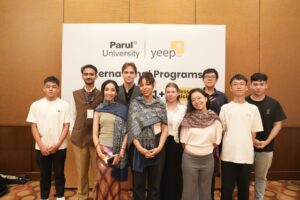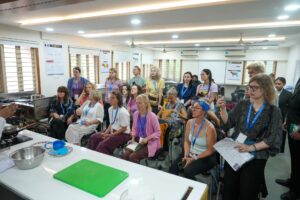
An architecture school reveals itself in two things: who it can bring to teach, and what its students can make. Young Ideas, the programme organised by the Faculty of Architecture and Planning at Parul University in collaboration with the Department of Interior Design, put both on display at once, pairing keynote sessions from four leading architects with an exhibition of a decade of student work.
The result was less a lecture series than a demonstration of an entire education, laid out in a single hall. This article is the map to it, and links to the deeper pieces on each speaker, the exhibition, and a student who came through the same programme.
What Young Ideas Was
The programme was hosted by the Faculty of Architecture and Planning, known as PIAR, which was established in 2012, and it coincided with the institute’s Foundation Day. It was organised in collaboration with the Department of Interior Design in the Faculty of Design, a pairing that reflects how closely the two disciplines sit in practice. In his address, the Dean, Dr. Bhargavjit Raval, acknowledged the mentors, alumni, and faculty who had built the institution and urged students to engage with the sessions and revisit the exhibition to understand the thinking behind each project.
The framing set the tone. This was an event about how architects are made, not just about finished buildings, and it treated the exhibition and the keynotes as two halves of one argument: theory from those who have practised it for decades, and evidence from those still learning it. Holding both in the same hall let a visitor see the full arc of an architectural education at once, from a first-year student’s paper model to a veteran’s built airport, which is a rare thing to witness in a single afternoon.
Four Master Architects, Four Perspectives
The keynote speakers approached architecture from four distinct angles, and each is covered in depth in its own article.
Ar. Snehal Shah offered five lessons on learning architecture and a method built on the sun, shadow, and ventilation. Professor Charanjit Singh Shah made the case for sustainability beyond net zero, cooling buildings without air conditioning. Ar. Yatin Pandya argued that architecture is more than buildings, the design of human experience. And Ar. Siddharth Majumdar gave an unusually honest account of the reality of an architect’s career, including the designs that never get built.
Between them, the four covered how to learn the craft, how to design responsibly for the climate, how to design for people, and how to survive the profession, which is close to a complete education in itself. The deliberate variety was the value: a student who attended all four heard a master on pedagogy, a specialist on sustainability, a philosopher on experience, and a realist on the business of practice, four angles that a single teacher rarely spans.
Ten Semesters of Student Work
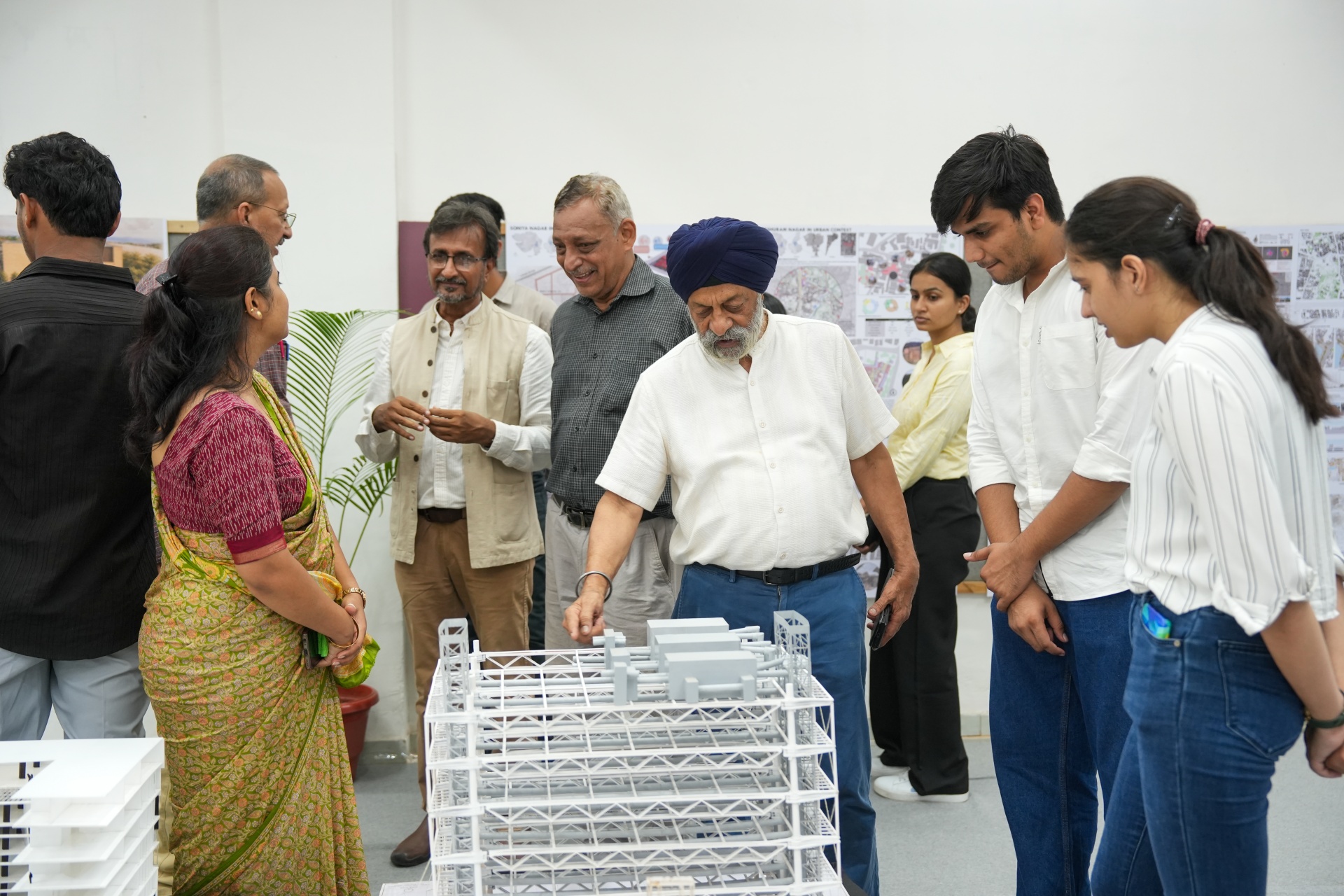
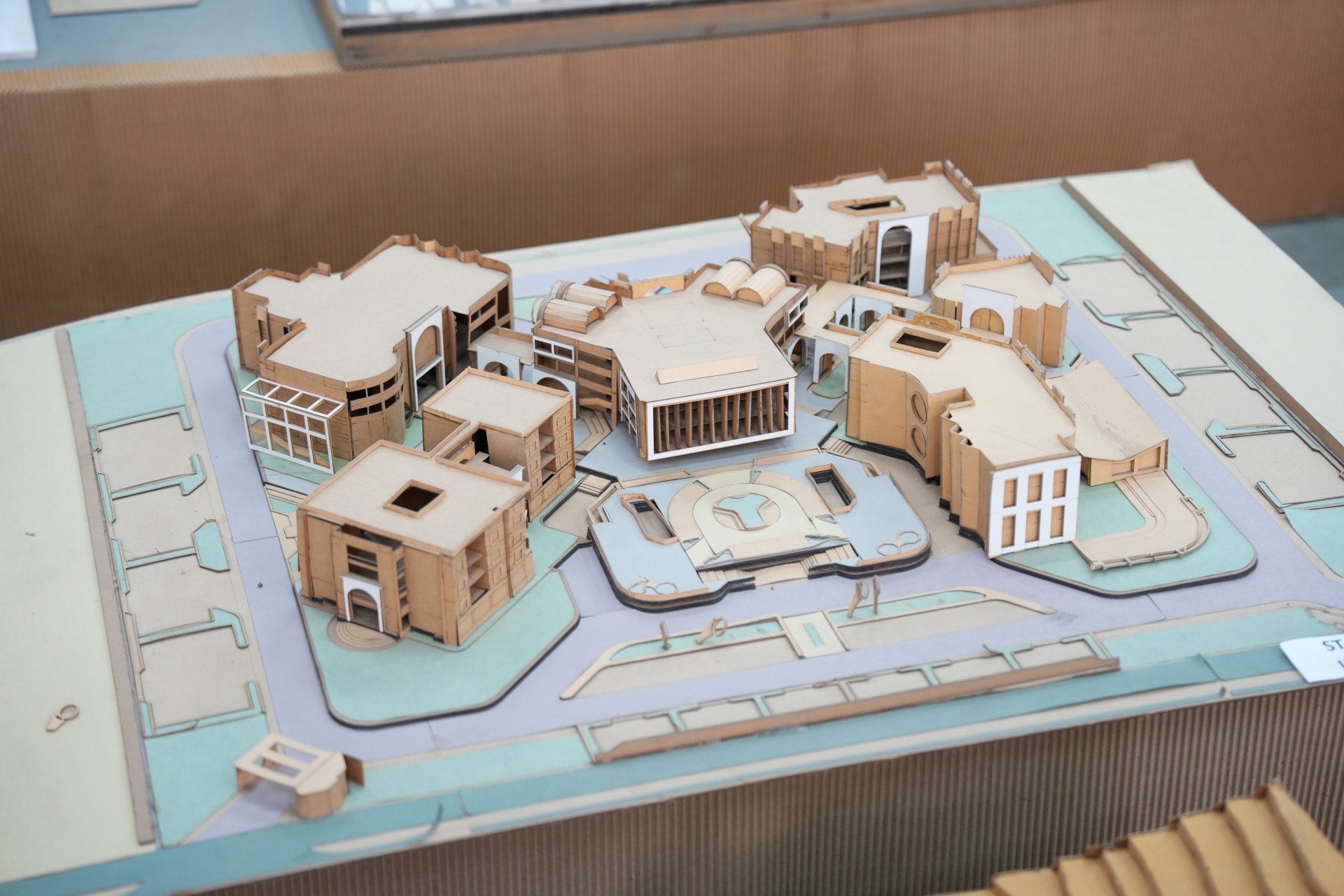
Alongside the sessions ran an exhibition of student and alumni work spanning foundation studios to final-year thesis, at scales from a single building to a whole city district. It included the urban design of Vadodara’s Vishwamitri area by 46 students, temple conservation studies from Maheshwar, an Olympic aquatic centre, a museum of motion, and proposals presented to the Council of Architecture. The full range is covered in a dedicated article on the exhibition, but its message was simple: the curriculum builds deliberately, semester upon semester, from crumpled-paper studies to civic proposals.
A Culture Students Carry Forward
What stood out was that the students did not merely exhibit their work. They stood in the hall explaining it, mentoring juniors, and carrying forward the culture of guidance that had shaped them. Students like Krishanshu Mohapatra and Pratham Vani acted as guides, and Pratham’s own path from a JEE aspirant to a committed architecture student is told in a separate profile. That ownership, students teaching students, is one of the clearest signs of a healthy studio culture.
The faculty’s student-facing initiatives sat behind that culture: a Design Cell, a Heritage Club, 3D-printing facilities, and a regular practice of field and site visits that send students out to document real neighbourhoods and heritage sites.
These are not extracurricular decorations. A Heritage Club that takes students to document ghats and temples, and a Design Cell that gives them a structure to build and exhibit in, are the machinery that turns a curriculum into a culture. A student learns as much from explaining their model to a visitor, or measuring a real building over two days, as from any lecture, and Young Ideas made that informal learning visible alongside the formal kind.
The Weight of the Guest List
The calibre of the speakers was itself a statement. Snehal Shah studied under B.V. Doshi and worked with Mario Botta. Charanjit Singh Shah has been called the Patrick Geddes of India and has designed more than sixty-five airports. Yatin Pandya is among India’s better-known architect-researchers, and Siddharth Majumdar practises with an established national firm. Architects of this standing do not lend their time to every institution that asks.
For a prospective student, that guest list is a more reliable signal than any marketing line, because time is the one resource even a famous architect cannot fake spending. A faculty that can bring such practitioners into a hall to teach, and that they judge worth teaching, is one connected to the profession rather than isolated from it. The exposure matters practically too: a student who hears these architects, questions them, and sees their work up close carries an understanding no textbook delivers.
Why an Event Like This Matters When Choosing a School
Prospective architecture students and their families often struggle to compare institutions, because glossy campuses reveal little about teaching. Two things cut through: who a school can bring to teach, and what its students can make. Young Ideas answered both in a single visit, master architects on the stage and a decade of student work in the hall.
That is the honest way to evaluate an architecture programme. Not by its prospectus, but by the practitioners it convenes and the proposals its students carry to government bodies and the Council of Architecture. On both counts, Young Ideas gave a prospective student real evidence to weigh rather than claims to trust, and evidence, unlike a marketing line, can be checked.
What Young Ideas Revealed About Architecture at Parul University
Taken together, the event was a demonstration of ten semesters of architectural thinking laid bare in one hall. It showed a curriculum that moves from geometry and material studies in the early years to quarry regeneration, memorial design, and Olympic-scale proposals by the final semesters. It showed students who carry that structure forward with genuine ownership, through national competitions, alumni contributions, and peer mentoring.
And it showed a faculty that can convene architects of the stature of Snehal Shah, Yatin Pandya, Charanjit Singh Shah, and Siddharth Majumdar for its students. For anyone judging architectural education at Parul University, Young Ideas was the evidence: serious, disciplined, and imaginative in equal measure.
The individual pieces of that evidence are worth reading in full, each speaker’s session, the exhibition, and one student’s journey through the programme, are covered in the companion articles linked throughout. Read together, they describe not an event but an education: one that treats climate, human experience, craft, and the hard realities of practice as parts of a single discipline, and that builds a student toward all of them over ten deliberate semesters.
Frequently Asked Questions
What is Young Ideas at Parul University?
Young Ideas is a programme organised by the Faculty of Architecture and Planning at Parul University, combining keynote sessions from leading architects with an exhibition of student work. The 2026 edition featured architects Snehal Shah, Charanjit Singh Shah, Yatin Pandya, and Siddharth Majumdar, alongside ten semesters of student projects.
Which architects spoke at Young Ideas?
The keynote speakers were Ar. Snehal Shah of Snehal Shah Architect, Professor Charanjit Singh Shah of Creative Group, Ar. Yatin Pandya of Footprints EARTH, and Ar. Siddharth Majumdar of ARCOP, each covering a distinct aspect of architectural practice and education.
Is Parul University good for architecture?
The Faculty of Architecture and Planning at Parul University runs a Council of Architecture-aligned curriculum that builds from foundation studies to civic proposals, convenes master architects through events like Young Ideas, and exhibits student work ranging from urban design to Olympic-scale thesis projects. Prospective students should also verify the specific programme and campus that fits them.