Read more about – A Designer’s-Eye View Through Parul University’s Indian Summer School!
For most of the students who arrive at the Indian Summer School Program at Parul University, it is their first time in India, and often the first time anyone in their family has made the trip. They come for two weeks, from universities across the world, to study, travel, and find out what a country most of them knew only through a screen is actually like.
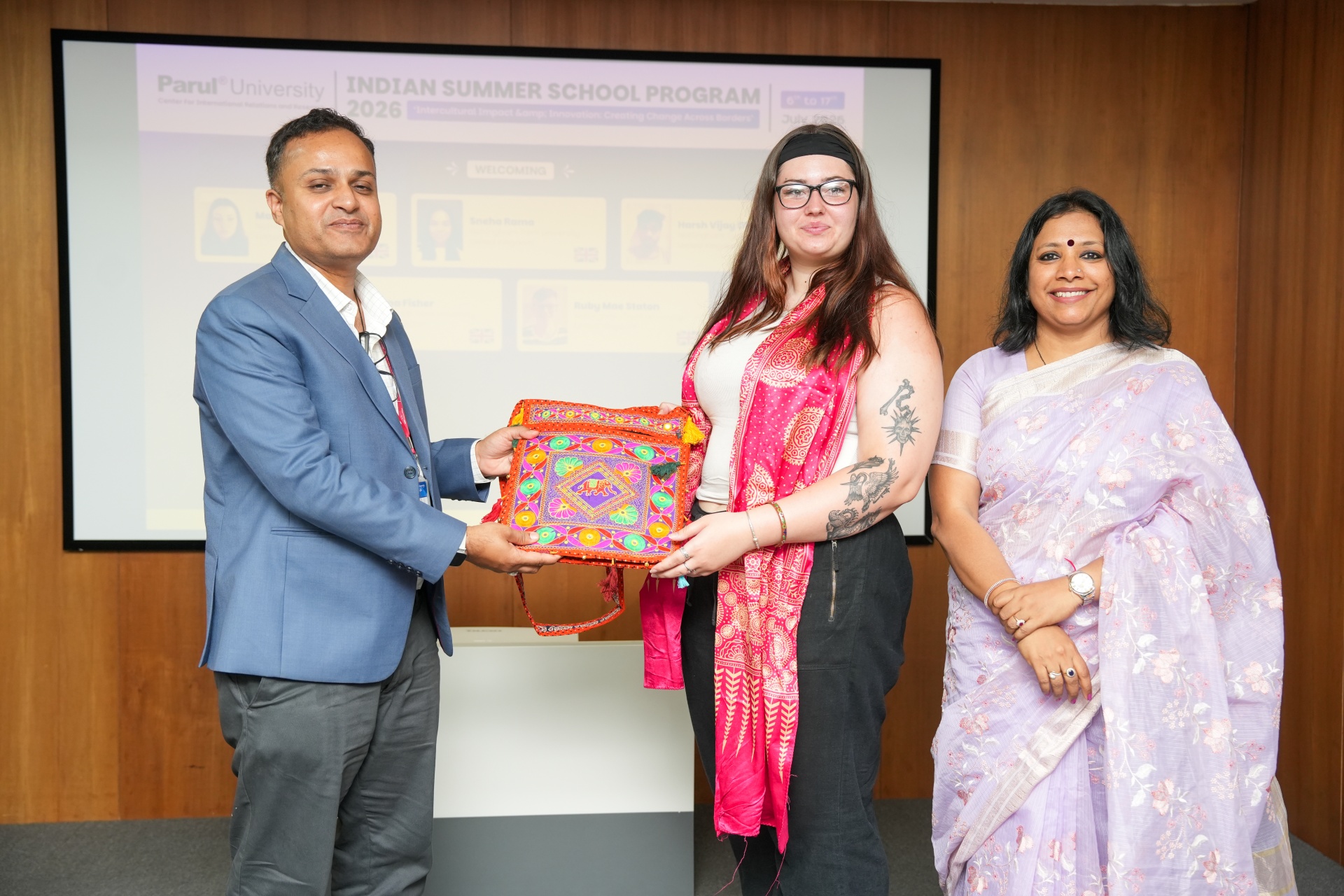
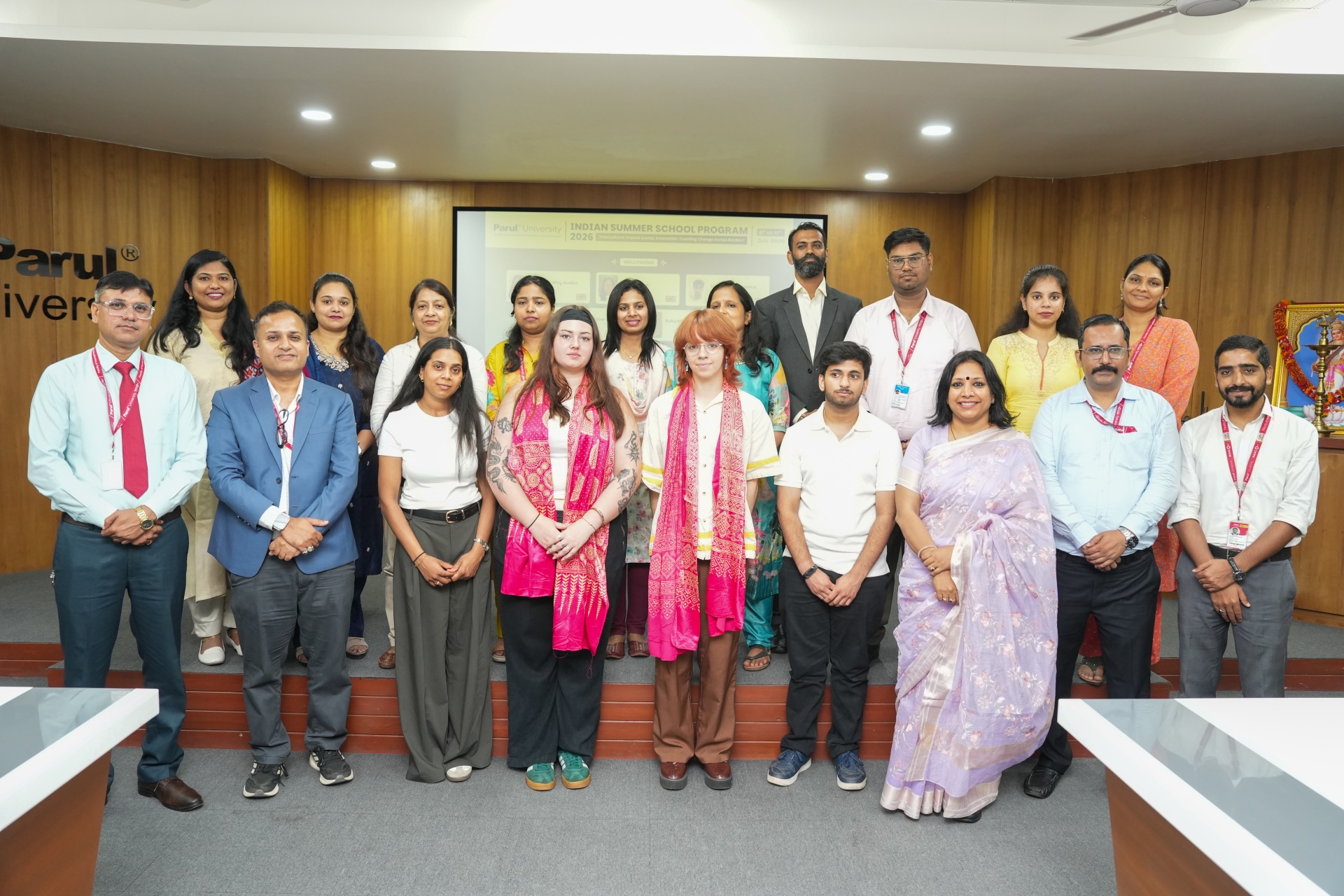
The July 2026 cohort brought fourteen international participants from seven countries and was run in collaboration with the Faculty of Management Studies and in partnership with Nottingham Trent University in the United Kingdom. Over the fortnight, from 6 to 17 July, they moved through several of the university’s faculties, toured the city, and lived on a residential campus that works very differently from the ones they had left.
This guide sets out what the program offers an international student, drawing throughout on the accounts of four of the students who were there. Their reflections are candid, which is what makes them worth reading: this is not a brochure, but a record of what two weeks in India were genuinely like.
What Is the Indian Summer School Program at Parul University?
The Indian Summer School Program is a short-term study-abroad program that brings international students to Parul University’s campus in Vadodara, Gujarat, for a structured fortnight of academic sessions and cultural immersion. It is run through the university’s Centre for International Relations and Research, and it is one of several ways Parul University connects with global partners, described further among its international programs.
The program runs more than one cohort across the year, drawing students from different partner universities. The July 2026 cohort described here came primarily through the partnership with Nottingham Trent University and gathered participants from seven countries into a single classroom, which turns out to be a substantial part of the point.
The structure balances two things that a purely academic exchange usually keeps separate: coursework across multiple faculties and a genuine cultural immersion in the city and the country around the campus. The result is a program that is as much about what happens outside the classroom as inside it.
Fourteen students, seven countries, two weeks. The international classroom is not a side effect of the program. It is the program.
Academic Exposure Across Multiple Faculties
One feature that surprised the visiting students most was the breadth of subjects available at once. In their home universities, several noted, a student studies their chosen subject and little else. At Parul University, they moved across faculties in a way that is unusual in the systems they came from.
The 2026 cohort’s sessions spanned several faculties, each offering something distinct.
- Faculty of Management Studies: discussions of real business problems, decision-making and global management practices, in collaborative and interactive sessions with faculty experts and with peers from different academic and cultural backgrounds.
- Faculty of Architecture and Planning: an introduction to creative design approaches and sustainable practice, and to the fundamentals of architectural thinking and design processes.
- Faculty of Performing Arts: sessions on Indian classical dance and music, with live performances and interactive demonstrations of the country’s artistic traditions.
There was also a dedicated Cross-Cultural Communication session, built around what it takes to communicate and cooperate across borders. Through discussion and activity, participants worked on cultural diversity, differing communication styles, and the practical business of adapting how you work when the people around you come from elsewhere. For a cohort drawn from seven countries, that session was less theory than daily reality.
Harsh, a computer science student from Nottingham who had switched to the field from architecture the day before enrolment, summarised the academic value in terms of range: the faculties together gave the group a mix of academic learning and cultural exposure, with each one offering something the others did not.
The International Classroom: Learning Alongside Seven Countries
The single most valued part of the program, across the interviews, was not a faculty member or a facility. It was the other students.
Sneha, a second-year Education Studies student at Nottingham Trent University, had expected a room of Indian and British students. Instead, she found herself studying alongside classmates from Madagascar, Ghana, Bangladesh and Zimbabwe, among others, and it changed what the coursework meant. Her course examined how inequality, gender gaps and social structures shape access to education in different countries, and the international classroom turned that from a topic into a set of first-hand accounts.
“Now I’ve got the knowledge of the countries I haven’t been to, the way their education systems work, and the hierarchy that works there.” – Sneha, Education Studies, Nottingham Trent University
For Harsh, the international connections were the outcome he had not seen coming, and the one he valued most.
“One of the best parts of this program was connecting with students from different countries. Together, we explored diverse cultures and built lasting global friendships. I wasn’t expecting it before enrolling, but it really helped me enhance my networking skills.” – Harsh, Computer Science, Nottingham Trent University
This is the argument for a program like this one made better than any prospectus could make it. A student can read about another country’s education system in a library. Sitting next to someone who grew up inside it is a different kind of learning, and it is the kind the Indian Summer School is built to produce.
A Different Kind of Campus: Honest Adjustments
None of the students pretended the adjustment was seamless, and the program is better represented by their honesty than by a smoothed-over version of it.
The first surprise was the campus itself. Several came from universities woven into the middle of a city, where the buildings sit among the streets, and students walk out into the town whenever they like. Parul University is the opposite: a large, self-contained residential campus, bounded and secured, with the city about an hour away. For students used to an urban campus, it took adjusting to, and it is worth being straightforward that it did.
What is interesting is where several of them landed on it. A boundaried, residential campus an hour from the city is, for a focused stretch of study, a feature rather than a limitation: it is a contained environment built for learning, with the distractions of a city held at arm’s length. Helena, a Fine Arts student, described it as an almost perfectly isolated place for study, and meant it as a compliment.
The other adjustments were the ordinary ones of travelling somewhere genuinely different.
- The daily timetable: regular, fixed classes each day, in place of the once-a-week tutorials they were used to. Some found it demanding at first, and several came to enjoy the structure.
- The climate: warmer than the cooler countries they had come from, and something that took a few days to settle into.
- Communication cues: the Indian head-nod and a more indirect style of classroom feedback left some of the cohort briefly unsure how to read a room, until the cues became familiar.
- Shared hostel rooms: three or four students to a room, rather than the single rooms common in the UK, which, as several of them noted, made friendships form far faster.
Sneha was candid that the communication gap was real at the start, and equally clear that it was a gap to be crossed rather than a fault to be blamed. She recognised that the tutors likely read the group’s early silence as disengagement when it was closer to careful listening from students still decoding an unfamiliar rhythm. Treating unfamiliar cues as information rather than an inconvenience is, in the end, the whole skill a program like this teaches.
Beyond the Classroom: The Cultural Immersion
The cultural program was, for several students, the part they will remember longest. The cohort was taken on a city tour of Vadodara, taking in Laxmi Vilas Palace, Sursagar Lake, local street markets and the Poicha temple, among other places.
For the design-minded students, the architecture was a genuine professional interest rather than a photo stop. Madeline, an Interior Design student at Nottingham Trent University, spent a long time studying the details of old buildings, temples and carvings for the ideas they gave her, and named Kirti Mandir as her favourite place in the city. Helena, whose own work is in sculpture, called the temple architecture among the best things she experienced in India.
Sneha was struck by the Poicha temple in particular, and by a Garba session the program arranged, which connected directly to her own Gujarati heritage and her family’s Navratri traditions. The cohort was also shown performances from several Indian states, widening the sense of the country’s range well beyond what two weeks would normally allow.
“I have no words for it. It’s fantastic. Here it’s absolutely crazy. Wonderful.” – Sneha, on the temple architecture and cultural program
The markets were their own education. Students used to fixed prices and supermarket aisles found a street market where you choose by hand and bargain to a price, and most of them loved it. Several bought gifts for themselves and their families and described the markets as the most colourful, unfamiliar and enjoyable part of daily life in the city.
What the Students Said About India?
Asked about the country rather than the program, the students returned, almost without exception, to the same thing: the friendliness of the people.
Sneha found the instinctive warmth of strangers the single most memorable feature of her stay, and the observation she was most certain she would carry home.
“If you’re sitting by yourself, they’ll just come and speak to you. When you’re walking around, if you’re alone, they’ll smile at you.” – Sneha, Education Studies, Nottingham Trent University
Helena, arriving from the United States by way of her studies in the UK, found the culture friendly and welcoming, and left with both Indian friends and friends among the international students at Parul University. She was candid too about the ordinary surprises of a first visit: cows on the roads, the free-flowing traffic of Vadodara, and a food culture far more diverse and, to her palate, more interesting than she was used to. Madeline, warned repeatedly that the food would be too spicy, found that she liked it.
The honest texture of these accounts, warmth and traffic and heat and spice all in the same breath, is what makes them credible. The students were not delivering testimonials. They were describing a place they had come to know, unevenly and quickly, and mostly come to like.
Warmth and traffic and heat and spice, all in the same breath. That is what makes the accounts credible rather than staged.
Why a Program Like This Matters?
Short-term international programs of this kind are a recognised national priority, not merely an institutional initiative. The National Education Policy 2020, published by the Ministry of Education, explicitly calls for the internationalisation of Indian higher education, both by bringing international students to India and by positioning Indian institutions as global study destinations. The Government of India pursues this through its Study in India initiative, and an inbound program like the Indian Summer School is a direct contribution to it.
For Parul University, the program sits within a broader international footprint. The university reports partnerships with more than 120 universities worldwide and a large international student community, and it runs the summer school alongside semester exchanges, internships and other mobility programs through its Centre for International Relations and Research. The Indian Summer School is the short, intensive entry point into that ecosystem.
For the students, the value is harder to reduce to a line, but Sneha came closest to it. She did not frame the fortnight as a credit on a transcript, but as a rare window, and her advice to anyone weighing it was unambiguous. The program connects to the university’s wider global partnerships and international programs, which is where a two-week visit can turn into a longer relationship.
“Honestly, do it. You’ll meet the nicest people, not just from India, but from around the world. I feel like it’s a one-time opportunity. So don’t overthink, just go for it.” – Sneha, Education Studies, Nottingham Trent University
Read more about – Study in India at Parul University – A Global Learning Experience for International Students!
FAQs
What is the Indian Summer School Program at Parul University?
The Indian Summer School Program is a short-term study-abroad program that brings international students to Parul University's campus in Vadodara, Gujarat, for a structured two-week period of academic sessions across multiple faculties and cultural immersion in the city and country. It is run through the university's Centre for International Relations and Research. The July 2026 cohort hosted fourteen participants from seven countries, in partnership with Nottingham Trent University.
Who can join the Indian Summer School Program ?
The program is designed for international students, typically drawn from Parul University's partner universities worldwide. The 2026 cohort described here came primarily through the partnership with Nottingham Trent University in the United Kingdom and included students of fine arts, education studies, interior design and computer science, among other subjects, from seven different countries.
What do students do on the Indian Summer School Program?
Students attend academic sessions across several faculties, including Management Studies, Architecture and Planning, and Performing Arts, along with a cross-cultural communication session. Alongside the coursework, they take part in a cultural program that includes a city tour of heritage sites such as Laxmi Vilas Palace, Sursagar Lake and the Poicha temple, cultural performances, and daily life on a residential campus with students from around the world.
What is Parul University's campus like for international students?
Parul University has a large, self-contained residential campus in Vadodara, secured and set about an hour from the city centre. International students on the 2026 program noted the contrast with city-centre universities, and several came to value it as a focused environment for study. Hostel rooms are typically shared by three or four students, which the visiting students found helped friendships form quickly. Classes run to a fixed daily timetable.
Is studying in India worth it for international students?
The students on the 2026 Indian Summer School Program described it in strongly positive terms, valuing above all the international classroom, drawn from seven countries, the cultural immersion, and the warmth of the people they met. Short-term programs of this kind also align with India's national push, under the National Education Policy 2020 and the Study in India initiative, to welcome international students. As one participant put it, the program was a one-time opportunity worth taking without overthinking.
Does Parul University offer other international programs?
Yes. The Indian Summer School is one of several international programs run through Parul University's Centre for International Relations and Research, alongside semester exchange programs, international internships and other mobility opportunities. The university reports partnerships with more than 120 universities worldwide, and the summer school serves as a short, intensive introduction to that wider