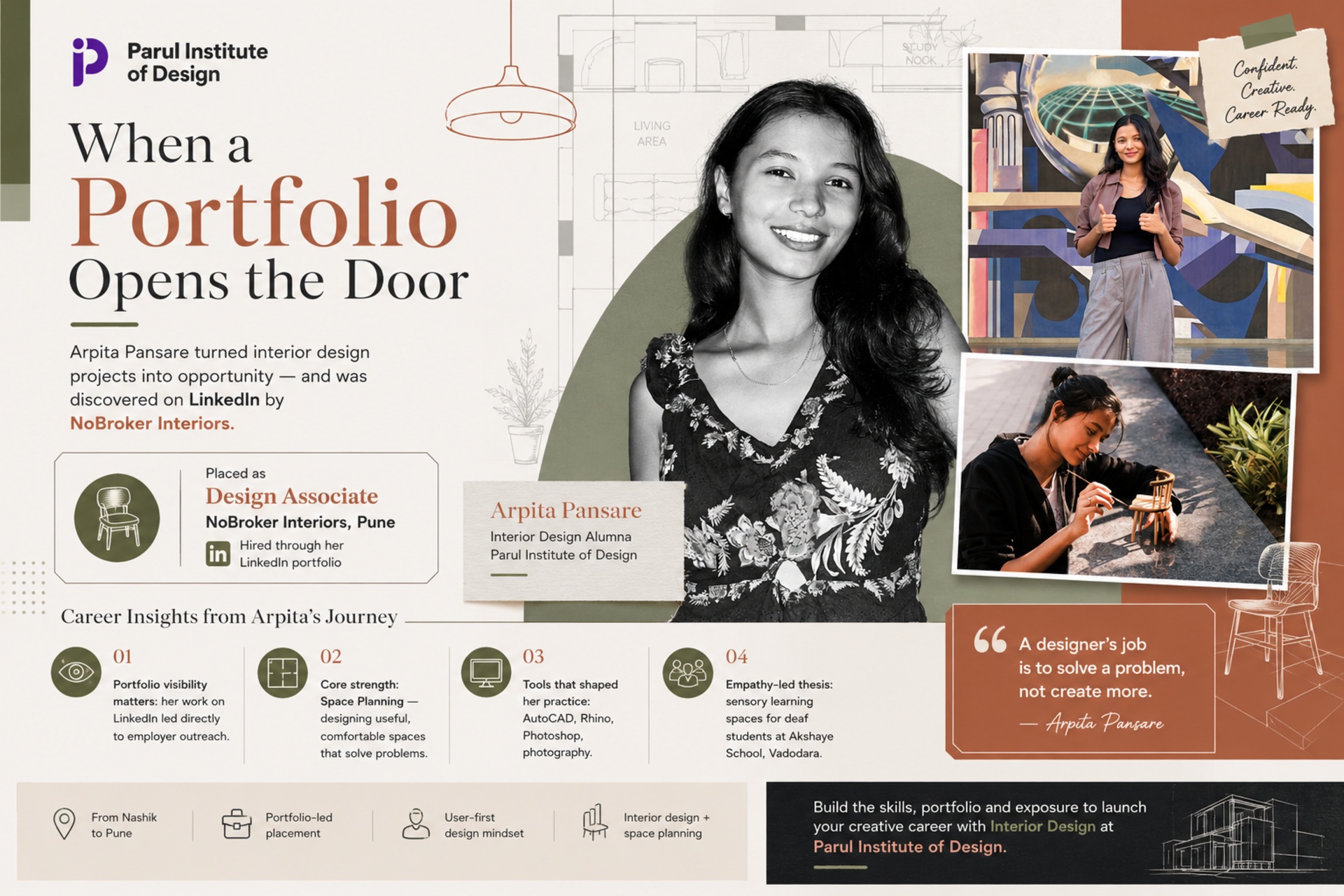
Most placement stories run through a campus interview or an internship that converts. Arpita Pansare‘s had a different journey. She secured a role as a Design Associate at NoBroker Interiors in Pune, and the most interesting part of her journey is that they called her because they found her design portfolio on LinkedIn. Without any traditional internship, placement drive, or any other process, her strong portfolio was the reason she found this job!
That is what makes this Parul University’s interior design placement worth reading closely. Arpita, from Nashik in Maharashtra, built a body of work at Parul Institute of Design good enough to be discovered, and then converted the interview on her own. Her story is a practical testament for design students who often underrate: that a visible, well-curated portfolio can matter as much as any formal recruitment channel.
This profile traces how she got there, from a neutral first year to a thesis about designing for children who are deaf, and into a role at one of India’s best-known proptech companies.
From Nashik to Parul Institute of Design
Arpita grew up in Nashik, in a family that combined business with a belief in education and global exposure. Her father runs a two-wheeler showroom; her brother studied in France and settled there. That blend of an entrepreneurial household and international outlook, she says, is part of what let her think ambitiously about design as a career, and it foreshadows where she wants her own career to end up.
Right from her time in school, she travelled with friends and loved exploring new places, and that habit allowed her to navigate unfamiliar places, settled quickly.
She found Parul Institute of Design the way a lot of students now find universities, through a video online, followed by advertisements and news coverage. She was initially wary of choosing a college on the strength of its marketing, which is a sensible instinct. What changed her mind was the campus itself. For a prospective design student, the way the institute’s spaces were planned and built was itself persuasive, and a visit turned her uncertainty into a decision. She lived in the university hostel for two years, learning independent living alongside her peers, then moved off-campus for the rest of the degree, choosing a further step in independence.
From a Neutral First Year to Recognised Talent
Arpita is candid that she did not arrive as a standout. She conveyed that her first year experience was an observational phase wherein she explored the curriculum, grasped the basics and found her calling. Her turning point was in the second year; that’s when the curriculum shifted from basics to real-time interior design subjects. Moving with the times, she got guidance from faculties & mentors, followed by getting recognition for her work, and that’s when she wasn’t an average student anymore!
The moment she marks as a milestone was external validation: a piece of furniture she designed and built was selected for an exhibition in Ahmedabad. Seeing her work displayed beyond the campus was both a proud moment and, in her telling, the thing that deepened her love for design. It is a small event with a large effect, the point at which a student starts to see herself as a designer. That trajectory, from neutral fresher to exhibited work, is the arc a good interior design programme at Parul University is meant to produce.
A piece of furniture she designed was selected for an exhibition in Ahmedabad. That is the point a student starts to see herself as a designer.
The Skills That Made Her Employable: Space Planning and Software
On a priority basis, she’s passionate about Space Planning – the only skill her employer needed. Space Planning is the core discipline in the interior design field, and hence she is still mastering its core with her 100% enthusiasm.
Her education was grounded in how people actually live. As a passionate student, she studied Vastu Shastra and the core principles of making homes comfortable and worth living. She has fully absorbed a philosophy she keeps repeating –
A designer’s job is to solve a problem, not to create more. A space must not look good, but it should be comfortable enough to maintain. This user-centric thinking is what sets her skills apart from a basic designer!
On top of the concepts sat the tools. Parul Institute of Design trained her in the software the profession runs on.
- AutoCAD: For drawing accurate plans and technical drawings.
- Rhino: For building three-dimensional models of spaces and objects.
- Photoshop and photography: For presenting designs professionally and documenting finished work, the skills that later let her build a portfolio good enough to be discovered.
That last point is worth underlining. The photography and presentation skills were not incidental. They are precisely what made her LinkedIn portfolio compelling enough for an employer to act on, which means the technical training and the placement were causally linked.
The Mentor Who Believed in Her: Rutu Bhatt
Most students who succeed can name the one teacher who made the difference. For Arpita, that person was Rutu Bhatt. The bond with her was so close that both of them literally cried during the time of Arpita’s farewell; it really shows how faculty go beyond their professional limits and support students at all levels. A bond that can’t be explained easily!
Rutu Bhatt was, in Arpita’s account, the person who steadied her when she was struggling or full of doubt, and who kept believing in her when she found it hard to believe in herself. A single line of encouragement stayed with her.
“I know you’re good, you can do it.” – Rutu Bhatt, faculty mentor, as recalled by Arpita Pansare
It is a small sentence, but Arpita credits it with helping her get past her fears and grow into a more confident designer. Mentorship of that kind rarely appears on a placement record, yet by her own account it was part of what produced this one.
Following a Childhood Passion: The VFDF Fashion Festival
Arpita did not treat her degree as only a degree. She had loved modelling since childhood, and the university gave her room to pursue it alongside her design studies, which she counts among the things she valued most about her time there.
At the VFDF fashion festival, she did more than walk the ramp. She helped select the models and directed them on stage, taking a leadership role while living out a childhood dream in front of a large audience. She was deliberate about which activities she gave her time to, favouring events on campus and educational trips over travel-heavy festivals, a focus that says something about how she managed her priorities.
Those educational trips included visits to the National Institute of Design and to the Lakshmi Vilas Palace in Vadodara, both of which she credits with deepening her understanding of architecture and design. Exposure to landmark design and architecture is part of how a designer’s eye is trained, and it complements the studio facilities at Parul Institute of Design.
A Thesis Built on Empathy: The Akshaye School Project
A final-year thesis is where a design student shows what they truly think design is for. Arpita could have designed a store or a luxury home. She chose instead to design for the Akshaye School in Vadodara, which serves children who are deaf, and in doing so produced the work she is still proudest of.
Her starting point was respect rather than pity. She saw the students as people who experience the world differently, and she noticed something concrete when she visited: the school had classrooms and playgrounds, but no spaces designed for the specific way its students learn and play. She set out to change that.
What she designed was not a conventional school interior. It was a set of spaces built around sight and physical sensation, using visual cues and vibration to help deaf students understand and engage with their environment in a way suited to how they perceive it. The project was not about constructing a building; it was a demonstration that design can serve people whose needs are usually designed around rather than for. It is the clearest possible statement of the user-first philosophy her course had taught her, applied to a group that mainstream design routinely overlooks, and it is exactly the kind of work that marks out a designer worth hiring. If you’re as passionate as her, delay not and enrol on Parul University’s B.Des in Interior and Furniture Design and Master of Design in Interior Design program and get to work for Top & Trending Design firms of India!
She designed spaces built around sight and vibration, so that deaf students could engage with their environment in a way suited to how they perceive it.
A Parul University Interior Design Placement, Made on LinkedIn!
When Arpita began looking for work, she did the modern thing: she made her work findable. She put her projects, including her thesis, on LinkedIn, curating a portfolio that showed exactly what she could do. It worked in the most direct way possible. Employers saw the work and started calling her.
One of them was NoBroker, India’s first proptech unicorn, whose interior-design arm, NoBroker Interiors, runs design services and experience centres across Bangalore, Hyderabad and Pune. NoBroker found her contact details through her LinkedIn portfolio and called her in for an interview. She converted it and accepted the offer, joining the company’s Pune branch as a Design Associate. Notably, she did this without a traditional internship: the job came from her portfolio and her performance in the interview alone.
As a Design Associate, she began by supporting senior designers, doing the space planning and sketching she had learned at Parul Institute of Design, and as she gained experience, she started taking on her own design projects. The continuity between what she studied and what she now does is unusually clean: space planning was her core skill in college and her core task at work.
She is honest about the adjustments. NoBroker uses its own in-house design software, which she had to learn on the job, and she accepts readily that no college can teach every company’s proprietary tools. The larger shift was cultural. In college, teachers correct your mistakes; at work, the expectation is different, and she puts it in one memorable line.
“You have to be right, from the start.” – Arpita Pansare
That, she says, is what being a professional actually means: the safety net of the classroom is gone, and consistent, accurate work is simply the baseline. It is a clear-eyed thing to understand early, and it is the difference between a student and a working designer.
Her Advice: Enjoy First Year, Then Buckle Down
Arpita’s advice to juniors is refreshingly unromantic, and more useful for it. She does not tell students to grind from day one. She tells them the opposite, then adds the catch.
The first year, she says, is the time to enjoy campus life, explore, and relax, because the academic pressure is still light and everyone is on level ground. But once the second year begins and specialisations start, the time for unchecked fun is over. From that point, students have to focus intensely on mastering the fundamentals of their field, because a student who keeps coasting without grasping the basics will struggle to finish strong and build a career.
Her real message is balance: enjoy college genuinely, but pair that enjoyment with serious dedication once the work turns specialised. Success, she believes, cannot be spoon-fed. A student has to take the initiative to learn and improve, and accept that nobody arrives good without doing the work. It is the same self-directed attitude that led her to build a portfolio strong enough to be discovered.
The Long Goal: From Senior Designer to Her Own Studio
Arpita is content at NoBroker for now, and specific about why: supportive management, a workplace that does not pile pressure on its designers, and room to keep learning. Her immediate aim is to absorb as much as she can, build experience, and earn the title of Senior Designer.
Her longer ambition returns to where she started, her family’s entrepreneurial roots in Nashik. Once she has enough industry experience and has learned the business properly, she plans to start her own independent interior design studio. That is the kind of build-your-own-path ambition that Parul University’s startup and entrepreneurship ecosystem, PIERC, exists to support, having backed 254 student ventures with more than Rs 20 crore in funding, and it reframes her current role not as a destination but as an apprenticeship for something of her own.
It is a coherent plan: learn the craft and the business inside an established company, build a reputation as a senior professional, then step out to found a studio. For a designer who combines creative empathy with technical skill and a pragmatic sense of balance, it is an ambition with a credible route behind it.
FAQs
Where did Arpita Pansare get placed after studying interior design at Parul University?
Arpita Pansare, an interior design graduate of Parul Institute of Design at Parul University, was placed as a Design Associate at NoBroker Interiors in Pune. NoBroker is India’s exclusive unicorn in proptech, and their interiors arm runs design services & they have their centres in Bangalore, Hyderabad and Pune. She was directly hired via LinkedIn. As part of her learning process at Parul University, she used to upload her work regularly!
How did she get the job without any internship?
Arpita Pansare was passionate about her work, and so she used to post her projects and experiences on LinkedIn frequently. Employers from NoBroker found her there, contacted her, and that’s when she got her job!
What are the primary skills for a successful interior design career?
For Arpita Pansare, space planning was the single most important skill: the ability to analyse any space and use it effectively. Alongside it, she points to design software including AutoCAD for plans, Rhino for 3D modelling, and Photoshop for presentation, plus an understanding of user needs and principles such as Vastu Shastra. She also credits presentation and photography skills with making her portfolio compelling to employers.
Define Arpita Pansare’s thesis project?
Her final-year thesis designed learning and play spaces for the Akshaye School in Vadodara, which serves children who are deaf. Rather than a conventional interior, she created spaces built around sight and vibration, using visual cues and physical sensation to help deaf students engage with their environment in a way suited to how they perceive it. The project is an example of empathy-driven, user-first design.
Is Parul University good for interior design?
Parul Institute of Design at Parul University offers an interior design programme combining core theory, user-focused design principles and training in professional software such as AutoCAD, Rhino and Photoshop, alongside studio facilities and educational exposure to landmark design. Arpita Pansare, who was placed as a Design Associate at NoBroker Interiors, credits the programme's skills training, particularly space planning, with preparing her directly for the profession.
Can a design portfolio on LinkedIn help you get hired?
Yes, as Arpita Pansare's placement demonstrates. She published her design projects and thesis on LinkedIn, and NoBroker discovered her work and contacted her for an interview through the platform, leading to a Design Associate role without a traditional internship. A well-presented digital portfolio makes a designer discoverable to employers who are actively searching for talent.