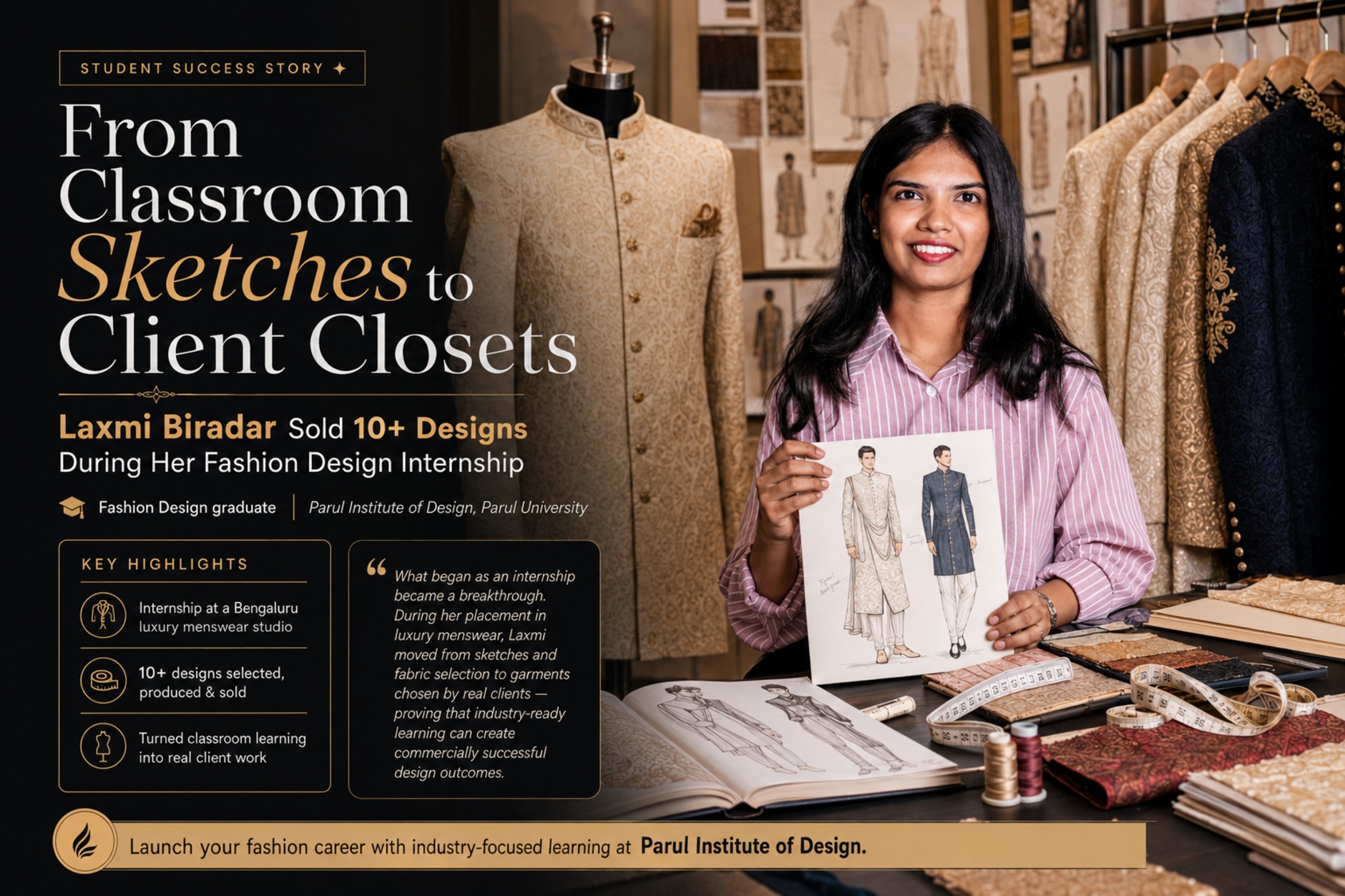
A fashion design internship is where the theory a student has spent years learning either holds up in a real studio or does not. For Laxmi Biradar, a Fashion Design graduate of Parul Institute of Design at Parul University, it did more than hold up.
During her internship at a Bengaluru luxury menswear studio, more than ten of the designs she worked on were selected, produced, and sold to actual clients, which is a rarer outcome for a student intern than a glowing reference letter and a far more useful one. Her story stands as a testament for aspiring fashion design students.
Dreaming of a career in fashion already? Begin your fashion journey with a Bachelor of Design in Fashion Design Technology and Diploma in Fashion Design & Technology courses from Parul Institute of Design, Parul University!
From Sketchbook to Runway – Fashion Design Graduation Collection
What a Fashion Design Internship Actually Involves?
The value of a fashion design internship is that it exposes the full production chain, not just the design sketch at the beginning of it. In her placement, Laxmi moved across the stages a working designer handles: researching references and briefs, developing and sketching design ideas, selecting fabrics, and helping construct garments from the first sample through to the finished piece. She worked alongside senior designers on menswear for weddings, which is among the most detail-intensive and least forgiving categories in the industry.
That end-to-end involvement is the point. A student who has only ever designed on paper learns, during an internship, how a concept survives contact with fabric behaviour, fit, client preferences, and delivery deadlines. The gap between a classroom brief and a paying client is where much of the real learning happens.
The Studio: Luxury Menswear as a Classroom
Laxmi chose the placement deliberately because she wanted exposure to the high end of the market rather than a generic role. The studio, part of the Pankaj Soni menswear label, is a Bengaluru name in luxury menswear, known for bespoke Indo-Western wear, sherwanis, and wedding outfits built on close attention to detail and custom fit.
For a fashion student, a bespoke luxury studio is an unusually effective teacher: every garment is made for a specific client, so there is no hiding behind mass-production tolerances, and the standard of finish is exacting.
The Outcome That Matters: Designs That Sold
A reference letter says a student showed promise. Ten garments sold to paying clients say the work was good enough to buy.
The milestone Laxmi describes as the most validating was not a grade or a certificate. It was watching clients try on, choose, and buy garments she had helped conceptualise and design. According to her experience, more than ten of her specific designs were selected, produced, and sold during the internship.
That is a different order of feedback from an academic mark, because it is delivered by the market rather than by an examiner, and it is the clearest possible evidence that her training translated into commercial work.
From Campus to Commercials
An internship outcome like this does not appear from nowhere. It is built on a design curriculum that trains students on real garments rather than only theory, which is how Parul Institute of Design structures its fashion teaching.
Anyone considering the field will find it useful to understand what you actually study in a fashion design course, because the technical foundation, including pattern making, garment construction, and textiles, is what makes a student useful in a studio from day one rather than someone who needs to be trained from scratch.
The Skill No One Lists: Presenting Your Work
Laxmi is candid that she did not begin as a confident presenter. What she did about it is the part worth noting: she treated presenting as a skill to build rather than a trait she lacked, deliberately volunteering to present, sharing work with peers, and learning to take critique without treating it as a verdict.
By her final year, she could talk through her work and defend her decisions, which is not a soft extra in fashion but a core professional requirement, since a designer who cannot articulate a choice cannot sell it to a client or a senior.
Her graduation collection, built around a concept she called Fluid Frost, was where that combination of technical skill and presentation came together.
FAQs
Define the role of a fashion design intern?
Basically, a fashion design intern supports the entire process of designing, which covers researching references, framing a moodboard, developing sketches, fabric selection, and constructing garments under the supervision of senior designers. Be it a luxury studio or boutique, the requirements differ at many levels.
How do you get a fashion design internship?
Usually, these internships come via a strong portfolio or faculty networks the design school provides. But the bigger question is which one to go for, as that plays a major role in students’ future ahead. Choosing a placement that matches your objective & passion is important; for example, if someone cracks an internship at a menswear studio, they will primarily learn bespoke tailoring. So the goal differs from person to person, and that’s when the faculty guidance plays a major role!
Do fashion students get their designs produced and sold during internships?
It happens, though it is not guaranteed and depends on the student and the studio. Parul Institute of Design graduate Laxmi Biradar had more than ten of her designs selected, produced, and sold during her internship at a Bengaluru luxury menswear studio. An outcome like that reflects both the student’s technical readiness and a studio willing to put intern work into production.
Why is an internship important in a fashion design degree?
An internship is a pathway to a corporate career, so it bridges the gap between classroom theory & real-time industry practice. It exposes students to trending fabric behaviour, fit, client taste, production & manufacturing processes and how to deliver everything by a finalised deadline. So that’s when they become real designers and kickstart their careers in their desired studios!