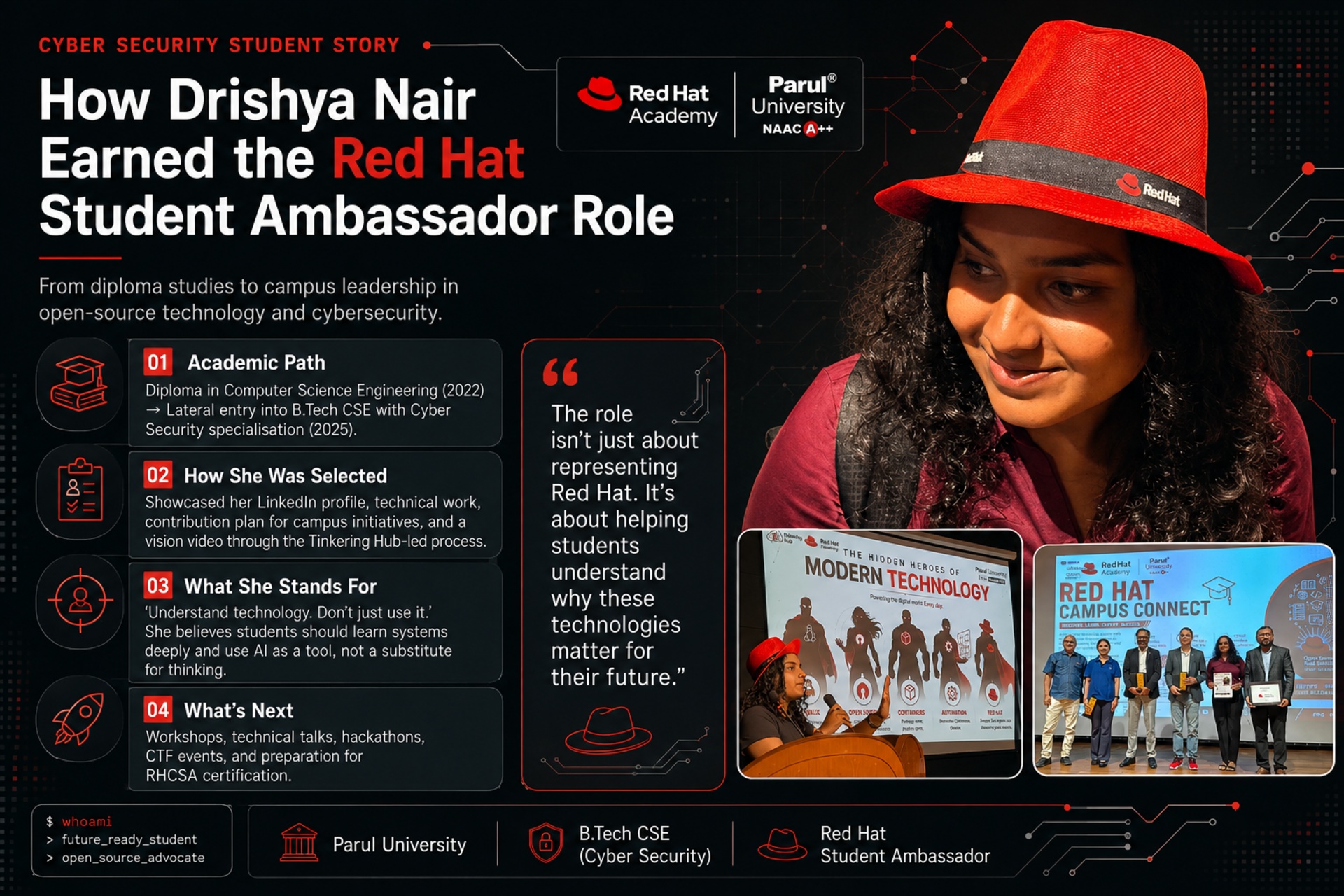
A student of Parul University studying B.Tech Computer Science became the Red Hat Student Ambassador, representing one of the world’s leading open-source technology organisations at the university level. Drishya Nair is a student from Parul University who will be a link between the campus community and the wider Red Hat ecosystem.
Her journey was not linear. She joined Parul University in 2022 for a diploma in computer science engineering. She then took a lateral entry into a B.Tech in Computer Science and Engineering with a Cyber Security specialisation in 2025, leading her path towards specialisation in ethical hacking, network security, and enterprise technologies. The through-line was not a plan so much as a temperament: curiosity.
How to Become a Red Hat Student Ambassador
The ambassadorship is earned, not assigned, and the selection process is specific enough to be a genuine guide. At Parul University, the opportunity was run through the Tinkering Hub, the University’s centre for Industry 4.0 skills, which also organised the Red Hat Campus Connect event. On the recommendation of faculty involved in the Red Hat programme, a few students were invited to:
- Present their LinkedIn profiles and current technical work.
- Explain how they could contribute to promoting Red Hat initiatives on campus.
- Submit a video outlining their vision as potential ambassadors.
Drishya earned the role on the strength of consistent academic performance, active engagement during her Red Hat training, and a demonstrated commitment to cybersecurity education and student development. She is clear about who made it possible, crediting Dr. Vaibhav Gandhi, Director of the Tinkering Hub, and faculty member Poonam Songde for the push and support that carried her to the role. She now joins a nationwide network of student ambassadors working across institutions to promote open-source and enterprise technology education.
The role isn’t just about representing Red Hat. It’s about helping students understand why these technologies are important for their future.
– Drishya Nair
The Foundation: Curiosity, Before Code
What made her effective in a technical field started well outside it. Drishya credits attributes she built from childhood, being outspoken, curious, and confident, to her training in Bharatanatyam and to years of debate and public speaking at school. That background left her comfortable communicating, leading discussions, and, most importantly, asking questions rather than pretending to know. In a field that changes constantly, she treats that willingness to ask as her strongest asset, and it is also, not coincidentally, exactly what a student ambassador’s job requires.
It also shaped how she learned. Through her programme, she deliberately leaned on faculty expertise rather than shortcuts, an approach that aligns directly with the conviction she is now most vocal about. Her technical grounding includes the Red Hat RH124 and RH134 Linux courses. This is covered in depth in why cybersecurity runs on Linux; this profile is about what she does with it.
Understand Technology, Do Not Just Use It
Without understanding how technology works underneath, we cannot truly understand the applications we use every day.
– Drishya Nair
Drishya believed that a good grip on tools is not the same as understanding the tool, and the gap shows us that software hides more of its workings. Learning Linux at the command line is not about memorising commands: it is about developing an understanding of systems, troubleshooting problems, and building secure environments from the bottom to the upper level.
That principle — understand the machine beneath the interface — is the spine of how she thinks about a cybersecurity career, and it is what she carries into every conversation with other students.
On Using AI: A Tool, Not a Substitute for Thinking
She applies the same principle to artificial intelligence, and it is here that her message is most timely. As AI reshapes nearly every industry, Drishya argues that students should push past merely using AI tools toward understanding the systems that make them work. She is not against AI; she is against outsourcing thinking to it.
AI should be used to make our work easier, not to replace our ability to think. Use it as a helping tool, do not rely upon it.
– Drishya Nair
Her advice to students is sequential and practical: develop your own ideas, analytical thinking, and problem-solving ability first, and turn to AI for assistance only after that foundation exists. She pairs this with a warning that fits her field, that many people use AI tools without awareness of the privacy and security implications, as large volumes of personal data are generated and can be shared onward. Using AI mindfully and thoughtfully, she argues, is now part of basic digital literacy, not an optional extra.
Red Ambassador Drishya's Vision: Communities That Learn Together
Drishya frames the ambassadorship as a responsibility rather than a title, and her plans are concrete. She wants to build an active learning culture on campus through awareness sessions, interactive workshops, technical talks, hackathons, and Capture the Flag (CTF) cybersecurity competitions that let students apply knowledge to real scenarios. She also works laterally, coordinating with Red Hat student ambassadors at other institutions across India, and with student ambassadors of companies such as Microsoft, Apple, and Google, to run events that benefit wider student communities.
Underlying all of it is a particular idea of leadership. For Drishya, leadership is not about holding a position; it is about influencing others to explore, ask questions, and keep learning. It is a definition drawn directly from how she got here.
Looking Ahead: RHCSA, and a Goal of National Service
Alongside her studies, Drishya is preparing for the Red Hat Certified System Administrator (RHCSA) certification, a globally recognised credential she sees as strengthening her path in cybersecurity and enterprise technology. Her longer ambition is public: inspired by a background of public service in her own family, she aims to work in a government cybersecurity role, using her technical skills to help protect the country’s digital systems, the kind of work carried out by national bodies such as CERT-In and the National Critical Information Infrastructure Protection Centre. It is a reminder that for many students, cybersecurity is not only a career but a form of service.
Also Read: Career Paths One Can Pursue in Cybersecurity
Frequently Asked Questions
What is a Red Hat Academy Ambassador?
A Red Hat Student Ambassador is someone who is a representative of Red Hat at the campus level. At Parul University, Drishya Nair represents the academy. Ambassadors promote open-source and Linux education and certifications.
How do you become a Red Hat Student Ambassador?
Selection is typically based on academic performance and active engagement in Red Hat training, followed by a process that can include presenting your LinkedIn profile and current work, explaining how you would promote Red Hat initiatives on campus, and submitting a video outlining your vision. Faculty recommendation and a demonstrated commitment to technology education and student development matter. At Parul University, the process ran through the Tinkering Hub.
Should students rely on AI for their work?
According to Parul University cyber security student and Red Hat ambassador Drishya Nair, AI should be used as a helping tool, not a replacement for thinking. Her advice is to first develop your own ideas, analytical thinking, and problem-solving skills, and only then use AI for assistance, while staying aware of the privacy and data-security implications of the tools you use. The aim is mindful, thoughtful use rather than dependence.
What does a cyber security student learn at Parul University?
Parul University’s B.Tech Computer Science with a Cyber Security specialisation combines theory with practical, industry-integrated learning, covering ethical hacking, Linux and command-line systems, network security, and enterprise technologies, including Red Hat RH124 and RH134 Linux courses. Through partnerships with Red Hat and ElectroMech CloudTech, students access enterprise technologies and globally recognised certifications as part of the programme.
What is the RHCSA certification?
The Red Hat Certified System Administrator (RHCSA) is a globally recognised certification validating core Linux system administration skills, such as managing systems, users, storage, and services on Red Hat Enterprise Linux. It is a common foundation certification for careers in system administration, cloud, DevOps, and cyber security, and is often the first Red Hat credential students pursue.