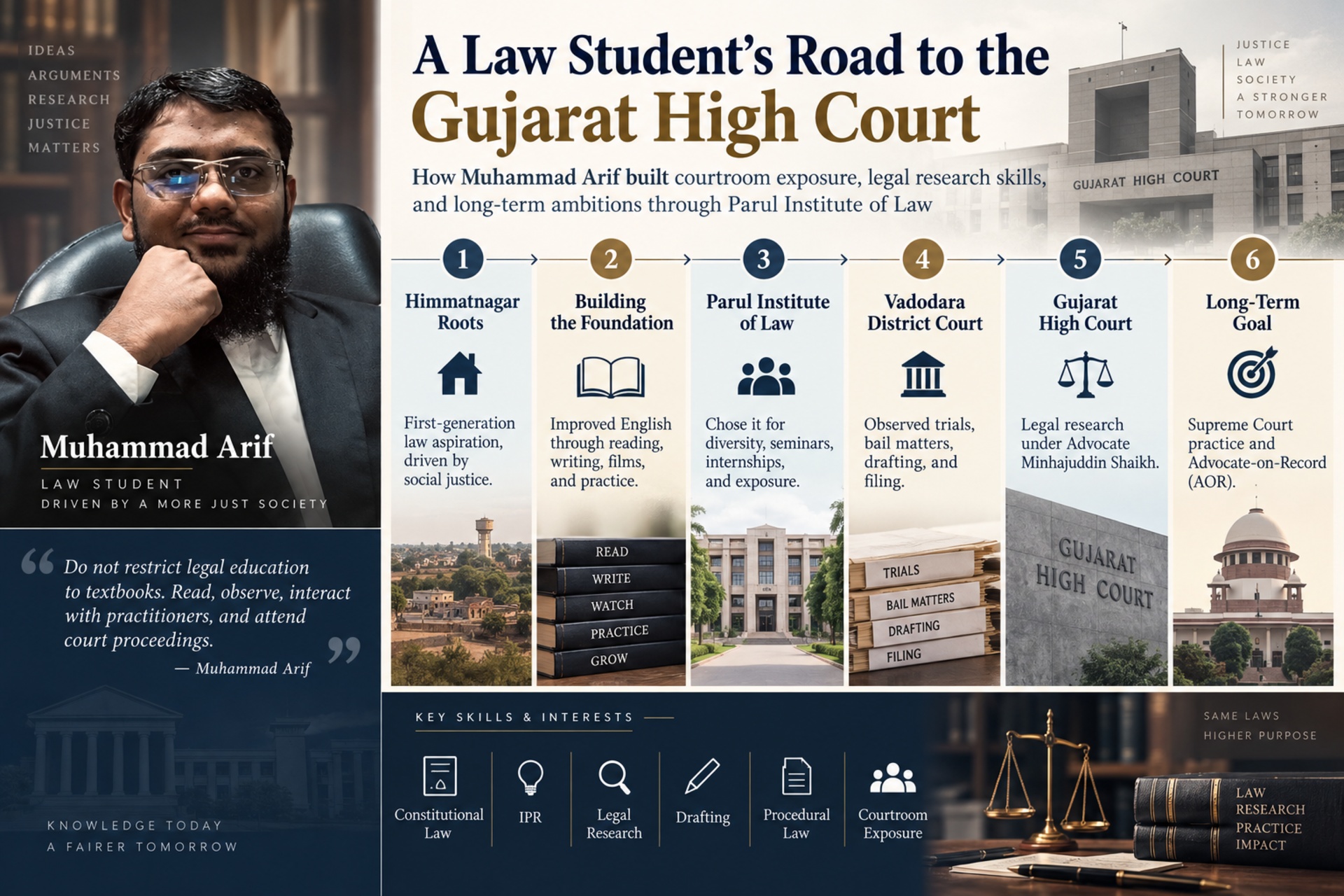
People come from different backgrounds. Arif is someone who comes from a family that is close to each other. A family that is supportive towards pursuing dreams. Hence, supports his education. Even though no one from his family comes from a law background. Law was never in picture for him during his growing-up years. This might look like, how can someone take up law without exposure? But rather, it became a motivation for them.
As he followed the news and read about people facing injustice and struggling to access legal support, a purpose took shape.
For Muhammad Arif, studying law was not only limited to just learning it. He wanted to pursue the degree along with understanding law and gaining exposure. He grew up in Himmatnagar. Today, as an LL.B student at Parul Institute of Law, that ambition has already carried him from a first, nervous step into a courtroom to researching complex legal questions at the Gujarat High Court.
I wanted to do something for my community, for my nation, and for people who are suffering from injustice.
– Muhammad Arif
A Smartphone That Opened a New World
His path into law began, unexpectedly, with a gift. People think smartphones will not be used for right things. But when Arif was gifted the smartphone, his journey began. He planned what he is looking for. He started searching about the courses, career possibilities and supporting certificates. He was not fully sure of what is required for becoming a lawyer. And as he started reading more on social justice, the idea of law as tool for change took hold. Sometimes a career begins not in a classroom, but with a question typed into a search bar.
Building the Foundation, and Facing a Language Barrier
Language barrier is something people usually when they get into college. It is not something someone should be worried about. It can be eased through consistent learning. Arif comes from a Gujarati Medium school. He took arts stream, and completed his degree in Arts. Bachelor of Arts in English, before entering law school. He knew that professional legal practice and education are in English. This does require efforts. He focused on learning the language. He worked on by reading, writing, communicating, and understanding the language English. He started with listening music, reading, watching movies to sharpen his skills. He still feels that speaking is still an area that requires improvement. But he has become a bit more confident now. As he can understand the lectures, express legal concepts in English, write notes in English. Motivating others that language barrier can be overcome with consistency.
Why Parul Institute of Law
When choosing where to study law, Parul University stood out to Arif for its diversity and exposure. He was drawn to a multicultural campus where he could interact with students from different disciplines, cities, cultures, and countries, an environment offering seminars, internships, and opportunities beyond the conventional syllabus. That search led him to Parul Institute of Law.
Finding His Fields: Constitutional Law and IPR
Arif’s interest in Constitutional Law flows directly from why he wanted to become a lawyer. He is drawn to fundamental rights and constitutional remedies, and understanding how the Constitution provides for the enforcement of those rights showed him how directly the law can affect a person who believes their rights have been violated. At the same time, watching technology and digital industries grow, he sees intellectual property (IPR) becoming an increasingly important field, proof that studying law has broadened his horizons beyond what he first imagined.
His First Courtroom, at the Vadodara District Court
Before law school, Arif had never been inside a courtroom. His first real experience of legal proceedings came during an internship under an advocate at the Vadodara District Court. His work involved reading and briefing cases, assisting with legal drafting, and filing documents, and he was told to sit in different courtrooms and observe bail matters and trials. The most valuable part was watching cross-examination in the trial courts. Concepts that had lived only in textbooks, evidence, procedure, advocacy, suddenly came alive as he saw how they interact in actual practice.
Stepping Up: The Gujarat High Court
Wanting to experience a higher forum, Arif sought a second internship at the Gujarat High Court, and, tellingly, he secured it himself. Rather than relying only on placement support, he built professional connections on LinkedIn, approached the office directly with his CV, and was accepted on the strength of his profile. There he worked under Advocate Minhajuddin Shaikh, an experienced practitioner (and, as Arif notes, a Supreme Court Advocate-on-Record) with around 15 years of experience across civil, criminal, and commercial matters. What impressed Arif most was the speed with which an experienced lawyer could absorb a file and prepare to argue, reviewing papers shortly before a matter, then confidently answering the court’s questions. When he asked how such command develops, he learned it is not personality but practice: repeatedly studying cases, anticipating issues, and gaining courtroom experience.
What the High Court Taught Him
At the High Court, Arif’s work shifted toward legal research, one assignment asked whether a divorced woman living separately could claim maintenance under the applicable law, using databases like Manupatra and the All India Reporter. It taught him that legal practice often begins long before an advocate enters the courtroom. Observing an intricate matter under the Narcotic Drugs and Psychotropic Substances (NDPS) Act, he was struck less by the outcome than by how his senior analysed the case and built the arguments. Two realisations stayed with him: that advocacy demands far more than knowing statutory provisions, and that procedural law, knowing how rights are actually enforced, is as vital as knowing the rights themselves.
A Long-Term Goal: The Supreme Court
Arif already has an ambitious horizon. In the years ahead, he hopes to build toward practising before the Supreme Court of India, and aspires to become an Advocate-on-record(AQR). His High Court internship showed him that reaching that level takes far more than a degree: years of practice, deep procedural knowledge, research and drafting skill, courtroom confidence, and continuous learning. He shared his own reflection on the experience in a thoughtful LinkedIn post about what serious legal practice demands.
His Advice to Young Law Students
Arif’s advice is refreshingly grounded. Do not chase only prestigious institutions or higher courts for your first internships, he says; for beginners, NGOs and district courts offer invaluable foundational exposure, showing how cases begin, how evidence is recorded, how trials proceed, and how procedural law works in practice. Once you understand those foundations, exposure to the High Court and Supreme Court becomes far more meaningful.
Do not restrict legal education to textbooks. Read, observe, interact with practitioners, and attend court proceedings.
– Muhammad Arif
Frequently Asked Questions
Where did Muhammad Arif intern as a law student?
Muhammad Arif is law student of Parul University. With his dedication he got an opportunity to work at Vadodara District Court as an intern and Gujarat High Court, where he worked under Advocate Minhajuddin Shaikh. Worked on legal research, and observed the complex matters.
How did he get his Gujarat High Court internship?
He secured it independently, by building professional connections on LinkedIn, approaching the office directly with his CV, and being accepted on the strength of his profile and academic background, rather than only through university placement support. His story shows the value of proactive networking for law students.
What are his goals in law?
Arif is drawn to Constitutional Law and intellectual property, and aspires to build a career that eventually takes him to the Supreme Court of India, including becoming an Advocate-on-Record. He also wants to strengthen his procedural-law knowledge and oral advocacy along the way.