Sanket Ashwin Panchal‘s engineering journey did not begin with the standard Class 12 to B.Tech route. It began with a decision after Class 10.
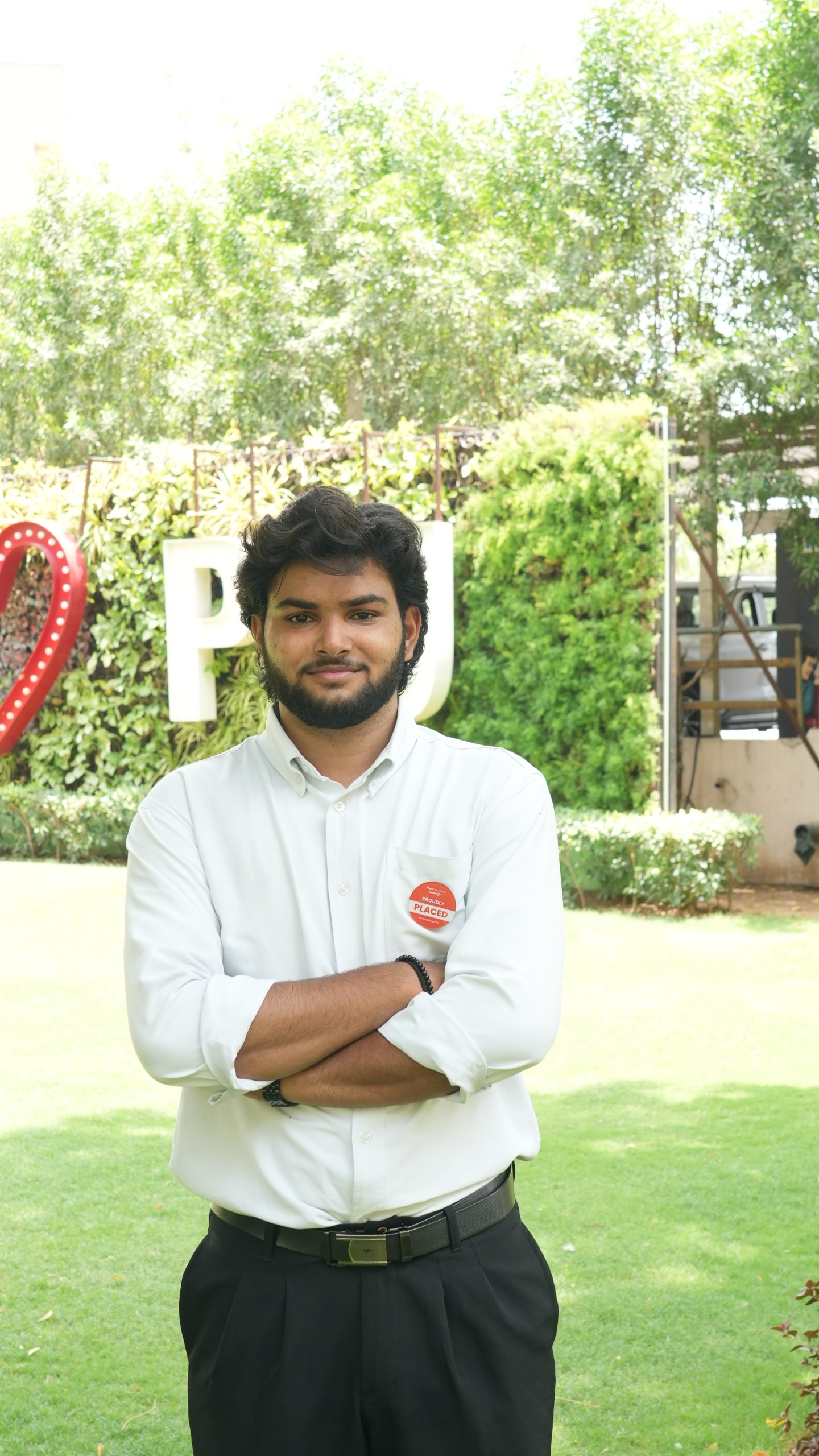
As he was born and raised in Tarsali (Vadodara), in a family where fabrication and contracting work shaped early exposure to the mechanical domain, Sanket chose to skip higher secondary school and enter a Diploma in Mechanical Engineering at Parul Polytechnic Institute directly after 10th Class. 3 years later, he has navigated the D2D – Diploma-to-Degree pathway into B.Tech in Mechanical Engineering at Parul Institute of Engineering & Technology. In May 2026, in his final year, he cleared the campus selection process & received a placement offer at Tetra Pak – the world’s leading food processing & packaging solutions company.
From Uma Vidyalaya to the diploma decision
Most students in Sanket’s school cohort moved to higher secondary education by default. He paused. He completed his schooling at Uma Vidyalaya in Tarsali, but then he consulted his father and his entire family for his career decision!
- Fabrication and contracting background: His father’s work environment gave Sanket early exposure to mechanical engineering terminology, workflows, and operational realities.
- Family advisory: Relatives in mechanical-related occupations confirmed the field’s alignment with his strengths and the family’s existing knowledge base.
- Leading to Tetra Pak: Mechanical Engineering’s industry-relevance, stability, and applied nature matched his learning style better than abstract academic tracks.
The diploma years: project work and early job offers refused
In his 3-year journey at Parul Polytechnic Institute, Sanket built a technically strong foundation that helped him in designing his final-year diploma project. His project was centred on the Multipurpose Agricultural Sowing Machine, designed to validate efficiency issues in smaller-scale farming operations and to eventually increase the mechanisation process for farmers. This was the very first successful project that helped him gain a concrete engineering output.
At the end of his diploma, the placement drives commenced. He cleared interviews at three to four companies. The offers came with a structural constraint that Sanket was not willing to accept. The recruiting companies wanted full-time joiners. Sanket wanted to continue to a B.Tech degree while working, asking only that the companies accommodate his examination schedule without funding the degree. None of the companies agreed. Sanket made the harder choice:
- Decline the immediate job offers: Each represented a guaranteed income but a closed academic ceiling.
- Tech Journey – Via a diploma-to-degree pathway at PIET, he was seeking a future-driven career trajectory!
- Self-fund the higher education investment: Trading immediate earnings for compounded career optionality.
D2D Pathway to PIET
This Diploma-to-Degree pathway at Parul University allowed Sanket to enter directly into the 2nd year of the B.Tech in Mechanical Engineering programme. This exclusive pathway is designed and recognised under the AICTE lateral entry framework that functions across diverse engineering disciplines of PIET. Besides this, the Placement Drive even captured the success story of Kondapalli Shanmukha Sai Ram’s ECE D2D story, which confirms the exclusive network & credibility of the T&P Cell!
At PIET, Sanket’s approach was deliberate. He did not chase rank or topper status. He maintained a steady CGPA of 7.48 across the B.Tech programme while structuring his time around three operational priorities:
- Academic competence: Conceptual clarity in mechanical engineering fundamentals rather than examination-driven memorisation.
- Project work: Hands-on technical projects that converted theory into demonstrable engineering output.
- Leadership and industry exposure: Society memberships, industry internships, and competition participation.
Academic projects: Smart India Hackathon and the Solar Panel Cooling System
During his B.Tech years, Sanket participated in the Smart India Hackathon (SIH), the Government of India’s flagship student innovation competition that brings together teams from across the country to solve real industry and government problem statements. His team’s focus was on a long-standing inefficiency in solar energy systems: the loss of photovoltaic output as panel temperatures rise during sustained sun exposure.
Solar panels lose efficiency when they overheat. The team built a cooling system to fix it. The Solar Panel Cooling System the team developed was designed to maintain panels at an optimal operating temperature, recovering the efficiency loss that occurs in standard installations under sustained Indian-summer conditions. The project demonstrated three things on Sanket’s emerging engineering profile:
- Applied thermal engineering: Direct application of heat transfer principles to a real renewable energy problem.
- Sustainable engineering orientation: Focus on clean energy efficiency improvement rather than only conventional mechanical applications.
- Team-based competitive engineering: Ability to operate within a multi-member team under SIH’s competitive structure.
ISHRAE leadership: Treasurer of the student chapter
One of the most underweighted credentials on Sanket’s profile, and one of the most decisive in his interview performance, was his role at the student chapter of the Indian Society of Heating, Refrigerating and Air Conditioning Engineers (ISHRAE). ISHRAE is the apex professional body for HVAC and refrigeration engineering in India, and its student chapter at PIET operates as an industry-academia bridge that the standard curriculum does not provide.
Sanket served as treasurer of the student chapter. The role taught him things the classroom could not.
The treasurer role placed Sanket inside the operational running of the chapter, where he handled:
- Budget management: Tracking chapter funds, planning expenditure for industrial visits and seminars, maintaining financial records.
- Event coordination: Organising factory visits, industrial tours, and technical seminars across the academic year.
- Public speaking: Hosting events and managing seminars in front of student peers and senior HVAC industry professionals.
- Industry interface: Direct interaction with HVAC and refrigeration sector professionals, gaining exposure to corporate communication norms.
Sanket identifies the ISHRAE chapter as the single most decisive credential in his interview readiness. Public speaking confidence transfers directly to interview composure.
Industry exposure at Saipona Engineers
Before the Tetra Pak’s placement chapter, Sanket completed a 15-day internship at Saipona Engineers, a packaging machinery manufacturer in the Vadodara region. The company specialises in packaging machines for products including spices and wafers, giving Sanket direct exposure to the packaging machinery design and operation domain that would later prove relevant in the Tetra Pak’s selection process. The short internship at Saipona Engineers produced three foundational learnings:
- Factory floor operations: How packaging machinery is assembled, calibrated, and operated under production conditions.
- Mechanical system integration: How individual mechanical components combine into functional packaging systems.
- Academic-to-industry translation: How textbook engineering principles map onto industry operational realities.
The Tetra Pak’s Internship & Pre-Placement Offer
Tetra Pak’s campus selection process at Parul University was conducted on 16 May 2026. The process ran across three stages.
Tetra Pak Pvt. Ltd. is the Indian operation of the Tetra Laval Group, the global food processing and packaging multinational. The company’s campus recruitment process at engineering colleges is structured around technical capability assessment combined with corporate fit evaluation. Sanket’s preparation began the moment he learned Tetra Pak was visiting campus. The Training and Placement Cell at Parul University provided structured logistical support: confirmed interview timings, dress code briefings, venue information, and mock interview practice. The three stages of the placement process were:
- Stage 1: Technical and aptitude test. Combined assessment of mechanical engineering fundamentals and general aptitude. Sanket cleared this stage and was selected among the twenty shortlisted candidates from across the screening pool.
- Stage 2: Technical interview. Domain-specific examination of mechanical engineering depth, project experience, and applied problem-solving. The composure Sanket had built through ISHRAE event hosting carried through this round.
- Stage 3: Human Resources interview. Corporate fit assessment, motivation evaluation, and final candidate confirmation. Sanket presented as a balanced candidate combining technical capability with the communication and behavioural qualities Tetra Pak’s HR layer was screening for. He cleared all three stages. The placement offer at Tetra Pak followed.
The mentor and the placement preparation infrastructure
Professor Ankit Pandya, the placement coordinator at PIET, served as Sanket’s direct mentor through the preparation cycle. The mentorship was practical and consistent. Whenever Sanket felt anxious during the preparation phase, Prof. Ankit Pandya motivated him to stay calm and provided structured guidance: Be patient, prepare thoroughly, stay composed.
The structured preparation infrastructure at the Training and Placement Cell complemented the personal mentorship through mock interviews, aptitude training sessions, and corporate interaction events. The same infrastructure is documented across other Parul University placement narratives, including Aayush Sharma Bank of America’s placement story, confirming the structural pattern.
Whatever will be, will be.
Sanket Ashwin Panchal, on the philosophy that anchored his preparation
What this means for B.Tech Mechanical Engineering students at PIET
Sanket’s trajectory carries specific signal value for two student populations at Parul University:
- Diploma students considering D2D entry to B.Tech: The pathway from Parul Polytechnic Institute to PIET preserves the practical diploma foundation while opening access to multinational campus recruiters that diploma-only credentials cannot reach.
- Tech Mechanical Engineering students at PIET: The progression from project work to society leadership to short industry internships to MNC campus selection is reproducible. Each component compounds across the four-year programme.
The Parul Institute of Engineering and Technology offers Mechanical Engineering across multiple specialisations and pathways, including the standard B.Tech in Mechanical Engineering, B.Tech in Mechatronics Engineering, B.Tech in Automobile Engineering, and the postgraduate M.Tech in Mechanical Engineering. The Diploma-to-Degree route at PIET, combined with the structured placement preparation through the Training and Placement Cell, the leadership opportunities through professional society chapters like ISHRAE, and the project ecosystem including the Smart India Hackathon and the PIERC incubation infrastructure, produces the kind of profile that converts in MNC campus selection processes.
FAQs
Who is Sanket Panchal & where did he get placed?
Sanket Ashwin Panchal is a proud final-year B.Tech Mechanical Engineering Student at PIET - Parul Institute of Engineering and Technology. Hailing from Tarsali (Vadodara), he started his journey with the D2D pathway after completing his Diploma in Mechanical Engineering at the Parul Polytechnic Institute. He has successfully championed an internship & placement offer at Tetra Pak Pvt. Ltd. via a 3-stage selection process!
What is the Diploma-to-Degree (D2D) pathway in Mechanical Engineering at Parul University?
The Diploma-to-Degree (D2D) pathway at Parul University allows students who have completed a three-year diploma in engineering to enter directly into the second year of the corresponding B.Tech programme. For Mechanical Engineering, the pathway connects the Diploma in Mechanical Engineering at the Parul Polytechnic Institute with the B.Tech in Mechanical Engineering at the Parul Institute of Engineering and Technology. The pathway is recognised under the AICTE lateral entry framework. D2D students retain the hands-on practical foundation from their diploma years and participate in the same campus placement drives as direct-entry B.Tech students.
How does Tetra Pak's campus selection process work at Parul University?
Tetra Pak's campus selection process at Parul University runs across three stages. Stage 1 is a combined technical and aptitude test that assesses mechanical engineering fundamentals alongside general aptitude. Stage 2 is a technical interview covering domain depth, project experience, and applied problem-solving. Stage 3 is a Human Resources interview that evaluates corporate fit and behavioural qualities. Sanket Panchal cleared all three stages on 16 May 2026, being shortlisted among twenty candidates after Stage 1 and progressing through to the final offer. Tetra Pak Pvt. Ltd. is the Indian operation of the Tetra Laval Group, the global food processing and packaging multinational.
What projects did Sanket Panchal complete during his engineering education?
Sanket Panchal completed multiple technical projects across his diploma and B.Tech years. During his diploma at the Parul Polytechnic Institute, he built the Multipurpose Agricultural Sowing Machine, designed to address efficiency problems in small-scale farming operations. During his B.Tech at PIET, he participated in the Smart India Hackathon with a Solar Panel Cooling System project that addressed the photovoltaic efficiency loss caused by panel overheating under sustained sun exposure. He also completed a 15-day industry internship at Saipona Engineers, a packaging machinery manufacturer in the Vadodara region specialising in machines for spices and wafers packaging.
What is the ISHRAE student chapter at Parul University?
The Indian Society of Heating, Refrigerating and Air Conditioning Engineers (ISHRAE) is the apex professional body for HVAC and refrigeration engineering in India. The ISHRAE student chapter at the Parul Institute of Engineering and Technology operates as an industry-academia bridge through factory visits, industrial tours, and technical seminars across the academic year. Sanket Panchal served as treasurer of the ISHRAE student chapter at PIET, responsible for budget management, event coordination, and public-facing seminar hosting. He identifies the ISHRAE chapter as the single most decisive credential in his interview readiness for the Tetra Pak campus selection process.
How does Parul University support Mechanical Engineering students for campus placement?
Parul University supports Mechanical Engineering students for campus placement through an integrated infrastructure operated across the Training and Placement Cell and the Faculty of Engineering and Technology. The framework includes structured aptitude training, mock interview sessions, communication skill development, corporate interaction events with named recruiters, professional society chapters including ISHRAE for leadership and industry exposure, project supervision through Smart India Hackathon and other competitions, and PIERC incubation support for entrepreneurial directions. The placement coordinator at PIET, Professor Ankit Pandya, provides direct mentorship through preparation cycles. Over 2,200 recruiting companies participate in Parul University campus placement drives, and the university has been awarded the Best University in Placements by ASSOCHAM for three consecutive years.