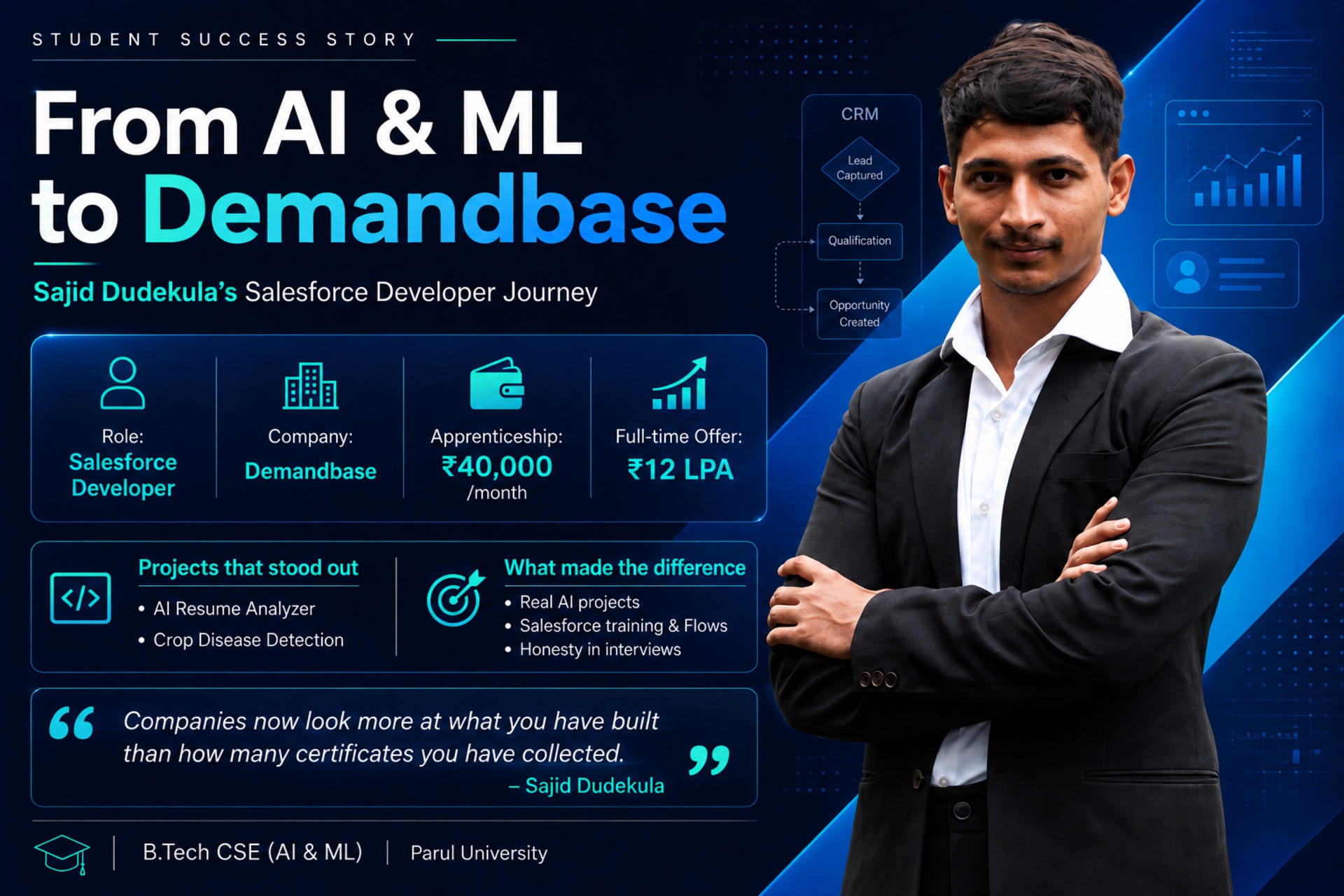
Not every strong career starts with a plan that survives contact with life. Sajid Dudekula, a final-year B.Tech CSE (AI & ML) student at Parul University, was placed at Demandbase, a San Francisco-based B2B go-to-market and account-based-marketing platform, as a Salesforce Developer, first through an apprenticeship at Rs 40,000 a month, then a full-time offer of Rs 12 LPA. The role sits at an unusual and increasingly valuable intersection: artificial intelligence and Salesforce development, and the way he arrived there is instructive for any student wondering how these paths connect.
From an Air Force Dream to a New Direction
Sajid is from Kurnool in Andhra Pradesh, from a middle-class family; his father is a bus driver, and the values he grew up with- hard work, discipline, and honesty- run through his whole story. Engineering was never the original plan. Since childhood, he had wanted to be an officer in the Indian Air Force, a dream that was partly his father’s too, a wish to see his son reach what he himself could not. After his intermediate, Sajid joined a defence academy directly and spent six months in physical training, running tests, and examinations, feeling his dream within reach. A health issue changed that. On his father’s advice he stepped back to continue his studies, a genuinely painful decision that cost him an academic year. Rather than stall, he started again, and now regards that difficult turn as the one that changed his life: one door closed, and another slowly opened.
The Turning Point at Parul University
Sajid joined Parul University for a B.Tech in Computer Science and Engineering with an AI & ML specialisation, knowing little about the field and simply wanting a fresh start. The first year was more of college life than study. The transition came in his second year, when he could notice how much his parents were doing to provide him the best education and being the eldest son, he could feel that responsibility on his shoulders. This realisation hit him that if he didn’t make good out of his education, the sacrifice of his parents would go to waste. Since then, he started focusing on studying only to pass and started working towards adding more skills, giving more and more time to technical learning outside the classroom and treating every semester as career preparation rather than a set of subjects to clear.
Learning About Artificial Intelligence and Machine Learning
Initially, AI, ML, neural networks, deep learning, etc., didn’t push him to gain deep knowledge of these terms. His curiosity led him to watch AI systems write content, generate images and answer questions; he wanted to understand how these tools work behind the scenes. He made his foundations strong, started with working on how machine learning works, how data is collected and used, and why maths matters, rewatching the video lectures to gain more insights into the topic from the lectures.
Over time, he worked through Supervised, Unsupervised, and Reinforcement Learning; Decision Trees, random forests, KNN, and clustering; Deep Learning, CNNs and RNNs; Computer Vision; Natural Language Processing; and Large Language Models.
He made genuine efforts to learn where each algorithm fits and memorised it for exams. Studied on the principle that no single model solves every problem, and as generative AI rose, he went deeper into LLMs and modern AI systems that create text and images rather than only predict outputs.
Also Read: Parul University Placement in 2026 with 3500+ Placement Offers.
The Projects That Got Him Hired
Companies now look more at what you have built than how many certificates you have collected.
– Sajid Dudekula
Sajid is emphatic that practical projects taught him more than theory, and that he built to solve real problems rather than to decorate a resume. Two projects carried him through his interviews. His AI Resume Analyzer, built for students and job seekers, compares a resume against a job description and reports how well they match: it uses the TF-IDF algorithm to surface important keywords, produces an ATS (Applicant Tracking System) score, and suggests missing keywords, and he later connected a Large Language Model so users receive richer suggestions rather than a bare score. His Crop Disease Detection system, built with farmers in mind, lets a user upload an image of a crop leaf and predicts the disease using a CNN model trained on the PlantVillage dataset, then uses a Large Language Model to recommend treatments such as pesticides and fertilisers.
One thing that he gained from writing code is that models can fail, outputs can give disappointing results, a single bug can at times take one whole day, and failure taught him that shipping something can solve real problems, and it is something that interviewers will remember.
Building Credentials Beyond the Classroom
Sajid backed his projects with a deliberate spread of experience. He started participating in events, workshops, etc that were related to his degree. He became a Google Student Ambassador, worked on workshops of the same, helped peers learn new technologies, and took a Machine Learning internship sponsored by IIT (BHU), Varanasi, to gain experience with AI and ML models. He took part in hackathons including the Google Big Code Challenge, the Cognizant TechnoVerse Hackathon, and the PU Code Hackathon, and earned certifications from IBM SkillsBuild, the Reliance Foundation Skilling Academy, and Salesforce, among others. Apart from academics, he joined NCC, and through these participations, he gained the experience of teamwork, leadership, and the habit of never giving up.
The Demandbase Interview
Sajid calls the Demandbase interview one of the toughest and best experiences of his placement journey. He never fixed himself on one specific company; before this interview, he sat for seven placement drives – some good, some not, some ending in rejection, and each one built his confidence. He started preparing almost two months before the announcement of the placement drive; he joined a two-week Salesforce training conducted by the Training & Placement Cell of Parul University. Through these trainings, students gain knowledge of working through the fundamentals of Salesforce, automation, and practical exercises that helped him in the interviews.
To get placed here, a few rounds were required; interviews and tests were conducted: the first was a written test, the second was GD, and the third round was a face-to-face interview.
The first round was passed so smoothly that he was in the top three and directly went to the technical round. The interviewers questioned him on both Salesforce and AI, handed him a laptop and asked him to demonstrate automation using Salesforce Flows, and probed his AI projects, his machine-learning models, and why he had chosen particular algorithms. He answered from what he had actually built, explaining his own work rather than reciting textbook definitions. One interview stayed with him: with Stacy, from the US team, who asked a few questions he could not answer. Instead of bluffing, he simply said he did not know, and worried it had cost him. She appreciated the honesty, telling him that technical skills can be learned later but honesty and a willingness to learn matter more. He also notes that the University’s Training and Placement Cell stayed with him throughout, mentoring him and arranging for his final HR round to be held on campus so they could support him if any technical issue arose. He completed four rounds in a single day, plus a final discussion, and left genuinely unsure he had done enough.
Companies can teach technical things. Honesty and a learning attitude matter more.
– Stacy, US team, as recalled by Sajid
The next day, he saw his name on the result. The apprenticeship at Rs 40,000 a month and the Rs 12 LPA full-time offer were, he reflects, not the product of technical knowledge alone, but of every prior rejection, every real project, daily learning, and staying honest under pressure.
What Does a Salesforce Developer Actually Do?
Because the role is less familiar than “data scientist” or “ML engineer,” it is worth explaining. Salesforce is one of the world’s most widely used customer relationship management (CRM) platforms, and a Salesforce Developer builds and customises applications on it. Much of the work is declarative, configuring business logic through point-and-click tools such as Salesforce Flows to automate processes without heavy code, and much of it is programmatic, using the platform’s development tools to extend functionality. For a company like Demandbase, whose product connects tightly to how B2B sales and marketing teams work, developers who can shape CRM workflows are valuable. Sajid’s combination is what makes his path notable: an AI & ML foundation plus Salesforce skills, so he can work where automation, data, and increasingly AI meet inside the systems businesses actually run on. It is a reminder that a specialised degree does not lock a student into one job title.
His Advice to Students
- Build projects, not just certificates: companies now weigh what you have built over how many certificates you hold, so solve real problems.
- Get the fundamentals first: understand Machine Learning, Deep Learning, and the basics properly before chasing the latest thing.
- Then go modern: layer on Large Language Models, RAG (Retrieval-Augmented Generation), Agentic AI, and AI assistants once your foundation is solid.
- Give many interviews: treat every drive as learning; rejections build the confidence that eventually converts.
- Stay honest: saying “I don’t know” with a willingness to learn beats bluffing, and interviewers notice.
Also Read: Getting Hired Through Hackathons, Efforts That Matter.
Frequently Asked Questions
What does a Salesforce developer do?
A Salesforce developer builds and customises applications on Salesforce, one of the most widely used CRM platforms. The work spans declarative automation, configuring business logic with point-and-click tools such as Salesforce Flows, and programmatic development to extend the platform’s functionality. Salesforce developers are in demand across companies that run their sales and marketing operations on CRM systems.
Can an AI or machine learning student become a Salesforce developer?
Yes. An AI/ML foundation combines well with Salesforce skills, since modern CRM work increasingly involves automation, data, and AI. Sajid Dudekula, a B.Tech CSE (AI & ML) student, trained in Salesforce alongside his AI projects and was placed as a Salesforce Developer at Demandbase, showing that a specialised degree does not restrict a student to a single role.
How do you become a Salesforce developer as a student?
Build a strong programming and problem-solving foundation, learn Salesforce fundamentals and automation (including Salesforce Flows) through training or self-study, and practise on real scenarios. Combining Salesforce skills with a complementary strength, such as AI/ML, and demonstrating real projects in interviews, strengthens a fresher’s prospects, as Sajid’s Demandbase placement shows.
What AI projects help a student get placed?
Projects that solve real problems and can be explained end to end. Sajid’s AI Resume Analyzer (using TF-IDF, an ATS score, and a Large Language Model) and Crop Disease Detection system (a CNN trained on the PlantVillage dataset, with LLM-based treatment suggestions) both stood out in interviews because he could explain what he built, why, and what he learned from its failures.