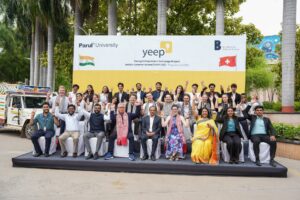
On 29 April 2026, H.E. Ameenah Gurib-Fakim, former President of Mauritius, UNESCO Laureate for Women in Science, and one of the world’s leading biodiversity scientists, spoke at Parul University’s IIMUN Global Perspective Series. She made a point that connects ancient medicine to modern healthcare systems, and it is a point that Parul University‘s own research validates.
India, she said, did something right: it codified and documented Ayurveda. The government deployed it across the health system. The WHO now recognises it. The knowledge that existed in texts like the Sushruta Samhita for thousands of years became part of the modern global healthcare infrastructure because it was written down, standardised, and validated through scientific frameworks.
Africa, she said, has equivalent medicinal plant knowledge. But it is transmitted orally. There are no written documents. No standardised research. The plants exist. The knowledge exists. But without codification, the knowledge remains invisible to modern healthcare systems, invisible to pharmaceutical companies, invisible to WHO policy frameworks.
“The good thing that the government of India has done is, first of all, to document and codify Ayurveda. And now it has been deployed across the health system. And the WHO recognises it.”
The Artemisinin Parallel: Same Plant, Different Fates
H.E. Ameenah Gurib-Fakim gave a specific example that makes the abstract principle concrete. Artemisinin, the cure for malaria that has saved millions of lives globally, comes from a plant known in Chinese traditional medicine. China had documented the plant’s properties. When modern pharmaceutical science needed an antimalarial compound, the documentation made it findable. Artemisinin became a WHO essential medicine.
An equivalent plant exists in Africa. People use it locally. But without documentation, without codification, without the kind of scientific validation that transforms folk knowledge into pharmaceutical evidence, the African equivalent remains unknown to the global system. The plant is the same kind of resource. The knowledge exists in the same way. The difference is documentation.
H.E. Ameenah Gurib-Fakim documented the first African herbal pharmacopoeia. She described codifying all African medicine knowledge as her dream. The scale of what remains undocumented is, by her account, enormous. The potential for developing medicine from African plants is huge. But the loss of biodiversity is faster in Africa, which means the window for documentation is closing.
The WHO Global Traditional Medicine Centre: In Gujarat, Same State as Parul University
The convergence is not coincidental. In 2022, the WHO established the Global Traditional Medicine Centre (GTMC) in Jamnagar, Gujarat, with USD 250 million in support from the Government of India. The foundation stone was laid by Prime Minister Narendra Modi in the presence of the Prime Minister of Mauritius and the WHO Director-General. The centre focuses on advancing research, facilitating knowledge exchange, conserving biodiversity, and fostering partnerships to connect ancient wisdom with modern science.
The WHO Global Traditional Medicine Strategy 2025-2034 was adopted at the 78th World Health Assembly in May 2025. It sets four objectives: strengthen evidence, ensure safety and regulation, integrate traditional medicine into health systems, and optimise its cross-sectoral value. Approximately 88 percent of all countries use traditional medicine. 170 of 194 WHO member states have reported its use. Over 40 percent of approved pharmaceutical products derive from natural substances.
Parul University sits in the same state, Gujarat, as this global centre. The university operates an Institute of Ayurveda with 2 NABH-accredited Ayurvedic hospitals. And it is doing exactly what the WHO strategy calls for: strengthening evidence, ensuring safety, and integrating traditional medicine with modern science through engineering.
The Karnadhoopan Device: What Codification Plus Engineering Actually Produces
While H.E. Ameenah Gurib-Fakim was describing the principle of codification at the IIMUN event, Parul University’s own researchers had already demonstrated what that principle looks like when applied. The Karnadhoopan Device, developed by a collaboration between the Institute of Ayurveda and the Faculty of Engineering at Parul University, takes a classical Ayurvedic ear fumigation procedure described in the Sushruta Samhita and engineers it into a precision medical device.
Karnadhoopan is an ancient procedure that uses medicinal herb smoke directed into the ear canal to treat CSOM (Chronic Suppurative Otitis Media), the leading cause of conductive hearing loss in India. The traditional method works but has no temperature control (burn risk), inconsistent dosage, no repeatability, and depends entirely on practitioner skill. The device controls four parameters: temperature, smoke density, flow rate, and duration. Medical-grade materials. Digital display. Sensors. GSBTM funded for 2025-26. Pilot studies show reduced discharge and symptom improvement.
This is the codification principle in action. The Ayurvedic knowledge (which herbs, which procedure, which condition) was already documented in the Sushruta Samhita. The engineering team standardised it through controlled delivery. The GSBTM grant validated it through funding. The pilot studies are generating evidence. The device could reach primary health centres where millions of CSOM patients currently have no treatment option.
H.E. Ameenah Gurib-Fakim said India codified Ayurveda and the world recognised it. Parul University is showing what happens in the next step: codified knowledge, re-engineered with precision, validated with data, and designed to scale.
Why This Matters for Students Choosing Between Traditional and Modern Medicine
The conventional framing positions traditional medicine and modern science as opposing systems. H.E. Ameenah Gurib-Fakim’s perspective, validated by Parul University’s own research, frames them as complementary systems that become powerful when integrated through documentation, standardisation, and engineering.
For students at Parul University, this integration is not theoretical. The Institute of Ayurveda and the Faculty of Engineering built the Karnadhoopan Device together. The Micro Nano Research and Development Center provides characterisation equipment. The 7 faculty members in the Stanford-Elsevier Top 2 Percent Scientists list include researchers from both traditional and modern science disciplines. Rs 58.31 crore in government-funded research across 315 projects supports this kind of interdisciplinary work.
Parul University offers programmes in Ayurved, Homoeopathy, Medicine, Pharmacy, Nursing, Engineering, and Applied Sciences. The Karnadhoopan Device could only have been built by an institution that houses both an Ayurveda faculty and an engineering faculty, and that has a research culture where the two collaborate rather than operate in silos.
Frequently Asked Questions
What did Ameenah Gurib-Fakim say about Ayurveda at Parul University?
She praised India for codifying and documenting Ayurveda, deploying it across the health system, and gaining WHO recognition. She compared it to African traditional medicine, which has equivalent plant knowledge but is transmitted orally without written documentation. She cited artemisinin (malaria cure from a Chinese plant) as an example of what codification makes possible. An equivalent plant exists in Africa but remains unknown because it is undocumented.
What is the WHO Global Traditional Medicine Centre in Gujarat?
Established in Jamnagar, Gujarat in 2022 with USD 250 million from the Government of India. Foundation stone laid by PM Modi in the presence of the PM of Mauritius and WHO DG. The centre focuses on research, knowledge exchange, biodiversity conservation, and partnerships connecting traditional and modern medicine. The WHO Global Traditional Medicine Strategy 2025-2034 was adopted in May 2025. Parul University operates in the same state with an Institute of Ayurveda and the Karnadhoopan Device research.
What is the Karnadhoopan Device at Parul University?
An engineered medical device that standardises Karnadhoopan, a classical Ayurvedic ear fumigation procedure from the Sushruta Samhita, for treating CSOM (chronic ear discharge). Controls temperature, smoke density, flow rate, and duration. Built by collaboration between the Institute of Ayurveda and Faculty of Engineering. GSBTM funded. Pilot studies positive. Designed for primary health centres.
How does traditional medicine connect to modern pharmaceuticals?
Over 40 percent of approved pharmaceutical products derive from natural substances. Artemisinin (malaria cure) originated from Chinese traditional medicine. Aspirin originated from traditional plant knowledge. The WHO recognises that codified traditional medicine systems like Ayurveda provide the foundation for evidence-based integration into modern health systems. India has invested USD 250 million in the WHO Global Traditional Medicine Centre in Jamnagar, Gujarat.