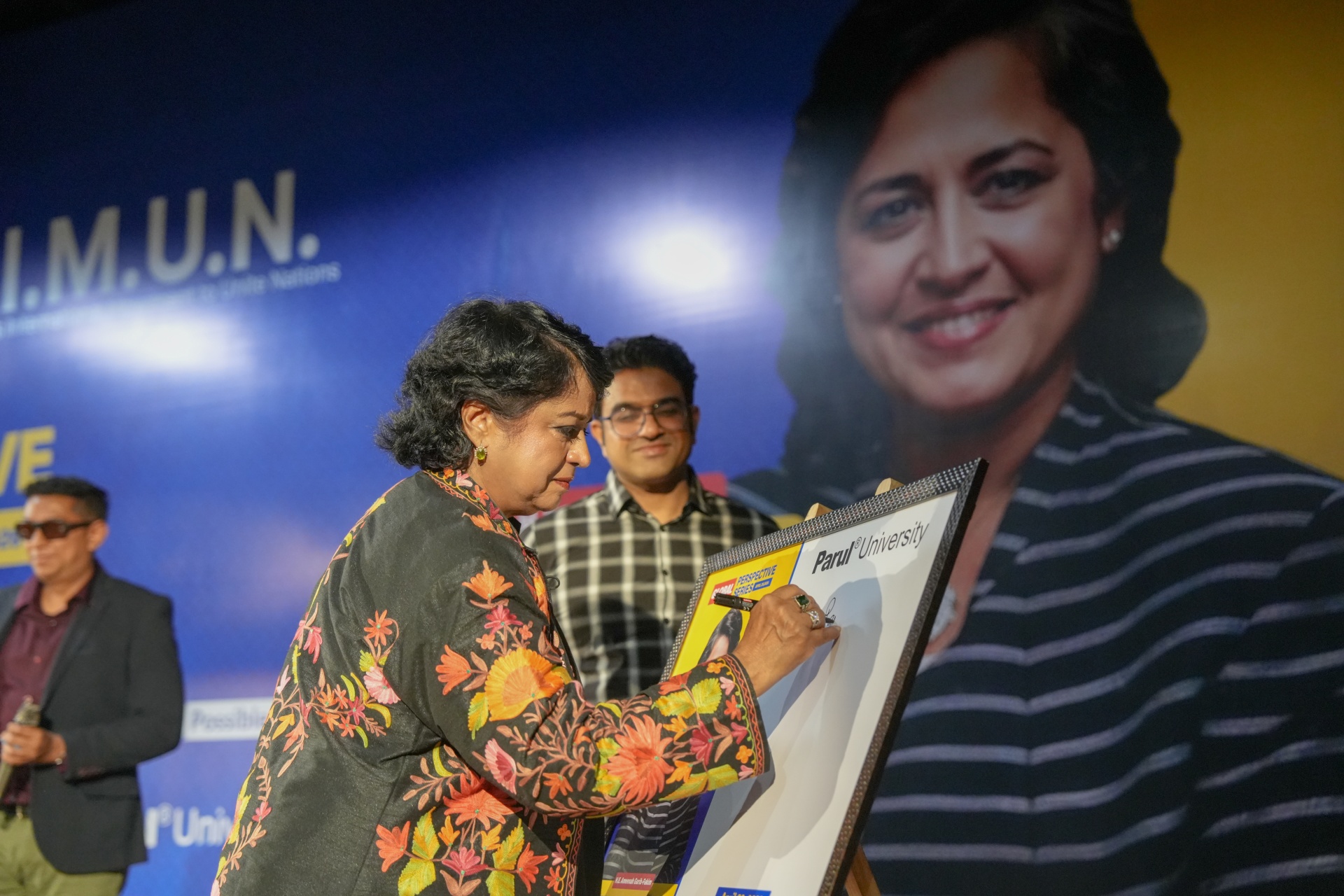
IIMUN Global Perspective Series welcomed H.E. Ameenah Gurib-Fakim to Parul University’s Central Auditorium on 29th April 2026. She is a biodiversity scientist and she made a history as the 6th president, and the first woman to hold that office in Mauritius. She has received the UNESCO Laureate Award for Women in Science and the African Union Award for Scientific Excellence.
She has authored over 28 books. She has served as an expert for international organisations across continents. She likes to visit India as has Indian roots, which trace to Lucknow, Uttar Pradesh.
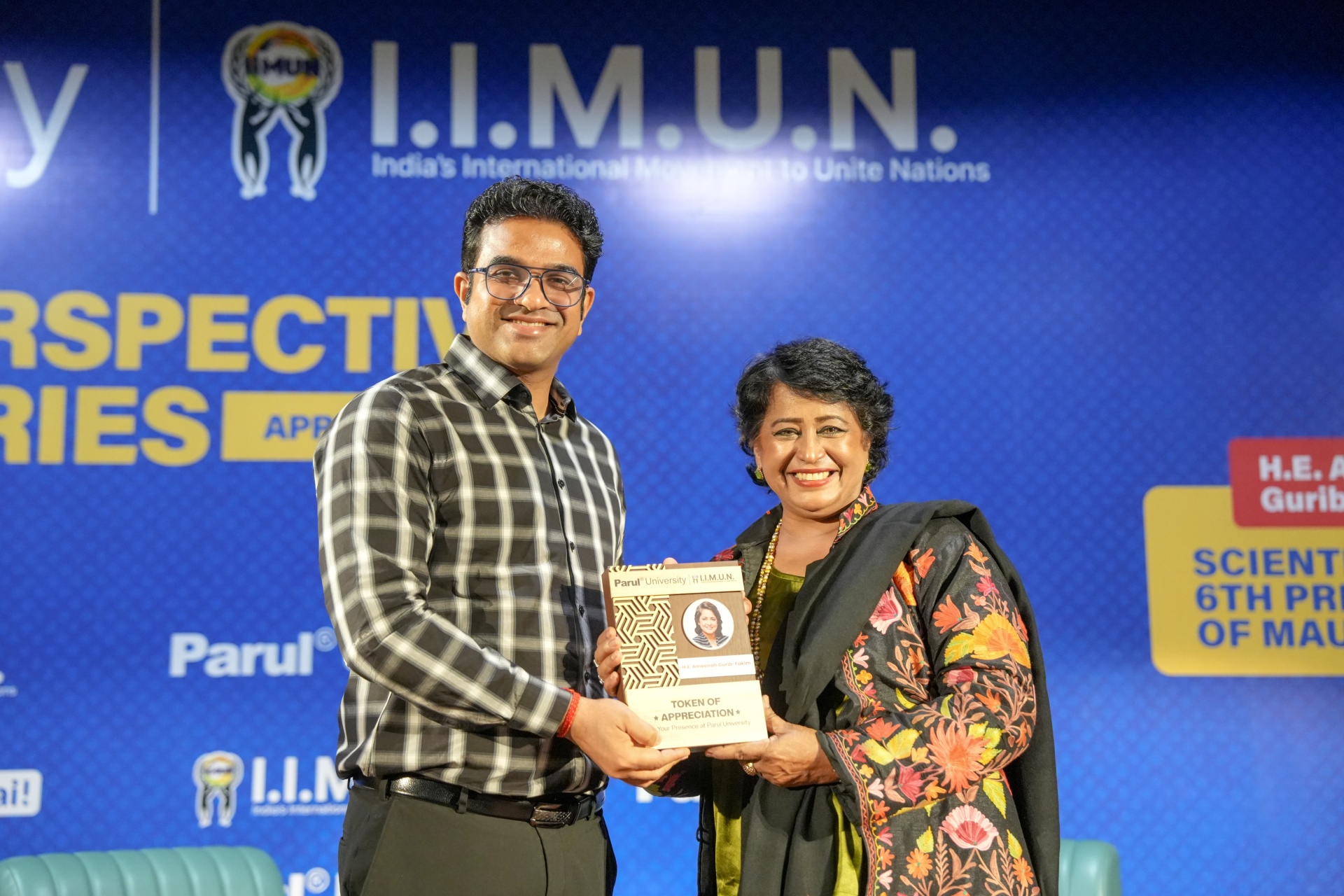
The session was hosted by RJ Shitij and Harshit Dave. Dr. Devanshu Patel, the president of Parul University, welcomed the former president of Mauritius with a memento. She was received with a huge round of applause by the audience, and what followed was more than a conversation. It was more of a conversation than a usual session. She talked about geopolitics, science, global warming, and more.
From Scientist to President: Why She Did Not Choose Politics
The first question was direct: why does a scientist go into politics? Her answer was equally direct. She did not choose the world of politics. She never had a name in politics. She had a name in academia and in entrepreneurship. Politics was not in her scope, she started her business after completing her studies.
This is what H.E. Ameenah Gurib-Fakim’s believes about leadership:
“In the world of science, everything is black and white. But in the world of politics, everything is grey. You have to manage by virtue of what is in front of you and then use your scientific acumen to see what is best in operation.”
During her year, she made two very important decisions:
First: She became part of the approval of the SDGs (Sustainable Development Goals) in September 2015. And shared about the timeline, which will not be met by 2030 when evaluation comes, she shared the timeline to maintain transparency.
The second: the Paris Climate Conference (COP), the first time the world recognised a common problem requiring differentiated solutions.
Climate Change Crisis: If Viewed Like COVID, The Changes Would Have Been Quick
She expressed her views on whether nations are doing enough or not to address the global climate change, she said:
“Climate change is real and the nations are not doing enough. We could have done it if we kept the same attitude as we did towards COVID. If we treat it as an emergency, we would see more progress.”
She connected climate to geopolitics: a rising multipolar world where middle powers are coming together, fragmentation is increasing, and a strong multilateral system is needed to tackle the crisis. She emphasised that this conversation matters most with young generations because it is going to be their problem.
How Does It Feel To Be a Woman in Power?
When asked about the problems she faced, her answer silenced the auditorium
“The main problem is myself. I am a woman.”
During the campaign, she was increasingly encouraged to step back. She stood her ground. She had nothing to lose. If anything, she could help serve her country at the highest level. It was the first time in Mauritius’s history that the name of the president was presented during the campaign. Previously, presidential candidates were not named publicly. When people voted, they knew this woman would be their president.
She drew a parallel with Dr. APJ Abdul Kalam, a rocket scientist who became India’s president and made history. In her own way, she said, she brought a similar mindset change to Mauritius.
India and Mauritius: Sugar, DTAA, and 70 Percent Indian Population
The moderator RJ Shitij noted that in Gujarat, sugar is called “moras” because it was historically imported from Mauritius. H.E. Ameenah Gurib-Fakim expanded on the economic history: after independence, Mauritius had a protected sugar market through the European Union’s sugar protocol. When that protection ended in 1998, the economy began diversifying. India’s Double Taxation Avoidance Agreement (DTAA) helped develop Mauritius’s financial sector, which now contributes approximately 25 percent of the national economy. Approximately 70 percent of the Mauritius population is of Indian origin.
For students at Parul University in Gujarat, this connection between their state’s linguistic heritage (moras) and Mauritius’s economic transformation illustrated how deeply intertwined the two nations are, not through recent diplomacy but through centuries of cultural and commercial exchange.
Ayurveda and African Medicine: Parallel Systems, Different Fates
When the anchor asked her what the similarities are between plant science and Ayurveda, her replies connected the dots with Parul University’s Ayurvedic Research (including the Karnadhoopan Device for CSOM treatment developed by the Institute of Ayurveda and Faculty of Engineering).
She was impressed with India’s part in codifying and documenting Ayurveda, deploying it across the health system, and gaining WHO recognition. In Africa, she said, they have equivalent medicinal plant knowledge, and it is given orally without a written document. She gave a specific example: artemisinin (the malaria cure) comes from a Chinese plant, but an equivalent plant exists in Africa, and people are not aware of it. She has complied and documented the first African herbal pharmacopoeia and described codifying all African medicine knowledge as her dream.
The parallel is instructive: India codified Ayurveda and now has WHO recognition and engineered medical devices based on ancient procedures. Africa has equivalent knowledge but without codification, it remains invisible to modern healthcare systems. The message to students: documentation and scientific validation transform traditional knowledge into institutional power.
The Era of Asia Rising and Wars as Resource Extraction
On whether global tensions affect island nations like Mauritius, H.E. Ameenah Gurib-Fakim placed the current moment in a 500-year historical frame. After five centuries of Western cultural domination, it is now the era of Asia rising. The last major transfer of political power was from Britain to America in 1945. The current transfer, toward Asia, will not be easy.
She described wars as fundamentally resource wars: the motive is to destabilise regions and extract resources. She noted that every bomb dropped costs 400 kg of critical minerals and the war in the Middle East over the preceding 50 days had already cost the American economy approximately 40 billion dollars. The number of houses, schools, hospitals, and healthcare that money could have funded is, in her word, unimaginable.
Educating Women Is Not the Right Thing to Do, It Is the Smart Thing to Do
A student from mass communication asked about scientific literacy for solving global challenges. H.E. Ameenah Gurib-Fakim answered through food security: in India and especially in Africa, women feed the country. If these women are empowered with technology tools and sound education, the result is increased productivity, increased yields, and better crop choices within a changing climate. In Africa, 85 percent of agriculture is rain-fed and driven by smallholder farmers.
“Educating women is not the right thing to do. It is a smart thing to do.”
Giving Up Is Not An Option: Her Advice
Her advice to students was simple but inspirational: “Never Give Up.” She spoke with compassion and empathy. She said usually the beginnings are small, but you keep adding to it, which leads to a large change. When asked about designing a new global institution that can be run by under 30 people, who are young and youthful, she said the primary goal should be peace and that UN reform, particularly African representation on the Security Council (1.4 billion people with no permanent seat versus 40 percent of the Council representing 150 million), is where young people must focus their energy.
Her final message to the Parul University audience:
“One thing that you have to remember in life is that it will not be easy. And there will be a lot of down time, down moments, but you have to make sure that the recovery is always efficient. Never, ever give up. If you give up, you play in the hands of the oppressor.”
What This Event Says About Parul University's Global Platform
Parul University’s IIMUN Global Perspective Series brought a former head of state, a UNESCO Laureate, and a globally recognised biodiversity scientist to speak directly with students in Vadodara. This is the same campus where 6,000+ international students from 75+ countries study, where the BFH Switzerland Innovation Management Programme sends 11 students to Bern annually, where 120+ foreign university partnerships operate, and where the PIERC startup ecosystem has incubated 254 startups.
The PU Talks platform has hosted 150+ speakers ranging from global leaders to youth icons. H.E. Ameenah Gurib-Fakim joins a speaker roster that includes D.Y. Chandrachud (Former Chief Justice of India), Dr. R. Venkataramani (Attorney General for India), Nitin Gadkari, Saina Nehwal, and Dr. Vijay Bhatkar (Padma Bhushan and Padma Shri Awardee, architect of India’s supercomputing initiative). The event was organised through IIMUN, an organisation empowering the next generation to engage in high-level dialogue and solve real-world problems. NAAC A++ (CGPA 3.55). MS Dhoni as brand ambassador.
Frequently Asked Questions
Who is H.E. Ameenah Gurib-Fakim?
The sixth president of Mauritius and the first woman to hold that office. A biodiversity scientist who received the UNESCO Laureate Award for Women in Science and the African Union Award for Scientific Excellence. Author of 28+ books. Indian roots from Uttar Pradesh, Lucknow. She spoke at Parul University's IIMUN Global Perspective Series on 29 April 2026.
What did Ameenah Gurib-Fakim say about climate change?
Nations are not doing enough. If the world treated climate change with the same urgency as COVID, more progress would be made. She participated in two landmark UN decisions: the SDGs approval (September 2015) and the Paris Climate Conference (COP). She said SDGs will not be met by 2030 and that young generations must engage because climate change will be their problem.
What global leaders have spoken at Parul University?
H.E. Ameenah Gurib-Fakim (former President of Mauritius), D.Y. Chandrachud (former Chief Justice of India), Dr R. Venkataramani (Attorney General for India), Nitin Gadkari, Saina Nehwal, Dr Vijay Bhatkar, and 150+ others through PU Talks and IIMUN. NAAC A++ (CGPA 3.55). 6,000+ international students from 75+ countries.
What is the IIMUN Global Perspective Series?
A programme organised by IIMUN (International Indian Model United Nations) at Parul University bringing global leaders, heads of state, and thought leaders to engage directly with students. IIMUN is an organisation empowering the next generation to engage in high-level dialogue and solve real-world problems. The April 2026 session featured H.E. Ameenah Gurib-Fakim speaking on youth, climate, women in leadership, and geopolitics.