The AICTE IDEA Lab inside Lakshya 2047 is two distinct workshop zones, not one. The Minor Machine Lab handles electronics, 3D printing, and precision prototyping. The Major Machine Lab handles heavy industrial fabrication. This article covers the second.
The Major Machine Lab sits adjacent to the AICTE IDEA Lab Prototyping Zone (Minor Machine Lab) inside Parul University’s Lakshya 2047 – Centre for Future Skills, inaugurated by Union Minister Dr. Jitendra Singh on 8 May 2026. While the Minor Machine Lab is built for additive manufacturing, electronics fabrication, and precision prototyping, the Major Machine Lab is built for subtractive manufacturing and heavy fabrication. Eight pieces of industrial-grade equipment cover wood cutting, metal drilling, precision machining, computer-controlled fabrication, and the full traditional manufacturing workflow that production-line work and fabrication services depend on.
Why a separate Major Machine Lab matters
Heavy industrial fabrication is a different skill stack from electronics prototyping. Different equipment safety practices, different career trajectories, different employer pool.
A student who can solder a circuit board on a YIHUA station and a student who can fabricate furniture-grade joints on a Band Saw and Mitre Saw are not the same workforce profile. The Minor Machine Lab develops electronics fabrication, PCB design, additive manufacturing, and precision prototyping competence. The Major Machine Lab develops heavy fabrication competence: cutting wood and metal at production scale, drilling holes accurately for assembly, milling and turning metal components, computer-controlled router work, laser cutting and engraving, and the angular cutting that furniture-making and structural fabrication require. Both skill stacks matter for the Make in India workforce capacity, but they target different sectors of the manufacturing economy.
The split structure also reflects different safety regimes. Heavy fabrication equipment requires different personal protective equipment, different operational discipline, and different machine-handling protocols than the bench-grade tools in the Minor Machine Lab. The Major Machine Lab is designed for this heavier safety regime, with the spacing, ventilation, and supervised-access structure that industrial-grade equipment requires. The Make in India workforce demand discussed in the AICTE IDEA Lab, plus Make in India plus NEP 2020 multi-mission article rests substantially on the kind of hands-on fabrication competence that this lab develops.
Equipment 1: Band Saw
- What it does. Cuts wood, plastic, and soft metal materials into different shapes and sizes. The continuously moving blade achieves smooth and accurate cutting during fabrication and prototype development work.
- Specifications. Motor Power 1 HP to 2 HP, Voltage 220V to 240V, continuous blade cutting system, adjustable cutting table, heavy-duty frame structure.
- What students do with it. Curved cutting, shape cutting, prototype preparation, woodworking activities, design fabrication work. Students gain practical exposure to cutting operations, material handling, and workshop fabrication techniques.
- Career relevance. Furniture-making, signage fabrication, prop-making for film and theatre, custom carpentry, prototype design fabrication services.
Equipment 2: Belt and Disc Sander
- What it does. Smooths, shapes, and finishes wooden and other material surfaces. Combined belt sanding and disc sanding systems improve surface finishing quality during prototype and fabrication work.
- Specifications. Motor Power 0.5 HP to 1 HP, Speed Range 1400 to 2800 RPM, combined belt and disc sanding setup, stable workstation design, electric motor-powered system.
- What students do with it. Surface smoothing, edge finishing, material shaping, prototype finishing, product development work. Students learn practical finishing techniques and material preparation processes.
- Career relevance. Finishing specialist roles, furniture finishing, prototype finishing services, product design fabrication where surface quality matters commercially.
Equipment 3: Bench Top Drill Machine
- What it does. Drills accurate holes in wood, plastic, and metal materials. Students learn the complete drilling process, including material positioning, speed adjustment, and drill bit operation.
- Specifications. Motor Power 0.5 HP to 1 HP, Speed Range 500 to 3000 RPM, adjustable drilling depth system, vertical drilling mechanism, stable metal body structure.
- What students do with it. Precision drilling, prototype manufacturing, fabrication work, material processing, workshop activities. Practical exposure to drilling operations, measurement techniques, and machine handling.
- Career relevance. Foundational fabrication skills across furniture-making, mechanical assembly, metal fabrication, and custom manufacturing services.
Equipment 4: Scroll Saw (Makita)
- What it does. Precision cutting and detailed shape cutting operations. The Makita scroll saw is compact and suitable for artistic and design-based fabrication work.
- Specifications. Variable speed operation, fine blade cutting mechanism, electric motor-powered system, adjustable worktable setup.
- What students do with it. Intricate design cutting, craft work, model making, prototype development, creative fabrication projects. Students learn precision cutting and detailed shaping techniques.
- Career relevance. Custom craft work, artistic fabrication, model-making services, design-led product development, niche fabrication entrepreneurship.
Equipment 5: Desktop Lathe Cum Milling Machine (Proxxon)
- What it does. Small-scale machining, shaping, drilling, and milling operations during prototype development and precision engineering work. The Proxxon machine supports both turning and milling operations in a compact setup, which is unusual for educational lab equipment.
- Specifications. Compact precision machining setup, variable speed control system, electric motor-powered operation, combined milling and turning functionality, stable metal construction.
- What students do with it. Precision machining, small component manufacturing, prototype development, engineering model preparation, educational machining activities.
- Career relevance. Precision component manufacturing, custom machining services, mechanical prototype development, small-scale industrial entrepreneurship. The lathe-and-mill combination is what distinguishes this equipment from typical educational lab access.
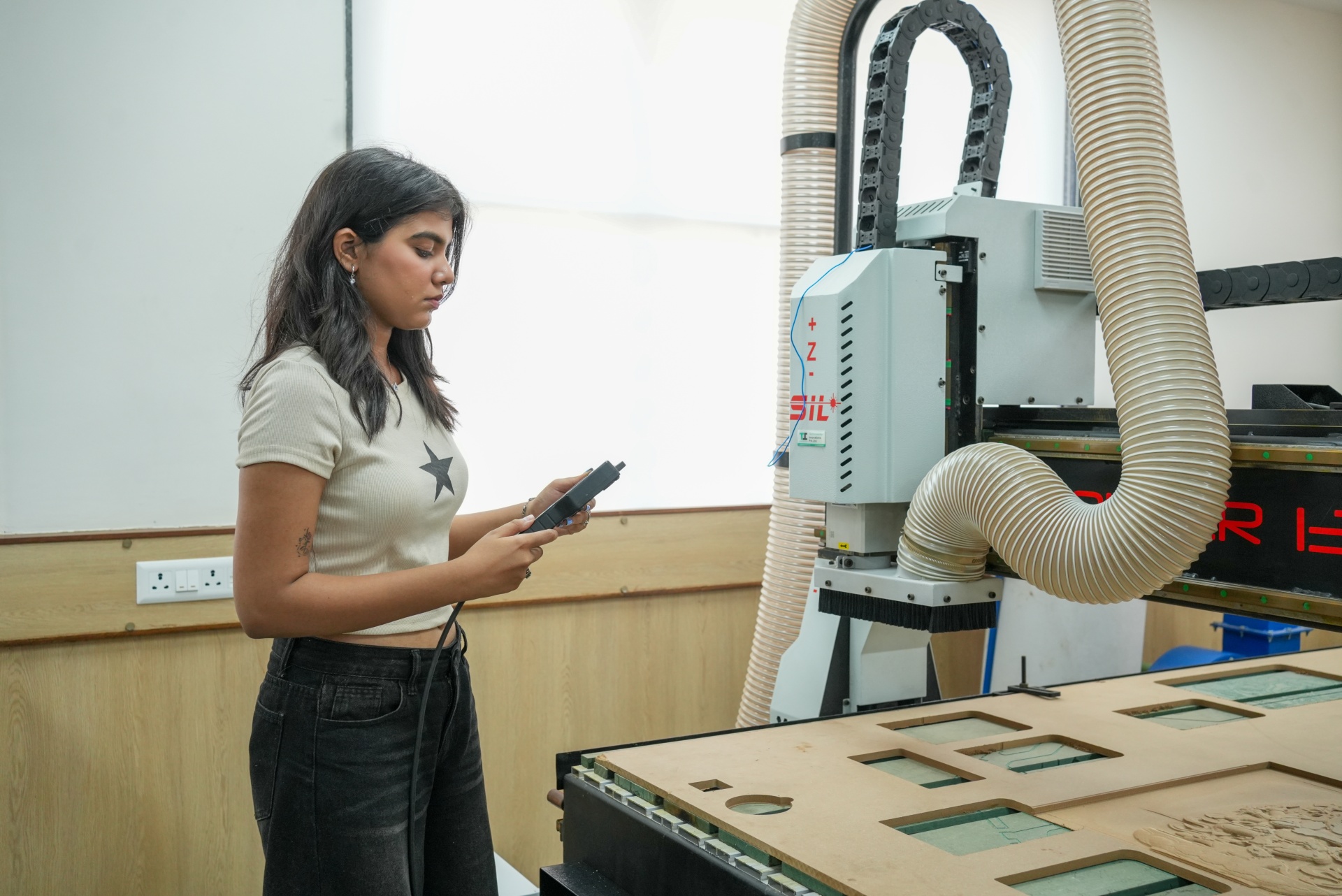
Equipment 6: CNC Router
- What it does. Automated cutting, carving, engraving, and shaping operations in wood, acrylic, MDF, and other materials. Computer-controlled programming achieves accurate and precise cutting results during fabrication and prototype development.
- Specifications. Computer-controlled machining system, high-speed spindle motor, automatic tool movement mechanism, precision cutting and engraving setup, stable heavy-duty machine structure.
- What students do with it. Wood carving, engraving work, prototype manufacturing, product design models, and industrial fabrication activities. Practical exposure to CNC programming, digital fabrication workflow, precision machining, and automated manufacturing systems.
- Career relevance. CNC programming and operation are among the higher-demand fabrication skills in modern manufacturing. The intersection of computer programming with physical fabrication is what makes CNC competence economically valuable across sectors from furniture to aerospace components.
Equipment 7: Laser Cutter
- What it does. Precision cutting and engraving operations using laser beam technology. The machine cuts materials accurately through digitally controlled laser movement.
- Specifications. Laser-based cutting system, computer-controlled operation, high-precision engraving setup, digital design compatibility, enclosed safety structure.
- What students do with it. Acrylic cutting, MDF cutting, engraving work, prototype preparation, design and fabrication projects. Practical exposure to digital fabrication, precision cutting, engraving techniques, and automated workflow.
- Career relevance. Laser cutting services are a substantial entrepreneurial pathway. Signage, custom gifting, architectural model-making, jewellery prototyping, and many adjacent sectors hire or contract laser cutting specialists. The capital requirements for entering the laser cutting services market have come down substantially as equipment prices have fallen.
Equipment 8: Mitre Saw
- What it does. Accurate angle cutting and straight cutting operations in wood and other materials. The rotating circular blade achieves smooth and precise cuts during fabrication and woodworking.
- Specifications. Motor Power 1 HP to 2 HP, Voltage 220V to 240V, high-speed circular blade system, adjustable angle cutting setup, stable workstation structure.
- What students do with it. Angle cutting, woodworking projects, furniture preparation, prototype fabrication, material sizing work. Practical exposure to cutting operations, angle measurement, machine handling, and workshop fabrication techniques.
- Career relevance. Furniture-making, custom carpentry, construction fabrication, prototyping services. Angle-cutting competence is foundational for any career involving structural wood or metal fabrication.
Career pathways the Major Machine Lab opens
- CNC Programmer and Operator. CNC competence is in active demand across furniture manufacturing, signage, custom fabrication, aerospace components, automotive components, and the broader machining services industry. The CNC Router work in this lab is foundational training for this pathway.
- Laser Cutting Services Entrepreneur. Laser cutting services have low capital requirements relative to demand. Common entrepreneurial ventures include custom signage, wedding stationery and gifting, architectural model-making, custom acrylic work, and educational prototyping services for other startups.
- Furniture and Carpentry Specialist. Modern furniture-making combines traditional woodworking (band saw, mitre saw, sanding) with digital fabrication (CNC Router, Laser Cutter). The combined skill stack from the Major Machine Lab is directly applicable.
- Fabrication Services Operator. Custom fabrication shops serve product startups, prototyping needs, architectural firms, and industrial customers requiring small-batch or one-off fabrication. The full equipment range in the lab maps to the services these shops provide.
- Precision Machining Specialist. The Desktop Lathe Cum Milling Machine (Proxxon) develops precision machining competence for small-component manufacturing, particularly relevant to instrument-making, watch and clock work, jewellery, and miniature mechanical components.
- Manufacturing Operations role at automotive or industrial firms. Hands-on fabrication experience is valued in entry-level manufacturing operations roles where graduates need to understand the physical reality of production processes.
- Industrial Entrepreneurship. Setting up small-scale manufacturing operations requires both design competence (covered in Autodesk and ANSYS labs) and fabrication competence (covered in this lab). The combination is what enables industrial entrepreneurship at a viable economic scale.
How the Major Machine Lab connects to other Lakshya 2047 labs
The Major Machine Lab pairs structurally with several other labs across the centre. The Autodesk Lab produces CAD designs that the CNC Router and Laser Cutter then fabricate. The AICTE IDEA Lab Prototyping Zone (Minor Machine Lab) provides the electronics and 3D printing capability that complements the Major Machine Lab’s subtractive manufacturing. The ANSYS Lab enables simulation of designs before fabrication, with the Major Machine Lab providing the physical realisation step.
For students pursuing manufacturing entrepreneurship, the connection to the industrial automation cluster (PLC and SCADA Lab, Industrial Drives and Control Lab, ABB Lab, Home Automation Lab) provides the automation competence that complements the hands-on fabrication. Together, the Major Machine Lab plus the industrial automation cluster cover both the hands-on physical fabrication side and the automated production-line side of modern manufacturing. The PIERC startup pipeline supports students taking fabrication and manufacturing ventures to market.
FAQs
How is the Major Machine Lab different from the Minor Machine Lab inside Lakshya 2047?
The two sub-labs cover different fabrication domains. The Minor Machine Lab handles additive manufacturing (Bambu Lab 3D Printer, PRUSA XL, ELEGOO Resin Printer), electronics fabrication (DGSHAPE SRM-20 desktop milling for PCB work, Puhui T-962A IC Heater, YIHUA soldering stations), and precision prototyping. The Major Machine Lab handles subtractive manufacturing and heavy fabrication: cutting wood and metal at production scale (Band Saw, Mitre Saw, Scroll Saw), drilling (Bench Top Drill), surface finishing (Belt and Disc Sander), combined turning and milling (Desktop Lathe Cum Milling Machine Proxxon), and computer-controlled fabrication (CNC Router, Laser Cutter). Both sub-labs together cover the full fabrication workflow.
Which Parul University programmes access the Major Machine Lab?
Multiple Engineering and Design programmes engage the lab. B.Tech in Mechanical Engineering students are the primary users for the machining, fabrication, and metalwork dimensions. Diploma in Mechanical Engineering students engage the lab for foundational fabrication skills. Design programmes engage in product design, fabrication, and prototype development. B.Arch programmes use the lab for architectural model-making. Cross-faculty entrepreneurial students pursuing fabrication-based ventures access the lab for prototype development.
Does the Major Machine Lab issue specific certifications?
The lab operates inside the broader AICTE IDEA Lab scheme framework alongside the Minor Machine Lab. The scheme framework provides regulatory recognition for the prototyping infrastructure. Specific equipment-vendor certifications are less applicable for traditional fabrication equipment (Band Saws, Drill Machines, Sanders) than for the digital equipment in other labs. CNC and laser cutter competence is increasingly recognised through industry workforce credentials that students can pursue based on the lab's hands-on training. The lab's primary credential value is the hands-on operational competence it develops, which is what employers in manufacturing and fabrication services actually hire for.
How does heavy industrial fabrication competence support Make in India workforce demand?
Make in India's manufacturing expansion requires workforce capacity across both automated and manual fabrication. The industrial automation cluster inside Lakshya 2047 develops the automated production-line competence. The Major Machine Lab develops the hands-on fabrication competence that complements automation. Most manufacturing operations require both layers: automated production lines operate alongside skilled manual fabrication for prototyping, custom work, repair operations, and the broader fabrication tasks that automation does not handle economically. Graduates with both layers of competence are positioned for the operational reality of modern Indian manufacturing rather than for a purely automated vision of the sector.
What safety practices does the Major Machine Lab teach alongside fabrication skills?
Heavy fabrication equipment requires substantial safety discipline. The lab's training covers personal protective equipment usage (safety glasses, hearing protection, dust masks for sanding work), machine-specific safety protocols (Band Saw blade tension and guard positioning, Drill Machine secure work-holding, CNC Router and Laser Cutter enclosure operation, Miter Saw blade guard discipline), workshop ventilation and dust management, electrical safety for industrial equipment, and the operational discipline of never leaving running equipment unattended. The safety regime is structurally different from electronics lab safety and is part of what the lab's training develops.