A deep-dive into the importance of Project
CIDCO Package 4 is a part of the Navi Mumbai Mass Housing Project. It covers housing units in Bamandongri, Kharkopar East & West, and Sector 39 of Taloja, with a total of 23,432 tenements. The project provides cost-effective housing for Economically Weaker Sections (EWS). Besides this, it also includes a multi-level car parking facility at Kharkopar.
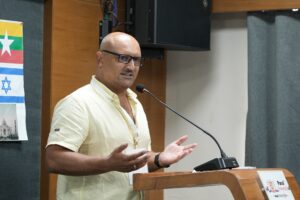
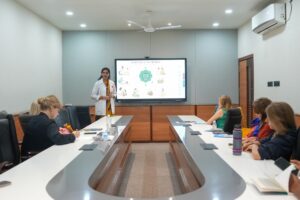
Briefing to Parul University’s Students
- Sanjay Dahedar, Superintending Engineer (Retired), CIDCO Ltd
- Sunil K. Samantaray, Project Director, TCE HSA JV
- Nawaz Shareef, Project Director, L&T (Main Contractor)
Raw & Real Observation by Parul University’s Students
- Precast concrete slabs being assembled: manufactured in a factory, transported, and fitted on site like modular components
- Monolithic construction techniques for structural elements
- Grouting processes for joining precast elements
- EWS housing design: how architects and engineers balance cost, space, structural safety, and livability for mass affordable housing
- Project coordination between CIDCO (the development authority), L&T (the contractor), and TCE HSA JV (project management)
The session connected directly to Er. Mahesh Tendulkar’s later discussion about precast housing: factory-made rooms cured in steam rooms and stacked by crane to build a 22-storey tower in 2-3 months. CIDCO Package 4 is that technology deployed at a scale of 23,432 units.
Site 2: AFCONS C-2 Bullet Train Tunnel at Vikhroli (Day 2)
Importance of Project
Primarily, this project is the C-2 section of the Mumbai-Ahmedabad High-Speed Rail (MAHSR). It is commonly known as the bullet train corridor and is being executed by AFCONS Infrastructure Limited, a Shapoorji Pallonji Group company. This tunnel will carry trains at speeds exceeding 250 kmph through dense urban Mumbai, requiring engineering precision with zero space for error.
Student Briefing
- Sunil Tyagi, Director of Project Operations, AFCONS Infrastructure
- Arun Deore, Chief Risk Officer, AFCONS Infrastructure
Students were truly inspired as both senior leaders engaged directly with them, answered questions, and shared experiences and perspectives on project management, engineering challenges, and risk mitigation. Subsequently, AFCONS posted about the visit on their official LinkedIn page, and Parul University students reposted it as well.
Student Observation
- The double-D shaped tunnel shaft: designed to allow excavation in both directions simultaneously, accelerating the boring process. After tunnel breakthrough, the shaft will be converted into an air conditioning and ventilation point for the operational rail corridor
- Tunnel Boring Machines (TBMs): massive precision machines imported specifically for this corridor, boring through varying geological conditions beneath Mumbai
- NATM (New Austrian Tunneling Method): an observational method where the rock mass around the tunnel is monitored continuously, and support is adjusted in real time based on actual ground behaviour rather than pre-calculated designs
- Safety systems engineered for trains at 250+ kmph: fire safety, ventilation, emergency evacuation routes, and structural redundancy requirements that far exceed standard metro or highway tunnels
- Geological analysis: core samples, soil strata mapping, and how unexpected rock or water conditions force real-time engineering decisions
Besides this, Mr. Tyagi spoke to students about the Atal Tunnel at Rohtang, the world’s longest highway tunnel above 10,000 feet. It is one of the premium case studies in extreme-condition tunnelling. He also discussed geological studies, ventilation systems, safety features, and the socio-economic impact of reducing travel time between Leh & Manali into a year-round connection for both civilian and defence use. If you too wish to build a career in civil engineering and infrastructure, delay no further and enrol into the B.Tech in Civil Engineering Program at Parul University!
Site 3: Runwal Garden City at Dombivli (Day 3)
About Project
Runwal Garden City is a premium-scaled township project in Dombivli, developed by Runwal Enterprises. This project is in sync with the Indian Green Building Council (IGBC) quality standards of sustainable construction. It’s executed in phases using a Cluster Development Approach.
Students Briefing
- Prashant Dhole, Executive Vice President and Construction Head of Runwal Group, spoke on sustainability practices, IGBC execution, RERA compliance, and planning philosophy.
- Raj Rangani, Planning & Construction Engineer, led the technical on-site tour followed by discussions on real-world experiences and case studies.
Interesting Observations by PU Students
- STP – Sewage Treatment Plant is a dedicated on-site facility for wastewater treatment and end-to-end recycling, demonstrating how a township can manage its own water sustainability.
- Biogas Plant – Organic waste from the township is converted into energy through anaerobic digestion, showcasing how residential projects can generate renewable energy from waste streams.
- The Plumbing System – A modern water distribution system designed across different project clusters, ensuring reliable supply despite the scale of the township.
- Aluminium formwork technology – A modern framework system that ensures speed, precision, and consistency compared to traditional timber or steel formwork. Aluminium forms can be reused multiple times, reducing cost, time, and construction waste.
- Cluster development – The township was developed in planned phases, creating a balance between infrastructure growth, timely delivery, and community readiness.
The sustainability integration at Runwal Group directly connects to Ar. Hafeez Contractor’s warning about India’s urban future: the country needs dense cities to protect farmland and forests. Runwal Garden City demonstrates what responsible urban density looks like in practice through on-site water recycling, waste-to-energy systems, and IGBC green building standards aimed at reducing environmental impact at every level.
Site 4: NHAI Regional Office, Mumbai (Day 2)
What students learned
- Highway project implementation models: EPC (Engineering, Procurement, Construction), BOT (Build, Operate, Transfer), and HAM (Hybrid Annuity Model). Each model allocates risk, financing, and responsibility differently between the government and private contractors.
- Sustainability measures already in practice: waste plastic mixed into road surfaces, fly ash utilisation, and plantation drives along highways.
- Digital monitoring: drones and advanced project management systems providing real-time visibility into construction progress, quality, and compliance across highway corridors.
- Flood-control strategies: expressway design that accounts for water drainage, flood-prone zones, and climate resilience.
- Regional focus: projects improving connectivity in Maharashtra, including expressways and corridors linking ports, industrial hubs, and cities.
The session demonstrated that NHAI’s work extends far beyond laying asphalt. It encompasses project finance, environmental management, technology-driven monitoring, and long-term infrastructure stewardship. For students considering government engineering careers, NHAI represents one of the most impactful employers in India. Such tours are rarely experienced at this scale in other universities across India. If you too wish to gain such exposure, delay no further and enrol in Parul University’s M.Tech in Construction Project Management program!
Site 5: RAHSTA Expo at Jio World Convention Centre (Day 4)
RAHSTA is Asia’s largest road, highway, and infrastructure exhibition, held at the Jio World Convention Centre in Mumbai. The expo showcased innovations from over 200 companies spanning:
- Sustainable road construction materials and techniques
- Intelligent infrastructure solutions (sensors, monitoring systems, AI-assisted maintenance)
- Tunnelling and bridge engineering technologies
- Live demonstrations of construction machinery and equipment
- The RAHSTA Awards 2025, recognising excellence in construction practices and innovation
The expo formed part of the broader India Construction Festival. For students, it provided a panoramic view of the technologies, companies, and career opportunities that define the infrastructure sector, all within a single venue and over the course of a single day.
Beyond Classrooms - What Site Visits Teach That Classrooms Cannot
The difference between a classroom and a construction site is the difference between knowing a formula and watching a 30-metre precast column travel 12 kilometres through Mumbai traffic at 2 kilometres per hour. Students can study TBM specifications in a textbook. Standing next to the machine in the Vikhroli shaft, hearing its vibration, seeing the geological core samples, and listening to the Chief Risk Officer explain what happens when the drill hits unexpected water is a different kind of learning.
Parul University runs 146 Practical Learning Tours across 19 cities covering 280 companies. The civil engineering tour to Mumbai is one programme within that ecosystem. The same infrastructure that produced this tour also supports the IIMUN Hyderabad Leadership Tour (11 sessions including DRDO, IIT Hyderabad, and Saina Nehwal) and the IIMUN Bangalore Tour (12 companies, 13 C-suite executives). Each tour takes students out of the classroom and into the real operating environment of their future profession.
Frequently Asked Questions
Did Parul University students visit the bullet train tunnel?
Yes. 28 B.Tech Civil Engineering students visited the C-2 section of the Mumbai-Ahmedabad High-Speed Rail project at Vikhroli, operated by AFCONS Infrastructure. They observed the double-D tunnel shaft, TBMs, NATM techniques, and safety systems for 250+ kmph rail. Mr. Sunil Tyagi (Director, Project Operations) and Mr. Arun Deore (Chief Risk Officer) briefed the students directly.
What is CIDCO Package 4?
Part of the Navi Mumbai Mass Housing Project. 23,432 tenements across Bamandongri, Kharkopar East and West, and Sector 39 of Taloja. Affordable housing for EWS using precast and monolithic construction techniques. Main contractor is L&T. Students observed live precast assembly, grouting, and project coordination on site.
What sustainable technologies did students see at Runwal Garden City?
Sewage treatment plant for on-site water recycling, biogas plant converting organic waste to energy, advanced pumping systems for water distribution, and aluminium formwork technology for fast, precise, low-waste construction. The project is aligned with IGBC green building standards.
How many construction sites did Parul University students visit in Mumbai?
Five sites plus one expo across four days: CIDCO Package 4 at Bamandongri (precast housing), AFCONS C-2 bullet train tunnel at Vikhroli, Runwal Garden City at Dombivli (sustainable township), NHAI Regional Office, and RAHSTA Expo at Jio World Convention Centre (200+ companies, live machinery demonstrations).