Most universities organise faculty by department and student work by single-discipline projects. Lakshya 2047 inverts both structures. This article walks through the faculty knowledge transfer architecture and the cross-faculty collaboration model that distinguishes the centre operationally.
This article addresses two related dimensions of how training actually happens inside the Lakshya 2047 Centre for Future Skills at Parul University, inaugurated by Union Minister Dr. Jitendra Singh on 8 May 2026.
The first dimension is the faculty knowledge transfer architecture: who teaches in the labs, what experience they bring, and how supervised hands-on training is structured. The second dimension is the cross-faculty collaboration model: how students from different departments work together on integrated projects rather than only on single-discipline assignments.
The two dimensions matter together because the faculty quality enables the cross-faculty collaboration, and the cross-faculty collaboration produces the graduate profiles that distinguish Lakshya 2047 from typical single-discipline training environments.
Dimension 1: The faculty knowledge transfer architecture
The labs across Lakshya 2047 are taught by industry-experienced trainers rather than purely academic faculty. The structural difference matters for what students actually learn during lab time.
- Industry-experienced trainer model. The labs operate with trainers who bring direct industrial experience to the teaching environment. This is operationally different from purely academic faculty teaching, where instructors may have substantial theoretical depth but less direct production experience. Industry-experienced trainers know how systems actually deploy in production, what common failure modes occur, and what the gap is between textbook description and operational reality.
- Supervised hands-on training emphasis. The labs are structured around supervised hands-on work rather than primarily theoretical instruction. Students engage equipment directly with trainer supervision rather than learning equipment operation primarily through lecture and demonstration. This requires more faculty time per student but produces deeper operational competence.
- Faculty member voice across the labs. The source documents repeatedly describe how “Faculty members explained…” specific equipment operation, software workflow, and operational procedures. This pattern reflects the supervised hands-on training emphasis where faculty actively guide student engagement with equipment rather than leaving students to figure out equipment independently.
- Global certifications as faculty endorsement of student competence. The 25+ industry-recognised certifications across the 18 labs require faculty preparation of students to meet certification standards. Faculty members are operationally accountable for students passing certification examinations, which structures their teaching toward operational competence rather than purely theoretical understanding.
The complete certification architecture is treated in the 25+ Industry Certifications Aggregator article. The faculty role in preparing students for these certifications is part of what distinguishes the operational training model from purely academic instruction.
Dimension 2: The cross-faculty collaboration model
Most university lab work is single-discipline: mechanical engineering students work on mechanical engineering projects with mechanical engineering faculty in mechanical engineering labs. Lakshya 2047 structurally enables cross-faculty collaboration where students from different departments work together on integrated projects.
The drone team example: a concrete cross-faculty collaboration model
Source documentation directly captures the cross-faculty collaboration model at work inside the Drone Ecosystem:
- The drone team collaboration quote. Source: “Different department students work together here. Aeronautical students make body of drone, CSE students do software coding for simulation, and EC students connect sensors and GPS module. It look like real industry work.”
- Why this matters operationally. A drone is not a Mechanical Engineering project or a Computer Science project or an Electronics project. A drone is all three at once. Building one requires expertise from multiple disciplines coordinated through integrated team work. Most university programmes treat drones as single-discipline projects, which misses the integration. The Lakshya 2047 drone work treats drones as the integrated systems they actually are, with cross-faculty teams handling different parts of the integrated build.
- Specific role distribution in the drone collaboration. Aeronautical Engineering students design and build the drone body (aerodynamic structure, frame, propulsion mounting). Computer Science Engineering students develop software for simulation, flight control logic, and mission planning. Electronics and Communication Engineering students integrate sensors, GPS modules, communication systems, and the broader electronics that drones depend on. Each discipline contributes domain expertise; the integration produces a functional drone.
- The URI Bird Surveillance Drone as student-built proof. The URI Bird Surveillance Drone is listed in the source as “Made by students” alongside commercial drones (AVPL Vraj Drone for agriculture, and other systems). The student-built drone is operational evidence of the cross-faculty collaboration producing actual working equipment rather than just project documentation.
The AR/VR Lab cross-faculty applications
The cross-faculty model extends across the centre. The AR/VR Lab hosts multiple cross-faculty applications:
- Medical and Computer Science integration. Medical students engage the AR/VR Lab for medical VR surgery training applications. Computer Science students write the code that makes the simulations work. The integration produces medical VR experiences that neither discipline alone could produce.
- Civil/Architecture and Computer Science integration. Civil Engineering and Architecture students use the AR/VR Lab for skyscraper walkthrough applications. Computer Science students develop the underlying immersive environment software. The integration produces architectural visualisation that supports both educational use and commercial client presentations.
- Design and Computer Science integration. Design students develop the 3D models and visual aesthetics; Computer Science students develop the interactivity and game mechanics. The integration produces immersive experiences that pure design or pure programming work cannot match.
The Mind Lab cross-faculty applications
The Mind Lab demonstrates cross-faculty integration across an unusually wide programme range:
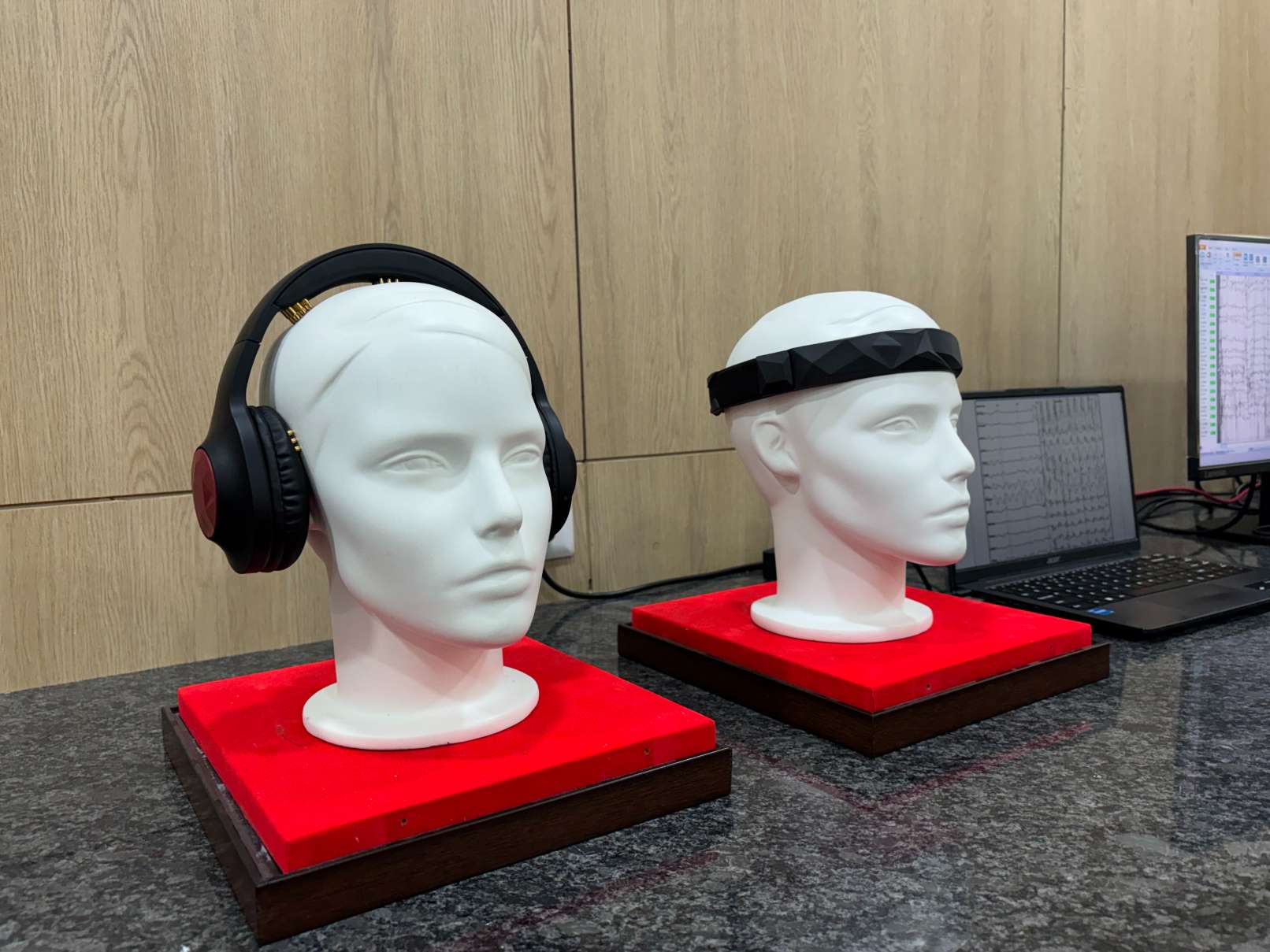
- Medicine and Psychology integration. Medical students engage the lab for clinical applications (sleep medicine, neurodiagnostic procedures). Psychology students engage for cognitive research. The two disciplines share equipment access while applying it to different research questions.
- Commerce and Psychology integration. Commerce students engage the Mind Lab for Neurofinance research; Psychology students provide the methodological grounding. The cross-disciplinary work produces Neurofinance competence that pure Commerce training or pure Psychology training cannot match.
- Computer Science and Psychology integration. Computer Science students working on Brain-Computer Interface engineering engage the Mind Lab for neural data collection; Psychology students provide the human factors grounding. The cross-disciplinary work produces BCI engineering competence that pure Computer Science training cannot match.
- Design and Psychology integration. Design students engage the Mind Lab for Neuroaesthetics research (using EEG and eye-tracking to measure cognitive responses to design); Psychology students provide the experimental methodology. The cross-disciplinary work produces design competence grounded in measurable cognitive science.
How the cross-faculty collaboration model produces distinctive graduate profiles
Graduates who have engaged cross-faculty collaboration during their academic programmes develop work patterns that purely single-discipline graduates do not. These work patterns matter operationally when graduates enter industry environments.
- Communication across disciplinary boundaries. Cross-faculty collaboration requires students to communicate with peers from different disciplines who have different vocabulary, different problem-framing habits, and different expertise. Graduates who have done this academically can do it in industry, which matters because most interesting industrial work crosses disciplinary boundaries.
- Integration thinking. Single-discipline training produces specialists who understand their discipline deeply but may have limited integration thinking. Cross-faculty training produces graduates who think in integrated systems rather than just in disciplinary components. Integration thinking is what enables modern technology development across most sectors.
- Comfort with not knowing. In cross-faculty collaboration, every team member starts not knowing parts of the project that other team members handle. This produces comfort with not knowing initially while still contributing productively. Single-discipline training often produces graduates uncomfortable with not knowing, which limits their effectiveness in industrial environments where integration projects are common.
- Faster learning at boundaries. Cross-faculty work develops the skill of rapidly learning enough about adjacent disciplines to collaborate effectively. This skill compounds across career duration because most career growth happens at the boundaries of one’s primary expertise.
Why this matters for prospective students choosing Parul University
Single-discipline training is widely available across Indian higher education. Cross-faculty collaboration training is less widely available. Students who benefit from cross-faculty trajectories (most modern technology careers, entrepreneurial pathways, and integration-heavy professional work) find the Lakshya 2047 model operationally suited. The cross-faculty model is one of the structural distinctions discussed in the structural comparison with IIT and NIT centres article.
- How parents should evaluate this. If your child’s career trajectory benefits from working across disciplinary boundaries (most modern engineering, design, healthcare technology, financial technology, AI integration, sustainability work), cross-faculty training matters operationally. The Lakshya 2047 model provides this training as default rather than as exception.
- How students should evaluate this. Consider whether your career interests cross disciplinary boundaries. If yes, the cross-faculty model supports your trajectory. If your interests are deeply specialised in a single discipline, the cross-faculty model still works but produces less differential value compared to specialist single-discipline alternatives.
How the faculty knowledge transfer architecture supports the cross-faculty model
Cross-faculty student collaboration requires faculty who can support cross-faculty work. The faculty knowledge transfer architecture inside Lakshya 2047 is structured to enable this support.
- Industry experience as cross-disciplinary preparation. Industry-experienced trainers have typically worked on cross-disciplinary projects in their industrial careers because production environments require cross-disciplinary integration. This experience makes them effective at supporting cross-faculty student collaboration in ways that purely academic faculty trained in narrow specialisations would find harder.
- Supervised hands-on training as collaboration scaffolding. Supervised hands-on training provides faculty presence during student work, which is what enables faculty to support cross-faculty collaboration in real time as it happens. Faculty can see when collaboration is breaking down and intervene; they can see when integration questions arise and provide expertise.
- Cross-lab faculty coordination. Cross-faculty student projects often require faculty coordination across multiple labs (drone work coordinating Aeronautical, Computer Science, and Electronics faculty; AR/VR medical applications coordinating AR/VR Lab and medical programme faculty; Mind Lab Neurofinance research coordinating Mind Lab and Commerce faculty). The institutional structure supports this coordination.
Honest limitations and trade-offs
The faculty and cross-faculty model has trade-offs worth acknowledging directly. The model is not universally superior; it serves some students and trajectories better than others.
- Research depth trade-off. Faculty resources directed toward supervised hands-on cross-faculty work may have less time for deep research depth in narrow specialisations. Students whose trajectory requires research-track preparation may find purely research-oriented faculty better suited for their specific needs.
- Disciplinary identity trade-off. Single-discipline training produces graduates with strong disciplinary identity (clearly Mechanical Engineers, clearly Computer Scientists, clearly Psychologists). Cross-faculty training may produce graduates with broader but less crisp disciplinary identity. For some career trajectories this matters; for others it does not.
- Faculty model variation. The “industry-experienced trainer” model varies across labs and may produce different teaching quality depending on the specific trainer at each lab. Faculty quality is not uniformly distributed in any institution; parents and students should evaluate specific labs and programmes rather than assuming uniform quality.
- Verification difficulty. Faculty quality is harder to verify externally than placement statistics or credential portfolios. Prospective students and parents should request meetings with current students from relevant programmes to discuss faculty experience directly rather than relying on institutional claims alone.
FAQs
What does 'industry-experienced trainer' mean operationally inside Lakshya 2047?
Industry-experienced trainers are instructors who bring direct industrial experience to the teaching environment alongside academic credentials. The operational difference from purely-academic faculty is that industry-experienced trainers know how systems actually deploy in production environments, what common failure modes occur in industrial use, what the gap is between textbook description and operational reality, and what employers actually look for in graduate hires. The source documents describe trainers across the labs delivering supervised hands-on training that includes industry-context explanations alongside technical instruction. The trainer model is part of why the 25+ industry-recognised certifications are achievable within the academic programme structure: trainers prepare students operationally for vendor examinations that pure-academic training does not always prepare students for.
How does the cross-faculty collaboration model actually work in practice?
Cross-faculty student teams form around integrated projects rather than around single-discipline assignments. The clearest documented example is the drone team where Aeronautical Engineering students design and build the drone body, Computer Science Engineering students develop software for simulation and flight control, and Electronics and Communication Engineering students integrate sensors, GPS modules, and communication systems. The integration produces working drones (including the student-built URI Bird Surveillance Drone) rather than just academic project documentation. Similar cross-faculty collaboration happens at the AR/VR Lab (Medical + Computer Science for medical VR surgery training, Civil/Architecture + Computer Science for skyscraper walkthroughs), and at the Mind Lab (Commerce + Psychology for Neurofinance research, Computer Science + Psychology for BCI engineering, Design + Psychology for Neuroaesthetics).
How can prospective students or parents verify faculty quality before deciding?
Faculty quality is harder to verify externally than placement statistics or credentials. Practical verification approaches include: visiting the campus and observing labs during active teaching periods to see faculty interaction with students directly; requesting meetings with current students from relevant programmes to ask about faculty experience candidly; asking specifically which labs are taught by which trainers and looking up the trainers' industrial backgrounds where publicly available; speaking with recent graduates working in target sectors about their academic experience. These verification approaches provide more accurate signal than institutional claims alone.
Does cross-faculty training produce graduates who lack depth in their primary discipline?
This is a legitimate concern worth addressing directly. The cross-faculty model adds breadth to disciplinary training rather than replacing it. A B.Tech Mechanical Engineering student engaging the Lakshya 2047 cross-faculty model still completes the core Mechanical Engineering curriculum that the programme structure requires. The cross-faculty engagement supplements rather than replaces disciplinary training. However, students who allocate substantial time to cross-faculty work may have less time for elective specialisation in their primary discipline. This is a trade-off rather than a strict deficit. Students whose career trajectory benefits from breadth find the trade-off favourable; students whose trajectory requires deep specialisation may find the trade-off less favourable.
What career advantages do graduates with cross-faculty experience have in industry hiring conversations?
Cross-faculty graduates carry specific work-pattern advantages that pure-single-discipline graduates often lack: communication across disciplinary boundaries, integration thinking, comfort with not knowing initially, and faster learning at the boundaries of primary expertise. These are operational capabilities that matter in modern industrial environments where most interesting work crosses disciplinary boundaries. Hiring conversations where these capabilities are screened for (AI integration roles, sustainability work, healthcare technology, financial technology, robotics, immersive technology, broader engineering integration work) favour cross-faculty graduates. Hiring conversations where deep single-disciplinary specialisation is the primary screen (some research-track roles, certain specialist engineering positions, some pure academic pathways) may favour graduates with stronger single-discipline depth.