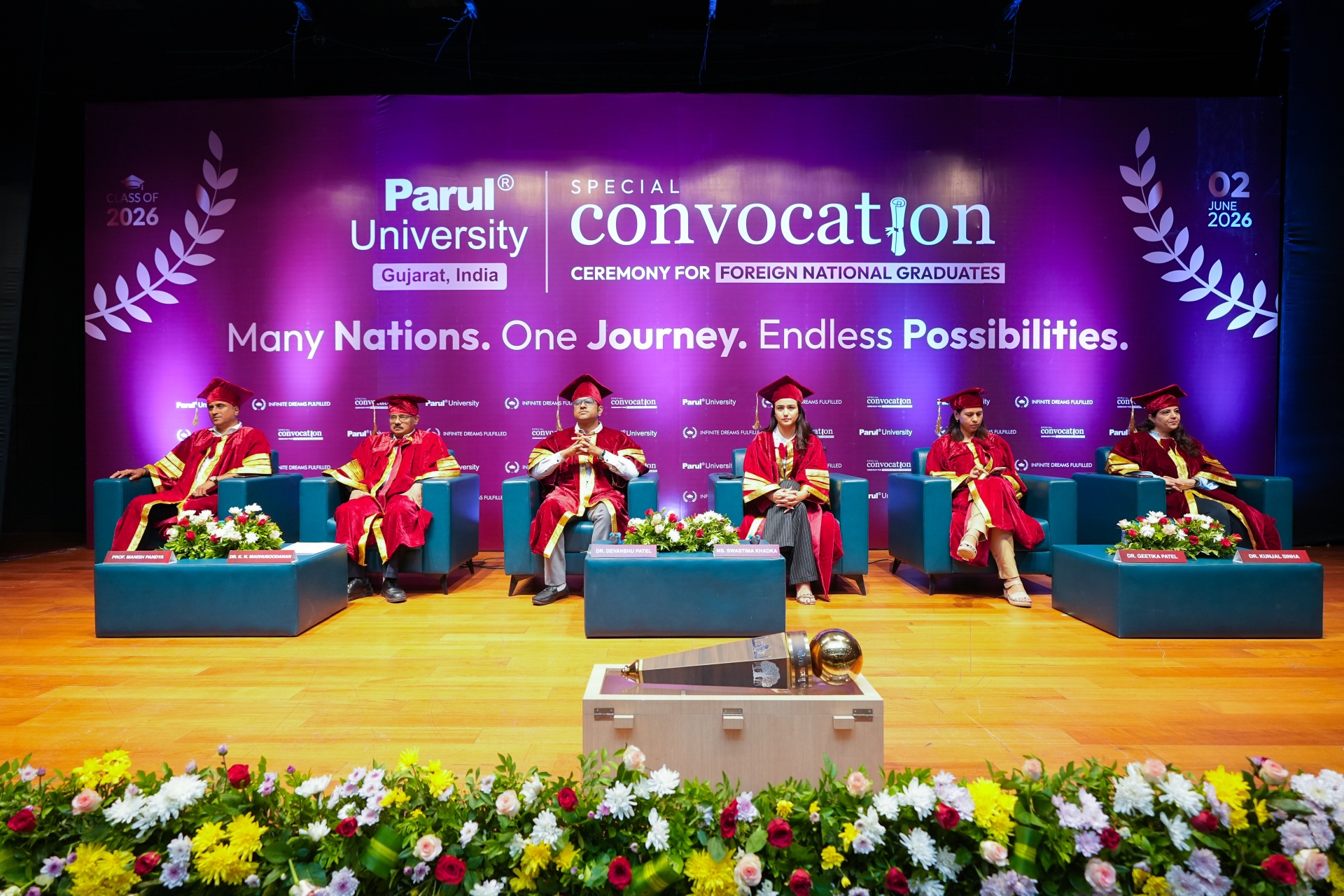
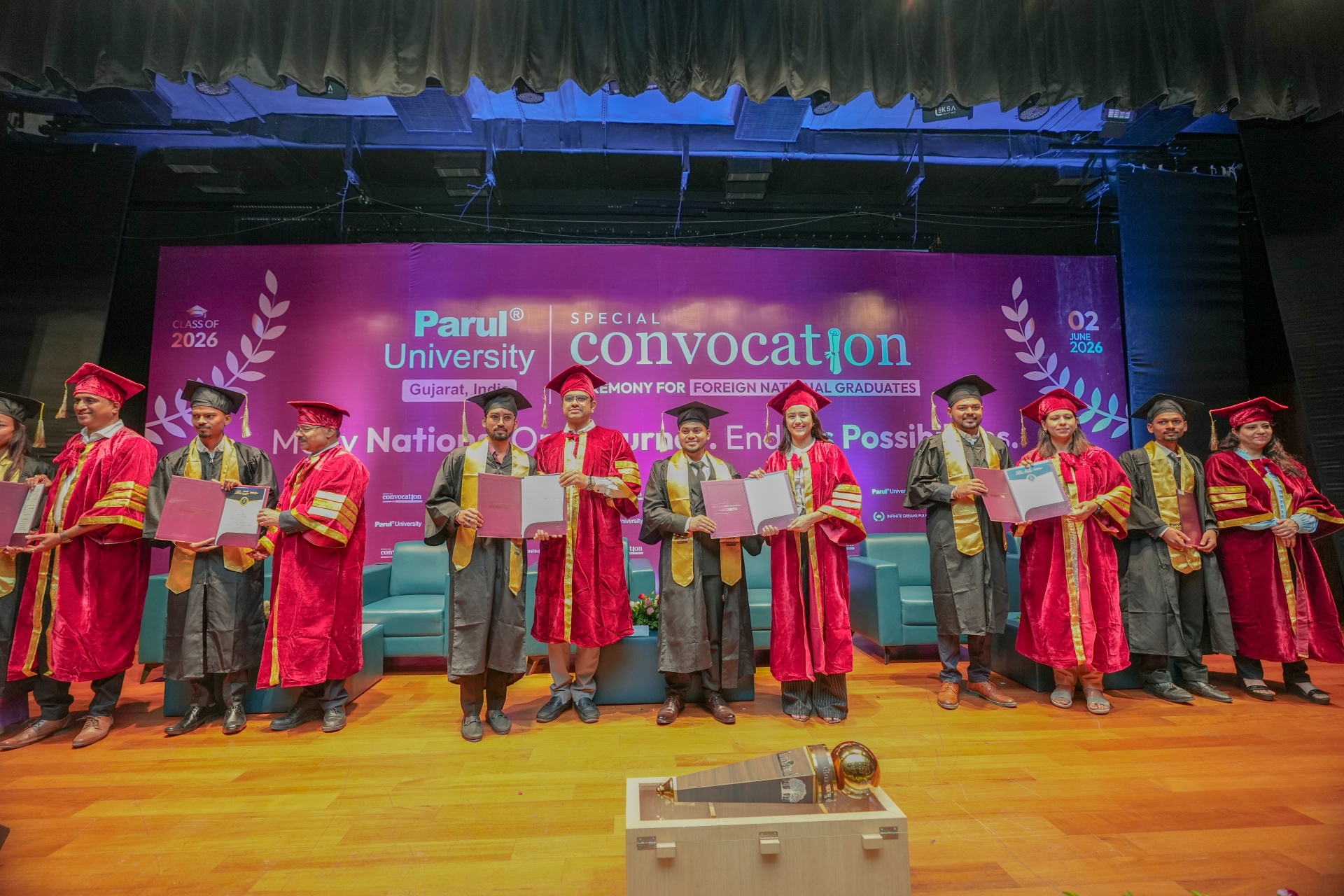
Convocation guest addresses are usually polite and forgettable. The guest speakers at the ceremony gave memorable speeches that will stay with the graduates for years. This article documents the words of the speakers and how it was an honour for them to attend an event like the convocation in India, while thanking Parul University for the opportunity.
Nepalese Film Actress at Special Convocation
Swastima Khadka, the Nepalese film actress, joined the convocation as Chief Guest. She introduced herself as an actor from Nepal and shared that before entering the film industry, she had also been a university student. Her address focused on the importance of university life in shaping a student’s future, building lifelong friendships, and preparing for what comes next.
- Swastima Khadka on university life. “This is the place where you build your future and make friends.”
- Swastima Khadka on pursuing one’s path. “Whatever you do in life tomorrow, do it with passion, do it with love.”
Her broader message was that talent alone is not enough to achieve success; hard work and dedication matter equally. She wished all the graduates a bright future and thanked Parul University for inviting her to the celebration. Her presence brought both star recognition and a relatable peer voice for graduates whose academic journey was transitioning into careers.
Guest of Honour: Zimbabwean Artist Ms. Atenda Chinx
Ms. Atenda Chinx, an accomplished singer and songwriter from Zimbabwe known for her captivating voice and music celebrating culture, self-expression, and empowerment, took to the podium with a presence that immediately caught the audience’s attention. She acknowledged the leadership of Parul University and introduced herself with honesty that commanded the room into silence.
- Atenda Chinx introducing herself. “I am just a girl that’s searching for growth like every single person here.”
She shared her story openly. Her father was a legendary figure in the Zimbabwean music industry, and she lost him when she was in grade six.
- Atenda Chinx on grief and continuation. “Losing a parent at such a young age is something that is very much life-changing. There are days where I felt lost, days where I felt like life is unfair. But I felt like I had to keep his legacy going.”
She paused to collect herself, then said with quiet confidence that her presence at the Parul University convocation made it clear that her father would have been extremely proud. She spoke directly to the graduating class about being told by an educator that she would never live up to her potential and now standing before graduates as visible counter-evidence.
- Atenda Chinx on individuality. “You being you is what makes you unique. That’s exactly what makes you different from the person sitting next to you.”
She concluded with a spontaneous a cappella performance, a song from Zimbabwe, inviting those who recognised it to join in. Her voice filled the auditorium, and several Zimbabwean students joined her. Some graduates bowed their heads, some whistled, and some smiled with recognition. The moment gave the ceremony a quality of cultural authenticity that institutional language cannot manufacture.
Guest of Honour: Tanzanian Content Creator Mr. Vincent Njao (Kiredio Tz)
Vincent Njao, known by his digital persona Kiredio Tz, is one of the most prominent Tanzanian content creators and social media personalities. Introduced as a storyteller passionate about youth empowerment, education, and community development, he noted that he was the fifth Tanzanian to attend a Parul University convocation as a speaker.
He opened by teaching the audience a piece of Swahili. He asked them to respond “Poa!” to his call of “Mambo!” The room filled with laughter and engagement within seconds, setting a tone for the address that was humorous, enlightening, and sincere.
He spoke candidly about his own first experience of India. He arrived knowing the country primarily through Bollywood films.
- Vincent Njao on the Indian image abroad. “We used to watch Shah Rukh Khan, that was India for us.”
India, he noted, had demonstrated itself to be much more than its film industry, with substantial hospitality, culture, and education beyond what foreign audiences typically perceive. A central theme of his address was the way digital technology is transforming the world and the social responsibility of using social media. He explained how content creation has developed into a viable industry, with examples of how engineers, educators, and business people can use digital platforms to inform audiences and build global communities for positive change.
- Vincent Njao on the universality of contribution. “Everyone of us has a story, knowledge or experience that can help.”
He addressed the graduates directly, joking that they were probably thinking, “Finally, no more assignments,” before telling them about the biggest assignment of all: dream bigger, work harder, and never stop learning. He closed by vowing to act as Parul University’s ambassador across East Africa, expressing his belief that the next academic year would see a meaningfully larger East African student presence at Parul University.
Chief Guest: Her Excellency Ambassador Stella Nkomo of Zimbabwe to India
H.E. Ambassador Stella Nkomo, Ambassador Extraordinary and Plenipotentiary of the Republic of Zimbabwe to the Republic of India (also accredited to Nepal, Sri Lanka, and the Maldives), brought the day’s addresses toward a formal conclusion. She has served as one of Zimbabwe’s leading public sector diplomats and a champion of international collaboration for over 20 years.
When she rose to speak, the auditorium settled into attentive stillness. Her presence was authoritative but warm, and her delivery was measured. She recognised the leadership individually by name and thanked the university for the invitation, introducing herself as representing both the people and government of Zimbabwe in India.
Her address was substantive and intellectually engaging. She placed the graduates in a rapidly changing world reshaped by artificial intelligence, globalisation, pandemics, and unprecedented connectedness, observing that today’s problems cannot be solved by yesterday’s paradigms. Global networks create opportunities while exposing shared vulnerabilities.
She made an interesting connection between Zimbabwe’s Education 5.0 concept, which combines instruction with research, community service, innovation, and industrialisation, and India’s multidisciplinary educational direction. Her framing was that both countries aim to provide citizens with opportunities to use educational knowledge for solving current problems rather than receiving certificates merely as completion markers.
She was visibly delighted by the presence of digital content creator Kiredio Tz among the guests, drawing laughter when she added, half in jest:
- Ambassador Nkomo on the digital age. “I do hope to see myself in one of your posts.”
On the substantive side, she offered the graduates three qualities essential for 21st-century success: resilience, lifelong learning, and integrity.
- Ambassador Nkomo on integrity. “In every profession and every position of responsibility, integrity remains the foundation of lasting success.”
She drew on a Shona proverb that speaks to the idea that a nation is built by its people, and the Zimbabwean representatives in attendance smiled in recognition. She spoke about the long-standing India-Zimbabwe relationship grounded in friendship, cooperation, and mutual respect, with education as one of its pillars.
- Ambassador Nkomo on the future. “I say to you, as you leave this institution, remember that the future will not be shaped by those who wait for opportunities. It will be shaped by those who create them.”
She encouraged graduates to create connections across cultures, countries, and communities, framing the most significant thing they would receive that day as not the certificate itself but the impact they would have on the lives of others. Her closing words, “Congratulations, Class of 2026,” were met with sustained applause.
Also Read: Special Convocation for Foreign National Graduates at Parul University
The cumulative tapestry: what the four voices together represent
Any one of these four addresses would have been notable. Together they formed something more substantial: a deliberate institutional decision to bring multiple distinct voices to the graduating class rather than relying on a single keynote pattern.
- Atenda Chinx provided emotional honesty. The voice of someone who had lost a parent young, been told by an educator she would never live up to her potential, and now stands as visible counter-evidence to both. The Zimbabwean song that closed her address brought cultural authenticity into the institutional space.
- Vincent Njao (Kiredio Tz) provided forward-looking energy. The voice of the digital-age creator whose career did not exist as a viable industry a decade ago, illustrating how rapidly career landscapes shift. His Swahili greeting opened the cultural distance in seconds.
- Swastima Khadka provided peer-relatable success. The voice of someone who had recently been where the graduates were sitting and could speak to what comes next from a position close enough in time to feel real.
- E. Ambassador Stella Nkomo provided substantive intellectual depth. The voice of formal diplomatic experience combined with genuine intellectual engagement. The Education 5.0 connection, the three qualities framework, the Shona proverb, and the address’s structure together formed the kind of substantive speech that elevates a ceremony from event to inflection point.
The four voices together signalled something specific about how Parul University positions itself: not a routine institutional moment with rotating polite speakers, but a curated convening of multinational voices, each chosen for what they specifically added to the graduating class’s understanding of the world they were about to enter.
Also Read: International Professor Visiting Program at Parul University
FAQs
Who were the distinguished guests at Parul University's Special Convocation Ceremony 2026?
Four distinguished guests addressed the convocation. Nepalese film actress Swastima Khadka, Zimbabwean singer and songwriter Ms. Atenda Chinx, Tanzanian content creator Vincent Njao, known for his digital persona Kiredio Tz, and H.E. Ambassador Stella Nkomo of Zimbabwe attended the event as the chief guests at Parul University. They shared how important it is to enjoy university life and learn during this time to get groomed for the next journey.
What was Ms. Atenda Chinx's central message and why did her address stand out?
Ms. Atenda Chinx's address stood out for emotional honesty and cultural authenticity. She shared her life journey, explaining how she lost her father (a famous figure in the Zimbabwean music industry) at an early age, when she was in sixth grade. At an early age, she could understand the importance of taking forward his legacy. She mentioned how she still remembers that an educator told her that she would never live up to her potential and now addressing the graduates in a foreign land. This shows a strong, evident contradiction of the future that her educator made. That's exactly what makes you different from the person sitting next to you.' Her spontaneous a cappella performance of a Zimbabwean song brought several Zimbabwean students in the audience into the performance, creating a moment of cultural recognition that institutional language cannot manufacture.
What did H.E. Ambassador Stella Nkomo say in her convocation address?
Ambassador Nkomo from Zimbabwe visited Parul University, India. She appreciated the graduates who are placed in a time that is being shaped by AI, globalisation, pandemic-like situations, and unparalleled connectedness. She compared Zimbabwe's education system with India's and their 5.0 concept of education. India's educational system focuses on multidisciplinary problem-solving. She shared the three qualities for the 21st century that one should have for success: resilience, consistent learning, and integrity. She drew on a Shona proverb about a nation being built by its people and closed with the framing that the future will be shaped by those who create opportunities rather than those who wait for them.
What did the four guest speakers collectively signify about Parul University's positioning?
The four addresses signalled a deliberate institutional choice to convene multinational voices spanning emotional honesty (Ms. Atenda Chinx), forward-looking digital-age energy (Vincent Njao/Kiredio Tz), peer-relatable success (Swastima Khadka), and substantive intellectual depth (Ambassador Nkomo). The presence of an Ambassador as Chief Guest alongside cultural and creative leaders from Zimbabwe, Tanzania, and Nepal signalled the institutional reach Parul University has built through its decade-plus of international student engagement.