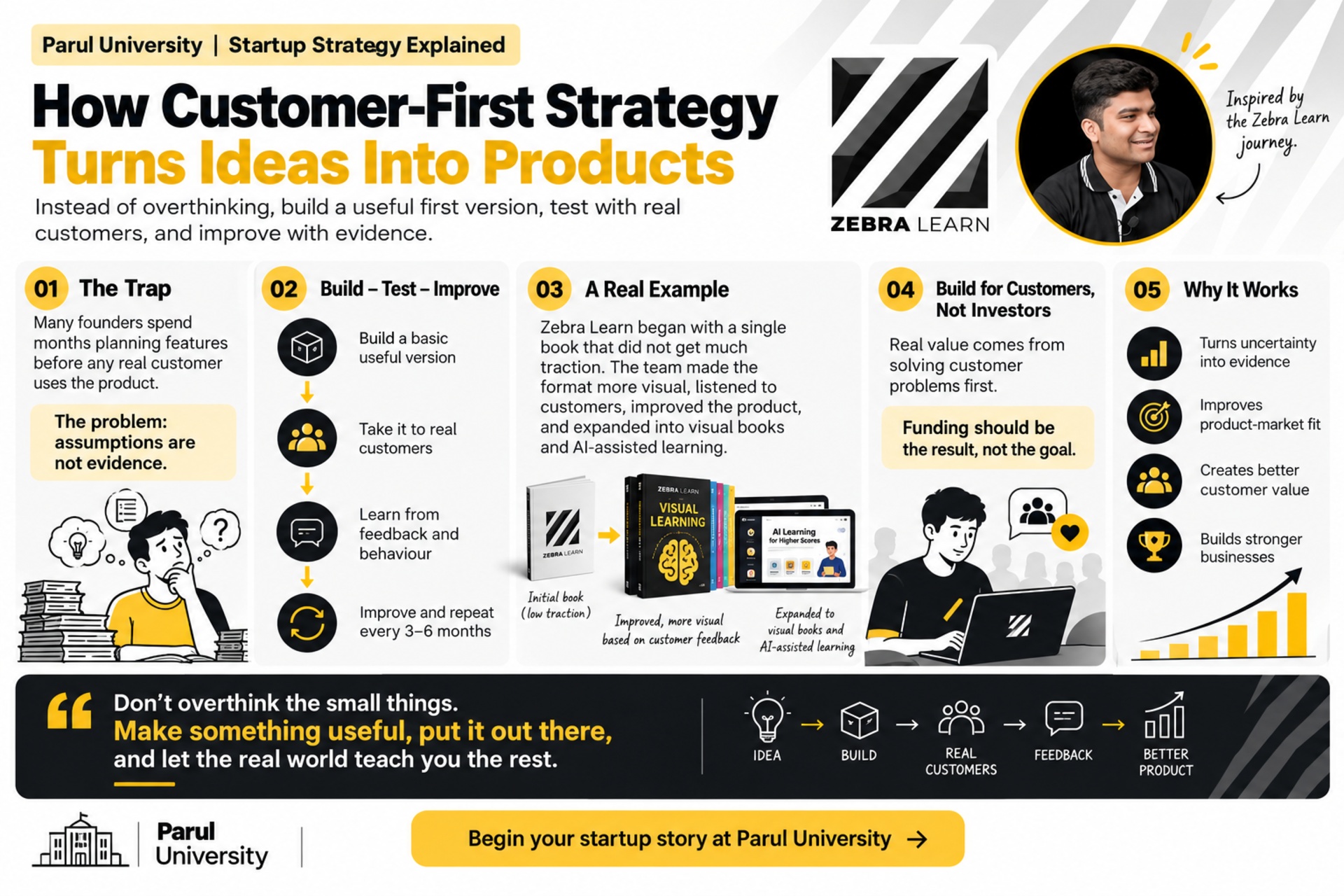
A customer-first product strategy involves creating a functional first version of your product and going to actual customers, listening to their feedback, and making changes to it, instead of designing and designing and designing until you feel ready to ship. This is one of the most consistent business rules, and a rule that many entrepreneurs from the success stories that have been taught at Parul University return to time and time again.
The Trap!
Many aspiring entrepreneurs go through the same cycle; they spend months developing a business idea, designing all the features, and preparing for all the problems that might occur before the first customer even gets a look at the product. The flaw is simple. Evidence can only come from an idea that is in your head. Before real people use real products, it is hard to determine what they want, how much they will pay, and the features that are important. It seems like they’re getting things done by overthinking, but it also means that they are putting off the time they are going to learn, and that is where many startups eat away quietly.
The Loop: Build, Test, Improve
The customer-first alternative is a continuous loop:
- Build a basic, useful version, not a perfect product, but something good enough to put in a customer’s hands. The goal is to create something real enough to react to.
- Take it to real customers, and ideally, try to sell it. Early sales are the strongest possible validation, far more honest than a friend saying “great idea.”
- Learn from the response, watch what users actually do, listen to their feedback, and note where the product falls short. This is information you simply cannot get from planning.
- Improve and repeat: use what you learned to build a better next version, then run the loop again. A development cycle of roughly three to six months per iteration is a practical rhythm.
Each turn of the loop converts uncertainty into evidence, which is the real currency of early-stage building.
A Real Example
One of the startups associated with Parul University’s PIERC, called ZebraLearn, started with a single book that was a dud. Instead, the founders took the lack of enthusiasm as a clue and tried making it more visual and graphical and got an even larger response, which eventually led to a vast range of visual books and then on to AI-assisted learning. It didn’t come from any master plan, but was developed in a small way, heard from customers and improved.
Focus on building for the customer, not for investors.
An important side effect of this is that you shouldn’t build to impress investors; you should build for your customers. After spending hours watching presentations, it’s easy to think about building a business just because it will get funded or perform well on stage. It is recommended by seasoned founders. When you fix the real problem for the customer well, the customers and then investors will follow, but if you have a business that is designed around raising capital and it has no real value for the customer, it has no foundation. Funding is the outcome, not the aim, of keeping the customer at the heart of it. Turn your ideas into revenue-driven outcome by discovering B.Des in Product Design, Diploma in Product Design, BBA in Entrepreneurship, and MBA in Entrepreneurship, Innovation & Startup Acceleration at Parul University.
Focus on Strategy!
Best of all, you can start practicing this strategy long before you begin a business. An app idea student can create a basic working version, rather than implementing all the features over the course of a few months. A student with an educational idea can produce a small model, try it out in class with students, and tweak it. The idea, turn uncertainty into information through action, applies to both a product and a project, or a career. “But don’t overthink the small things,” as one founder said. “Just make something useful, put it out there, and let the real world teach you the rest.”
FAQs
What’s the primary focus of any customer?
Product strategy is customer-first: Make a starter, useful version of your product; test with actual customers (try to sell to), gather their feedback; make enhancements; test again, gather feedback again, make enhancements again, and so on, instead of planning endlessly before introducing to the market. It is based on the real needs of its customers, not what they are assumed to want or what the investors might like.
What is the build, test, and improve loop?
The build-test-improve loop is a cycle: make an initial, simple, useful version of a product, expose it to real customers and try to put it on the market, listen to feedback, learn from it, create an improved version, and repeat. A typical cycle per iteration is 3-6 months. Each loop converts uncertainty into concrete proof of customer desire.
What is the best way to create a startup for customers or investors?
Build for customers. Focusing a startup primarily on investor appeal or impressiveness can lead to the development of a product that offers little value to actual customers. The solution to a real customer problem, if done well, attracts customers and subsequently, investors. Successful founders always say to keep the customer first and funding as a result, not a reason.