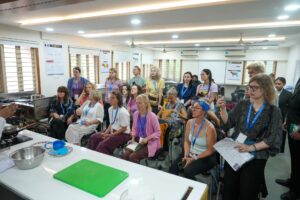
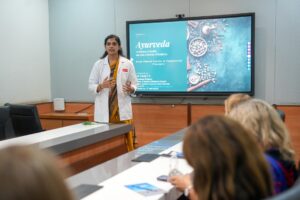
Nadi Pariksha is the Ayurvedic art of pulse examination, in which a trained practitioner reads the pulse to assess the state and balance of the three doshas (Vata, Pitta, and Kapha). Demonstrated to international practitioners at Parul University, it is one of Ayurveda’s most distinctive diagnostic methods, and one of its most misunderstood. Here is a clear, educational guide.
More Than a Heartbeat
In modern medicine, checking the pulse mainly measures heart rate and rhythm. In Ayurveda, the pulse is read for something broader: clues to the balance of the doshas and the overall state of the body and mind. The idea is that the flow of the pulse reflects the functional energies at work inside a person, so a skilled practitioner uses it as one window into their constitution and current balance. It is considered an art that takes years of practice and traditionally, study under an experienced teacher, to develop.
The Three-Finger Method
The technique is precise. As taught at Parul University, the practitioner places three fingers, index, middle, and ring, on the radial artery at the wrist, with the index finger nearest the base of the thumb, applying steady pressure to feel the pulse. Each finger is associated with a different dosha:
- The index finger senses Vata.
- The middle finger senses Pitta.
- The ring finger senses Kapha.
By feeling where the pulse is strongest, and by lifting fingers to isolate each signal, the practitioner assesses which dosha is most active at that moment. The pulse is also read for rate, rhythm, and quality, and classical texts poetically compare different dosha pulses to the movements of animals, a Vata pulse likened to a snake’s glide, and so on.
The Pulse Is Always Changing
A crucial point the faculty emphasised: the pulse is dynamic, not fixed. It shifts with activity, rest, eating, and even concentrated thought, which is why practitioners are encouraged to check their own pulse repeatedly, on waking, while eating, at rest, to learn how it changes. The daily routine that one decides. This variability is part of what makes Nadi Pariksha a genuine skill rather than a one-off reading, and part of why it belongs in the hands of a trained practitioner.
What It Can, and Cannot, Do
This is essential to understand honestly. In Ayurveda, Nadi Pariksha is used to assess the state of the doshas and a person’s overall balance, and it forms one part of a broader diagnostic approach (classically, one of the “eightfold” methods, Ashtavidha Pariksha, alongside examination of the tongue, urine, eyes, and more). It is not a way to diagnose specific named diseases from the pulse alone, and the classical tradition itself is clear on this point. It is also highly skill-dependent and subjective. So while it is a fascinating and valuable traditional tool, it complements rather than replaces proper clinical assessment, and it should always be done by a qualified practitioner, never used for self-diagnosis.
FAQs
How to explain Nadi Pariksha?
Ayurveda as said is wide field. There are various ways to detect diseases in the body. The initial diagnosis can be done through Nadi Pariksha. Nadi Pariksha is pulse diagnosis. A trained practitioner places three fingers around the wrist. It is done to read the pulse and find whether there is a balance between three doshas or not. Unlike a modern pulse check for heart rate, it is used within Ayurveda as a window into constitution and balance, as one part of a broader diagnosis.
How does the three-finger pulse method work?
The method is a traditional way of detecting the health. A qualified practitioner places the index, middle and ring finger on the radial artery around the wrist. Here each finger is associated with a dosha. Where the index finger is with Vata, middle is associated with Pitta and ring finger is associated with Kapha. The rhythm of these arteries leads to detection of balance/imbalance of doshas.
Can Nadi Pariksha diagnose diseases?
Not on its own. Ayurveda focuses on balance of body and mind. The internal balance leads to achieving the better health. Nadi Pariksha helps to find out the imbalance caused due to the three doshas. It is one part of the broader diagnostic approach. The classical "eightfold examination" and the tradition itself. Also, the diagnosis does not specify the diseases by pulse alone. It is skill-dependent and should be performed by a qualified practitioner, not used for self-diagnosis or as a substitute for proper medical assessment.