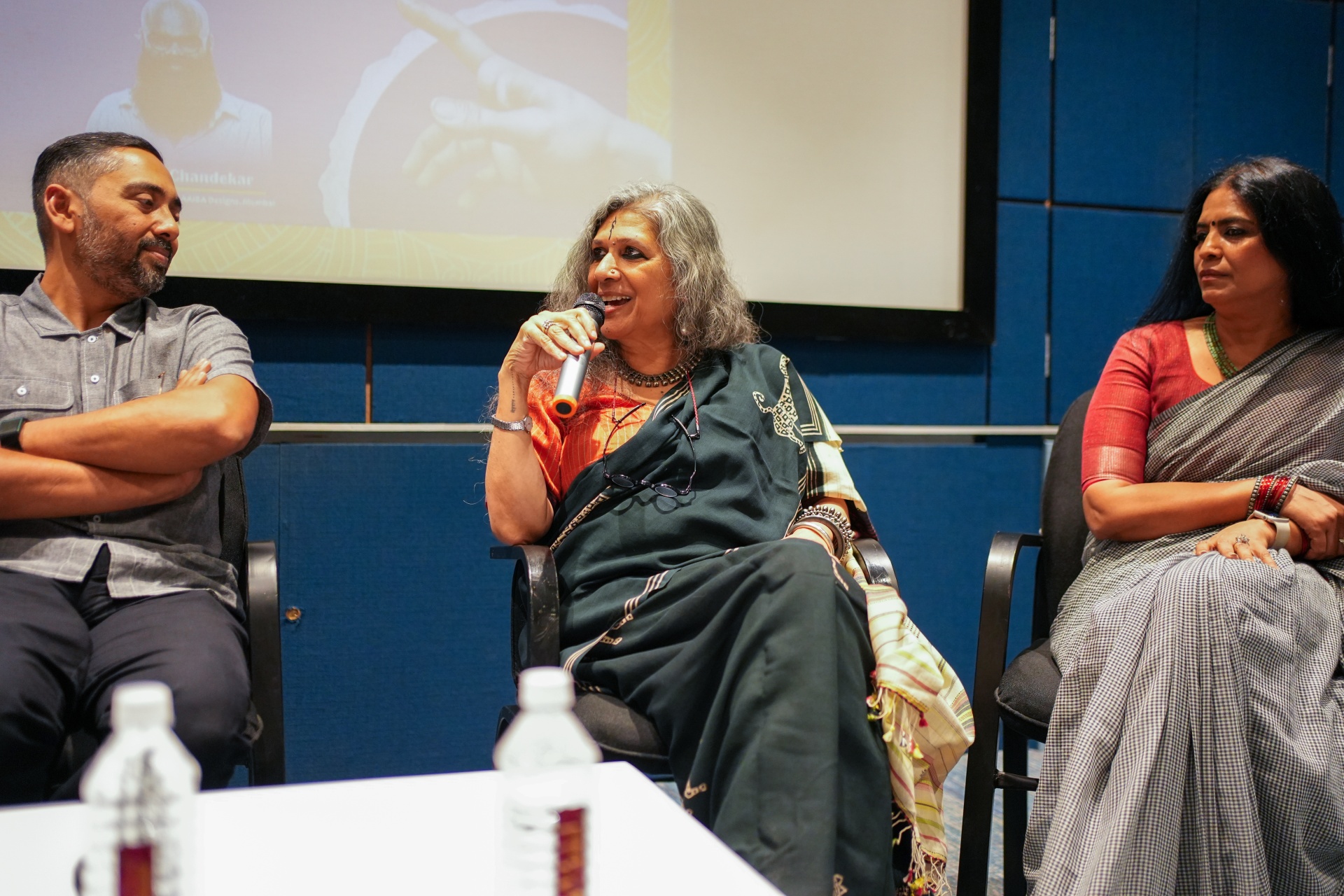
Rekha Rodwittiya was the most direct. She started from openness. She has no interest in excluding any tool. Technology is part of every era. But over forty years of working with students, she has watched what chat technology has done: less genuine effort, less real curiosity, less independent search for knowledge. At 67, she still works long hours. That is not a performance of dedication. It is what staying alert requires.
When a third-year student asked where the line is between using AI for research and fraud, Rekha disagreed with the more moderate panel answers. Her position: throw it out of your life right now. Not permanently. But at this stage, as a student, you do not need it. Go to a library. Let one thing lead to another. Understand the history of art you belong to. Learn how your hand and your head come into synchronicity. Art is not about perfection. It is about how you look at the world.
She asked the room: are you working 14, 18, 20 hours a day? If yes, you will be that artist who is part of history. If not, forget about it. The shortcut kills the journey. The journey is the entire point. Inspired by art already? Save your seat for BVA Painting at Parul University Program!
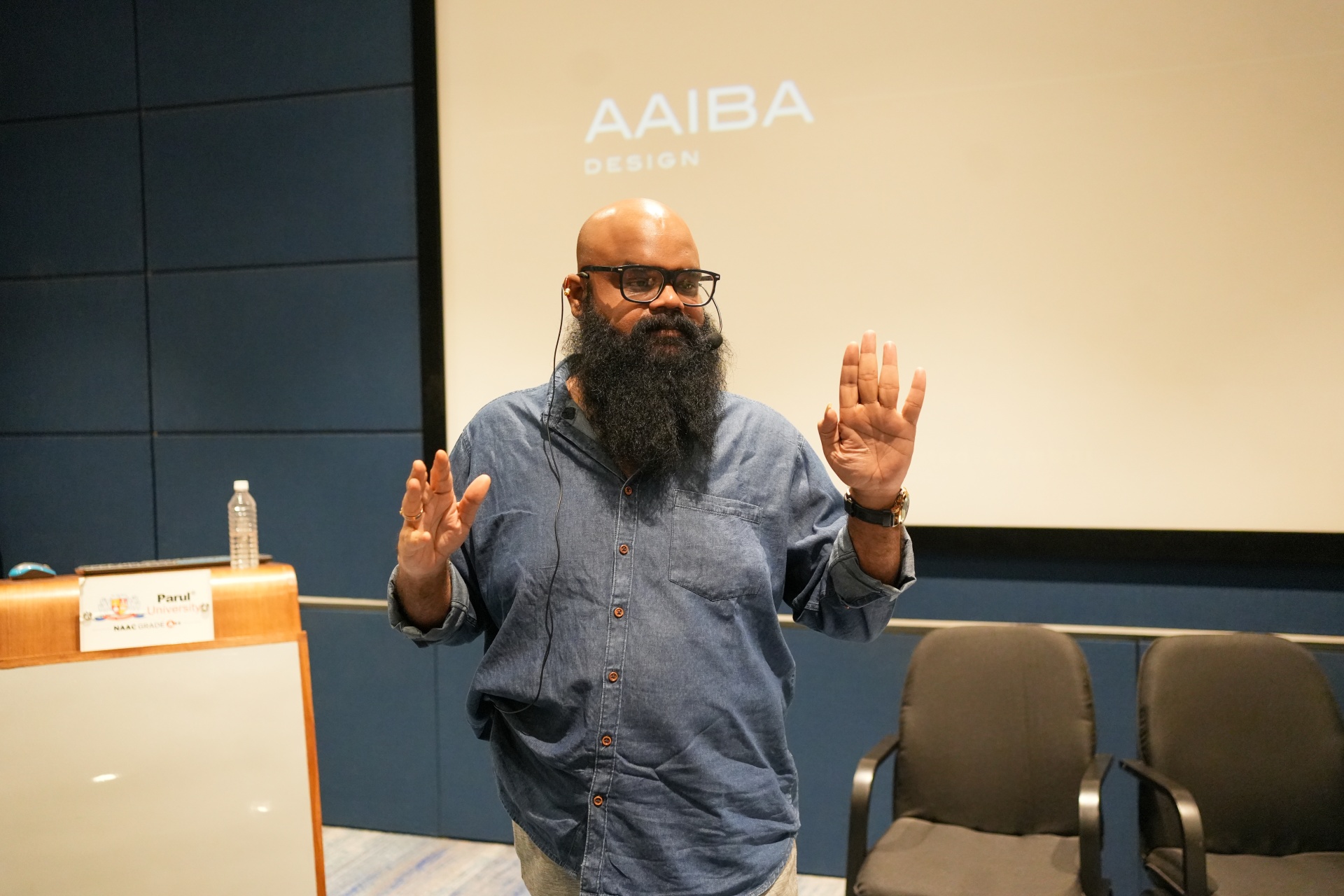
Saurabh Chandekar: ChatGPT Is Teaching You to Justify Empty Work
Saurabh Chandekar named the specific mechanism by which AI degrades creative practice. A colleague took six days on a logo and returned with three dots. The explanation was articulate, structured, and completely hollow: the kind of language ChatGPT generates perfectly. The design needed the explanation to exist. Without it, the logo was three dots. Minimalism has taken over to the point where it has stopped meaning anything, he said. ChatGPT knows what you say and how you say it and what can appeal to you. ChatGPT is manipulating.
His warning was not about the tool itself. It was about the gap between the language of justification and the substance of the work. When the tool teaches you how to sound considered while the work is not, authenticity dies. He also flagged UI/UX saturation as a direct consequence. AI is doing to UI/UX what photography was once feared would do to illustration, except faster. Some clients now put it in contracts: if you are using AI tools, they will not work with you. The market is beginning to recognise AI output as a particular kind of sameness.
His advice: if the goal is money, UI/UX is fine. If the goal is a personal identity, a name in the industry, and money alongside that, authentic art is what you need to choose. The content creator’s span is 60 seconds. The illustrator’s span is a lifetime. Shape the future of design leadership with a Master of Design in Design Management and Communication Strategy.
The Practical Framework: 7 Tasks for AI, 3 Tasks for You
Vinit Nair (Gallery White) offered the most actionable framework. Ten tasks in a day. Three are the important ones inside the actual practice: the thinking, the making, the creative decisions. The other seven are administrative, time-consuming, and annoying. Use technology for those seven. Protect the three. The moment AI is telling you what to do in those three, you are not working. You are assembling someone else’s past into something you claim is yours.
Debojyoti Purkayastha (Grand Prix Cannes) was equally clear. Research done through Google or AI is inspiration, not work. If AI tells you what to create, that is dishonesty. You are mixing other people’s past work and calling it your own. His personal practice still starts with hand-drawn sketches, physical newspapers, and a notepad carried everywhere. Twenty years of this. Not a beginner’s habit. A foundation habit that working practitioners return to.
On the Applied Arts panel, Mithun Rodwittiy, founder of 2Point5, moderated a discussion where both Saurabh and Debojyoti agreed: AI makes output faster but does not make it meaningful. Students must build strong fundamentals in typography, design sense, aesthetics, and thinking process. Without those foundations, AI output is just fast noise. Advance your creative vision through a design management and communication strategy course at Parul University!
The Polishing Machine Parable: Learn Hands First, Then Tools
The Dean of Fine Arts told a story that became the festival’s most quoted moment. A student was making stone sculptures and wanted to use a polishing machine. His teacher, sculptor Mahendra Pandya, said no. Use your hands. A week later, the same teacher told the student to use the machine. The student was confused. Mahendra Pandya’s answer: first you learned how to apply the pressure with your hand. Now use the machine. Now you will be a better sculptor.
That is the sequence. Not the tool as a shortcut. The tool as the next step after the foundational work is already in your hands. This was the through-line of every AI discussion across all three days. Nobody at VVF 2026 said AI is evil. Everyone said the sequence matters. Foundation first. Tool second. Without that order, the tool does not enhance the practice. It replaces it. And what it replaces cannot be recovered.
A Foundation-Year Student's Honest Question
A foundation-year student asked one of the most honest questions of the festival. She goes to Pinterest for references. She finds something close to what she was already imagining. Then she makes something that looks like what she found. She knows this is happening. She wants to know how to stop.
Rekha Rodwittiya’s answer: leave the phone outside the classroom. But the deeper problem is visual literacy. Without enough art history, regional tradition, cinema, and careful observation of surroundings, the student has not built a visual language strong enough to resist the pull of whatever Pinterest serves. Build that up and the trap dissolves. References stop being instructions because you already know more than they are offering. Nobody is original. That is not the goal. The goal is uniqueness. Make it unmistakably yours. Build a career at the intersection of design, strategy, and communication by exploring Design Programs at Parul University
FAQ: AI in Art and Design 2026
Should art students use AI?
The consensus at VVF 2026: not yet, not for the core practice. Use AI for administrative tasks (Vinit Nair's 7-out-of-10 framework). Protect the creative core. Learn foundations first (the Mahendra Pandya polishing machine sequence). Rekha Rodwittiya: throw it out for now and go to a library.
Is UI/UX still a good career for design students?
Saurabh Chandekar (Cannes Lions): UI/UX saturation is close. AI is replacing repetitive design tasks. Clients are adding anti-AI clauses to contracts. If the goal is only money, UI/UX works for now. If the goal is identity and lasting career, authentic art is the stronger path.


