

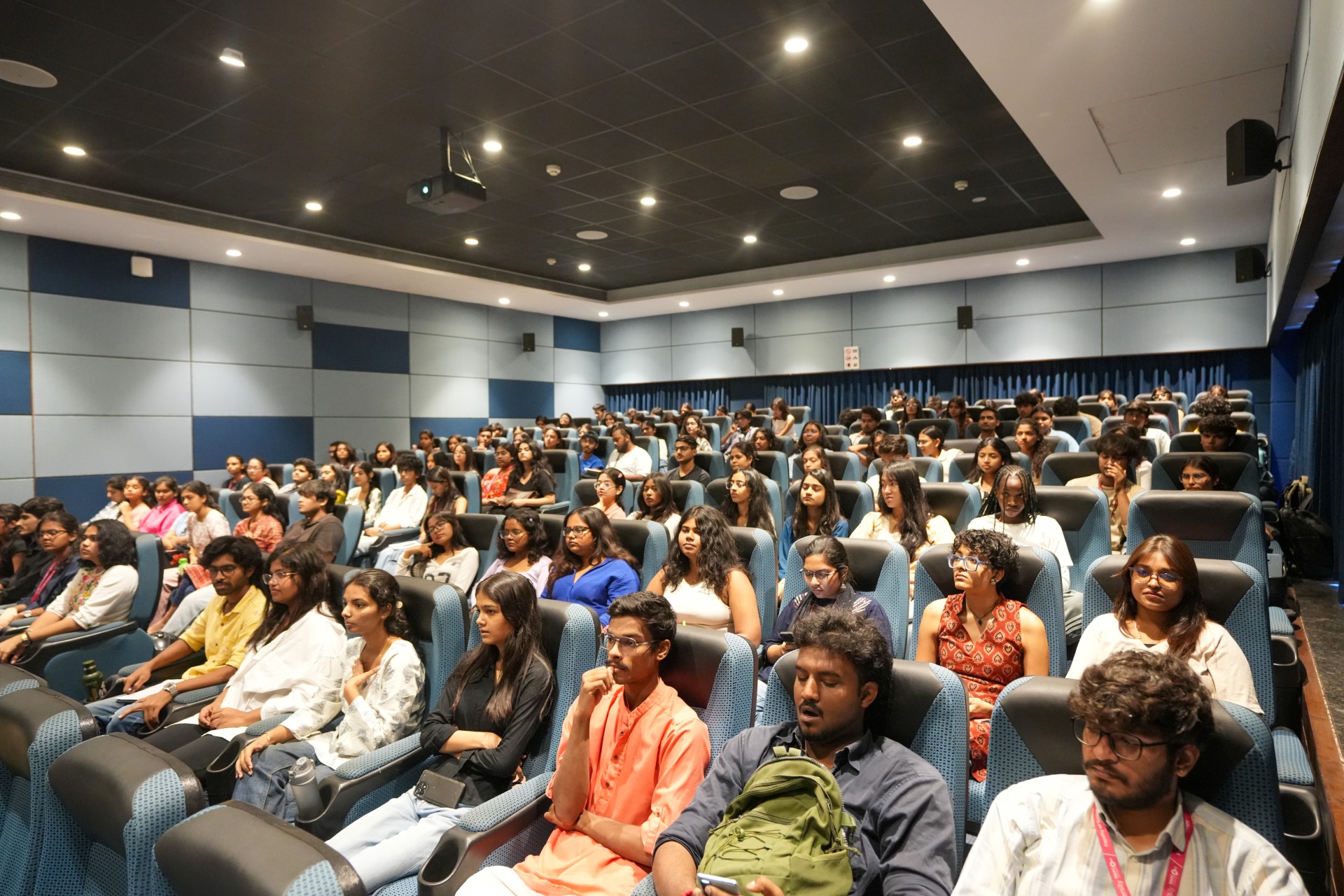
On the closing day of the Vadodara Film and Design Festival at Parul Institute of Design, a panel of four working designers, filmmakers, and educators spent forty-five minutes debating whether AI was going to flatten the design profession.
The panel’s title was Design in the Times of AI: Homogeneity vs Diversity and Uniqueness. Sameer Sarkar moderated. On stage: Aparna Sud (Filmfare Award winning production designer), Shital Verma (National Design Head, Navbharat Times), Nitesh Mohanty (educator, curator, founder of Root Network), and Saurabh Kabra (filmmaker and startup founder at vault.rent) and Prof Bhaskar Mitra, Dean of PID. They did not agree on the specifics. They converged on one point.
“AI is a tool. It amplifies the thinking behind the prompt. A lazy prompt returns a lazy output. The human decision still sets the ceiling.”
The Central Thesis: Same Tool, Different Output
Nitesh Mohanty framed the argument early. The panel’s title positioned homogeneity and diversity as opposing outcomes. Mohanty rejected that framing almost immediately. According to him, the true opposite of homogeneity is not diversity in the abstract. It is specificity. It is the ability of a designer’s cultural context, lived experience, memory, and editorial instinct to produce a prompt that no other person would think to write.
Mohanty’s central argument was practical rather than theoretical: everyone now has access to the same AI tools. That part is already settled. The real difference lies in what the designer brings into the prompt itself. Twenty-five students using the same AI image generator with the same assignment brief will eventually begin producing recognisably similar work if they rely on generic prompting. The students producing distinct outcomes will be the ones whose observation, cultural grounding, and personal experiences appear in the specificity of their instructions.
Shital Verma reinforced the point through her own professional experience. Around a year before VFDF, she explained, an AI company had approached her requesting permission to purchase her artwork as training data. She refused. But she also acknowledged that her work had already circulated online long enough that scraping was probably unavoidable. For her, the larger question was never whether AI could imitate the visual appearance of her style. The question was whether it could reproduce the emotional imperfection behind it.
If you’re passionate about building a career at the intersection of design and artificial intelligence, enrol into Parul University’s M.Des in Design & AI program!
“A machine draws things that are perfectly symmetrical. My art has broken lines and uneven strokes. That roughness is the thing a machine can copy visually but cannot feel.”
Aparna Sud on Spaces That an AI Cannot Build
Aparna Sud brought a different perspective to the AI discussion through the lens of production design. Her body of work includes recreating the Pan Am aircraft environment in Neerja, along with designing the physical worlds of Jubilee, Ramprasad Ki Tehrvi, and Pagglait. One of the questions she frequently encounters is whether AI image-generation tools can eventually replace production designers. Her response was not defensive. It was structural.
According to Sud, AI can generate a convincing still image of a room within seconds. But production design is not the construction of an image. It is the construction of a space. Actors move through that space. Camera operators navigate around it. Sound teams record within it. The image itself remains two-dimensional. The designed environment functions across multiple dimensions simultaneously.
A real production space contains continuity of light, actor eye-line alignment, practical movement pathways, environmental ageing, object placement continuity, and emotional texture that remains consistent from one scene to another. A coffee cup placed in frame twenty-three must still logically exist in frame thirty-six. Wall textures must reflect the timeline of the story. Furniture wear must match the socioeconomic history of the characters. An AI-generated image does not inherently contain those narrative systems. A production designer’s process does.
If you want to build advanced storytelling and visual-world creation skills, enrol into Parul University’s B.Sc in Animation & VFX program!
The broader argument that emerged from the panel was that designers working in physical, three-dimensional environments such as product design, interiors, fashion, and production design are being affected by AI differently than designers working primarily in two-dimensional image systems. The opportunity landscape is not identical across disciplines, and neither is the threat model.
Inside the PID exhibition: six departments, 300+ student projects
Most Cited Moment - The Environmental Question
The most discussed moment of the panel did not come from the speakers on stage. It came from a student in the audience who raised her hand and introduced a statistic that abruptly shifted the room’s energy.
According to the student, a single large AI data centre can consume enormous quantities of fresh water every day for cooling systems, with much of that water effectively removed from the local ecosystem through evaporation and industrial use. She referenced the Meta Data Centre in Georgia, USA, where residents have publicly raised concerns about local water stress and infrastructure pressure linked to large-scale data-centre operations.
Her question to the panel was direct: if major AI infrastructure hubs continue expanding into Indian metropolitan regions like Mumbai and Chennai over the next decade, what happens to drinking-water availability in cities already facing urban pressure?
Nitesh Mohanty acknowledged that most designers rarely think about the environmental footprint attached to everyday AI usage. He admitted that the ecological cost behind generative systems remains largely invisible to users because the interface feels frictionless. Mohanty remarked that his own generation may eventually be remembered as the one that accelerated systems whose long-term environmental consequences were not fully understood at the time.
Saurabh Kabra extended the comparison through the example of plastic bottles. When plastic first became commercially widespread, society celebrated convenience, portability, and scalability. The ecological consequences only became obvious decades later. According to Kabra, AI may be moving through a similar historical curve. At present, most conversations in the design industry focus on automation, efficiency, and job displacement. The environmental cost of AI infrastructure is still largely absent from mainstream discussion.
Prof Bhaskar Mitra's Closing: India Is Not Producing, India Is Consuming
Prof Bhaskar Mitra, Dean of Parul Institute of Design, closed the panel with perhaps the most uncomfortable observation of the day.
Every major AI platform currently dominating the global ecosystem is American-owned: OpenAI, Google’s Gemini, Anthropic, and Meta’s Llama ecosystem. The presence of Indian-origin executives such as Sundar Pichai or Satya Nadella at the leadership level does not alter the ownership structure of the technology itself. India may rank among the world’s largest economies, Mitra argued, but in the creation of foundational AI systems, the country still largely functions as a consumption market rather than a production ecosystem.
“We have become consumers. Stop being a consumer. Start being a producer.”
The statement resonated because Mitra immediately grounded it in a real student example rather than abstract nationalism. He referenced a PID student film from the previous year centred on village untouchability and menstruation that was selected from among nearly 4,000 submissions at the Festival de Cannes. His argument was not simply that the student was exceptionally talented. It was that the production pathway already exists.
A design institute in Vadodara had managed to place a first-time filmmaker onto an international Cannes platform. The infrastructure for creation already exists inside institutions, studios, workshops, and collaborative spaces. According to Mitra, what is often missing is the mindset shift from passive consumption toward active production.
If you are passionate about storytelling, ideation, visual communication, and execution across mediums, Parul University’s B.Des in Communication & Storytelling programme is designed for creators who want to build rather than just consume. Admissions for 2026 are now live.
What the Panel Means for Students Choosing Design Programmes
Three takeaways for students considering a design programme in India:
- The discipline you choose shapes the kind of AI disruption you are likely to face. Three-dimensional design practices such as product design, interior design, furniture, fashion, and production design are affected differently than purely two-dimensional fields like illustration, layout, and certain forms of advertising graphics. Students interested in long-term differentiation may find stronger protection in disciplines rooted in materials, spatial thinking, fabrication, and craft.
- Cultural specificity functions as a long-term creative advantage. AI systems naturally converge toward averaged outputs because they are trained on averaged datasets. Designers whose work emerges from a specific geography, language, community, craft tradition, or lived experience are producing references that cannot easily be flattened into generic outputs. This is not only a cultural argument. It is also a positioning argument within the future creative economy.
- The environmental impact of AI will increasingly become a professional ethics issue. Future designers will not only be expected to use AI tools effectively, but also understand the ecological, infrastructural, and geopolitical systems powering those tools. Design education that trains students only to consume AI without questioning its environmental cost is preparing them for an industry conversation that is already beginning to shift.
PID’s design ecosystem spans multiple disciplines specifically to allow students to position themselves differently within this evolving AI landscape. The User Experience and Interaction Design with AI pathway trains students to actively build with AI-assisted systems. B.Des Product Design and B.Des Interior and Furniture Design focus on physical objects, materials, and spaces. B.Des Fashion Design and Technology and Communication Design integrate craft, textile, visual systems, and storytelling practices where originality and cultural specificity remain central creative advantages.
The Chhello Show Fame – Mr. Pan Nalin at VFDF 4.0, Parul University!
Frequently Asked Questions
Will AI replace designers?
At the VFDF 4.0 AI panel at Parul Institute of Design, four working practitioners argued that AI will not replace designers as a category. It will replace designers who use AI lazily and do work that AI can average into. Designers whose work is culturally specific, materially rooted, or three-dimensional face different displacement pressures than those doing flat-image work.
What is the environmental cost of using AI tools?
A single AI data centre can consume up to 19 litres of fresh water per day, with approximately 80 percent of that water lost and not returned to the local water table. At the VFDF panel, a student cited complaints from residents near the Meta Data Centre in Georgia, USA, about drinking water shortages. The environmental cost is under-discussed in the AI design conversation
Does Parul Institute of Design offer a design programme focused on AI?
Yes. Parul Institute of Design offers a Bachelor of Design programme in User Experience and Interaction Design with AI as part of its undergraduate design offerings. The programme trains students to build with AI rather than only consume it, addressing exactly the concern raised by Prof Bhaskar Mitra, Dean of PID, at the VFDF 4.0 panel about India's current role as a consumption market in the global AI economy. PID also runs Product Design, Interior and Furniture Design, Fashion Design and Technology, and Communication Design programmes that give students alternative positions relative to AI displacement.
Who are the major AI platforms and who owns them?
The dominant AI platforms including OpenAI (ChatGPT), Google (Gemini), Anthropic (Claude), and Meta (Llama) are owned by American technology companies. As Prof Bhaskar Mitra, Dean of PID, noted in his VFDF closing remarks, India currently operates as a consumption market in the global AI economy rather than a producer, despite the presence of Indian-origin leadership at some of these companies.
Who spoke on the VFDF 4.0 AI panel?
The Design in the Times of AI panel at VFDF 4.0 featured production designer Aparna Sud (Filmfare Award winner for Neerja), Shital Verma (National Design Head, Navbharat Times), educator and curator Nitesh Mohanty, and filmmaker and startup founder Saurabh Kabra (wall.rent). Sameer Sarkar moderated, with closing remarks by Prof Bhaskar Mitra, Dean of Parul Institute of Design.


