

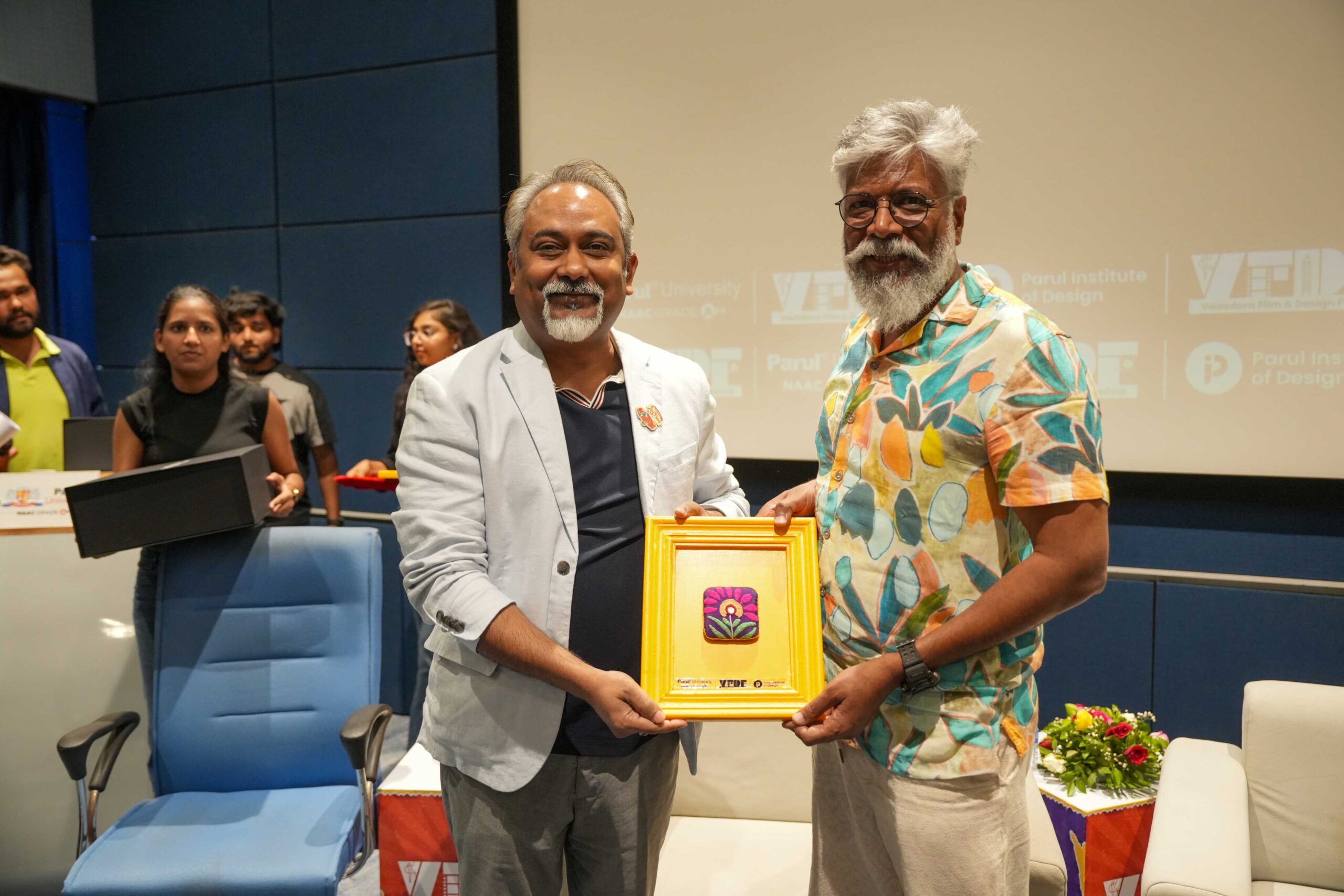
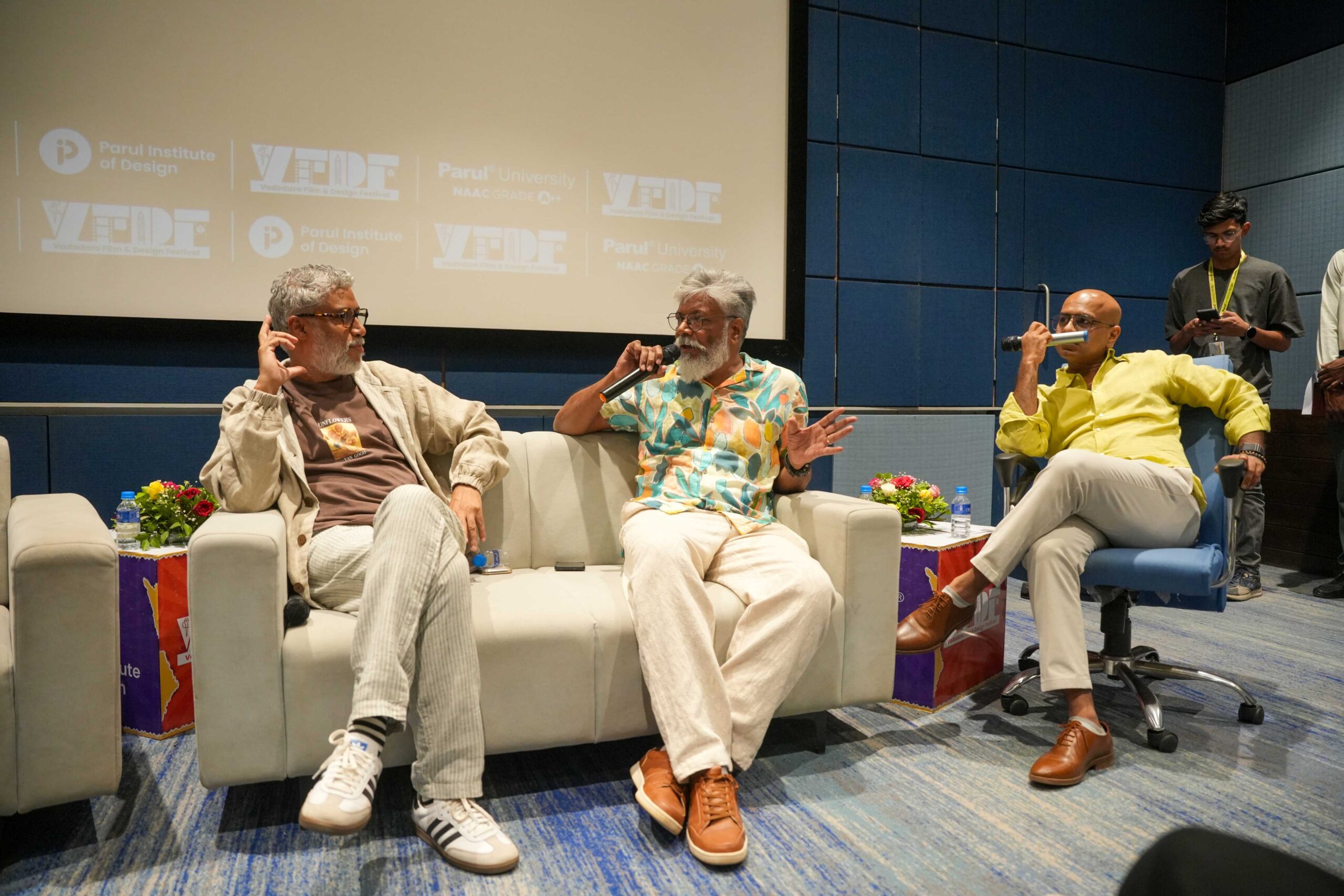
Shital Verma is the National Design Head at Navbharat Times, one of India’s largest Hindi-language daily newspapers.
His role covers visual direction across the publication’s print, digital, and platform properties. He brings a specific combination of skills to student workshops. The discipline of meeting daily deadlines at scale. The ability to articulate creative ideas to non-designer stakeholders. The experience of producing campaigns and front-page designs under real commercial constraints.
That combination is what made his workshop different from a purely craft-based storyboard session. The students were not being trained to draw better. They were being trained to think better under time pressure, with or without AI tools.
Read more: VFDF 4.0 at Parul Institute of Design: complete festival guide
The Workshop Format: Concept First, Tools Second
The three-hour workshop ran with a specific structure.
Students were given thirty minutes to develop an advertisement concept for a product or brand of their choice. The product could be real or invented. The constraint was that the concept had to be pitchable to a client in under ninety seconds.
- Stage one: individual concept development on paper, no tools beyond pen.
- Stage two: concept refinement with Shital Verma walking the room and asking probing questions.
- Stage three: storyboard sketching, with AI tools available for reference imagery but not for the core frames.
- Stage four: individual pitches to the room, with peer feedback and Shital’s professional assessment.
The AI-tools component was deliberately positioned as a reference and ideation aid, not as the primary production tool. Students who leaned too heavily on AI-generated imagery found their storyboards were visually impressive but conceptually thin. Students who hand-drew their key frames found the opposite.
“AI will generate a hundred variations of an idea, but it will not generate the idea for you. The storyboard is the idea, not the rendering.”
This framing is what production-grade storyboard training looks like at advertising agencies and film production houses. The craft skill matters. The concept skill matters more.
The Twenty-Five Pitches: A Snapshot
The final pitch session compressed twenty-five original advertisement concepts into roughly forty-five minutes.
The range of ideas demonstrated what a well-structured workshop can extract from a cohort.
- A post-apocalyptic burger advertisement, where the last human on earth bites into a still-warm burger and smiles.
- Chuchu’s creative-block brick wall, a self-referential ad for a pencil brand where the creative director’s writer’s block is a physical wall of bricks.
- A magical stopwatch that can pause time, used to pause a family moment for an insurance brand.
- Shubham’s crying crumpled paper, a discarded draft that comes to life and weeps for what it was supposed to become.
- A girl talking to the moon, an intimate monologue ad for a telecom brand.
- Talking fruits on a supermarket shelf, competing for the attention of a passing shopper.
- Balaji Wafers reunion, estranged siblings reconnecting over a shared childhood snack.
- A pillow dream, an entire ad framed as the internal monologue of a pillow.
- A lost dog in a forest, a slow-paced search for a pet-care brand.
- Sunflower and clouds, a weather-forecast dialogue between a flower and the sky.
Each pitch carried a complete concept, a proposed shot list, and an articulated brand rationale. Not storyboards as drawings. Storyboards as pitches.
Leela Santhosh Kohli and the Dhurandhar Moment
The standout pitch of the session came from Leela Santhosh Kohli.
Leela is an engineering-background student who crossed over into the design track. Her pitch was for Virat Kohli, the cricketer. The structure of the pitch was a double timeline. On one side of the frame, Kohli as a seventeen-year-old under-19 player, nervous, unsure, still finding his footing in national cricket. On the other side of the frame, Kohli in 2026, the experienced veteran with a hundred centuries and two decades of pressure behind him.
“The two Virat Kohlis share a single frame. They see each other. The younger one asks the older one a question. The older one answers by looking at the camera.”
The concept compressed twenty years of a cricketer’s life into a single advertising frame. Her design professor, Nishan Sir, paused the session to give her feedback. He nicknamed her Dhurandhar on the spot, using the Hindi word for master, expert, or consummate practitioner.
The nickname stuck. Leela has been called Dhurandhar by her classmates and faculty since the workshop. A single moment of creative recognition, delivered publicly, carrying permanent weight.
This is what good workshop feedback looks like. It is specific, it is witnessed, and it becomes part of the student’s identity going forward.
Read more: B.Sc Film and TV Production at Parul Institute of Design
Why This Workshop Format Works
Three-hour workshops at festival-scale events are usually superficial. Participants get a taste of a technique and walk away with a sketch. Little transfers into long-term practice.
The Shital Verma workshop avoided this pattern for three structural reasons.
- The constraint forced real pitches. Twenty-five students producing twenty-five finished concepts in three hours requires focused work, not exploration.
- AI tools were positioned correctly. As a reference and ideation aid, not as a crutch. Students learned to treat AI the way professional studios actually treat it.
- Professional feedback was delivered in front of peers. When Shital Verma or Nishan Sir delivered an assessment, the whole room heard it. The feedback became a shared learning rather than a private note.
This format is replicable. It is how advertising agencies train junior designers. It is how production houses run concept-development sessions. Students who have experienced this format once know what professional design training feels like, and they demand it of themselves afterward.
Frequently Asked Questions
Who is Shital Verma of Navbharat Times?
Shital Verma is the National Design Head at Navbharat Times, one of India's largest Hindi-language daily newspapers. He leads visual direction across print, digital, and platform properties for the publication. At VFDF 4.0 in 2026, He ran a three-hour storyboard workshop with B.Design and B.Sc Film and TV Production students at Parul Institute of Design.
Does AI replace storyboard artists?
No, and Shital Verma's workshop demonstrated why. AI tools can generate reference imagery and accelerate ideation, but they cannot produce the core creative concept. The storyboard is the idea, not the rendering. Students who understood this distinction during the workshop produced the strongest pitches. Students who relied on AI-generated imagery without a strong concept produced visually impressive but thin work.
What is the correct way to use AI in storyboarding?
As a reference and ideation aid, not as the primary production tool. AI can generate variations of a composition, explore colour palettes quickly, and produce mood-board reference imagery. The core frames of a storyboard, the ones that carry the narrative beats and emotional peaks, benefit from hand-drawing or deliberate image direction by the designer.
Who is Leela Santhosh Kohli and why does she matter?
Leela Santhosh Kohli is an engineering-background student at Parul Institute of Design who pitched a Virat Kohli double-timeline advertisement concept during Shital Verma's workshop. Her design professor, Nishan Sir, nicknamed her Dhurandhar on the spot in recognition of the concept's craft. Her story exemplifies how cross-disciplinary backgrounds produce strong design thinking when paired with the right workshop environment.
What career paths do storyboard skills open up for design students?
Advertising agency creative teams. Production house concept departments. Film and television storyboard artistry. Animation pre-production. Game design narrative development. UX and platform design for campaign-driven work. Independent creative direction. The skill transfers across every visual-narrative industry that hires designers.


