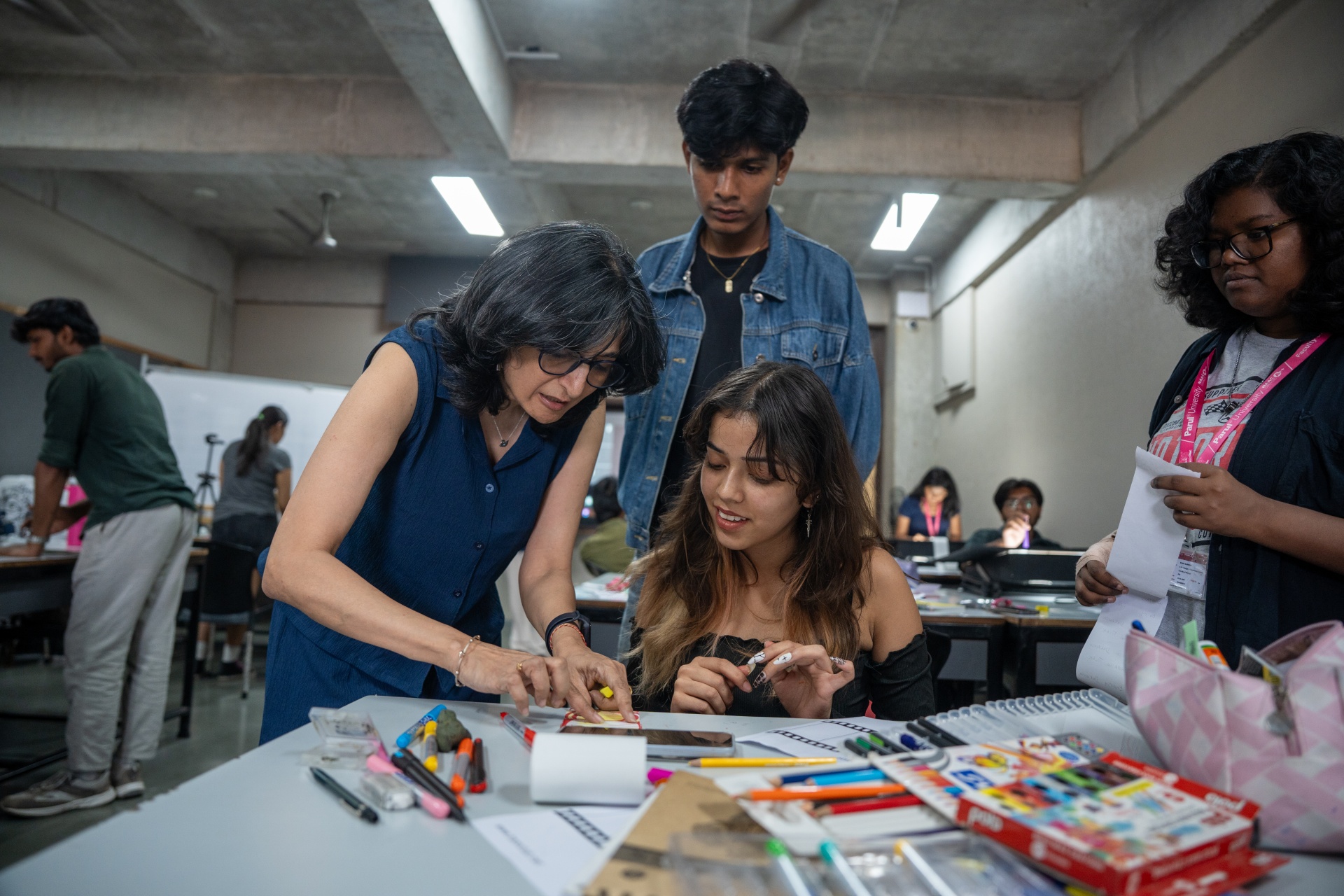
On the very last day of VFDF aka Vadodara Film & Design Festival as hosted by Parul Institute of Design, the animation educator Tehzeeb Khurana started her 3 hour workshop with a very unique question!
Question – What are the different types of animation you know?
Students answered quickly. Stop-motion. 2D. 3D. Then they went deeper: sand animation, shadow animation, mixed media. Tehzeeb Khurana accepted every answer. Then she told them the entire field of animation was older, stranger, and more experimental than most film school curricula let on. Her workshop’s purpose was to introduce them to the tradition that preceded Disney.
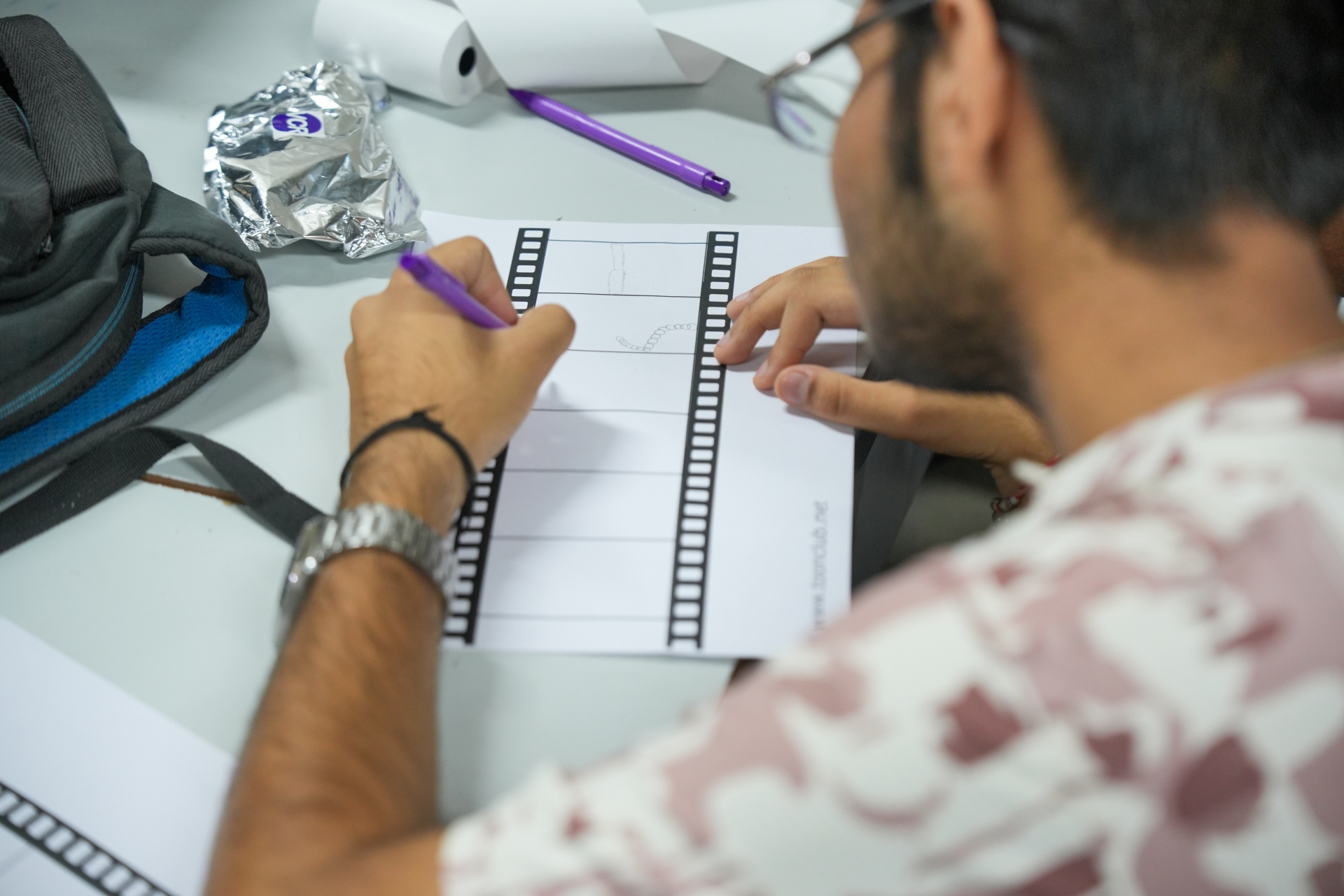
That tradition included direct-on-film animation developed by Norman McLaren, pin screen animation, paint on glass, and pixilation. By the end of three hours, every student in the room had drawn a cameraless animation on a roll of grocery-bill paper. She took every roll back to Mumbai to compile them into a single collaborative film titled VFDF.
Who Tehzeeb Khurana Is and Why Her Credentials Matter
Tehzeeb Khurana is the founder of Toon Club, an animation institute in Mumbai. She is an animation educator, cultural curator, and juror. Her juror credentials include the Annecy International Animation Film Festival (the world’s most significant animation festival) and the Kids Cinema Festival. She is co-founder of the Animela Festival in India.
Her range matters because she is not a commercial animator teaching commercial animation. Besides this, she is a practitioner who has judged work at highest film festival level and teaches cameraless techniques so that most commercial programmes do not cover. PID students who attended her workshop indeed encountered animation as an artistic discipline, not as some another VFX pipeline for films. If you’re passionate about VFX & animation, then enrol into PID’s B.Sc in Animation & VFX program to master creative & technical processes.
The Animation History Most Textbooks Skip: A Woman Made the First Feature, Not Disney
Her most pedagogically important moment came early. She asked students what the first animated feature film was. The answers, predictable: Disney’s Snow White and the Seven Dwarfs, 1936.
She told them the real answer. Almost ten years earlier, in 1926, a woman named Lotte Reiniger made a stop-motion silhouette animation feature called The Adventures of Prince Achmed. The film was made in Germany using paper cutouts and silhouette techniques. It is widely considered the first animated feature film in cinema history. This film is not included in most Indian animation curricula. The default history starts with Disney because Disney built the commercial industry. But the commercial industry is not the whole history of the form. Khurana’s corrective was specific: a PID animation student who thinks Disney is the starting point will never develop their own editorial voice. Lotte Reiniger is the starting point, so master the techno-creative concepts with PID’s Certificate Program in VFX and Animation program!
Students were given homework: find The Adventures of Prince Achmed online. Watch it, even if it is in German. The frame-by-frame craft of silhouette animation predates almost every technique they would learn in a commercial 3D pipeline.
Other Animation Forms That Commercial Curricula Skip
She walked PU students through multiple animation traditions that do not fit into the commercial 2D/3D framework –
Pixilation
Human bodies became the characters in stop-motion, as appearing and disappearing in every frame. Students were asked to watch Norman McLaren’s 1952 film Neighbours, for using pixilation to narrate a story of two neighbours fighting over one single flower.
Pin Screen Animation
A board covered with pins is pushed and pulled to create shadows that animate frame by frame. Students were told to find Mindscape by Jacques Drouin as an example.
Paint on Glass
In the session, she even spoke of an animator that paints on a glass surface with a light source beneath, it even photographs the painting, erases and re-paints the portion that needs animation and photographs again. She even pointed students to The Street by Caroline Leaf.
Sand Animation
The animator moves sand across a backlit glass surface, photographing each movement. She even highlighted The Owl Who Married a Goose, another Caroline Leaf masterpiece.
Silhouette Animation
Lotte Reiniger’s technique was the paper or black cardboard cutouts animated against a white backlit surface. This is the technique of The Adventures of Prince Achmed.
The point of the tour: commercial animation is one branch of a much larger tree. Students who know only the commercial branch are animation technicians and who understand the larger tree can become animators.
New York Indian Film Festival Director – Mr. Aseem Chhabra at VFDF 4.0!
Norman McLaren and the Direct-on-Film Tradition
The pedagogical anchor of Tehzeeb Khurana’s workshop was the work of Norman McLaren, a Canadian filmmaker who pioneered cameraless animation. McLaren drew and painted directly onto blank 35mm film strips, bypassing the camera entirely. The resulting films were handmade in the truest sense.
Khurana screened a documentary clip of McLaren explaining his philosophy. He wanted to maintain the intimate relationship a painter has with a canvas. Traditional filmmaking involves chemistry, mechanics, and processing. All of those processes put distance between the artist and the final work. Direct-on-film animation eliminated that distance. McLaren could draw a frame, run it, see the result, and redo it immediately.
“Handmade cinema. Thought that could be seen, had thoughts been visible.”
McLaren’s 1949 film Begone Dull Care (made with jazz pianist Oscar Peterson) was the key screening. Students saw how McLaren used darker colours for low-pitched music and lighter colours for high-pitched music. The synchronisation was instinctive, not rule-based. He drew what he felt. The film’s energy matched the jazz energy because both were improvised in tempo.
Why Grocery Bill Paper: The Register Roll as an Animation Canvas
Khurana’s practical innovation was using register rolls, the same paper that D-Mart and other retailers print bills on. The rolls are cheap, widely available, and long enough to draw multiple seconds of animation on a single strip.
Students were given the following framework:
- Framing: use a pencil to draw boxes along the roll in the 16:9 format of the television screen. Expect 60 to 120 frames per student
- Registration master sheet: draw all stages of the intended motion on a separate master sheet. Place the roll over the master sheet and use a light source to trace each frame, moving the roll one box down for each trace
- Math: at 24 frames per second, animating on twos (each drawing repeated twice) means 12 drawings per second. Five seconds requires 60 drawings. Ten seconds requires 120
She briefed students to aim for 5 to 10 seconds of animation each. Once individual animations were combined into a single film, the total length would be enough to submit to international festivals. She referenced her previous students, whose collaborative films made from similar classroom exercises had been submitted to international juried competitions. Bachelor of Science in Film and TV Production is designed in a way to make students master the entire funnel and production pipeline at college level itself so they can become industry-ready even before they get a degree!
Two Techniques: Frame by Frame vs Frameless Animation
Khurana taught two distinct approaches on the register rolls:
Frame by Frame
Draw inside the boxes. Control the shape. Use the master sheet to track motion. This is the commercial technique, compressed onto paper.
VFDF 4.0 complete guide: 30+ speakers across four days
Frameless
Ignore the boxes, draw wiggly, and continuous lines running across the entire roll without respecting frame boundaries. When run through a camera, the result is the chaotic, jazz-like animation Norman McLaren pioneered.
Most PID students started with frame-by-frame because it felt safer. Khurana pushed the room toward frameless. Her repeated instruction to every student walking past her with a half-finished roll: add more colours. The McLaren tradition is bright. Do not hold back.
What PID Students Actually Drew on Their Rolls
The student outputs were heterogeneous. Some were meticulous. Some were chaotic. All were handmade. Examples that drew Khurana’s attention:
- A post-apocalyptic burger advertisement that Khurana helped restructure into an eye-reflection opening
- A creative-block narrative where a brick wall dissolves into ideas when music plays
- A magical stopwatch story that a boy finds in his grandfather’s cupboard and uses to reach a hospital in time
- A sunflower survival story about a seed growing against drought
- A Balaji Wafers advertisement that Khurana restructured to replace a village trope with a wardrobe-change metaphor
One standout came from a first-year engineering student, Leela Santhosh, who was not enrolled in an animation programme at all. His Virat Kohli cricket advertisement storyboard used layered emotional beats (young Kohli at Under-19 selection, present Kohli motivating his younger self, a transition through an eye reflection to the Wankhede stadium crescendo) that the PID faculty nicknamed Dhurandhar. The cross-departmental student attending the animation workshop ended up producing one of its most memorable pitches.
The Collaborative Film She Will Make in Mumbai
As the workshop ran toward its close, it became clear that only one or two students would have time to film their completed rolls using the camera stand set up in the classroom. Instead of letting the work remain incomplete, She made a commitment:
“I’m going to take this back to Bombay and shoot it all over again. I’m going to collect all your reels, shoot them, and package it up like a proper film.”
She took every student’s roll back to her Mumbai studio. She promised to scan every paper, credit every student by name, and edit all contributions into one collaborative film titled VFDF. The resulting film would be shot, edited, and finalised to a professional standard. Students would receive copies of the final film with their individual names in the credits.
That commitment mattered structurally. The workshop did not end with students taking home a roll they would never look at again. It ended with the students becoming credited contributors to a collaborative work that could potentially be submitted to festivals.
Why This Workshop Mattered at PID
PID’s Bachelor of Science in Animation and VFX programme covers the complete animation and VFX pipeline: concept development, modelling, animation, lighting, rendering, compositing. Students spend four years learning commercial techniques because those techniques are what animation studios hire for.
What Tehzeeb Khurana’s workshop added was a framework for understanding those commercial techniques in a longer tradition. A student who knows Lotte Reiniger, Norman McLaren, Caroline Leaf, and Jacques Drouin alongside modern 3D pipelines has editorial range. A student who only knows the 3D pipeline is a technician.
The specific practical lesson: most animation students will never get to draw on 35mm film in their careers. But every animation student can draw on register rolls. The technique is not the tradition. The thinking is. The same frame-by-frame discipline that Norman McLaren applied in the 1940s is available to any Indian animation student with a stack of grocery bills and a pen.
Frequently Asked Questions
Who is Tehzeeb Khurana?
Tehzeeb Khurana is an animation director, educator, and cultural curator. She is the founder of Toon Club, an animation institute in Mumbai, and a juror at prestigious international animation festivals including the Annecy International Animation Film Festival. She is co-founder of the Animela festival in India and has taught animation to students across age groups from children to senior learners.
What was the first animated feature film?
Contrary to the common assumption that it was Disney's Snow White (1936), the first animated feature film is widely considered to be Lotte Reiniger's The Adventures of Prince Achmed, made in Germany in 1926, nearly 10 years before Snow White. Reiniger's film used silhouette animation with paper and cardboard cutouts. Tehzeeb Khurana raised this point in her VFDF 4.0 animation workshop at Parul Institute of Design.
What is cameraless animation?
Cameraless animation, also called direct-on-film animation, is a technique where the animator draws or paints directly onto blank film strips or other physical surfaces frame by frame, bypassing the camera. The tradition was pioneered by Norman McLaren. At PID's workshop, students worked on register rolls (grocery bill paper) as a cost-effective alternative to celluloid film.
Does Parul Institute of Design offer a Bachelor's programme in Animation and VFX?
Yes. Parul Institute of Design offers a Bachelor of Science in Animation and VFX as a four-year programme, available in Regular and Honours formats. The curriculum covers concept development, 2D animation, 3D modelling and animation, VFX compositing using node-based workflows, lighting, rendering, and final output pipelines. Student films from the programme have been selected for CUIFF Film Festival 2025 (Aakhri Dor: The Last Thread) and nominated at 24FPS International Animation Awards 2025. Admission is through PU-DAT, the Parul University Design Aptitude Test.
What is the Annecy International Animation Film Festival?
The Annecy International Animation Film Festival is the world's most prestigious animation festival, held annually in Annecy, France. Tehzeeb Khurana has served as a juror at the festival. Getting an Annecy selection is one of the highest recognitions an animator can receive globally, comparable to Cannes for live-action cinema.
What is Norman McLaren's contribution to animation?
Norman McLaren (1914-1987) was a Canadian filmmaker who pioneered cameraless animation by drawing and painting directly onto blank 35mm film strips. His films Begone Dull Care (1949) and Neighbours (1952) are canonical. McLaren's philosophy was to maintain an intimate relationship between the artist and the medium, eliminating the mechanical and chemical distance created by traditional film processing.


