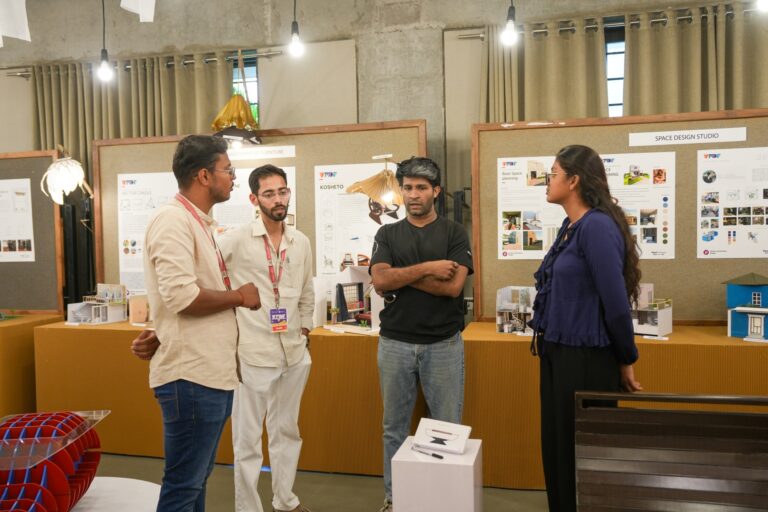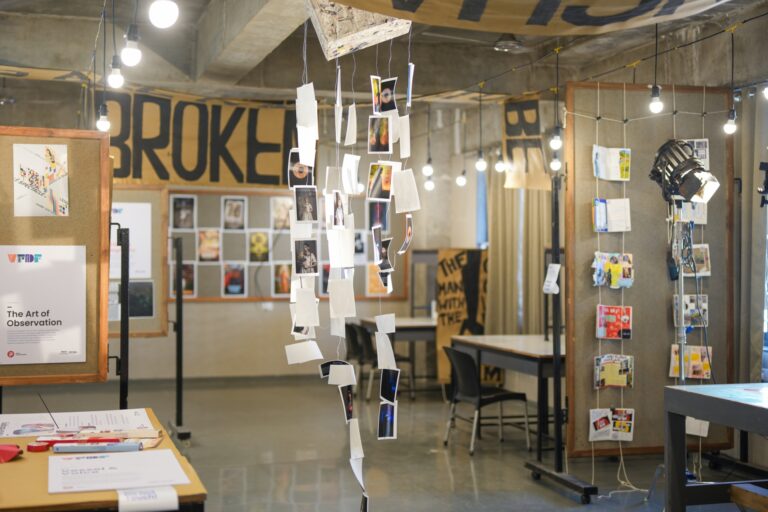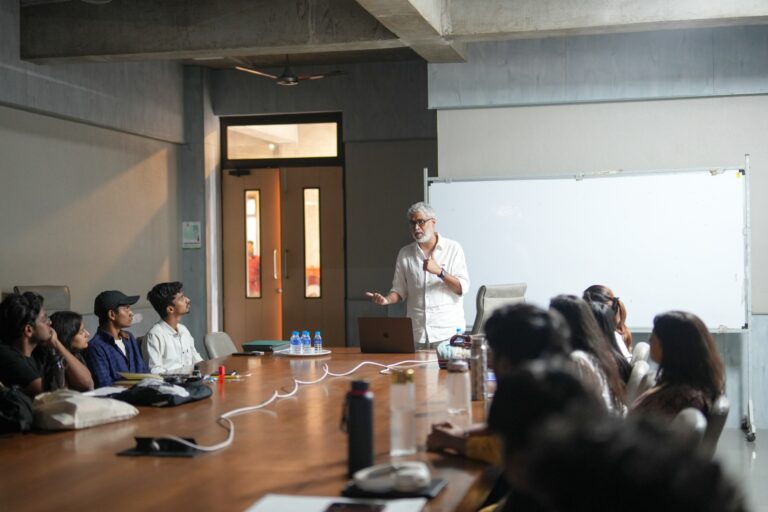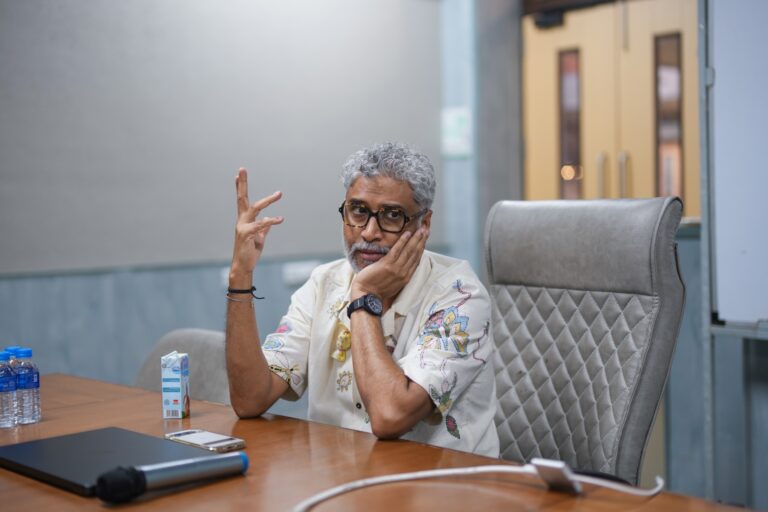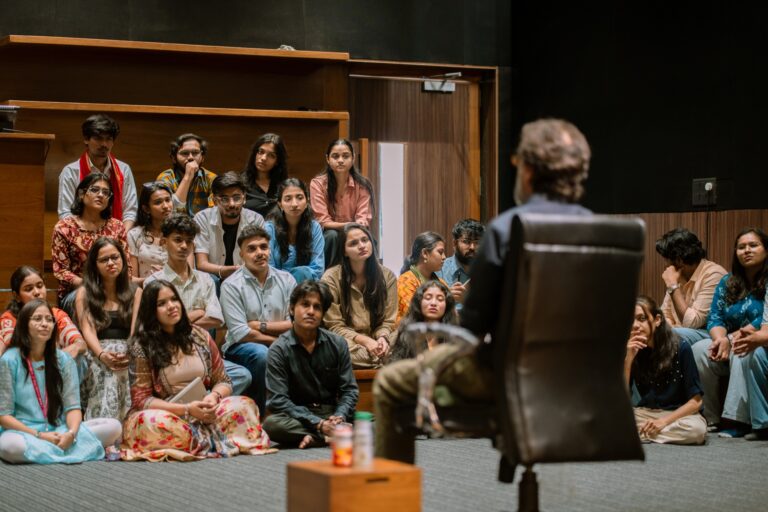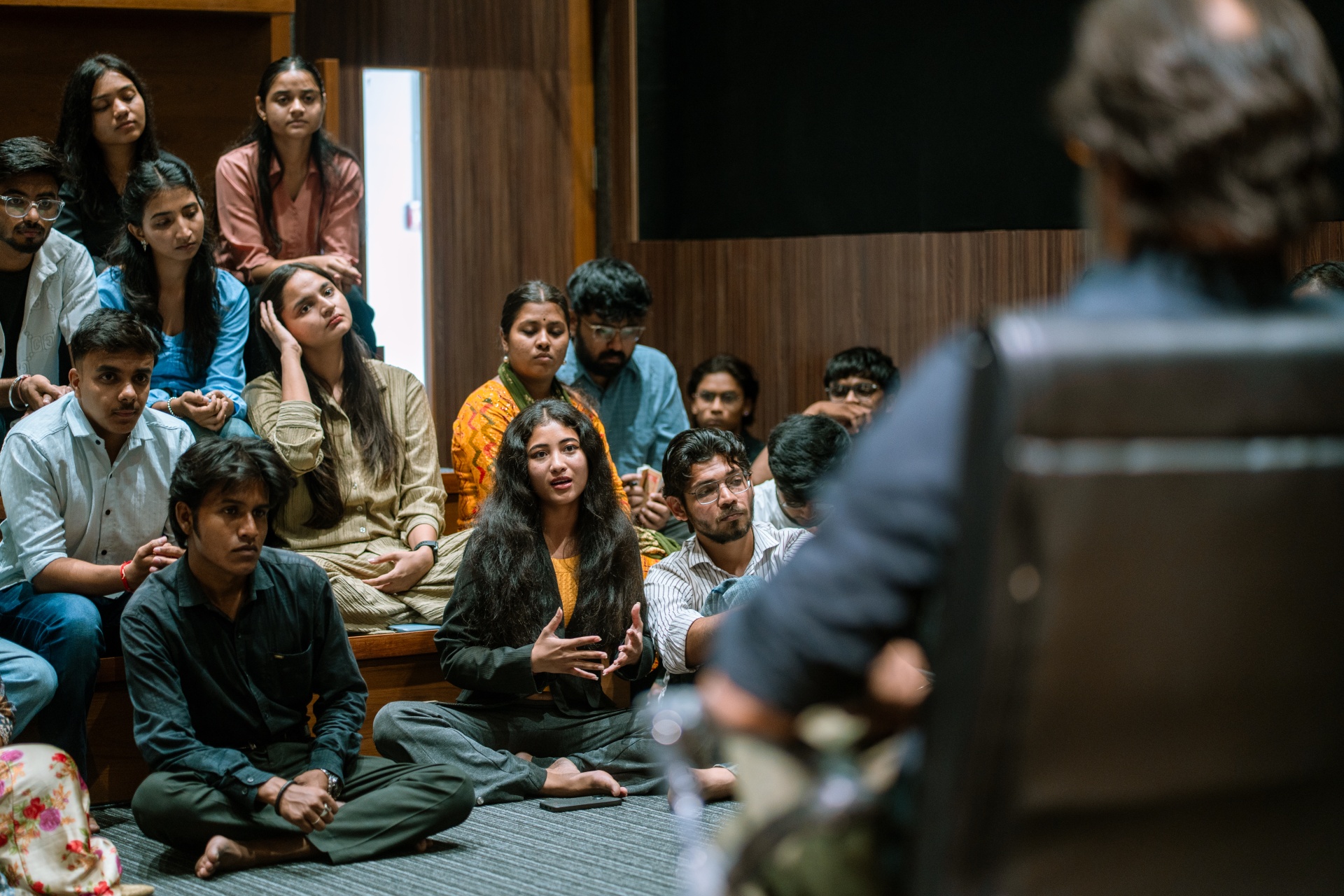
The AI panel was the closing session of VFDF 4.0. Five people on stage.
- Sameer Sarkar, moderator, designer and entrepreneur.
- Aparna Sud, Filmfare Award-winning production designer (Neerja).
- Shital Verma, National Design Head at Navbharat Times.
- Nitesh Mohanty, designer, curator of the Blue Project exhibition.
- Saurabh Kabra, technology practitioner working at the AI-design intersection.
The audience was the full PID student body plus VFDF attendees. The question Sarkar opened with was direct.
“Will AI replace designers? Yes or no. And why.”
No panellist gave a yes-or-no answer. Each one reframed the question. The reframing is where the useful content was.
Read More: Vadodara Film & Design Festival 4.0 – Sarita Patil’s Producer Playbook!
The Homogeneity Argument
The first reframing came from Shital Verma.
He argued that the question is not whether AI replaces designers. The question is what AI does to design when every designer uses the same tools.
“If twenty-five of you use the same prompt on the same AI tool, you will get twenty-five versions of the same thing. The tool homogenises.”
This is a specific critique, not a generic one. Verma was not arguing that AI output is low quality. He was arguing that AI output is converging quality. The distinctive point of view, the individual voice, the specific creative instinct that makes one designer’s work recognisably theirs, is what gets flattened when everyone is prompting the same models.
The strategic implication is that designers who lean heavily on AI for the core creative idea will become indistinguishable from each other. The designers who use AI for execution acceleration while keeping the core concept human-authored will remain distinguishable.
The Environmental Cost That Almost No One Raises
The second reframing came from a student question during the Q&A.
The student asked about the environmental cost of AI. She cited specific numbers.
- A single AI data centre can consume up to 19 litres of fresh water per day in cooling.
- Approximately 80 percent of that water does not return to the local ecosystem.
- Meta’s data centre in Georgia was cited as a specific example where local groundwater was affected.
- Training a single large language model generates carbon emissions equivalent to five cars over their entire lifetime.
The question silenced the room. No one had addressed this dimension of the AI conversation in the previous hour. Nitesh Mohanty responded with an observation about photography. His ten-month-old son is photographed daily by relatives who will never develop, print, or preserve those images in any durable way.
“Every one of those photos is stored on a server that consumes energy and water. The AI question is the same question at a larger scale. What is the environmental cost of producing and storing everything we produce and store?”
This framing pulled the AI debate into the broader environmental conversation. Design students entering the industry in 2026 will face client and consumer pressure to work with lower-footprint production methods. Designers who treat environmental cost as a core consideration will have a competitive advantage over those who ignore it.
Read more: UN Water on the water cost of digital infrastructure
Mahendra Pandya's Polishing Machine
The third reframing came from Mahendra Pandya, also a voice from the audience.
He told a story about polishing machines. His point was simple. A polishing machine is a tool. It does not replace the craftsperson who knows what to polish and why. A craftsperson without a polishing machine works slowly but produces good work. A polishing machine without a craftsperson produces nothing useful.
“AI is the polishing machine. Foundation first, tool second.”
The analogy is durable. Every generation of new design technology has produced the same anxiety. Photography would replace painters. Photoshop would replace illustrators. 3D modelling software would replace sculptors. Each wave displaced some practitioners and created new categories for others. The designers who survived each wave were the ones with strong foundations.
The implication for design students in 2026 is that fundamentals matter more, not less, in an AI-intensive environment. A student who graduates from the Parul Institute of Design having built portfolio volume through real projects, architectural vocabulary through eleven arch types and nine staircase types, material fluency through working drawings, and presentation skills through jury reviews, has the foundation the polishing machine amplifies.
Read more: B.Design Interior and Furniture Design at Parul Institute of Design
Dean Bhaskar Mitra's Closing: Producer vs Consumer
Professor Bhaskar Mitra, Dean of the Parul Institute of Design, closed the panel with a geopolitical observation.
“Every major AI tool, software, and social platform involving AI is owned by American companies. India has become a massive market consuming what the United States produces.”
His challenge to the students was to shift from consumption to production. The AI replacement question, in Mitra’s framing, was the wrong question for Indian students to ask. The right question was how Indian designers, technologists, and founders could build the next generation of tools rather than only using the ones that already exist.
This framing connects to the Make in India and Startup India policy frameworks that are actively investing in indigenous technology development. The Parul Innovation and Entrepreneurship Research Centre (PIERC) supports student founders who want to build rather than only consume. Solnce Energy, a PIERC-supported startup, secured investment on Shark Tank India Season 4 on exactly this logic.
Read more: Parul Innovation and Entrepreneurship Research Centre (PIERC)
The Ground Truth: Anvi Chanodia's Livspace Role
Outside the panel discussion, the simplest counter to the AI-replacement narrative is on the ground.
Anvi Chanodia works at Livspace. The work is real. The client projects are real. The modular kitchens, the material choices, the three-year-old design challenges, the client conversations. All real. All requiring human judgment, human empathy, and human decision-making that AI cannot deliver at the level a paying client expects.
AI tools appear in her daily work as acceleration, not replacement.
- Rendering software produces faster client previews.
- Image libraries offer reference material for material selection.
- Internal platforms at Livspace use AI for preliminary project matching.
- The final design decisions are still made by Anvi and her senior designers.
This is the realistic pattern of AI adoption in Indian design work in 2026. Acceleration of execution. Retention of judgment. Designers who understand their tools as extensions of their foundation, rather than replacements for it, keep working. Designers who outsource their core creative judgment to AI become interchangeable.
Read more: Anvi Chanodia’s complete placement story: AI-adjacent real work
The Specific Design Work Most Exposed to AI Displacement
Honest analysis requires naming the work that is most exposed.
Generic graphic design tasks with low creative differentiation (social media template generation, basic logo iteration, stock image selection) are the most exposed to AI displacement. Students planning to enter these categories as their entire career should reconsider.
The less exposed categories include.
- Interior and furniture design involving physical space, materials, and client collaboration.
- Production design for film, television, and stage involving narrative context and emotional atmosphere.
- Communication design involving multilingual and multi-cultural India contexts that foreign-trained AI models handle poorly.
- Craft-intensive fashion and textile work involving hand techniques and regional traditions.
- Animation and film production involving storytelling, cinematography, and post-production judgment.
- Curatorial and exhibition design involving research, cultural context, and spatial choreography.
Each of these categories is represented in the programme offerings at the Parul Institute of Design. Students who choose specialisations with higher human-judgment components have more career durability over the next decade.
Also Read: Is The University A Good Choice in 2026?