

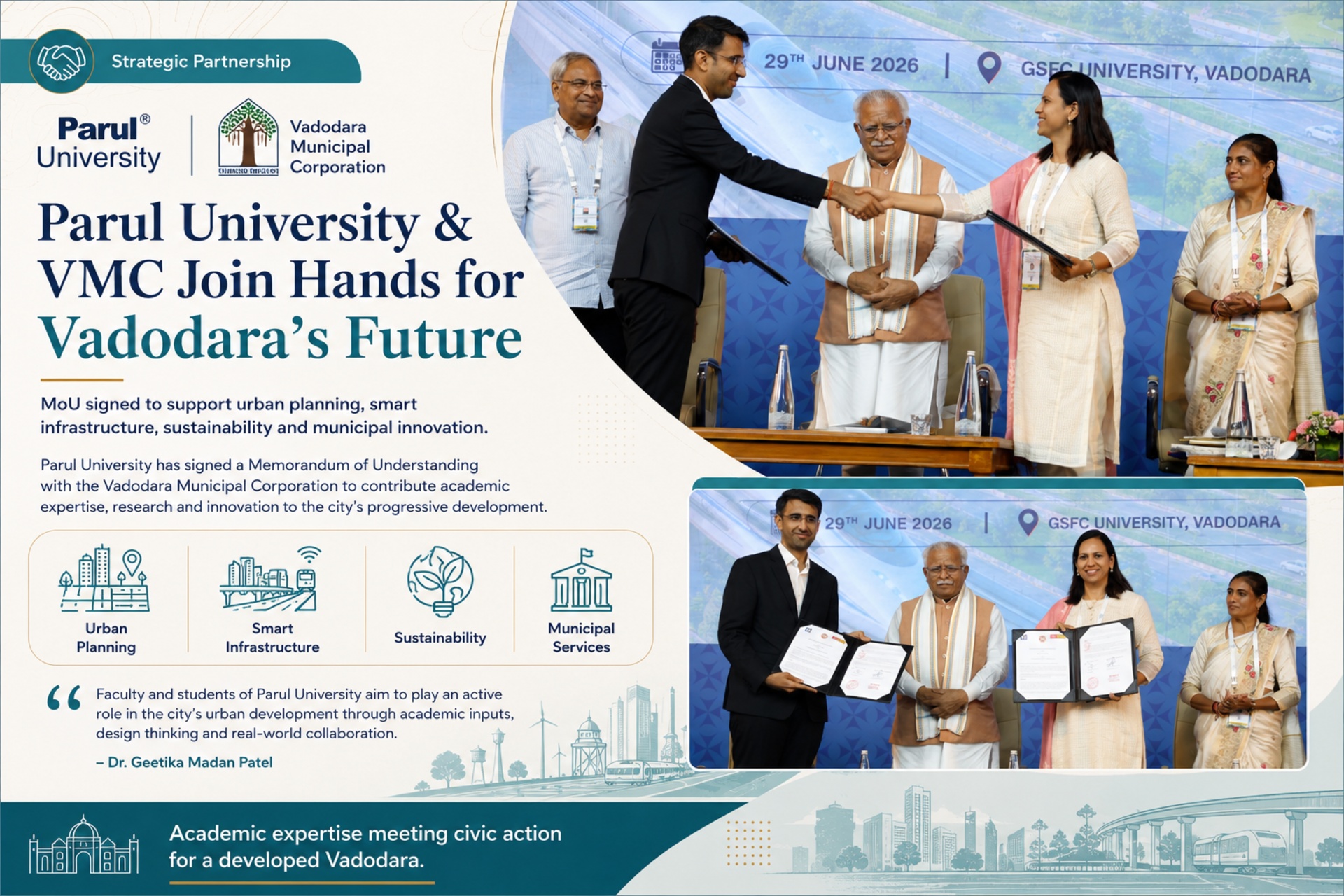
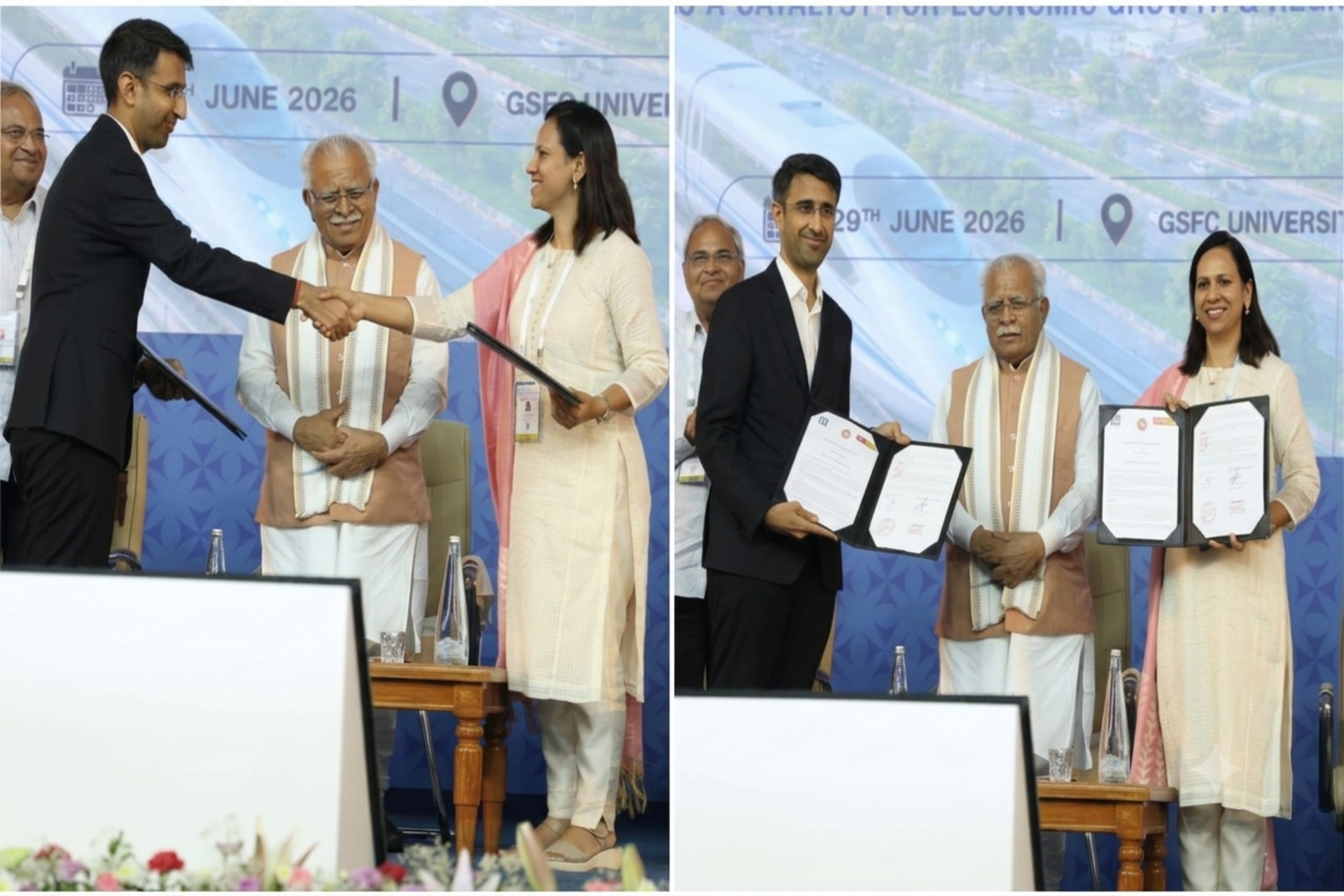
Parul University & VMC – Vadodara Municipal Corporation have successfully signed an MoU (Memorandum of Understanding), designed to elevate Vadodara’s urban planning, sustainability & technological progression. This agreement was signed with the support of the Municipal Commissioner – Shri Arun Mahesh Babu and is designed to build a seamless cooperation between academia & municipal administration!
The partnership is a framework for joint work rather than a single project. It sets out to support urban development through activities spanning capacity building, technical consulting, research, innovation and the sharing of knowledge, bringing the University’s academic capacity to bear on the practical problems of running and improving a city. The idea behind it is straightforward: a municipal corporation carries the operational responsibility for a city, while a university carries research, design and technical expertise, and an agreement of this kind is a structured way to bring the two together.
This article sets out what the Parul University and Vadodara Municipal Corporation MoU covers, how the collaboration is intended to work, and what the University brings to it.
What the Parul University and Vadodara Municipal Corporation Partnership Covers
The Memorandum of Understanding identifies a broad set of sectors where the University and the Corporation intend to work together. These are the areas that most directly shape the daily experience of living in a city.
- Smart infrastructure: Technology-enabled civic systems and their planning.
- Urban planning and urban design: How the city’s spaces are laid out and developed.
- Urban transport: The movement of people and goods across the city.
- Waste management: Collection, processing and disposal systems.
- Sustainability and energy efficiency: Reducing the environmental cost of urban systems.
- Urban governance: The administration and decision-making that runs the city.
- Municipal service delivery: How services reach citizens day to day.
Taken together, these sectors describe an intention to work across the whole span of a modern city’s functioning, from the infrastructure beneath the streets to the governance that directs it.
“From the infrastructure beneath the streets to the governance that directs it, the MoU spans the whole of how a city works.”
How the Collaboration Is Intended to Work
The Memorandum of Understanding sets out the mechanisms through which the two institutions will cooperate. The emphasis is on research, evidence and the transfer of skills into the municipal system.
- Research-driven projects and pilot studies: Joint work drawing on national and international best practice to test urban solutions before scaling them.
- Innovative urban solutions: Applying new approaches to established civic problems.
- Specialised training and technical sessions: Programmes to raise the professional capacity of the municipal system.
- Curriculum development and post-training evaluation: Structured training with follow-up assessment, rather than one-off workshops.
- Technical consulting and knowledge sharing: The University’s expertise made available to the Corporation’s work.
The inclusion of post-training evaluation is worth noting. It signals an intention to measure whether capacity building actually changes practice, rather than treating training as an end in itself. That is a more rigorous approach than a memorandum of this kind often describes.
Architecture, Planning and Infrastructure Support
A significant part of the Memorandum of Understanding concerns the built environment, the area where the University’s design and planning faculties are most directly relevant. The partnership opens cooperation across several technical fields.
- Architecture and urban design consulting: Professional design input on the city’s buildings and public spaces.
- Landscaping and master planning: The shaping of open spaces and the long-range planning of city areas. It also extends to the planning and implementation of the basic infrastructure a city depends on, the systems that are noticed only when they fail.
These are the physical foundations of urban life, and they are precisely the areas in which a university with strong architecture, planning and engineering faculties can offer the Corporation trained technical support, from design through to implementation. The distinction between planning and implementation matters here: many civic problems arise not from a lack of plans but from the gap between a plan on paper and its execution on the ground, and technical support that spans both is more useful than either alone.
What Parul University Brings to the Partnership
The University’s contribution rests on academic capacity that maps closely onto the MoU’s sectors. Parul University’s programmes in architecture and planning are approved by the Council of Architecture, and the University holds recognition from the Institute of Town Planners India, alongside faculties of engineering and design whose disciplines run directly through the agreement’s technical fields. Parul University’s roots in the Faculty of Architecture and Planning and across the Faculty of Engineering and the Faculty of Design are where the partnership finds its academic footing. Urban development is inherently multidisciplinary, and the breadth of the University’s faculties, from architecture and planning through civil engineering, environmental science and design, is what allows it to contribute across the full span of the agreement rather than in a single area.
The value to the city is not only expertise but capacity: a large body of faculty and students who can contribute to real civic projects. For students, that is a direct route into applied, real-world work of exactly the kind that builds industry readiness, a live project in the city rather than a hypothetical one in a studio.
Dr. Geetika Madan Patel, Vice President of Parul University, set out the University’s intended role in those terms.
“The faculty members and students of Parul University, through their expertise and enthusiasm, aim to play an active role in contributing to the urban development of the city through academic activities such as internships and academic inputs on topics such as urban development and design, smart cities, heritage conservation, and other civic developments.” – Dr. Geetika Madan Patel, Vice President, Parul University
The reference to internships and heritage conservation is telling. It frames the partnership as one that runs in both directions: the city gains academic input, and students gain the experience of working on the development of the place they study in.
Academia, Governance, and the Vision of a Developed Vadodara
The larger significance of the Memorandum of Understanding lies in the model it represents: a working link between the education sector and local governance. Bringing a university’s research capacity alongside a municipal corporation’s operational reach is a practical way to pursue sustainable urban development, and it aligns with the wider vision the Corporation frames as Viksit Vadodara, a developed Vadodara. It also connects to national efforts such as the Smart Cities Mission, within which technology-enabled urban development is a stated priority.
For Parul University, the agreement is part of building an ecosystem in which academic work reaches beyond the campus into the life of the city. For the Vadodara Municipal Corporation, it adds trained research and design capacity to the task of governing a fast-growing city. It is worth being clear-eyed about what has happened and what has not: a framework has been agreed, and the substance will be the projects that follow it. The measure of the partnership will be those projects that lie ahead, but the structure that makes them possible is now in place.
Why an Academia and Government Partnership Matters
Partnerships between universities and city governments are becoming a recognised route to better urban management, for reasons that apply directly here. Each side holds something the other needs.
- Evidence over guesswork: A university can bring research, data and tested methods to civic decisions that might otherwise rest on convention, which is the purpose of the research-driven projects and pilot studies the MoU describes.
- Capacity at scale: A large body of faculty and students adds working hands to a municipal system that is often stretched, particularly on technical and design tasks.
- A living classroom: The city becomes a real setting in which students test what they learn, which produces graduates who have worked on genuine problems rather than only theoretical ones.
The arrangement is therefore mutual rather than one-directional. The Vadodara Municipal Corporation gains research and technical depth; Parul University gains a field in which its teaching and research are applied and tested. For a city that’s rapidly growing, come be a part of an ecosystem that has everything – from structured collaborations to labs, top placements, startup support and the best exposure anyone can have. Come, contribute to the city’s skyline and holistically support the vision of Viksit Bharat 2047!
FAQs
What’s the Parul University & Vadodara Municipal Corporation partnership about?
Parul University has signed an MoU (Memorandum of Understanding with the VMC to elevate & support Vadodara’s development via urban governance & technological advancements. As signed with the holistic support of Municipal Commissioner Shri Arun Mahesh Babu, it shows a cooperation between municipal administration and academia across research, technical consulting & knowledge sharing!
Which areas does the Parul University and VMC partnership cover?
The partnership covers smart infrastructure, urban planning, urban transport, waste management, sustainability and energy efficiency, urban governance, and municipal service delivery. It also extends to architecture and urban design, landscaping, master planning, and the planning of basic infrastructure such as roads, bridges, drainage, water and electricity.
How will Parul University students and faculty be involved?
According to Vice President Dr. Geetika Madan Patel, faculty and students will contribute to the city's urban development through academic activities, including internships and academic inputs on urban development and design, smart cities, heritage conservation, and other civic matters. The arrangement gives students real-world project experience while providing the Corporation with academic and technical input.
Who signed the MoU between Parul University and the VMC?
The Memorandum of Understanding was signed between Parul University and the Vadodara Municipal Corporation with the support of the Municipal Commissioner, Shri Arun Mahesh Babu, IAS. It was framed as a partnership between municipal administration and academia, with Parul University's involvement represented by its leadership, including Vice President Dr. Geetika Madan Patel.
What is Viksit Vadodara?
Viksit Vadodara, meaning a developed Vadodara, is the vision of a well-developed, sustainable city that the Vadodara Municipal Corporation works toward. The Memorandum of Understanding with Parul University is intended to support that vision by combining academic research and design capacity with municipal governance.


