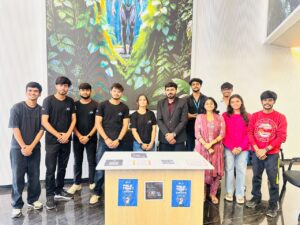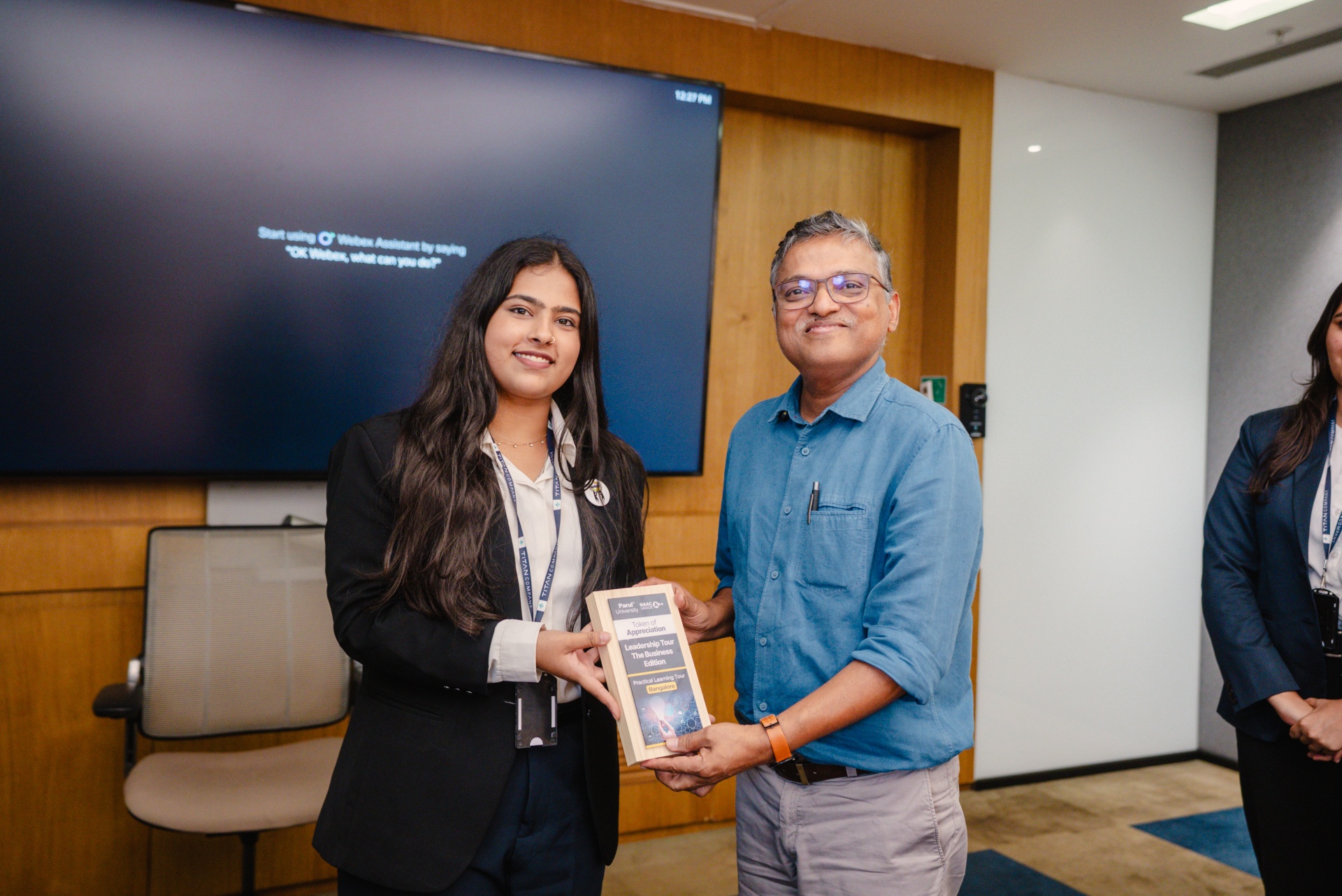
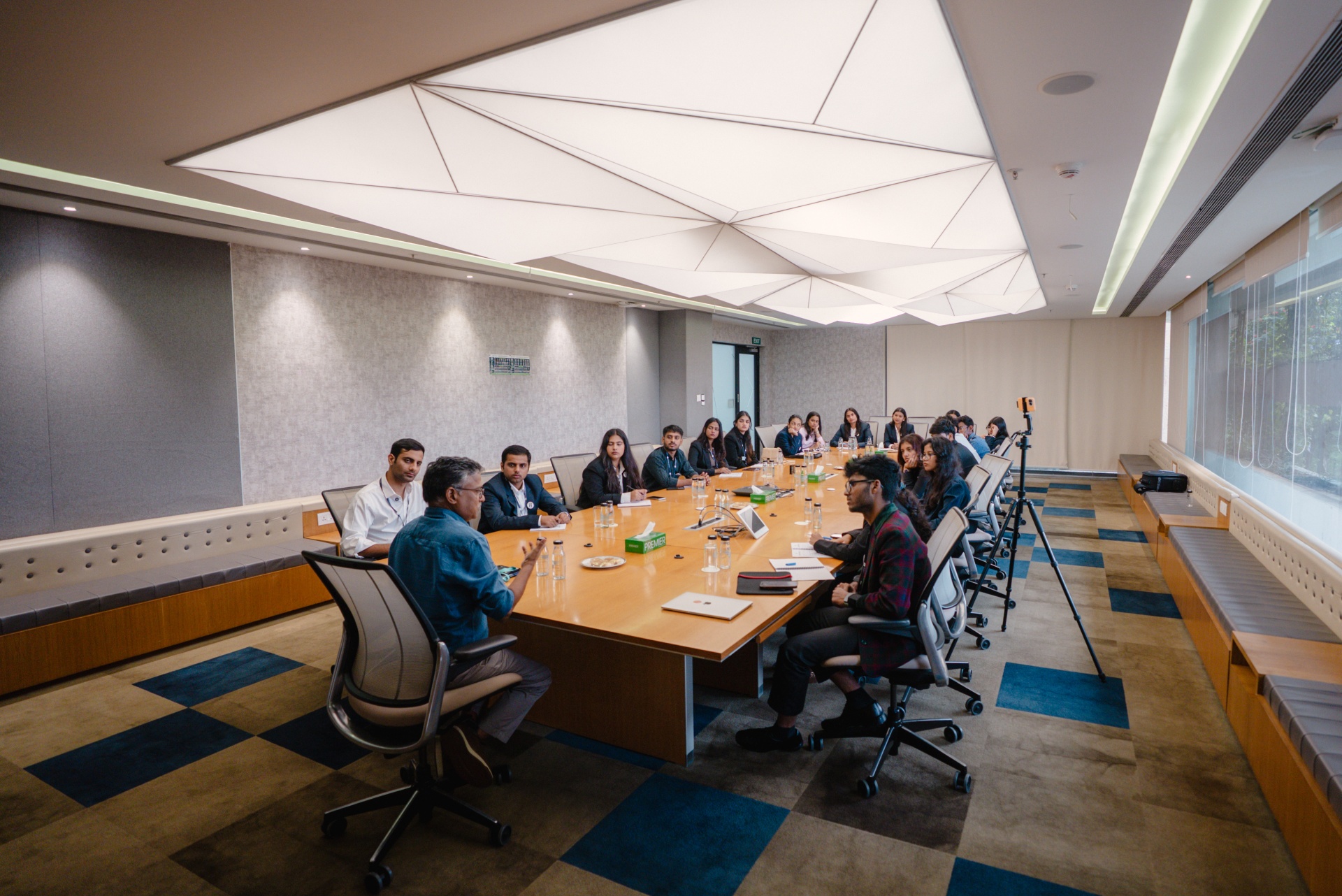
Mr. Ashok Sonthalia‘s session with Parul University students during the Business Leadership Tour in Bangalore was the single longest deep dive into the mind of a Chief Financial Officer that the students experienced across the four days. Titan Company Limited is one of India’s most admired lifestyle conglomerates, owning brands including Tanishq, Titan Watches, Fastrack, Mia, CaratLane and Zoya.
Mr. Sonthalia has served as its CFO for over four years, having come to Titan from a career that spans multiple Tata Group companies and Larsen and Toubro Infotech. From start to final level of job placement, Parul University’s Faculty of Commerce provides end to end support in MBA Programme. Delay not and enrol right away!
Why Long-Term Career Planning Usually Fails
The first question the host asked Mr. Sonthalia was about his early mindset as a young Chartered Accountant joining Tata Steel in 1991, and what drove him towards finance and leadership. His answer directly contradicted most career advice that Parul University students commonly encounter in the social media era:
“Life is a flow. You can’t overplan it. And particularly very long term, if you plan, disappointments may come. So planning is necessary but it is more short term, medium term. If you plan 10 years hence I want to be this, 15 years hence I want to be that, I think let it flow.”
The Tata Steel Context
Mr. Sonthalia grounded the principle in his own experience:
- Joined Tata Steel in 1991 as a junior accounts officer
- Part of a batch of about twenty young Chartered Accountants joining together
- Tata Steel had around 5,000 officers at the time at Jamshedpur
- At the initial officer dialogue, the stated ambition for most young officers was to retire as a Deputy General Manager; that was considered a successful career
- Sonthalia exceeded that goalpost within the decade he spent at Tata Steel
His point was not that ambition is wrong. It was that the specific destination a 22-year-old imagines is almost never where they land at 42. Short and medium-term plans are useful; very long-term plans are something to write down and feel good about, but not to treat as binding contracts.
The XLRI Episode: A Formative Disappointment
Mr. Sonthalia shared a story from his time at XLRI Jamshedpur that shaped his thinking on career entitlement. He was selected for the one-year full-time management programme sponsored by Tata Steel. The students who were selected were on high performance ratings and were considered the chosen few. A three-year bond was required after the programme.
During the programme, the students raised their concerns with the senior leadership: what would happen after graduation? Would they get promotions or special assignments? The Chief Human Resources Officer at the time, whom Mr. Sonthalia still remembers by name, gave them a disappointing answer: nothing special would be done. But the CHRO added:
“I assure you that we are equipping you with tools with knowledge and skills which will help you.”
Mr. Sonthalia said that at the time, this was a disappointment. But in retrospect, it was the differentiating moment of his career. The extra knowledge and skills from XLRI gave him a perspective on business subjects that differentiated him from others with similar backgrounds. The lesson he wanted students to take away: what feels like a disappointment in the moment is often the most important investment in your career. If you wish to develop your career in the finance domain, delay not and explore Management Programmes after 12!
The Tata Chemicals Covenant Crisis of 2008 to 2009
The longest portion of Mr. Sonthalia’s session was devoted to a specific story from his time at Tata Chemicals that illustrated how young professionals can drive high-stakes outcomes without organisational authority.
The Situation
- In 2008, Tata Chemicals made a major international acquisition
- In January 2009, the global financial crisis hit and world markets collapsed
- Tata Chemicals had significant international exposure through exports and the UK business
- Projected covenant breach date: September 2009 (six to seven months away)
- Loan at risk of recall: approximately USD 900 million
Mr. Sonthalia's Role
A cross-functional team was formed to address the crisis. Mr. Sonthalia’s position at the time:
- Second line of strategic finance and treasury, not in the senior leadership
- Junior to nearly everyone involved in the programme
- Appointed as the programme manager or project officer of the cash generation team
The Target
- Generate more than Rs 500 crore in additional cash within six months
- Reduce net debt (the covenant metric was debt minus cash)
- Execute across all global Tata Chemicals operations: United Kingdom, Kenya, Muthapur, India, Baburala
The First Month and a Half
Progress was slow; the team was making a little headway but not enough
- The only thing that helped was visible passion and dedication
- The team entered the war room every morning, wrote down the twelve things to accomplish that day, and refused to leave until all twelve were ticked off, even at 2 AM in some cases
- The next morning at 8 or 8:30 AM, they were back in the office
- This pattern continued consistently for a month and a half
The Outcome
The programme was successful:
- Generated more than Rs 500 crore in additional cash
- Avoided the covenant breach
- Protected the Tata Group’s reputation
- Protected the organisation from the recall of a USD 900 million loan
The Principle That Emerged
“It is your persistence, perseverance, your passion for the cause which kind of then gradually brings people aligned. You actually don’t need a position for people. Irrespective of your position, if you are really showing deep passion about that cause, people do get aligned.”
For Parul University students, this is the most important single takeaway from the Titan session: influence can precede authority. Major organisational outcomes can be driven without holding a senior title, provided the work is visible, documented, relentless, and sustained over a period long enough for others to notice. His story has inspired students of Parul University, here are their heartfelt experiences they shared on LinkedIn –
Technology, Artificial Intelligence, and the Finance Function
The host asked Mr. Sonthalia about how Titan is adopting artificial intelligence and technology across operations. His response framed the broader context:
- Technology has always disrupted finance, starting from personal computers in 1991
- At that time, Tata Steel was highly unionised and there was resistance to computerisation; unions worried about job displacement
- Traditional Enterprise Resource Planning systems came next
- Then digital Software as a Service platforms
- Now artificial intelligence, which Mr. Sonthalia called slightly more profound in its potential
The Redundancy Challenge and Titan's Employee Policy
Mr. Sonthalia spoke directly about how Titan handles the risk of redundancy from automation:
- Titan’s employment culture is effectively lifetime employment, unless the employee commits fraud or a serious value-based infringement
- Senior employees may occasionally be asked to leave based on continuous performance lag, but the default is long-term retention
- Titan is growing at approximately twenty percent per year at current scale
- The company is opening new units and acquiring companies, which creates new opportunities
- Retraining and upskilling employees is the primary response to automation, rather than redundancy
Legacy and Finance as a Business Catalyst
Asked about the legacy he wants to leave at Titan, Mr. Sonthalia focused on the transformation of the finance function itself. His ambition:
- Build a very formidable finance team at Titan by the time he leaves
- Ensure every person in finance has the opportunity to learn, contribute, and give back to the business
- Break the perception of finance as a gatekeeper that says no
- Establish finance as a business catalyst, playing the dual role of pushing the accelerator when opportunities exist and applying brakes when risk demands it
- Position guard rails and governance as enablers of speed, not obstacles to it
The Rapid Fire Round: Myths and Beliefs
During the rapid-fire portion of the session, the students asked Mr. Sonthalia which finance myth he would most like to break. His answer was the most quoted moment of the session and was captured independently by multiple students including Mr. Prashwet Khobragade:
“About finance, I think diversification of portfolio mitigates the risk. I think it’s a much overhyped concept. I think it doesn’t work.”
On Numbers versus Intuition
When asked what drives better decisions, numbers or intuition, Mr. Sonthalia’s answer was balanced:
- Always start with numbers and do the analysis
- Do not get paralysed by numbers, because 10 to 40 percent of the numbers you need will not be available
- Layer intuition on top, where intuition is the accumulation of experience rather than feeling
Customer Centricity Lived in Spirit
Customer centricity is a phrase used in most management conversations, but Mr. Sonthalia noted that living it in spirit is different from stating it. Titan empowers its front-end store staff to execute on customer needs with unusual autonomy. The central office delegates significant authority; as CFO, Mr. Sonthalia noted that once a budget is agreed upon, a monthly review is all that happens, and business units execute within their plans without requiring further permission.
Data-Driven Customer Prediction
Titan has been using its customer database for the last seven to eight years with advanced technology platforms. Mr. Sonthalia noted that Titan is one of the strongest Indian companies at predicting which customer is likely to make which type of next purchase, based on their association with the brand.
The Unorganised Sector Principle
Titan’s strategic rules for entering new industries:
- Enter industries that are currently unorganised, with no large national player
- Help uplift the supply chain in those industries, such as the karigars (artisans) in jewellery and the bunkars (weavers) in Taneira ethnic wear
- Focus on product categories where women are a central customer base
Profit as an Outcome, Not a Target
“Profit is an outcome for us. We have a plan budget but if the right thing needs to be done today which might impact my profit for this month or for this quarter while I’m a publicly listed company, that thing will be done because it is right.”
The Gold Price Hike and Jewellery Affordability
A student asked how Titan manages gold price hikes and product affordability, particularly given that gold prices had moved from approximately Rs 400 per gram at the time of Mr. Sonthalia’s wedding 30 to 33 years ago to approximately Rs 12,000 per gram today. His answer:
- Titan’s core jewellery business is converting gold into jewellery and earning from the conversion margin
- Titan does not take price positions on gold; the company is 100 percent hedged
- Any gold in Titan’s inventory is already hedged against price fluctuations
- Titan operates four jewellery brands at different price points: Zoya (highest), Tanishq (the largest brand), Mia, and CaratLane (more affordable)
- CaratLane and Mia focus on sub-1 lakh price points, with sweet spots around Rs 25,000 to Rs 30,000
How This Session Connects to Parul University Programmes
Mr. Ashok Sonthalia’s session is directly relevant to several Parul University programmes:
- B.Com with specialisations in Accounting, Finance, and Taxation
- Master of Commerce (M.Com) with specialisations in Accountancy and Finance
- Bachelor of Business Administration (BBA) with specialisations in Finance, Marketing, and Human Resources
- Master of Business Administration (MBA) with specialisations in Finance, Marketing, HR, Operations, and International Business
- Chartered Accountancy coaching and Competitive Examination Cell support for students preparing for ICAI, CA, CS, and CMA exams
Parul University’s Faculty of Management Studies places students at companies comparable to those Mr. Sonthalia has worked at over the course of his career, including Tata Group companies, Larsen and Toubro, and others. The broader placement ecosystem, with 3,500 plus offers in a single season and 2,200 plus recruiters, includes the kinds of multinational corporate finance and strategic finance roles that Mr. Sonthalia built his career in.
FAQ
Who is Mr. Ashok Sonthalia?
Mr. Ashok Sonthalia is the Chief Financial Officer of Titan Company Limited, one of India's most admired lifestyle conglomerates.
What myth did Mr. Ashok Sonthalia say he would most like to break in finance?
The myth that diversification of a portfolio automatically mitigates risk. Mr. Sonthalia described it as an overhyped concept that does not work as cleanly in practice as in textbooks. His argument is that blind diversification without understanding core strengths can actually increase risk, and that clarity about what you are good at matters more than spreading across unrelated assets.