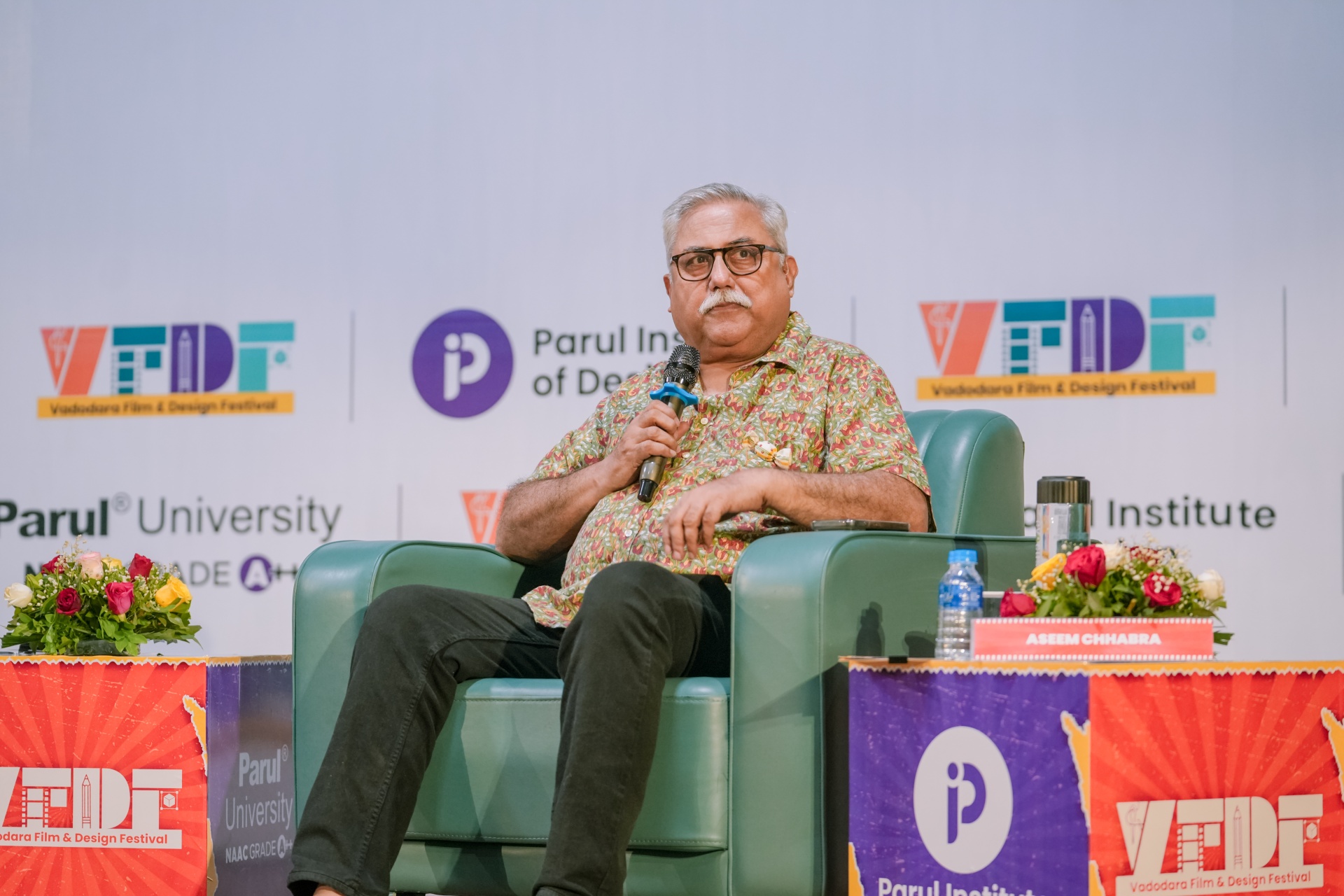
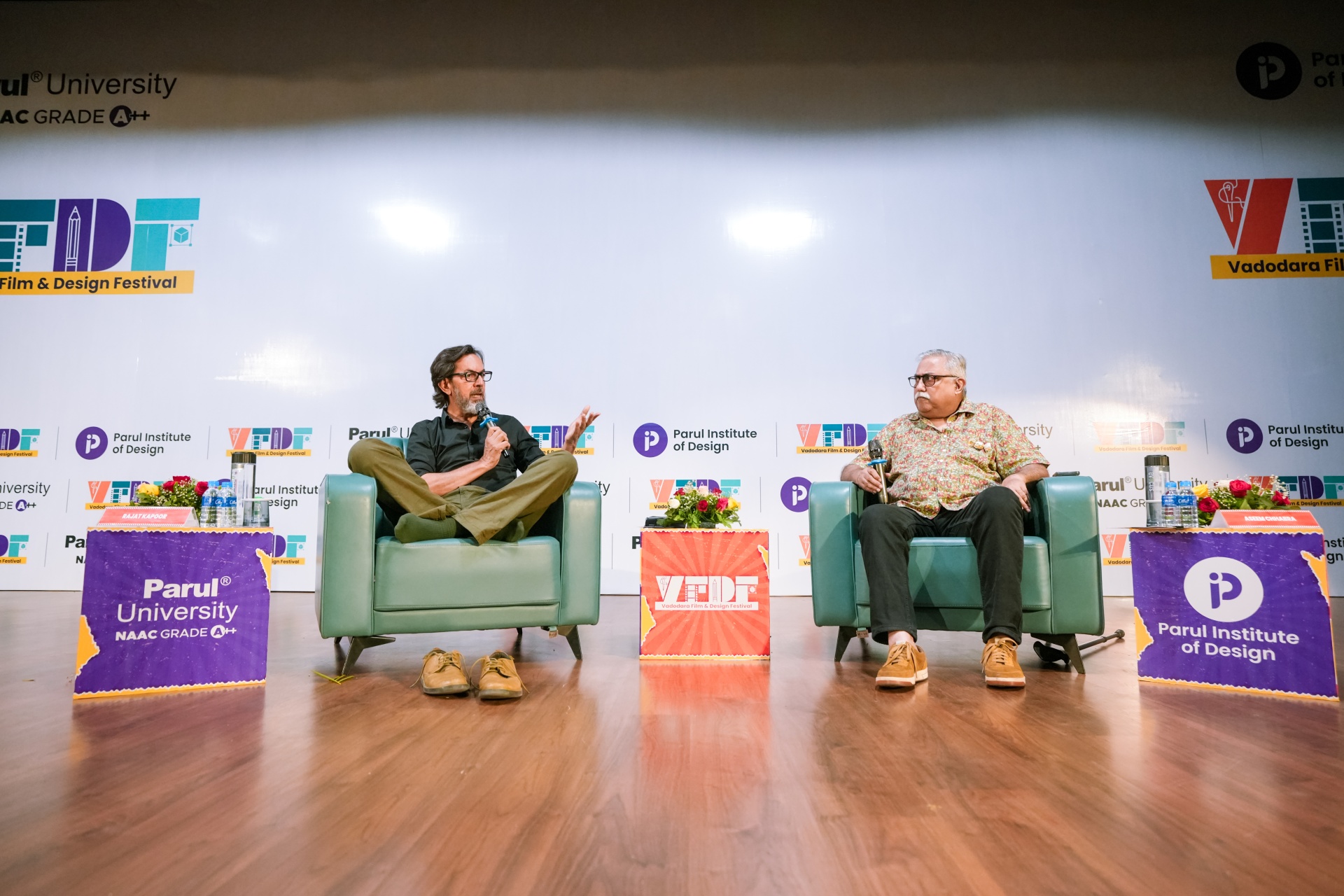
On Day 2 of the Vadodara Film and Design Festival at Parul Institute of Design, the film journalist and festival director most Indian film students read before they read anyone else walked second-semester Film and TV Production students through four decades of how to write about cinema without writing gossip.
Mr. Aseem Chhabra is the festival director of NYIFF, a role he proudly held for 16 years. He holds a master’s degree in journalism from Columbia University and a business degree from Boston. His writing has appeared in The New York Times, Outlook & The Boston Globe, besides this, he is the author of 3 major biographies – Shashi Kapoor, Priyanka Chopra, and Irrfan Khan.
He told PID students that none of that was planned. All of it came from being in the right place with right email and sending 60 messages. Subsequently, if you too are such passionate about filmmaking and production, enrol into B.Sc in Film & TV production course of Parul University!
From Political News in Delhi to an Om Puri Screening in New York
Aseem Chhabra‘s early career was not in film. He wanted to write political news like his father had. He studied at Delhi University and Jawaharlal Nehru University before moving to America in his early twenties. His first journalism job was at India Abroad, the Indian newspaper in America, covering politics.
The switch to film journalism happened incrementally. Chhabra had loved cinema since attending film festivals at Vigyan Bhavan in Delhi in bitter January cold, watching National Award-winning films by directors like Shyam Benegal. His bosses at India Abroad eventually let him write about film alongside politics.
The inflection point came in the late 1990s when actor Om Puri visited New York to promote the film East is East. Chhabra found the email address of the arts editor at the Philadelphia Inquirer. He pitched an Om Puri interview. The editor said yes.
He quoted – “It was like the whole world just opened up for me. It was luck. But the thing about luck is that you have to have already sent the email.”
That one interview opened the door to the Boston Globe. From Boston he began writing about filmmakers from Iraq, Afghanistan, and across the global South. He never explicitly positioned himself as a film critic. He focused on interviews and cultural coverage, which in his view do different work than reviewing.
Pan Nalin on selling his Mumbai house to finance Chhello Show
16 Years of the New York Indian Film Festival!
Aseem Chhabra’s current anchor role is festival director at NYIFF, which he joined over 16 years ago. The path in was unusual. The previous director had left. The Indo-American Arts Council in New York had lost significant funding. He went to the board and offered to do the job for no money or very little money. They said yes.
“I’m glad I said that because I got the job, and now it’s been 16 years.”
The festival operates as a distributed team. Some staff in New York, some in Bangalore, some in Pune. They coordinate over WhatsApp. They chase filmmakers for trailers and posters and they spend months curating.
NYIFF’s programming choice is deliberate. It does not show Bollywood’s commercial star vehicles. Those films already play in American theatres for the NRI market. NYIFF shows independent films the diaspora would otherwise never see. Past editions have featured films from Assam, Meghalaya, Maharashtra, and Kerala. The 2026 edition opened with Boong, a Manipuri film about a boy searching for his father, which Chhabra said won a major award over big Disney titles at a competing festival. PU student’s short films were featured in Cannes and many such world-revered platforms, if you too wish to master the art of storytelling then delay not and enrol into Certificate Program in Photography and Cinematography of Parul University!
Three Books: Shashi Kapoor, Priyanka Chopra, Irrfan Khan
Aseem Chhabra’s books did not begin with a pitch. They began with a Facebook message from a publishing-house editor asking if he wanted to write one. The first ask was for 40,000 words, which terrified him. His longest articles until then had been 2,000 words, though he said yes anyway.
Shashi Kapoor: getting the access
The Shashi Kapoor book required permission from the Kapoor family. Chhabra went to Sanjana Kapoor‘s house for the first time. She was not there. Staff did not know who he was. He was about to return to New York. He sent an email explaining. She apologised and invited him back at 10 AM the next day. She was not there the second time either. He waited. She arrived ten minutes late. She gave him an hour-long interview about her father, her British acting mother, and the Kapoor family’s theatrical roots. The book succeeded because Chhabra did not leave the first time.
Priyanka Chopra: writing without the subject
When the publisher asked Chhabra to write the Priyanka Chopra book, she was writing her own memoir. She was contractually unable to speak to him. His editor’s advice was to become a detective. Chhabra built the book entirely from his own previous interviews with Chopra, an interview with her manager in America, and an old conversation with her mother in Toronto. The subject of the book was not in the book. That did not stop the book from working.
Irrfan Khan: the cold text at 2 AM
The Irrfan Khan book was the hardest. When Chhabra signed the contract, Irrfan announced his cancer diagnosis and moved to London for treatment. Chhabra emailed Irrfan’s manager. He waited two weeks with no response. Then one afternoon while he was napping in Delhi, he received a text message directly from Irrfan.
“Hello Aseem, this is Irrfan. Is it a good time to talk to you?”
Chhabra called back. Irrfan was in the middle of treatment but sounded engaged. He gave Chhabra names of friends and teachers to contact, including Varun Gautam, whom Chhabra eventually interviewed at a New York Starbucks. Chhabra spoke to Irrfan’s classmates from the National School of Drama, who told him the young Irrfan used to sit quietly in the corner of his dormitory and smoke all day. He was not sociable. Those specific, granular details from people who knew him before he was Irrfan Khan gave the book its human texture. Writing is a rare passion, only the one with an essence of reading & storytelling can pursue it 100%, if you too wish to, then enrol into BA in English program of Parul University and kickstart your writing career!
Why Star Ratings Are Not Film Reviews
A PID faculty member asked Aseem Chhabra why the long, considered film reviews that used to run in Indian newspapers have largely disappeared. The question’s premise: earlier critics wrote about camera angles, lighting decisions, narrative meaning. Now most reviews are number-out-of-five ratings attached to plot summaries.
Chhabra did not pretend the shift was neutral. He pointed to two forces:
- Newspaper space has shrunk. There is less room for 1,500-word reviews than there was in the 1990s or early 2000s
- Online audiences scroll. Most readers want to know if a film got three stars or four. They are not reading 1,000 words to find out
He then named a harder problem. Fans of big commercial films (he cited Pathaan and Jawan) now harass critics online, particularly women critics, when reviews are negative. That harassment creates a chilling effect. Writing honest negative reviews about star-led commercial films has become professionally risky.
His position: readers must stop outsourcing their viewing decisions to five-star ratings. Full reviews still exist. They take effort to find. That effort is part of what makes film literacy possible.
Why Film Critics Still Matter More Than Ever
A PID student asked Aseem Chhabra whether critics still matter in an industry dominated by commercial cinema. Chhabra told the room a specific story.
He had gone to a theatre in Hyderabad to watch the Malayalam film Aattam. The theatre had sold two tickets. Him and a friend. The ticket manager almost did not run the screening. Chhabra had to beg another couple to buy tickets so the screen would turn on.
The lesson, he said, is why critics are still essential. Beautiful, meaningful films like Aattam get made. They reach theatres. But if critics do not write loudly about them, audiences do not know they exist. By the time word spreads, the films have left the screens. Critics are the last functional bridge between small cinema and the audience that would love it.
He extended the argument to 12th Fail, the 2023 Vidhu Vinod Chopra film. He said that film succeeded because it showed human emotions clearly. More films like it would help Indian cinema if more people knew to look for them.
Why This Session Landed at Parul Institute of Design
Chhabra’s session had a specific audience: second-semester Film and TV Production students at PID. The curriculum these students are in treats film history and film journalism as connected disciplines. A director who cannot read critically cannot respond to feedback. A cinematographer who cannot contextualise their work in film history produces imitative frames.
PID’s programme architecture supports that overlap. The Bachelor of Science in Film and TV Production programme covers screenwriting, direction, cinematography, editing, and sound design. Communication Design students sit alongside film students in several visiting-faculty sessions, including Chhabra’s, because cultural writing is a Communication Design discipline as much as a journalism one.
Chhabra’s final advice to the room was to write from life. Not from research. Not from other films. Not from trying to be universal. The best writing (and the best filmmaking) comes from a writer’s own family, their own neighbourhood, their own memory. That specificity is what travels.
FAQs
Who is Aseem Chhabra?
Aseem Chhabra is the festival director of the New York Indian Film Festival (NYIFF), a film journalist, and the author of three biographies: Shashi Kapoor, Priyanka Chopra, and Irrfan Khan. He holds a master's degree in journalism from Columbia University and a business degree from Boston. His writing has appeared in The New York Times, Outlook, and The Boston Globe.
What is the New York Indian Film Festival (NYIFF)?
The New York Indian Film Festival is the oldest festival of Indian independent cinema in North America. Chhabra has served as its director for over 16 years. NYIFF programs independent Indian films rather than commercial Bollywood titles, with past editions featuring films from Assam, Meghalaya, Maharashtra, and Kerala.
What books has Aseem Chhabra written?
Aseem Chhabra has authored biographies of Shashi Kapoor, Priyanka Chopra, and Irrfan Khan. Each book required extensive original reporting. The Shashi Kapoor book was built on access to Sanjana Kapoor and the Kapoor family. The Priyanka Chopra book was built on his own previous interviews with Chopra and her family. The Irrfan Khan book drew on Irrfan's own outreach and interviews with his NSD classmates and collaborators.
Does Parul Institute of Design offer a programme suited for film journalism or film writing?
Parul Institute of Design offers Bachelor of Design in Communication Design and Bachelor of Science in Film and TV Production. Both programmes cover cultural writing, film history, and visual storytelling alongside their core technical training. PID's curriculum treats film journalism as a natural extension of Communication Design rather than a separate discipline, which is why visiting faculty like Aseem Chhabra (NYIFF director and biographer) sit with students across both programmes. Admission is through PU-DAT, the Parul University Design Aptitude Test.
What did Aseem Chhabra tell PID film students about writing?
At the VFDF 4.0 session at Parul Institute of Design, Chhabra told students to write from life, not from research. The best stories come from a writer's own family, neighbourhood, and memory. He warned against writing gossip: serious journalism requires printed, verifiable proof before making any claim. He also told students to read full reviews rather than star ratings, because small independent films depend on critics for audience discovery.


