

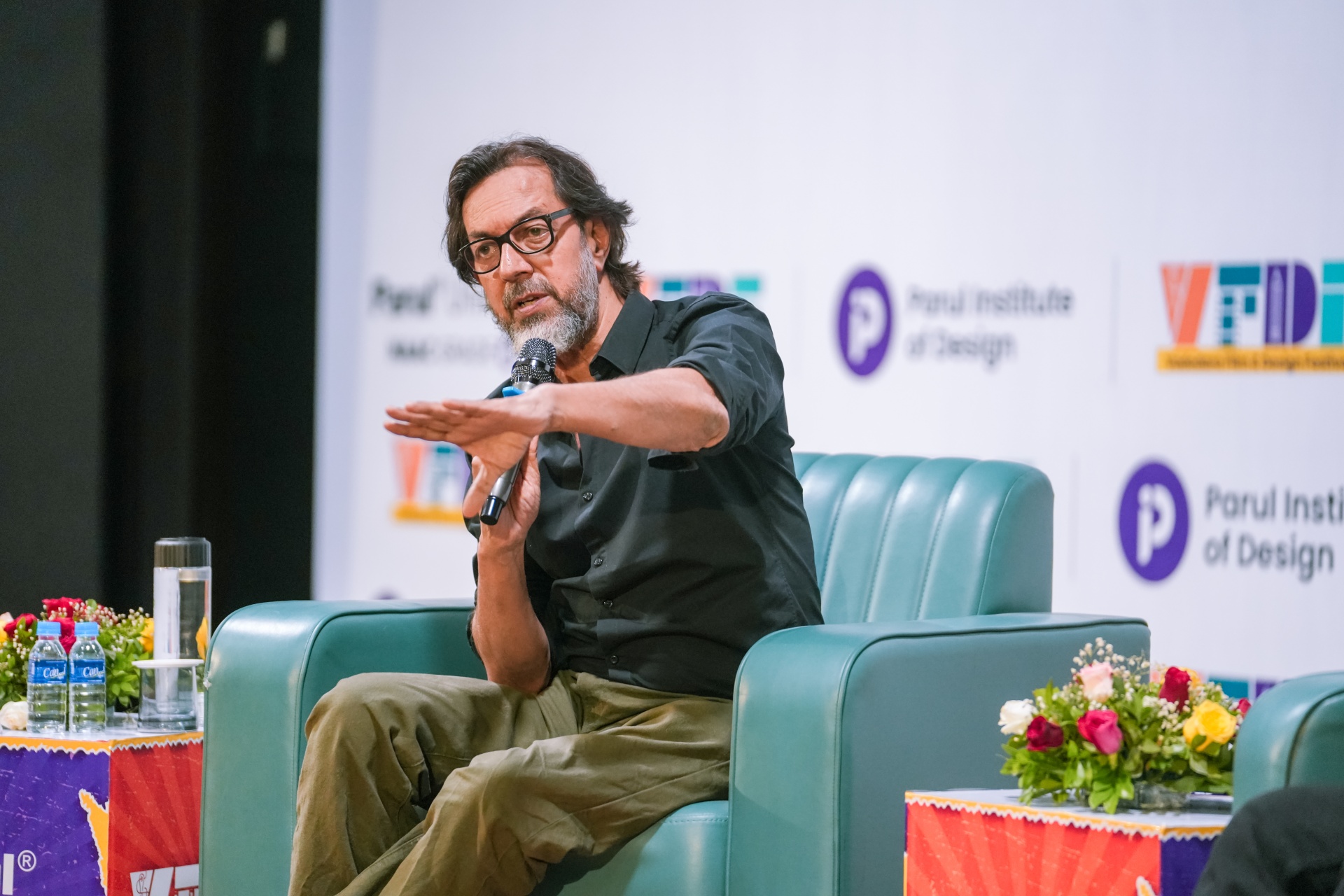
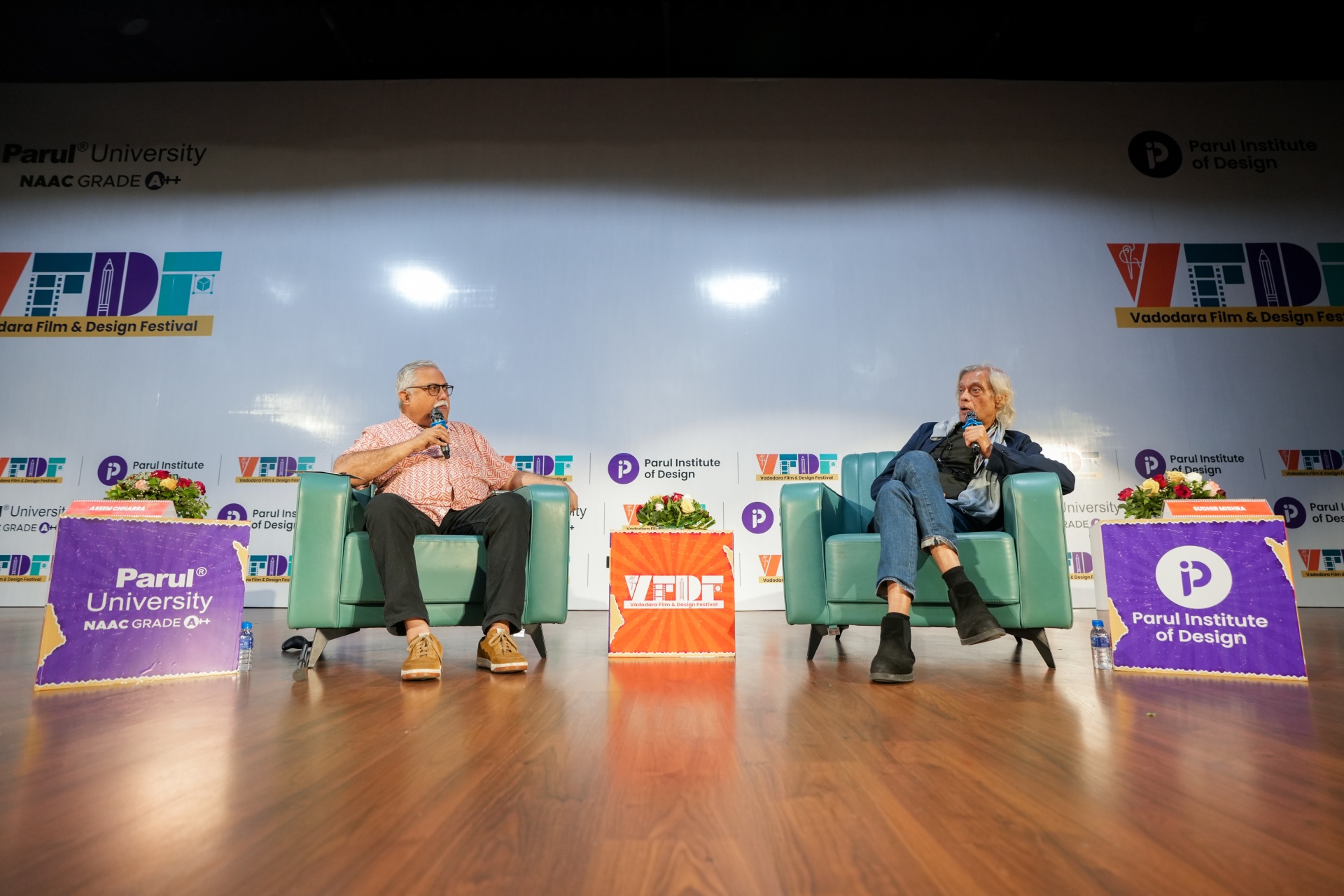
On Day 2 of the Vadodara Film and Design Festival at Parul Institute of Design, two filmmakers with more than three decades of combined experience in Indian cinema walked into consecutive sessions moderated by the same interviewer.
Sudhir Mishra, director of films such as Hazaaron Khwaishein Aisi, Is Raat Ki Subah Nahin, and Afwaah, was followed by Rajat Kapoor, known for films including Raghu Romeo, Mithya, Kadakh, and Ankhon Dekhi. Both sessions were moderated by noted film journalist and New York Indian Film Festival director Aseem Chhabra inside the main auditorium at Parul Institute of Design as part of the PU Talks format.
What connected the two conversations was not simply filmmaking technique or industry storytelling. It was the question of what it actually takes to remain independent in Indian cinema across decades without fully surrendering to commercial formulas. Neither filmmaker attempted to romanticise the process. Both spoke directly about the compromises avoided, the projects lost, the financial instability involved, and the personal cost of choosing creative independence over predictability.
Sudhir Mishra on Bollywood’s A-list will not play his protagonists!
Sudhir Mishra’s session was titled Shades of Grey: Giving Liability to an Un-Hero. The frame set the argument before he could speak.
His films don’t have traditionally masculine protagonists. They are flawed and weak and sometimes morally compromised and sometimes unfaithful to their wives. Is Raat Ki Subah Nahin’s main character is an advertising executive who is having an affair on his wife. Hazaaron Khwaishein Aisi’s lead trio is a pragmatic fixer, an idealist leftist and a woman straddling both. None of them are easy to cast, because they are not the kind of hero Indian mainstream cinema builds around.
“That’s why most big stars don’t work with me. The characters are flawed, sometimes weak, sometimes not that male.”
Sudhir Mishra arrived in Bombay in 1982 after a chance meeting with Vidhu Vinod Chopra. His grounding, he told the PID room, was not Bombay. It was street theatre in Delhi and Lucknow in the late 1970s. His father, a mathematics teacher in Lucknow, founded a film society through which the young Mishra first encountered European cinema. That combination (street theatre plus European film exposure) shaped a filmmaker interested in raw human struggle rather than polished performance. If you’re interested in building a career in TV & Film Production, enrol into PID’s B.Sc in Film and TV Production program!
Pan Nalin on why he sold his Mumbai house to make Chhello Show
The Three Archetypes in Hazaaron Khwaishein Aisi and Why They Still Matter
Hazaaron Khwaishein Aisi is the film Mishra is most asked about. At PID he broke the film down into its three central archetypes, all drawn from people he knew during Emergency-era India:
- The Fixer: the pragmatic operator who works the system. Mishra noted that this archetype has largely won in modern India
- The Lefty: the idealist who refuses to work the system and often loses
- The Woman (Geeta): the character navigating between the two men and the two ideologies, and in Mishra’s reading, the most steadfast of the three
Mishra was asked which of the three he identifies with. Neither the fixer nor the leftist, he said. The woman. The character holding multiple conflicting truths at once, refusing to collapse into either side.
Mishra also discussed his adaptation of Manu Joseph’s novel Serious Men for the Netflix film. The book’s protagonist, Ayyan Mani, was written by Joseph as something closer to a scumbag. Mishra’s film, with Nawazuddin Siddiqui in the role, humanised the character. The point was not softening the edge. The point was showing a man navigating a rigged system. Mishra reads portions of the source text daily during production, he said, to stay close to the author’s acerbic worldview.
Rajat Kapoor on Emailing 60 Friends in 2002 to Make a Film
Rajat Kapoor‘s route to filmmaking was longer than most students assume. He was trying to make films for the entire 1990s. Private Detective (1995) was never released. Raghu Romeo sat in his drawer as a finished script from 1996. No producer was willing to fund either, even at small budgets. He did not get into acting until he needed income, and even that happened by accident: an advertisement led to Dil Chahta Hai, and Dil Chahta Hai changed the math.
Then in 2002 he did something that had not been done in Indian cinema before. He sent an email to 60 friends asking each for one lakh rupees to fund Raghu Romeo, with a target of 80 lakh. In two weeks, 40 lakh came in. Somebody’s cousin in New York. A friend in San Francisco. People he did not know but who trusted people who trusted him.
“People I didn’t know sent money because they wanted this film to be made. That’s how Raghu Romeo got made. It was probably the first crowd-funded film in India.”
The budget was roughly 80 lakh rupees. The model was unprecedented at the time in the country. Twenty-plus years later, the film’s crowdfunding story is still cited in Indian film history as a reference point for independent financing.
Rajat Kapoor on What Streaming Platforms Actually Changed
Rajat Kapoor was blunt about the current environment. Streaming is a double-edged sword. The positive: more content is being made than at any previous point in Indian cinema history. There is work, budgets exist and platforms commission.
The negative: the algorithm decides. OTT platforms want stars on their covers and certain kinds of hooks in the first ten minutes. The absolute creative freedom of making a film with friends’ money, with no notes from a corporate structure, is harder to find. When Kapoor crowdfunded Raghu Romeo, nobody was watching the cut except the people who had already given him money and trusted him to finish the film. That kind of trust-based production loses something when a platform is writing cheques.
His position on the phone-screen viewing shift was unsentimental. He said it is heartbreaking when someone watches a film he spent two years designing for a big screen on a five-inch screen while sitting in a bus. The sound design assumes a theatre. The visual composition assumes scale. But that is the reality. He would rather people watch the film on a phone than not watch it at all.
What Both Filmmakers Told Film Students
The advice converged on specific points:
- Give yourself a time frame. Kapoor told students to commit to five or ten years of trying, with a clear exit plan if it does not work. Open-ended struggle with no time limit is not a career strategy
- Do not chase the global or pan-Indian audience as a starting point. Both filmmakers told students their work only travels when the local specificity is real. Ask what is unique about you, not what the market wants
- Every director has a stamp. Two minutes of a Scorsese film or a Coen brothers film and you know it is theirs. That stamp is built, not inherited. It comes from life, not from imitating directors you admire
- Kapoor on the industry margins: he is happy being on the margin. His structure is making one film every two to three years. That pace gives him creative autonomy most in-industry filmmakers do not have
- Mishra on provocation: young people today are too polite. Cinema requires discomfort. It requires asking what betrayal actually means, what loyalty means, and refusing to answer those questions glibly.
They even navigated focused on education part, when studied from the best universities such as Parul Institute of Design, PU avails you with the best course in design, website designing, film production and journalism as well.
Both filmmakers were asked whether their kind of cinema can still be made in the current climate. Neither was defeatist. Mishra continues to work, including on Afwaah, a film directly engaging with the issues of our time. Kapoor continues to release one film every two to three years, most recently Kadakh. Neither has compromised the script to make the film easier to finance.
Parul Institute of Design’s Bachelor of Science in Film and TV Production and Diploma programmes train students in the complete filmmaking pipeline: screenwriting, direction, cinematography, sound design, production design, editing. But the PID curriculum’s deeper point, as both Mishra and Kapoor’s sessions made explicit, is that technical training is the easy part. The hard part is developing a specific editorial voice and defending it for 30 years.
Vadodara Film & Design Festival 4.0 – Master Designing in the Age of AI!
FAQs
Who is Sudhir Mishra and what films has he made so far?
Sudhir Mishra is a famous and offbeat Indian Filmmaker. His movies - Hazaaron Khwaishein Aisi, Is rat ki subha nahin, Chameli, Calcutta mail, and Afwaah. Besides this, he adapted Manu Joseph’s novel Serious Men into a Netflix film with Nawazuddin Siddiqui.
Who is Rajat Kapoor?
He is an Indian Actor, filmmaker, playwright and screenwriter. As a director, his films are - Raghu Romeo, Mithya, Ankhon Dekhi, Kadakh and Fatso. As an actor he has appeared in Dil chahta hai, Monsoon wedding, Kapoor and sons, Bhopal express, PK/RKay. Raghu Romeo was probably India’s first feature film, financed via 2002 email campaign.
What is Hazaaron Khwaishein Aisi about?
Hazaaron Khwaishein Aisi, directed by Sudhir Mishra, is a 2003 film set against the backdrop of the Emergency period in India. It follows three central characters: a pragmatic fixer, an idealist leftist, and a woman navigating between them and their ideologies. Mishra has said the film is about a generation that rejected the post-independence idea of India.
How did Rajat Kapoor crowdfund Raghu Romeo in 2002?
Rajat Kapoor sent an email to 60 friends in 2002 asking each for one lakh rupees to fund Raghu Romeo, with a target of 80 lakh. In two weeks, 40 lakh had come in from friends and friends-of-friends across India and the United States. The film was eventually completed and is widely cited as probably the first crowd-funded feature film in Indian cinema history.
Does Parul Institute of Design offer a programme in film making?
Yes. Parul Institute of Design (PID) offers a Bachelor of Science in Film and TV Production at Parul University, Vadodara. The programme covers the complete filmmaking pipeline including screenwriting, direction, cinematography, sound design, editing, and colour grading. PID also offers a Diploma in Filmmaking. Student films from the programme have been selected for the Festival de Cannes Short Film Corner (The Fire Kept Its Promise) and CUIFF Film Festival 2025 (Aakhri Dor). Admission is through PU-DAT, the Parul University Design Aptitude Test.
Is independent Indian cinema still viable with OTT platforms?
At the VFDF 4.0 session, Rajat Kapoor described streaming as a double-edged sword. More content is being made than ever before, and budgets exist. But the algorithm-driven commissioning model restricts the creative autonomy that independent filmmakers had when working with friends' money. Sudhir Mishra has continued to make films including Afwaah in the current environment, suggesting the work is viable but the fight is different.


