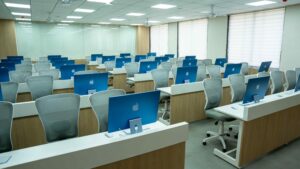
Inside Pragya, the Advanced Skills and Simulation Centre at the Parul Institute of Medical Sciences and Research, the most technically striking moment of Dr Jitendra Singh’s visit to Parul University on 8 May 2026 was a live neurosurgical demonstration introduced by Dr. Iype Cherian, Director of Neurosciences at Parul University. What unfolded was not a presentation about future possibilities. It was a working demonstration of where neurosurgical technology stands today.
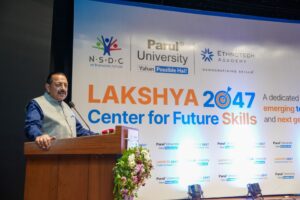
Full event context, including the inauguration of the new Lakshya 2047 Centre for Future Skills (Gujarat’s first NSDC Centre for Future Skills, established in partnership with the National Skill Development Corporation and Ethnotech Academy), is in the inauguration hub. The broader simulation infrastructure that hosted this demonstration is documented in Pragya at Parul University: 16,000 sq ft, 11 simulation units.
Who Dr. Iype Cherian is, in independently verifiable detail
Dr. Iype Cherian is Director of Neurosciences at Parul University and a globally recognised neurosurgeon, educator, and inventor. His qualifications and roles are independently documentable across the World Federation of Neurological Societies, the Asian Congress of Neurological Surgeons, peer-reviewed neurosurgical literature, and recent strategic announcements from publicly listed medical-technology companies.
- Ch (Neurosurgery): Christian Medical College, Vellore.
- Fellowship: Skull Base and Vascular Neurosurgery, Nagoya, Japan.
General Counsellor: Asian Congress of Neurological Surgeons (ACNS).
Chair: Innovations and Technology Committee, World Federation of Neurological Societies (WFNS).
- Founder & President: Neurosurgery Coach, a global micro-neurosurgical training platform.
- Director, Time Medical India: appointed November 2025 to lead clinical innovation and translational strategy for the DRIS-iMRI Medharanya program.
Dr Cherian’s inventive portfolio includes Cisternostomy and the Brain Cooling Theory, both of which have influenced contemporary neurosurgical practice and postoperative recovery strategies. His advanced microsurgical routes include the Transcavernous and Modified Kawase approaches for accessing complex intracranial regions. His instrument and platform inventions include the Sanma Yoko Exoscope, the STMC Bypass Set, the Sookshmaranga Endovascular Robot, the Medharanya Theatre Concept, and the DRIS-iMRI Medharanya AI-enabled intraoperative MRI system covered in Tribune India and India Education Diary.
The demonstration: a 2 cm cranial channel and a robotic exoscope
The technique demonstrated by Dr. Cherian allows complete cranial access through a minimally invasive channel of just 2 centimetres. Through that opening, a robotic exoscope navigates to wherever in the operative field a surgeon needs to work. The exoscope’s vision and sensor system can follow any direction of surgical movement, eliminating the line-of-sight constraint that has historically limited neurosurgical access and increased procedural risk.
For neurosurgery, the channel width is the critical variable. A larger opening means more bone removed, more tissue traversed, more recovery time, more risk. A 2 centimetre channel that still permits full operative field access means the surgical footprint shrinks while the procedural reach stays comparable. This is the direction the entire minimally invasive surgical category has been moving toward for decades, and the Sanma Yoko Exoscope class of instruments represents one of the more advanced expressions of that direction in current practice.
How wide is the channel?
Dr Jitendra Singh, opening question to Dr Iype Cherian during the demonstration
Dr. Singh‘s first question was precisely the one a medical professional would ask. He is himself an MBBS from Stanley Medical College, Chennai, and an MD from AIIMS New Delhi. The answer, 2 centimetres, opened the technical exchange that followed.
The clinical conversation moved next into suture work, and the term STMC was referenced by both Dr. Singh and Dr. Cherian. STMC, the Super Micro Anastomosis bypass set developed by Dr Cherian, uses suture tips approximately six times finer than conventional suture material. This is the layer at which modern neurovascular bypass work is now executed: the difference between a vessel that survives anastomosis and a vessel that does not is often a function of how fine the suture is and how precisely it can be controlled.
Dual-view collaboration: two surgeons looking through the same system
In the midst of the discussion, the demonstration showed a feature that is not incidental: Dr. Singh and Dr. Cherian both looked through the shared exoscope system at the same time, observing the same operative field simultaneously. Dual-view capability transforms how surgical training, second-opinion consultation, and intraoperative guidance work. A senior neurosurgeon who is not physically in the operating room can observe the operative field at full fidelity, advise in real time, and effectively participate in procedures across geographical distance. For a country with the geographic spread of India and the uneven distribution of subspecialty neurosurgical expertise, this is a structurally significant capability.
- Surgical training: trainees observe procedures at full visual fidelity rather than from a peripheral position.
- Second-opinion consultation: senior surgeons advise during procedures without physical co-location.
- Tele-surgery foundations: the technical groundwork for remote surgical consultation and guidance across hospitals.
- Educational replay: procedures can be reviewed by the operating surgeon and by training cohorts post-procedure.
Where the AR-VR convergence comes in
The demonstration concluded with Dr. Singh donning an AR/VR headset, the same category of technology he had experienced earlier in the day at the Lakshya 2047 AR/VR Lab inside the NSDC Lab Ecosystem. This time, instead of opening a virtual car bonnet, the headset placed him inside a photorealistic, three-dimensional simulation of an operative scenario. From within the headset, he experienced what it is to navigate a surgical field in three dimensions, to see operative anatomy with depth and spatial clarity, and to understand the relationship between the surgeon’s visual field and the physical constraints of the procedure.
The thread connecting Lakshya 2047 and Pragya became visible in that moment. The AR-VR technology that the engineering and design students inside Lakshya 2047 are learning to build, through the NSDC AR/VR Lab fitted with Apple Vision Pro and Meta Quest, is the same technology that the medical and surgical students inside Pragya will increasingly train on. The Sanma Yoko Exoscope, the dual-view collaboration, the DRIS-iMRI Medharanya intraoperative MRI system Dr Cherian is developing with Time Medical India, and the AR-VR surgical simulation environments are converging into a single technical fabric that will define how neurosurgery is practised and learned in the next decade.
Why this matters for Parul University students choosing neurosurgery
For an MBBS student at the Parul Institute of Medical Sciences and Research considering a neurosurgical specialisation pathway, the presence of Dr Cherian as Director of Neurosciences and the access to demonstration-grade exoscope and simulation infrastructure changes the structural calculus of where to train. Neurosurgery is an extreme-apprenticeship discipline. Who teaches, what equipment is available, and what intellectual culture surrounds the trainee determine the trajectory.
- MBBS at PIMSR: the entry point into the medical pathway.
- MS General Surgery: the surgical foundation.
- MCh Neurosurgery: the super-specialty programme where Dr Cherian’s exoscope and microsurgical curriculum directly applies.
- Neurosurgery Coach platform: global access to Dr Cherian’s micro-neurosurgical training content, with Parul University as the residency institution.
The MCh Neurosurgery candidates at Parul University work in the structural orbit of the Director of Neurosciences. The MS General Surgery residents who plan to enter neurosurgical training similarly benefit. The MD General Medicine trainees who will manage neurological patients as physicians gain exposure to the diagnostic and clinical framework that complements surgical management.
FAQs
Who is Dr Iype Cherian at Parul University?
Dr Iype Cherian is the Director of Neurosciences at Parul University, Vadodara, and a globally recognised neurosurgeon. He holds an M.Ch in Neurosurgery from CMC Vellore and a Fellowship in Skull Base and Vascular Neurosurgery from Nagoya. He is the General Counsellor of the Asian Congress of Neurological Surgeons (ACNS), Chair of the Innovations Committee at the World Federation of Neurological Societies (WFNS), and the inventor of Cisternostomy, the Brain Cooling Theory, the Sanma Yoko Exoscope, the STMC Bypass Set, and the Sookshmaranga Endovascular Robot. He founded Neurosurgery Coach, a global micro-neurosurgical training platform.
What was the neurosurgical demonstration Dr Jitendra Singh witnessed at Parul University?
Dr Iype Cherian demonstrated a minimally invasive neurosurgical technique using a 2 centimetre cranial channel through which a robotic exoscope navigates the operative field. The exoscope eliminates line-of-sight constraints, supports simultaneous dual-view observation by two surgeons, and integrates with STMC ultra-fine suture work approximately six times finer than conventional suture material. The demonstration concluded with an AR-VR headset experience placing the viewer inside a photorealistic three-dimensional simulation of an operative scenario.
What is the Sanma Yoko Exoscope and STMC Bypass Set?
The Sanma Yoko Exoscope is a robotic surgical visualisation system developed by Dr Iype Cherian for use in minimally invasive neurosurgical procedures, supporting line-of-sight-independent operative field access. The STMC Bypass Set is Dr Cherian's instrument set for Super Micro Anastomosis bypass procedures, using suture tips approximately six times finer than conventional suture material to enable anastomosis of microvessels that would be inaccessible with standard suture work.
Can students at Parul University specialise in neurosurgery?
Yes. Parul University offers MCh Neurosurgery as a super-specialty programme at the Parul Institute of Medical Sciences and Research, with Dr Iype Cherian as Director of Neurosciences. The pathway runs MBBS to MS General Surgery to MCh Neurosurgery. Students gain access to the simulation infrastructure at Pragya, the cadaveric centre inaugurated 8 May 2026, and Dr Cherian's Neurosurgery Coach micro-neurosurgical training framework.
What is Cisternostomy and the Brain Cooling Theory?
Cisternostomy is a neurosurgical technique developed by Dr Iype Cherian that involves opening cerebrospinal fluid cisterns to reduce intracranial pressure, particularly in moderate to severe head injury cases. The Brain Cooling Theory, also developed by Dr Cherian, explains the role of cerebrospinal fluid shift in postoperative recovery and informs the surgical management of traumatic brain injury. Both have influenced contemporary neurosurgical practice and are covered in peer-reviewed neurosurgical literature.