APPLE INDIA TOP 350 STUDENT APP (v2)
During Dr Jitendra Singh‘s inauguration of the Lakshya 2047 Centre for Future Skills at Parul University on 8 May 2026, the most commercially indicative moment of the walkthrough was not a piece of equipment. It was a student.
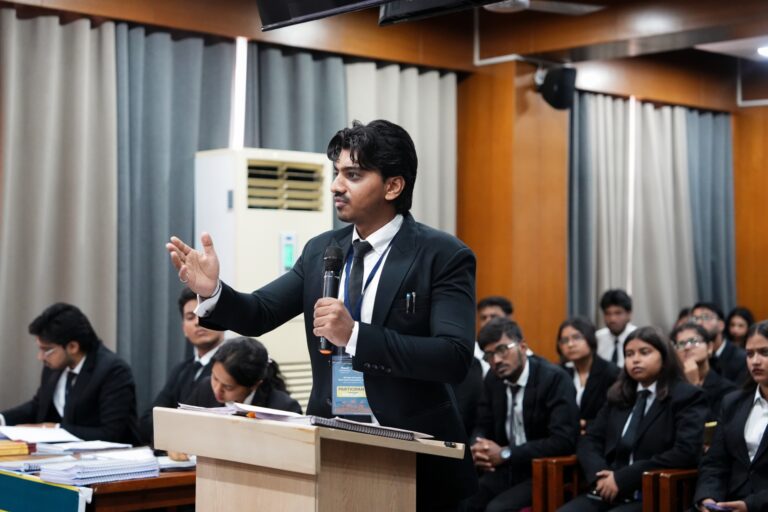
Inside the Apple Lab on the ground floor of the new building, a faculty mentor drew the chief guest’s attention to one of his Computer Science students, who stepped forward to present a mobile application he had developed independently. The application had been recognised among the top 350 apps by Apple in a national competition.
The Apple Lab is one of ten laboratories in the NSDC Lab Ecosystem at Lakshya 2047, established at Parul University in partnership with the National Skill Development Corporation (NSDC) and Ethnotech Academy as Gujarat’s first Centre for Future Skills.
The student’s name was not formally announced during the public walkthrough. What was made clear was the application itself, the problem it addressed, the technical environment in which it was built, and the recognition it had received.
The problem the application addresses
The student noticed a problem in his own life. Hours of daily screen exposure on coursework, programming assignments, and project work had left him with the symptoms now recognised as digital eye strain syndrome: dry eyes, intermittent blurry vision, headaches around the temples, and a fatigue that persisted even after sleep. He could have accepted these symptoms as a cost of the discipline he had chosen. He chose instead to build something.
The result is an eye-movement game. The user is guided through targeted eye exercises designed to stimulate the natural production and distribution of tear film, reduce ocular dryness, and recover the eye’s accommodation range. The game format keeps users engaged through gameplay mechanics rather than clinical reminders. Built into the interface is a real-time visual display of the user’s eye-health restoration progress, converting an exercise routine into a feedback loop that the user can see working.
- Problem identified: digital eye strain, dry eye, visual fatigue from prolonged screen exposure.
- Intervention: structured eye-movement exercise routines delivered as game mechanics.
- Engagement model: real-time visual feedback on eye-health restoration.
- Distribution: iOS App Store, recognised among Apple India’s top 350 apps.
Why the Apple India top 350 recognition matters
Apple’s editorial standards are among the strictest in the global software industry. App reviewers assess against design quality, performance, accessibility, privacy compliance, and user experience consistency. Apple’s country-specific recognition lists, including India, are selected from the broader population of submitted apps and reflect what Apple’s editorial team considers to represent technical and design quality on the platform.
A top 350 placement in Apple India‘s recognition lists means the application cleared the App Store review process and was further selected by Apple’s editorial team as representative of quality on the platform. For a single student developer working without a corporate engineering team behind him, that recognition is structurally significant.
The Apple Lab at Parul University: NSDC-aligned production environment
The Apple Lab inside the Lakshya 2047 lab catalogue is structured around the full iOS application development lifecycle. The curriculum runs through Swift programming, SwiftUI for user interface development, backend logic, data management, integration with Apple’s ecosystem APIs, testing and debugging, and App Store submission.
As part of the NSDC Lab Ecosystem, the Apple Lab at Parul University delivers training aligned with global certification standards integrated into the existing B.Tech in Computer Science Engineering curriculum. The NSDC Centre for Future Skills model under which the Apple Lab operates is active across 11 institutions in India and has trained over 50,000 candidates. Parul University is the first such Centre for Future Skills in Gujarat. The lab provides the environment in which independent student work like the eye-health app becomes possible.
The business-ready mindset in observable behaviour
Parul University frames the development of a business-ready mindset as a structural commitment, not a slogan. The eye-health app is what that commitment looks like in observable student behaviour: a student notices a real problem, has the technical training to address it, has the institutional environment to support the work, and ships a finished product that an external editorial filter (Apple India) independently validates.
The supporting infrastructure is PIERC, the Parul Innovation and Entrepreneurship Research Centre.
- PIERC: 254 start-ups incubated.
- Funding extended: ₹20 crore plus through PIERC to incubated start-ups.
- Revenue generated: ₹40 crore plus from PU start-ups across the incubation portfolio.
- Idea Lab & Incubation Centre: government-recognised, with start-up studios in Vadodara, Surat, Ahmedabad, and Rajkot.
- NSDC Centre for Future Skills: Apple Lab certification track integrated with B.Tech curriculum at Parul University.
Named cases: students who built things and got noticed
The eye-health app student’s name was not made public during the inauguration. The named cases below illustrate the broader pattern of student and recent-graduate work produced through the same institutional environment at Parul University.
Solnce Energy: Yash Tarwadi and Chintan Shah
Solnce Energy, founded by Yash Tarwadi and Chintan Shah, is a clean-energy technology start-up developing advanced solar solutions through PIERC. The company secured a ₹1 crore investment on Shark Tank India Season 4, backed by Aman Gupta. Recent placement and start-up coverage at the Placement Day hub documents the wider entrepreneurial track record.
Voldebug Innovations: Meet Bisht, Monika Chand, and Rohit Ganaka
Voldebug Innovations is a cybersecurity start-up delivering secure digital solutions and threat-monitoring systems. The company was recognised with the Outstanding Performance Award by the Hon’ble Home Minister of India, Amit Shah, for its Security Information System software.
Yield Pro Earth: Ram Mehta and Sameer Mehta
Yield Pro Earth develops affordable, electricity-free irrigation solutions that improve water efficiency for smallholder farmers. The company secured a purchase order of more than ₹75 lakh from the ICICI Foundation and was awarded Best Performer Startup in Incubation.
Cligent Aerospace: Harsh Joshi and Vivek Dhut
Cligent Aerospace is described as India’s first hydrogen-electric aircraft start-up, developing a zero-emission aircraft for regional cargo and passenger mobility. The company is building a 9-seater STOL (Short Take-Off and Landing) aircraft.
Dori Handcrafts: Tushar Ahir
Dori Handcrafts is a sustainable lifestyle brand modernising traditional macramé into global home and fashion products. The brand has empowered more than 50 rural artisans and was showcased at the Republic Plenary Meet in New Delhi before the Hon’ble Prime Minister.
Why one student's app sits within a larger pattern
Recent placement data at Parul University reports 3,500 plus confirmed offers from 3,500 plus recruiters in the latest season, including the 60 LPA Tanish Patel offer at Microsoft. The institutional pattern is consistent: students who notice problems, build solutions, and ship work into external validation contexts go on to be hired by the companies that build the platforms those solutions sit on, or to found their own start-ups inside the PIERC infrastructure.
The B.Tech in Computer Science Engineering is the entry pathway into the Apple Lab, with adjacent specialisations in AI and Machine Learning and Information Technology feeding students into the wider Lakshya 2047 ecosystem.