This medicine tour of Pune took MBBS students inside the very depth of Pune’s healthcare ecosystem wherein from a palliative care centre where the MD explained that only 40% diseases are curable and 60% rest are under chronic conditions, needing care rather than cure, to a hospital where 8 senior doctors spent a whole year together learning before treating their 1st patient on 1st December 1993, to an advance level robotic surgery suite where patients go home within the time frame of 23 hours with blood loss of only 40-55 cc, to a retired Army doctor who has literally maneuvered a small hospital in Assam with a carpenter, a painter and solid determination to make the place welcoming rather than frightening. The tour is from 23-26 Feb 2026.
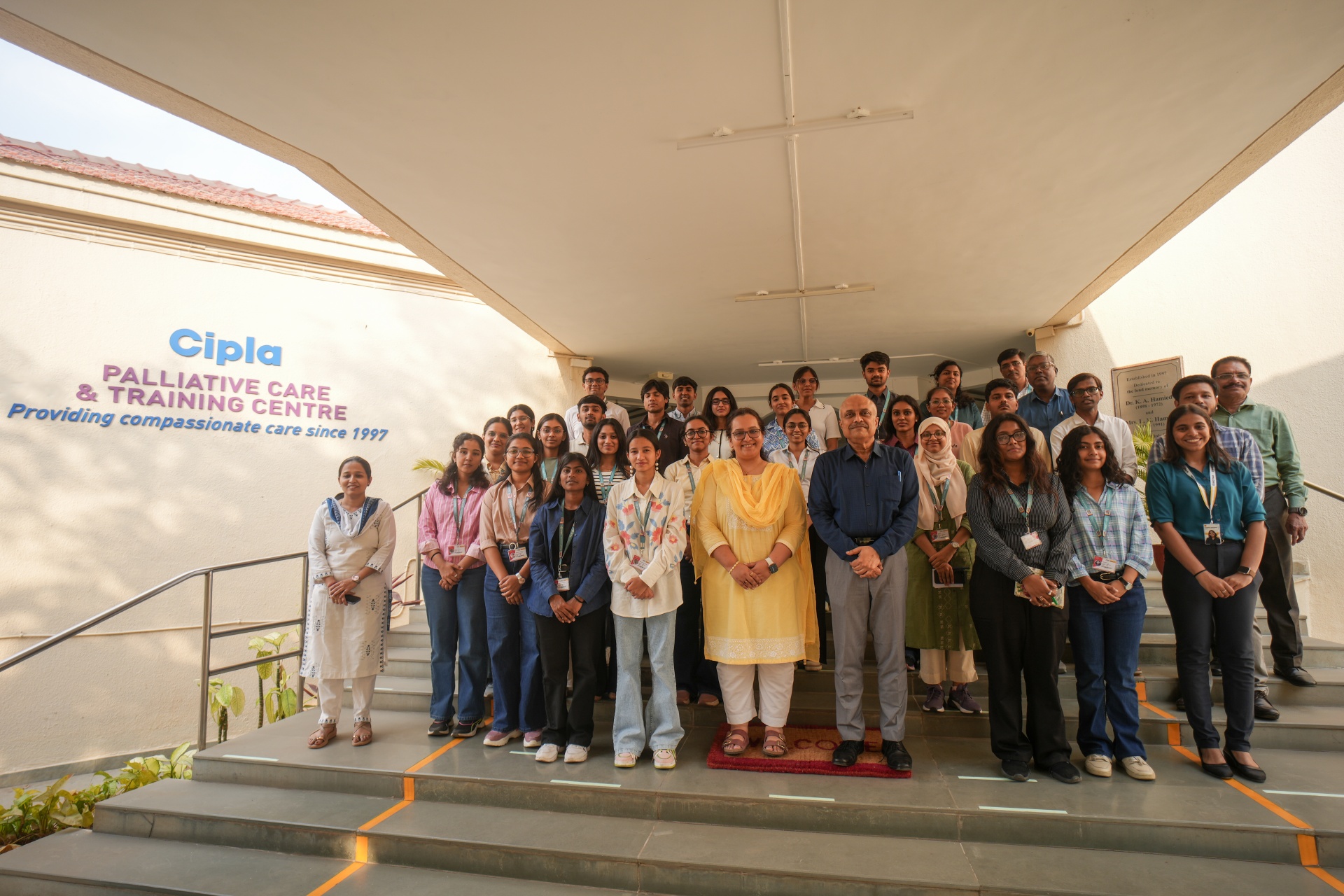
Cipla Palliative Care and Training Centre
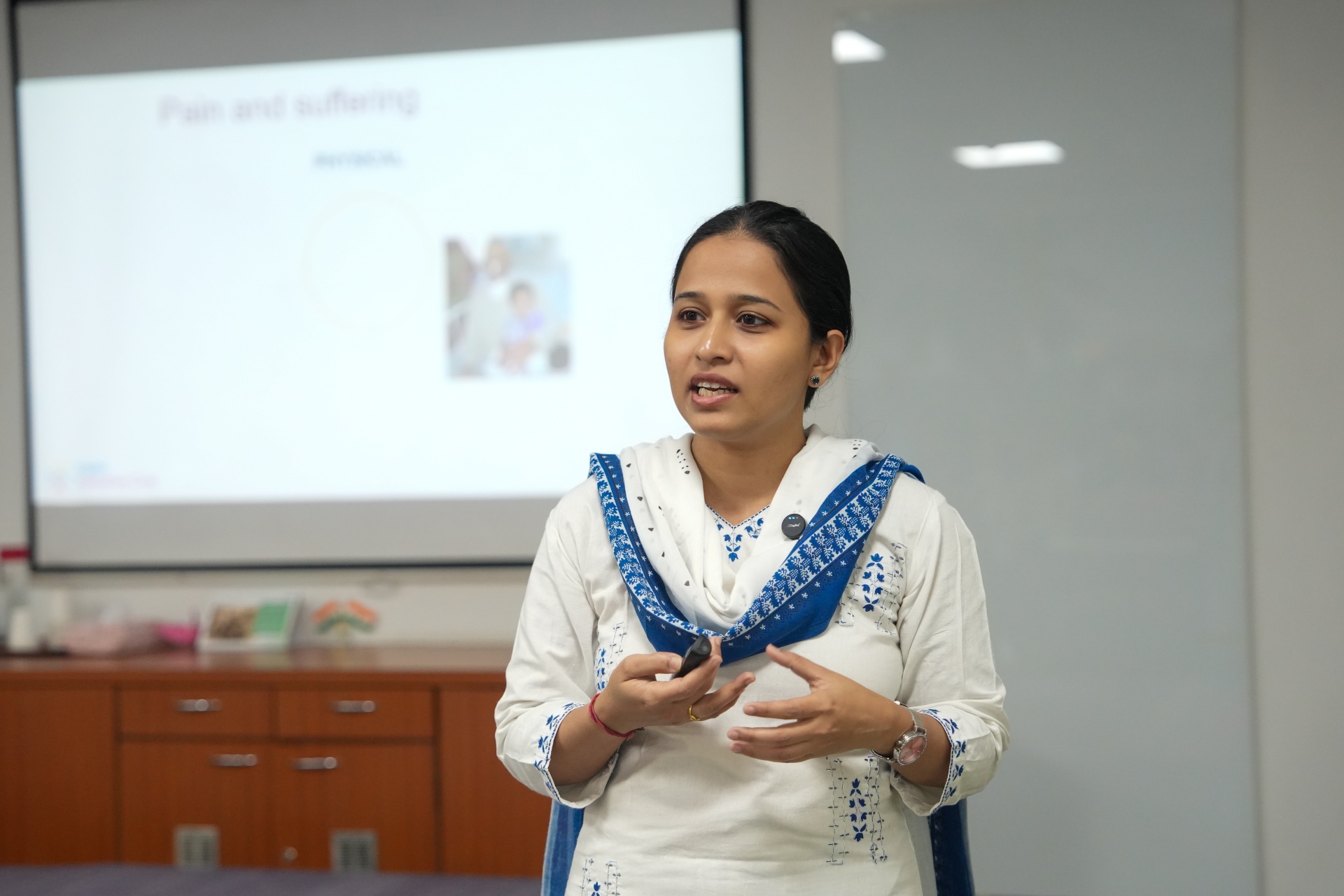
3 prime speakers have led this session – Dr Jayarajan, Dr Vivek Nirbhawane (Head of Clinical Services & Senior Consultant) and Dr Tulsi Kadam (HOD & Senior Physician) from Cipla Palliative Care & Training Centre. The primary message re-framed what medicine means for most of the patients a doctor will encounter in their entire career.
Only 40% of diseases are completely healable or curable, rest 60% are chronic. Subsequently, palliative care begins at the diagnosis, not at the end of life and runs side-by-side with curative treatment. The idea of total pain expanded what pain means beyond physical – emotional distress, social isolation, psychological burden, and spiritual questioning. Dr Tulsi Kadam even introduced the PQRST aka Pain Assessment Framework – Provocation, Quality, Region/Radiation, Severity, and Timing. The multidisciplinary team includes doctors, nurses, psychologists, social workers, physiotherapists, dieticians, and volunteers.
A real case study even made this concept tangible – a patient with severe illness, pain, depression, social isolation, and financial stress about his daughters’ future, so via Pallative Care, his pain was cured and emotional support was provided, and assistance was arranged for his daughter’s education & marriage. Study MBBS after 12th from Parul University and get an hands-on experience in internship and healthcare ecosystem!
“Add life to their days, not days to their life.”
Medical Courses After 12th – Technology, Leadership & Future of Healthcare!
Only 40% Diseases are Curable – Future Doctors Explored Beyond Myths in Pune’s Medicine Tour!
Deenanath Mangeshkar Hospital and Research Centre
Dr Dhananjay Kelkar, Medical Director from Deenanath Mangeshkar Hospital & Research Centre, told a story that most students had never heard from a hospital leader. Eight to nine doctors, all professionally successful, all dissatisfied with routine practice, came together. They were given a condition and it goes like this, stay together, travel together and learn for 1 entire year. During that year, they visited urban hospitals, small clinics, and tribal areas where healthcare was absent.
They met doctors working selflessly on infant mortality, public health, and affordable treatment. In 1992 they started a medical foundation. Within two months they raised Rs 15-20 lakhs through honest appeal. First patient: 1 December 1993. The hospital started with hardly any patients. Within two years it was full. Within a few more years, a waiting list. Lata Mangeshkar provided land for expansion. Their principle: not charge more than required, not provide less than necessary. No commission. No unnecessary investigations. No pharma influence. Any doctor violating ethics terminated immediately.
“Teamwork, rationality and ethics are pillars of leadership in medicine.”
Sahyadri Super Speciality Hospital
Dr Shona Milon Nag, Director of Oncology from Sahyadri Super Speciality Hospital, shared her evolution from basic chemotherapy knowledge to understanding that every patient is different and treatment cannot follow a one-size-fits-all approach. During her fellowship abroad she learned that saying “I do not know” is acceptable and opens the door to learning.
Cancer treatment is always a team effort: surgeons, oncologists, radiologists, pathologists, nutritionists, physiotherapists, pain specialists. The advances: immunotherapy (body’s own immune system fights cancer), targeted therapy (focuses only on cancer cells), modern drug delivery (medicines act directly on tumour cells), and daycare chemotherapy (patients return home same day). Music therapy, yoga, and counselling integrated for mental health. Major challenge: late diagnosis due to lack of awareness and fear of medical tests.
“If you do not document it, it did not happen.”
Onco Life Care Centre, Talegaon
Mr Sachin Deshmukh, Managing Director of Onco Life Care Centre. His father was the Asia head for a multinational medical systems company. Despite opportunities abroad, he left his job to start a hospital in Satara because people had to travel to Mumbai for treatment. Many discouraged him. Medical equipment is expensive. It took 5 years to break even. His advice: start with single speciality rather than multi-speciality. Traditional nursing homes may decline as patients prefer larger hospitals offering government schemes. Every medical student should learn healthcare management (finance, HR, operations) because clinical excellence alone will not be enough as competition grows. The centre integrates Radixact radiotherapy alongside chemotherapy for precise, targeted cancer treatment.
Aditya Birla Memorial Hospital
Four speakers: Dr Sandip Bartakke (Senior Consultant, Gynaecological Oncologist), Dr Nikhil Parwate (Associate Director, Surgical Oncology), Dr Madhuri Shimpi (HOD Nuclear Medicine), Dr Pankaj Kshirsagar (Consultant, Surgical Oncology) from Aditya Birla Memorial Hospital spoke on Da Vinci robotic surgery (first made 1994) delivers what seemed impossible a generation ago:
- Bloodless surgery: 40-50 cc blood loss
- Patients discharged within 23 hours without drains or catheters
- Working patients return to jobs within 72 hours
- 360-degree instrument rotation (impossible for human wrists)
- Surgeon operates from a console with sterilised tools, reducing infection risk
Nuclear medicine (Dr Madhuri Shimpi): FDG PET CT (cancer cells consume more sugar and show up clearly), bone scans detecting stress fractures before X-rays can, stress thallium heart scans predicting heart attack risk for the following year, and theranostics (PSMA therapy for prostate cancer, DOTA therapy for tumours).
On AI: it found many problems but was not good at determining which were real, leading to potential overtreatment. Dr Sagar (senior surgeon, 5,000+ surgeries) warned that by 2027, two people in every family may have cancer, making oncology a critical and demanding field requiring massive multidisciplinary teams. The Tumour Board concept: when doctors disagree, follow NCCN guidelines and prioritise the patient’s best interest.
“Make your vision clear and write down your goals to make them reality.”
Sancheti Advanced Orthocare Hospital
Lt Col (Dr) Lavneesh Tyagi, Head of Hospital from Sancheti Advanced Orthocare Hospital. After MBBS he worked in surgery and neurology, joined the armed forces (Indian Navy and Army), then pursued MD in Hospital Administration.
He introduced the Triple I technique (Imbibe knowledge, Improvise to situations, Implement in practice) and the DIKW Pyramid (Data → Information → Knowledge → Wisdom). The distinction between treatment (managing a condition) and healing (physical, mental, and emotional well-being) was central. An ethical example: a doctor honestly supporting another hospital’s treatment instead of criticising it unnecessarily demonstrates integrity that builds trust.
“Rather be a demo, before people make a sample out of you.”
Col (Dr) Surekha Kashyap - Interactive Session
Col Surekha Kashyap, a proud board member at Academy of Hospital Administration. Retired Army Doctor. Born in Saharanpur, UP, no family members in army or medicine. Her mother never listened to those who said she could not join AFMC. Teacher Omar Menan told her to join the army. AFMC batch: 125 students (25 girls, 105 boys), students from Nepal and Bhutan. Military training in Lucknow: stretcher carrying, parade (she led it because of her strong debate-trained voice), weapons training.
Worked in a Delhi army hospital delivering babies without ultrasound, using clinical skills alone. Posted to Srinagar during active terrorism where her clothes had soldiers’ blood daily. Chose Hospital Administration to have time for family. Started telemedicine in the army. Designed hospital floor plans.
Her defining story: she transformed a small hospital in Misamari, Assam, using a carpenter and painter to create artwork on walls. The gardener won prizes for flowers. A visiting colonel joked that patients would never want to leave. She proved that a great hospital does not require a great budget, just a great heart.
At 50, she was commanding officer in a Rajasthan desert at 50 degrees Celsius, living in a tent without water or electricity, the only woman among hundreds of men. When men teased her about her height: my mother told me it is only how tall you are above the shoulder which counts. She organised free health camps, women-only clinics, and school visits for disabled children.
“If the body is weak it can toughen up. If the mind is weak then nothing can be done.”
Pune Municipal Corporation
Dr Khedkar and Dr Gunesh, Medical Officers from Pune Municipal Corporation. Public health operations at municipal scale: every birth and death recorded within 7 days. Insect Control Department for malaria prevention. Contributory Health Scheme for 20,000 PMC workers (90% expenses covered, 150+ hospitals).
Poor Urban Poor Health Scheme (Rs 10 registration, 1-year insurance, Rs 2 lakh for cardiac/dialysis, Rs 1 lakh for other conditions, 50 free clinics).
PC-PNDT Act enforcement: 950 ultrasound centres checked every 3 months, Form F signed by doctor and patient, registered place + registered doctor + registered machine required, licence revoked permanently for violations. The population doubled from 25 lakh to 50 lakh but Medical Officer count remained unchanged. 32 new towns added. PMC hospitals ranked top 5 nationally for 3 consecutive years under the Kayakalp programme.
“Talking nicely solves ninety percent of all problems.”
CDAC and Ruby Hall Clinic
CDAC (Centre for Advanced Development and Computing): Mercury Nimbus Neo high-performance computing for medical data processing, NRC for EHR Standards of India (standardised electronic health records for interoperability across hospitals), and Akansha Radiation Treatment Planning System (indigenous solution reducing dependence on external technology).
Speakers: Bhumika Khawshi (HPC of Medical and Bioinformatics Applications Group) and Jaya Sonavane (Project Engineer, NRC for EHR Standards). Ruby Hall Clinic: Mr Behram Khodaiji (CEO) and Col Denu Thomas (Head of HR) on radiation oncology advancements and leadership, with the principle that technology may advance healthcare but leadership and teamwork sustain it.
Are you searching for an MBBS programme that combines learning with real clinical experience? Enrol in MBBS from Parul University and get all of it under one campus!
Parul University Practical Exposure: 19 Cities, 280 Companies
What This Tour Says About Parul University's Medical Programme
The Medicine Tour is one of 146 Practical Learning Tours across 19 cities and 280 companies. Parul University operates 7 NABH-accredited hospitals (including 1 Allopathy and Super-speciality) as part of a NAAC A++ (CGPA 3.55) ecosystem. The same institution that sends engineering students to IIT Hyderabad and DRDO, physiotherapy students to Bombay Hospital and Apollo, BHMS students to NIH Kolkata and CCRH, and law students to Gujarat High Court sends MBBS students to Cipla Palliative Care, Deenanath Mangeshkar Hospital, Sahyadri Super Speciality, Aditya Birla Memorial, and Pune Municipal Corporation. Pragya, the Advanced Skills and Simulation Centre, provides hands-on training in emergency medicine and first-line medical care on campus.
FAQs
Is Parul University good for MBBS?
The Pune Medicine Tour visited 9 institutions including Cipla Palliative Care (Medical Director, 3 senior physicians, total pain concept, MDT), Deenanath Mangeshkar Hospital (Medical Director, 8 doctors who spent 1 year learning before starting, ethical framework, Lata Mangeshkar support), Sahyadri Super Speciality (Director of Oncology, immunotherapy, daycare chemo), Aditya Birla Memorial (Da Vinci robotic surgery, nuclear medicine, theranostics, 4 senior oncology specialists), and Col Dr Surekha Kashyap (AFMC graduate, retired Army doctor, telemedicine pioneer). Parul University provides 7 NABH-accredited hospitals, Pragya simulation centre, and 146 Practical Learning Tours across 19 cities. NAAC A++ (CGPA 3.55). 2,200+ recruiters.
What is palliative care and when should it start?
Palliative care improves quality of life for patients with serious illnesses. It begins at diagnosis, not at end of life. Only 40% of diseases are completely curable; the remaining 60% are chronic. The concept of total pain includes physical, emotional (anxiety, depression), social (isolation, family obligations), and spiritual dimensions. Delivered through a multidisciplinary team: doctors, nurses, psychologists, social workers, physiotherapists, dieticians, volunteers. Assessed using the PQRST framework. As Cipla's team stated: add life to their days, not days to their life.
What career options exist in medicine beyond clinical practice?
Based on the tour: hospital administration (Sancheti: Triple I, DIKW pyramid; Deenanath Mangeshkar: ethical management framework), healthcare entrepreneurship (Onco Life Care: single speciality first, 5 years to break even, healthcare management essential), armed forces medical services (Col Kashyap: AFMC, telemedicine, hospital design, community outreach), public health administration (PMC: PC-PNDT enforcement, health schemes, Kayakalp quality programme, managing 50 lakh population), healthcare computing (CDAC: Mercury Nimbus Neo, EHR standards, Akansha radiation planning), and institutional leadership (Ruby Hall: technology plus leadership plus teamwork).