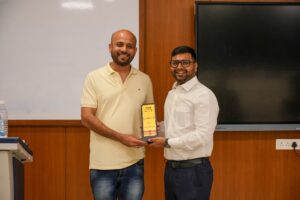
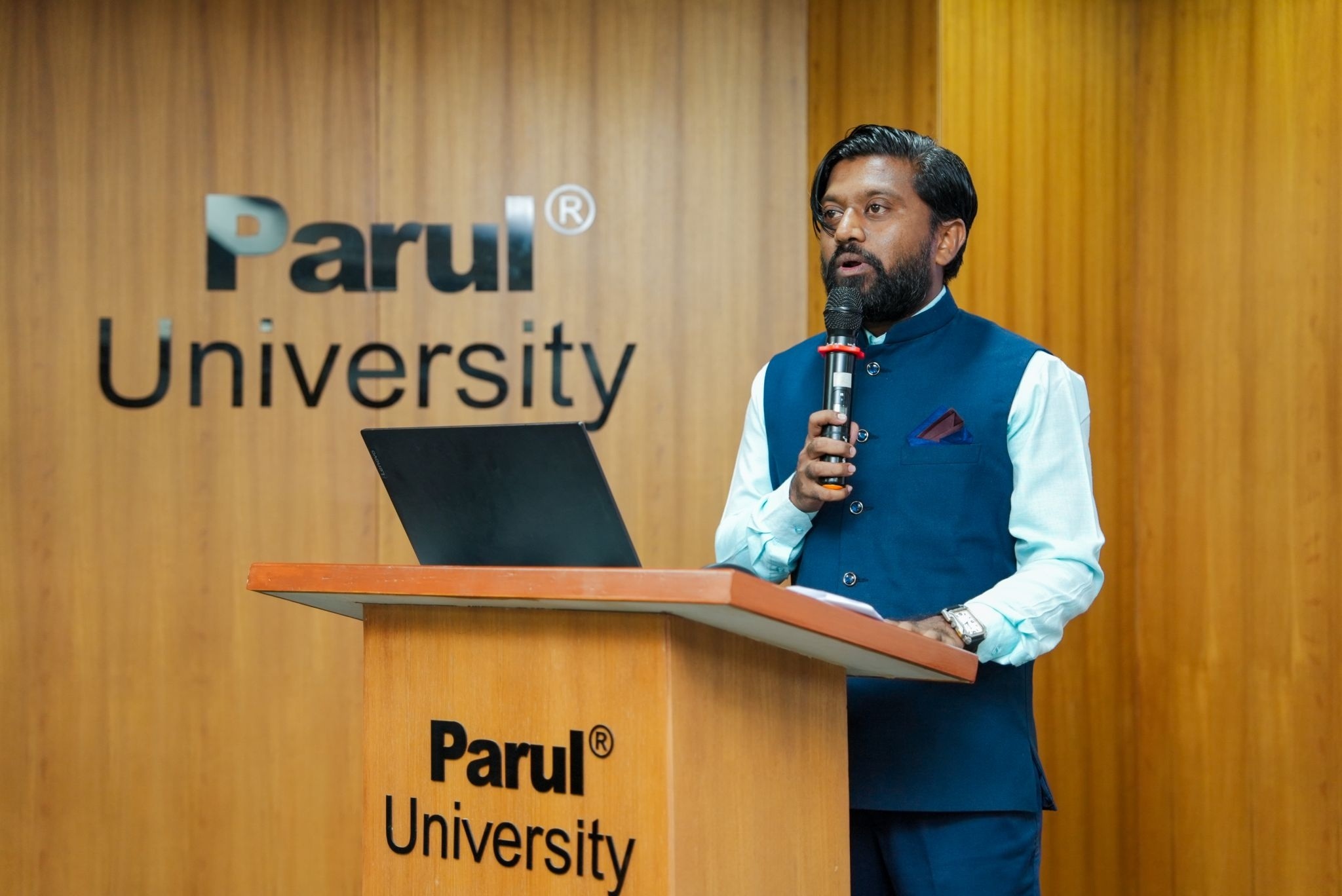
The rule is simple – every single institution is running on that one single person who’s managing everything behind the scenes but never gets accreditation. But at Parul University, the rule isn’t the same; they feature the ones who are running the show at all levels. And at Parul Innovation & Entrepreneurship Research Centre, that gem is Mr. Hutesh Baviskar – the Incubation Manager. He is solely responsible for welcoming the dignitaries and extending promised opportunities to students, founders & startup enthusiasts.
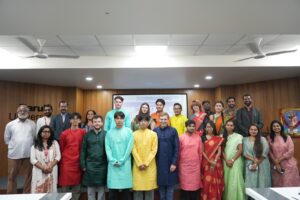
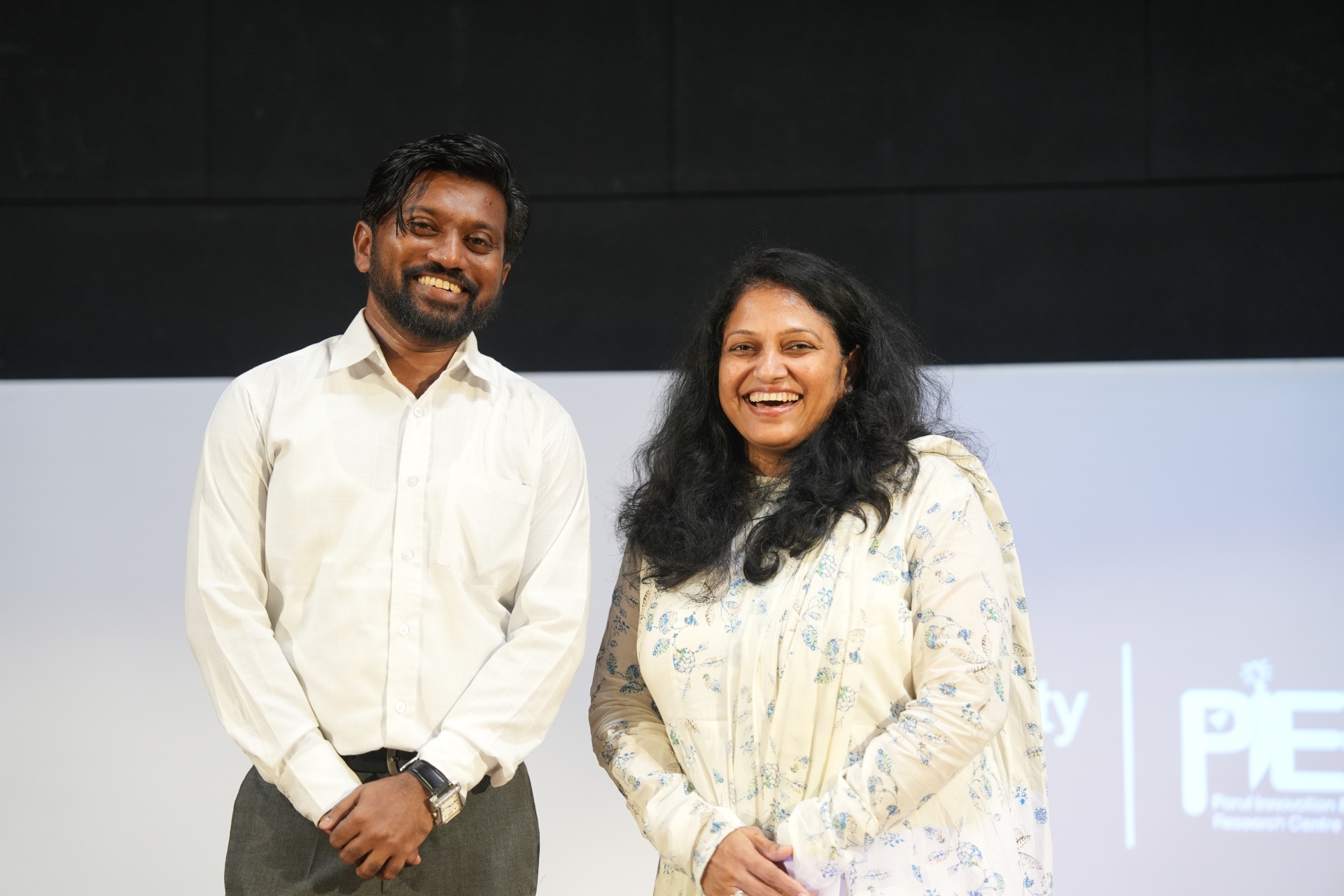
At the closing ceremony of the 3-day PM SHRI’s Regional Mentoring Session on Innovation for students & teachers, proudly hosted by the Nodal Centre – PIERC, the vote of thanks was delivered by Mr Jay Sudani, the Chief Executive Officer of PIERC. In a room full of guests, teachers, faculty, and participants, he called up one name to recognise the holistic execution of this workshop, Mr Hutesh Baviskar.
He is the one who was working tirelessly behind the scenes and constantly coordinating with AICTE’s Innovation Cell, juries, participants, teachers and students. He is just one person with different hats, Mr Hutesh Baviskar, thank you for your commendable work & efforts!
Mr. Jay Sudani, Chief Executive Officer, PIERC
Roots: from a Khanvel village school to a Bharuch degree college
Mr. Hutesh Baviskar’s hometown is Khanvel, a village in the Dadra & Nagar Haveli (Union Territory) across Gujarat & Maharashtra. His father worked as a government employee, and the household was mainly managed by his mother & grandmother. They both ran a grocery store without any deep knowledge of sales or how a business works.
But they did it great, and that’s how Hutesh watched it and got the rhythm of stock, sales, customer management, cash flow and knowing every customer by name. The quiet discipline of running a small enterprise to a daily standard. He would not have called it entrepreneurship at the time. The foundation was being laid before the word had entered his vocabulary.
He studied in a Marathi-medium school from Class 1 through Class 10 in the village. After his tenth-board examinations, he decided to pursue science, which required commuting twenty kilometres every morning at 6 AM to the nearest English-medium science college in the main town. The college, however, used an English-communication entrance test to gatekeep admissions from vernacular-medium students. Hutesh had taken English as a subject seriously from Class 5, treating its grammar as a discipline rather than a hurdle. He cleared the test and was admitted to a batch of sixty students, where he was the only one from a fully Marathi-medium background. He passed his Class 12 science with 67 per cent, a result he describes not as a peak grade but as proof that the wall could be climbed.
After Class 12, he secured a seat in the government Diploma in Electronics and Communication programme, navigating an in-person seat allocation process in Ahmedabad. He completed the diploma among the top rankers in the Electronics and Communication batch of his year, then applied under the Diploma-to-Degree (D2D) scheme and was admitted directly to the third year of a B.E. programme at Veer Narmad South Gujarat University in Surat, a city he had not previously visited. He completed the degree in three years, again finishing among the top rankers in his college batch.
The 2011 Electronics and Communication market crash and the decision to stay in India
By the time he graduated, the Electronics and Communication job market in India had collapsed. The crash was not gradual. Within three months in 2011, hiring for Electronics and Communication graduates effectively stopped at scale. Companies that had absorbed hundreds of graduates each year halted recruitment. Departments that had run four to eight full classes were down to one or two within a few years. The field Hutesh had chosen, excelled in, and built his identity around no longer had a front door open for him.
Approximately 80 per cent of his batchmates from both the diploma and degree programmes chose to leave India. The international market still values the Electronics and Communication skill set. Hutesh chose differently. His family, while emotionally supportive, was not positioned to fund a startup from scratch. What was needed first was stability. He began taking coaching classes for younger students, his first experience of teaching from the other side of the table, and applied for institutional teaching positions while he waited.
January 2012: joining Parul Polytechnic as the 36th faculty member
In January 2012, Mr. Hutesh Baviskar joined Parul Polytechnic Institute as a faculty member in the Electronics and Communication department. He was the 36th faculty member in a department that would reach 55 teaching staff by 2014. At that time, the EC department at Parul Polytechnic was a powerhouse, with four classes running at full capacity and applicants unable to secure admission even after enrolments were closed. What distinguished his early years was not just his teaching. It was his willingness to take on every additional responsibility the department offered.
- Examination Coordinator: Coordinating question papers, invigilation rosters, result processing, and the logistics of academic assessments at scale, working alongside the Head of Department and the Dean.
- Acting Head of Department: Stepping in for approximately eight to nine months when the permanent HOD was on maternity leave, managing the full departmental portfolio without prior leadership preparation.
- Entrepreneurship Development Cell (EDC): Active institutional involvement in identifying student entrepreneurs and channelling diploma-level ideas into structured competitive opportunities.
- Dhoom Coordinator and Sports Coordinator: Anchoring two to three years of the university’s biggest cultural and sports events, including participation across departments and inter-institute coordination.
The breadth of these roles was not a coincidence. It was how he built the cross-departmental network that would later make him effective at the scale of PIERC.
The Spartans E-Cell: diploma students who beat MBAs at IIT Mumbai
One of the formative chapters of Hutesh’s early years at Parul Polytechnic was the student entrepreneurship team he built and named with characteristic flair: the Spartans E-Cell.
The team was a group of eight students selected and trained with particular care. They were not English-medium students. They were not from management schools or degree colleges. They were diploma students, the same kind of student Hutesh himself had been, preparing to compete in national-level entrepreneurship and innovation challenges against graduates, postgraduates, and MBA students from some of India’s most prestigious institutions. From 2016 onwards, the team began attending hackathons and ideathons across the country, including in Goa and Bangalore. The structure of knowledge transfer ran from senior batches to junior batches through workshops conducted by the seniors themselves, organised by Hutesh and sustained by the students.
In 2018, Hutesh entered the Spartans in the National Entrepreneurship Challenge (NEC) at IIT Mumbai, a competition with participation running into the thousands and a nine-month structure across institute-level, external-review, online, and in-person rounds. The Spartans cleared every round to reach the top ten teams nationally. In the final round at IIT Mumbai, facing graduate and management students, the diploma team from Parul Polytechnic finished in third place nationally.
After the result was announced, Hutesh called Dr. Devanshu Patel, the President of Parul University, to convey the news. The university leadership had already arranged the return travel logistics for the team in anticipation. The 2019 NEC at IIT Mumbai brought a repeat of the achievement. The Spartans entered again, cleared the multiple rounds again, and finished in the top five nationally. This time they came in second place. The system of knowledge transfer Hutesh had built was producing top-five national results year after year. Following this second consecutive top-five finish, the team received formal notification that they were barred from participating in the same competition for ten years, a rule that exists to prevent any single team or institution from dominating the competition ecosystem.
When you become a winner, you cannot participate for ten years because you become a substrate, a role model. So that was regarding how, as an EDC institute, I did it with a team.
Mr. Hutesh Baviskar, on a ten-year ban after consecutive top-five finishes at the National Entrepreneurship Challenge
The M.Tech gold medal, the smart ambulance thesis, and the conversation with Dr. Devanshu Patel
By 2020, Parul University had a standing mandate that every faculty member should hold at least a master’s degree. Mr. Hutesh Baviskar had nearly a decade of institutional service, an acting HOD tenure, two consecutive top-five finishes at IIT Mumbai’s NEC, and several coordinator portfolios behind him, but he did not yet have a master’s degree. The hesitation was not academic. It was financial.
Dr. Devanshu Patel, President of Parul University, called him directly. The conversation was not a formal HR engagement. It was a one-on-one discussion with someone who had known Hutesh since 2014 and had watched him grow. Dr. Devanshu Patel asked what the problem was, and Hutesh explained. The response was practical: join Parul University’s own M.Tech programme, and the fees would be managed institutionally. The faculty salary would continue. Hutesh would not have to leave the institution to grow inside it.
He enrolled in 2020, in the same year COVID arrived. His first year was fully online; his second year was offline. He completed the programme and appeared for his final examinations in March 2022.
His batch began with fifteen students. By the second year, only seven remained. Mr. Hutesh Baviskar finished with a CGPA of 9.21, the highest in the batch and the highest in the programme. He was awarded the gold medal, having paid only the examination fees of approximately Rs 10,000 per year, while the institution covered the remainder of his tuition through the arrangement Dr. Devanshu Patel had set up.
His M.Tech thesis addressed smart ambulance communication systems and real-time data transfer between ambulances and hospitals, with a focus on pre-arrival treatment preparation enabled by live ECG data transmission. He had approached more than five hospitals during the research phase, all of which had been enthusiastic about the concept, with bandwidth constraints identified as the primary technical barrier.
On the day of his dissertation presentation, an unknown phone number called him repeatedly. He did not answer because he was about to present. The number belonged to an industry delegation that had specifically come to his dissertation day to discuss the research direction. Government channels had picked up the thesis through his guide, and a smart-ambulance grant application was filed through related channels in the same period. The thesis topic had moved, while he was still finishing the degree, from academic exercise to active industry conversation.
Mid-2022: from Parul Polytechnic faculty to Incubation Manager at PIERC
The transition from faculty to PIERC’s Incubation Manager role had been under discussion since March 2019. Hutesh’s responsibilities at the Polytechnic, however, were immense, and a sudden departure would have left significant institutional gaps in examination coordination, student-team preparation, and ongoing EDC commitments. The transition was deferred, and a handover was structured over time. By mid-2022, after completing his M.Tech’s gold medal in March, he formally joined PIERC with the title of Incubation Manager.
The structure of PIERC and what each manager owns
PIERC is the innovation engine of Parul University. It functions not only as an incubation centre but as the coordinating body for all innovation, entrepreneurship, startup, and ranking-related activities across the university’s twelve-plus departments and institutes.
The core team is divided across specific working domains.
- Jay Sudani, Chief Executive Officer: Strategic direction, external representation, and the institutional positioning of PIERC.
- Sonal Sudani, Incubation Manager (Grants): Grant management, applications, documentation, and compliance, including the recordkeeping required for ranking submissions.
- Anup Chaudhari, Manager, Incubation Programme: Startup development and the structured progression of incubated startups through the programme.
- Prashant Khanna, Manager, Incubation Programme: Startup support and incubation programme execution, working alongside Mr. Anup Chaudhari.
- Hutesh Baviskar, Incubation Manager: Events, ground-level coordination, faculty training, and the discovery of student startups through classroom and departmental engagement.
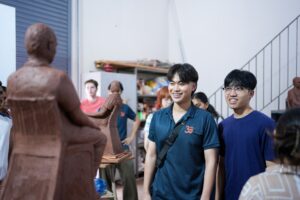
Physically central to the centre’s operations is the FabLab, a fabrication laboratory that bridges idea and prototype. Equipped with 3D printers, laser cutters, electronic prototyping equipment, and the in-charge guidance to use them, the FabLab allows any student, regardless of engineering background, to walk in with a concept and leave with a working Minimum Viable Product (MVP). For machinery the lab does not stock, the in-charge connects students directly to Gujarat Industrial Development Corporation (GIDC) partners and other industry contacts. The FabLab’s founding grant came from the district commissioner’s office.
You go with your idea. You can make a prototype; you can make an MVP. You get a technical advantage. It is a bridge where you get real mechanical and electronic guidance. It is not abstract support. It is someone who tells you exactly how this can be made.
Mr. Hutesh Baviskar, on the role of the PIERC FabLab
ARIIA ranking, NIRF Innovation Top 50, and four consecutive years of IIC 4-star recognition
One of the first tasks assigned to Mr. Hutesh Baviskar and Mrs. Sonal Sudani at PIERC was building Parul University’s positioning under the Atal Ranking of Institutions on Innovation Achievements (ARIIA), implemented by AICTE and the Ministry of Education’s Innovation Cell. The ranking evaluates higher education institutions on seven criteria: budget and expenditure supporting startups, infrastructure and facilities for innovation, awareness creation and outreach, idea development activity, intellectual property commercialisation, innovative course offerings, and innovation governance.
The work was foundational rather than cosmetic. Every startup that had been incubated with PIERC between 2015 and 2022 needed to be documented with authority letters, selection records, and evidence of funding decisions. Teams that had applied and not been selected had their records archived. Teams that had been selected and onboarded formed the portfolio that ranking evaluators would assess.
The result: Parul University achieved a position in the NIRF Innovation Top 50, a national recognition placing the institution among the most innovation-active higher education centres in India. The parallel Institution’s Innovation Council (IIC) rating, also operated by the Ministry of Education’s Innovation Cell and AICTE, has been ranked four stars for four consecutive years. The 4-Star IIC designation is awarded to institutions that have built a well-organised innovation and entrepreneurship campus ecosystem, and holding it for four consecutive years signals sustained performance rather than a one-time achievement.
65 faculty coordinators across twelve-plus departments: building a distributed network
One of the most complex aspects of Hutesh’s work at PIERC is the management of the faculty coordinator network. He currently oversees approximately 65 faculty coordinators drawn from the university’s various departments and institutes.
These coordinators are not dedicated PIERC staff. They are faculty members with full teaching loads, papers to set, assignments to check, and administrative meetings to attend. On top of all of this, they are asked to function as the ground-level agents of the innovation ecosystem: identifying students with ideas, promoting PIERC programmes within their departments, conducting activities, and ensuring the innovation culture reaches every department, even down to a third-year student who might otherwise never hear the word ‘incubation.’ Hutesh understands the weight of the additional responsibility because he carried similar responsibilities during his Polytechnic years.
As faculty responsibilities continue to increase, I guide and support faculty members in managing their time effectively so they can contribute to entrepreneurship, innovation, and startup ecosystem development alongside their regular academic and administrative duties. Through continuous motivation and mentoring, I encourage their active involvement in entrepreneurial initiatives and innovation-driven activities.
Mr. Hutesh Baviskar, when asked about the hardest part of his job at PIERC
The architecture he has built is distributed rather than centralised. Senior student coordinators train junior ones. The pre-incubation team functions as an extension of his reach within the student body. By the time a student reaches the third year, some of them are themselves running aspects of the PIERC ecosystem in their departments. The layered structure means Hutesh is not the bottleneck at every node. He is the architect of a system that, at its best, runs without requiring him at every point of execution. The model is now formalising through a faculty train-the-trainers programme launched in early 2025.
During his first three months at PIERC, before the faculty coordinator network was trained in its current form, he personally visited classrooms across the university’s institutes. In one month during this period, he conducted approximately 75 classroom sessions, an average of more than two and a half per working day across an entire month. The conviction behind the schedule was specific: the students who needed PIERC most were the ones who had never heard of it, and discovery does not happen passively.
The flagship events: VSF, Women's Startup Meet, Toycathon, COIL, and the PM SHRI Schools Regional Mentoring Session
Mr. Hutesh Baviskar has served as Single Point of Contact (SPOC) for a series of PIERC’s most consequential events.
The Vadodara Startup Festival (VSF), PIERC’s annual flagship, brings together startup pitching, jury evaluation, investor interactions, and student innovation showcases that represent both the university and the city’s broader entrepreneurial ecosystem. The Women’s Startup Meet, originally hosted under the university’s management school and now consolidated under PIERC, provides a dedicated platform for women entrepreneurs and women-led startups, with external women founders participating alongside students. The Vadodara Hackathon brings coding talent from across Gujarat through a multi-day competition with full logistical infrastructure, including overnight sessions, jury coordination, problem statements, and technical setup.
Three other initiatives complete the portfolio of events Mr. Hutesh Baviskar has anchored as SPOC.
- The Vadodara Toycathon: A competition that brings innovation to school-level participants, asking children to design and propose toy innovations that address real gaps. The Toycathon represents PIERC’s position that the innovation funnel should not begin at the college level but should reach school students who already have ideas.
- The Collaborative Online International Learning (COIL) programme: Structured academic collaboration between Parul University students and partner international universities, including the institutional coordination of the student trips to Switzerland under the related partnership.
- The PM SHRI Schools Regional Mentoring Session: A three-day initiative under AICTE’s Innovation Cell, in coordination with the Ministry of Education’s PM Schools for Rising India (PM SHRI) scheme, brings innovation pedagogy and design-thinking exposure to schoolteachers and students at the regional level.
Each of these events involves multi-stakeholder coordination across AICTE liaisons, external faculty experts, juries, volunteers, participants, travel logistics, accommodation, and the internal PIERC programme team.
The PM SHRI Schools Regional Mentoring Session was the most recent large-scale event Hutesh anchored, and it was at its closing ceremony that Mr. Jay Sudani named him publicly for the work behind the scenes.
42 startups mentored: the numbers and the discipline of honest reporting
From 2022 to the date of this profile, Mr. Hutesh Baviskar has personally guided more than 42 startups through the PIERC incubation process. Of these, approximately 25 to 26 remain active and in mentorship with him today.
The remaining 16 to 17 represent a range of outcomes. Some businesses ran out of financial runway before they reached viability. Others determined through the incubation process that the customer need they had initially identified was less acute than expected, or that competition had foreclosed the market window. Some founders signed customers, built operating businesses, and graduated from incubation on their own terms. A few collapsed not because of the idea but because of the people, through co-founder disputes, operational breakdowns, or commitment failures. The framing matters. An incubation centre that only celebrates its wins is not being honest about the process. A 25 to 26 active portfolio out of 42 is a realistic working ratio, and the active cohort is in genuine mentorship rather than on a passive database.
A second outcome that Hutesh tracks is employment generation through the portfolio. More than 18 to 19 interns have been placed by Hutesh directly into PIERC portfolio startups. Of those intern placements, approximately 60 per cent have converted into full-time employment. The startups under his mentorship are not only building products. They are becoming small employers within the Parul University ecosystem, creating livelihoods that did not exist before.
One of the most instructive cases in the portfolio is a student startup founded by a Liberal Arts student at the Parul Institute of Liberal Arts. The founder, who had personally experienced the difficulty of finding accommodation as an incoming student in Vadodara, built an aggregator platform for student accommodation near the university campus. Within one month of launch, the business had crossed Rs 3 lakh in revenue. Within one year, it had crossed Rs 10 lakh. The founder invested Rs 30 to 35 lakh of his own family resources to build operating infrastructure, signing agreements with hostels and paying advance deposits to secure inventory.
But there is one founder I think about more than any other.
A Liberal Arts student – Devashish Sawant, a Marathi-speaking person like me, who came to Vadodara and could not find a decent place to live. He turned that frustration into a student-housing startup. The name of his startup was – Accomzy Accommodation Services Private Limited. Not an app at first, just a phone, a notebook, and the will to knock on every hostel door in the city. Three lakh rupees in his first month, followed by 10 lakh in his first year. He wanted to drop out because, in his words, he was already a businessman. I told him to finish the degree. No one ever calls you a failure for having both.
Within one month of launch, the business had crossed Rs 3 lakh in revenue. Within one year, it had crossed Rs 10 lakh. The founder invested Rs 30 to 35 lakh of his own family resources to build operating infrastructure, signing agreements with hostels and paying advance deposits to secure inventory.
The arc of the startup is what makes it instructive. Early growth was followed by erosion: strained co-founder relationships, cash-flow pressure, debt that turned from foundation to weight. The founder dropped out and went on to a corporate job.
He returned later to PIERC’s office to deliver a handwritten letter stating that he wanted to restart. Mentorship resumed by message. At the time of writing, the founder is rebuilding, having opened a new venture in another Indian city after Mr. Hutesh Baviskar advised against attempting a restart in Vadodara on the original terms. The letter remains in his drawer. The story matters not because the first attempt collapsed but because the relationship between mentor and founder outlasted the collapse, which is what genuine incubation looks like at the working level.
The next five years: 20 per cent external funding, train the trainers, and a startup of Hutesh's own
When asked where he sees PIERC and himself in the next five years, Mr. Hutesh Baviskar speaks on two parallel tracks: the institution and the individual.
Earlier, we were focused on how the student would come to us with their startup ideas. Now we are focusing on how the startup will be funded by us, supported by us, and how the startup will be raised in the house. We are thinking of pillars within the next five years.
Mr. Hutesh Baviskar, on the next phase for PIERC!
For PIERC, the institutional ambition is specific and measurable. At least 20 per cent of the startups currently being supported should be able to raise external investment within five years. The shift is from a discovery and development centre to a funding-facilitation centre, which requires building relationships with investors, creating structured pathways from ideation to an investor-ready pitch, and connecting the grassroots discovery work to a maturing capital pipeline at the other end.
For himself, the plan is a deliberate portfolio shift. The faculty train-the-trainers programme has been launched and is now producing people who can do parts of what Hutesh does. As the trainer network deepens, he is reducing time spent on event coordination and increasing time spent on direct startup mentorship. He is also, in measured terms, building a venture of his own, applying in his own work the frameworks he has taught 42 founders. The frame he offers is institutional rather than individual: the best mentors are the ones who have been through it themselves.
The institutional context for his own ambition is consistent with how Parul University has positioned its broader innovation and entrepreneurship infrastructure. PIERC has supported more than 254 incubated startups across the university to date, with over Rs 20 crore in funding provided and more than Rs 40 crore in revenue generated by PU-incubated ventures. Notable portfolio cases include Solnce Energy, which secured a Rs 1 crore investment on Shark Tank India Season 4, backed by Aman Gupta, and Rehabveda, a brain-controlled rehabilitation venture from the PIERC pipeline. The broader pattern of student outcomes through Parul University includes Amal Pushp Sinha‘s recent selection as a Google Gemini Student Ambassador and Tanish Patel and Suraj Jagtap‘s 60 LPA offers from Microsoft, documented separately. The COIL collaboration with Bern University of Applied Sciences in Switzerland formalises the international engagement that Mr. Hutesh Baviskar has helped coordinate.
FAQs
Who is Hutesh Baviskar & his role at PIERC?
Hutesh Baviskar is the Incubation Manager at PIERC, Parul University. For the last 13 years, he has served as a faculty member in the Electronics & Communication Department at Parul Polytechnic Institute and then transitioned to PIERC in mid-2022. At PIERC, he is solely responsible for events, coordination across 12+ departments, faculty training, and mentoring students via the incubation programme!
Define the core role of PIERC and its structure?
PIERC, also known as Parul Innovation & Entrepreneurship Research Centre, is the engine of Parul University. As designed to inspire student founders and startup enthusiasts, the incubation centre is the central body for innovation, entrepreneurship, startup based activities across institutes and departments. It’s headed by the CEO, Mr. Jay Sudani; Mrs. Sonal Sudani leads as the Incubation Manager; Mr. Anup Chaudhari & Mr. Prashant Khanna are the managers of the incubation programme, and Mr. Hutesh Baviskar works as the Incubation Manager!
Define FabLab at PIERC & what does it offer?
The FabLab is the fabrication lab at PIERC, and it’s fully equipped with 3D printers, electronic prototyping equipment, laser cutters, and end-to-end machinery for physical fabrication. It allows students to turn an idea into a working prototype or MVP. The leads are extending holistic guidance to students on mechanical approaches and connecting GIDC partners & industry connections when there is a shortage of machinery. Their founding grant came straight from the commissioner’s office, and hence PIERC is a practical incubation centre, not just a conceptual one!
Define Parul University’s record on the ARIIA, NIRF & IIC’s innovation ranking?
Parul University have championed a position in the NIRF Innovation Top 50, a ranking that places the institution among the next-gen and highly active education centres in India. In parallel, the IIC rating is operated by the Ministry of Education’s Innovation Cell & AICTE, wherein they’ve championed 4-star for four consecutive years. Subsequently, the ARIIA’s framework is closely based on criteria such as startups, infrastructure, awareness, IP, course offerings and governance.
How many startups has Mr. Hutesh Baviskar mentored at PIERC?
Mr. Hutesh Baviskar has personally guided more than 42 startups through the PIERC incubation process from 2022 to the date of this profile. Of these, approximately 25 to 26 remain active and in active mentorship. The remaining startups represent a mix of outcomes: some ran out of financial runway, some discovered through incubation that the initial customer need was less acute than expected, some signed customers and exited incubation on their own terms, and a few collapsed due to co-founder or operational reasons. Across the portfolio, he has placed more than 18 to 19 interns directly into PIERC startups, with approximately 60 percent of those placements converting into full-time employment.
What major events at Parul University has Mr. Hutesh Baviskar coordinated?
Mr. Hutesh Baviskar has served as Single Point of Contact (SPOC) for a series of PIERC flagship events. These include the Vadodara Startup Festival (VSF), Parul University's annual showcase of regional startup talent; the Women's Startup Meet, a dedicated platform for women entrepreneurs and women-led startups; the Vadodara Hackathon, a multi-day coding and innovation competition; the Vadodara Toycathon, an innovation competition for school-level participants; the Collaborative Online International Learning (COIL) programme, including the coordination of student trips to Switzerland; and most recently the three-day Regional Mentoring Session on Innovation for Teachers and Students of PM SHRI Schools, under AICTE's Innovation Cell.
What is PIERC's plan for the next five years?
PIERC's stated ambition for the next five years is that at least 20 per cent of the startups currently being supported should be able to raise external investment within that horizon. The shift represents a move from a primary discovery-and-development model to a funding-facilitation model that connects grassroots startup discovery to a maturing capital pipeline. The plan requires building structured investor relationships, creating clear pathways from ideation to investor-ready pitch, and deepening the faculty train-the-trainers programme so the discovery work that Mr. Hutesh Baviskar has been doing manually can be scaled across the institution's full academic footprint.