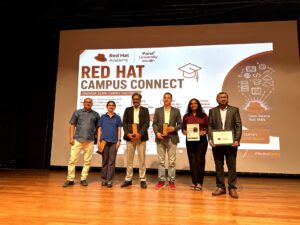
Designing an aircraft wing on paper is a different problem from knowing whether the wing will hold under flight load. The gap between the two is exactly what simulation software exists to close. The Lakshya 2047 was inaugurated by the Union Minister Dr. Jitendra Singh on 8 May 2026 has ANSYS Lab at Parul University. The purpose of the lab is to train students in the complex skills of engineering that are career-relevant.
What ANSYS simulation actually does
ANSYS lets engineers test whether their designs will work before building anything physically. The cost savings are planned and structured. The traditional engineering technique of workflow made physical prototypes, tests them, identifies failures, redesigns and iterates.
The cycle is slow and expensive. ANSYS replaces most of the early iteration with digital simulation. Engineers build a digital model, apply realistic loads and conditions, let the software compute the response, and identify failure modes before any physical material is committed. The cycle compresses from months to days, and the cost compresses from lakhs to compute time.
The lab teaches the four core simulation domains that ANSYS covers:
- Finite Element Analysis (FEA): An analysis where students get to learn and analyze how structures such as buildings, vehicles, machines, and other components respond to forces, vibrations, and pressures. This analysis breaks the structure, elements and enumerates how each element works under pressure, then accumulates the results to show how the whole structure performs.
- Computational Fluid Dynamics (CFD): Fluid and gas flow around objects can be ascertained through pipes, surfaces, and inside complex geometries. The lab works on giving a 40-hour CFD course, as it is a highly in-demand course.
- Thermal analysis for heat behaviour. Engineers need to know how heat moves through materials, where hotspots develop, and how cooling systems should be designed. Thermal analysis covers electronics cooling (preventing chip overheating), heat exchanger design, and the broader thermal management work that modern engineering requires.
- Electromagnetic simulation for electrical and electromagnetic systems. Coverage extends to the simulation of electrical motors, transformers, antennas, and the electromagnetic compatibility work that distinguishes professional electronic design from amateur work.
The five-step simulation workflow students master
ANSYS work follows a structured workflow. Students learn to execute the workflow end-to-end.
- Step 1: Model creation. Students build the 3D digital model of what they want to simulate, often importing CAD geometry from Autodesk or other design tools. The model is the starting point for everything that follows.
- Step 2: Meshing. Students break the model into small finite elements that the software can compute. Mesh quality affects simulation accuracy substantially, and learning to mesh well is one of the foundational ANSYS skills.
- Step 3: Boundary conditions. Students specify the loads, supports, fluid inputs, thermal sources, and other real-world conditions the simulation needs to account for. Boundary conditions translate physical reality into something the software can compute.
- Step 4: Solver execution. The software computes the response of the model under the specified conditions. Solver runs can take seconds for simple models or hours for complex ones. Students learn to manage the computational cost of their simulations.
- Step 5: Results visualisation. The software turns simulation output into readable graphics and animations. Students see how their part bends, twists, heats up, or vibrates over time. Stress maps show red zones where material is failing and blue zones where the material is handling load. The visual feedback is the learning tool that converts numerical output into engineering insight. If a student sees their bridge design collapse in animation, they know which beam needs to be thicker or made of a different material, and they take that information back to step one to repeat the workflow until the design is feasible.
Also Read: AWS Cloud Computing Lab at Lakshya 2047 – Centre for Future Skills, Parul University!
Why simulation skills matter across engineering sectors
- Chemical industry. Simulation helps design systems for handling dangerous materials safely. Containment vessels, transfer pipes, and reaction chambers all need to be modelled for thermal, structural, and fluid behaviour before they are built and operated with hazardous chemicals inside.
- Electronics manufacturing. Modern electronic components run hot. Simulation ensures that tiny computer chips do not overheat during operation, that cooling solutions are adequate, and that the broader thermal design of electronic products keeps them within operational temperature ranges.
- Aerospace. ANSYS ensures that complicated parts fit together correctly and that components like airplane wings can handle the stresses of flying at high altitudes. The cost of getting aerospace simulation wrong is measured in lives, not just in money.
- Automotive. Vehicle aerodynamics, crash safety simulation, engine thermal management, and structural analysis all depend on ANSYS. Indian automotive manufacturers, including those connected to the Lakshya 2047 Autodesk Lab’s named partnerships (Tata Motors, Mahindra, Ashok Leyland), use ANSYS extensively for design validation.
- Civil engineering and construction. Bridge design, building structural analysis, foundation engineering, and seismic simulation all use FEA. Civil engineers who can simulate their designs are positioned for senior structural engineering roles.
- Energy sector. Wind turbine design, oil and gas equipment analysis, nuclear plant safety simulation, and renewable energy infrastructure all rely on ANSYS workflows.
Career pathways the ANSYS Lab opens
The ANSYS Lab is the simulation-and-analysis backbone of the design and engineering simulation cluster inside Lakshya 2047. The pairing with the Autodesk Lab is structural: Autodesk produces the CAD geometry that ANSYS imports for simulation. The cycle of design in Autodesk, simulate in ANSYS, redesign in Autodesk, re-simulate in ANSYS is the standard engineering workflow that the two labs together support.
The lab also intersects with the NVIDIA Lab’s GPU compute infrastructure for computationally heavy simulations that benefit from GPU acceleration, with the AICTE IDEA Lab Prototyping Zone for students who want to physically fabricate the designs they have simulated, and with the industrial automation cluster for students simulating industrial systems before deployment.
FAQs
How are FEA and CFD inside ANSYS different?
FEA (Finite Element Analysis) and CFD (Computational Fluid Dynamics) are simulation approaches but in different ways. The first one focuses on structural problems such as how solid objects respond to forces, stresses, vibrations, and thermal loads. While the second one handles fluid and gas behavior that focuses on air flows around an airplane wing, working on how water flows through a pipe and how exhaust gases move through an engine. It is used in aerospace aerodynamics, HVAC design, process industries, and any application where fluid or gas behavior matters. The lab provides training across both, with the dedicated 40-hour CFD specialisation for students who want deeper focus on the fluid dynamics dimension.
Which Parul University programmes access the ANSYS Lab?
Multiple Engineering programmes engage the lab. B.Tech in Mechanical Engineering students are the primary users across FEA, thermal analysis, and CFD work. B.Tech in Aeronautical Engineering students engage heavily for aerospace simulation. Civil Engineering (where offered) uses FEA for structural work. B.Tech in Electrical Engineering students engage for electromagnetic simulation. B.Tech in Electronics and Communication Engineering students engage for electronics cooling and electromagnetic compatibility work. Diploma, undergraduate, postgraduate, and PhD students access the lab at appropriate technical depth.
Why is ANSYS the industry standard for engineering simulation?
ANSYS has been developed continuously since 1970, with the company building one of the deepest and broadest simulation software suites in the engineering industry. The combination of breadth (FEA, CFD, thermal, electromagnetic, multiphysics, and specialised solvers for nearly every engineering domain) and depth (decades of validated solver development) is what makes ANSYS the default choice across most engineering sectors globally. Engineers who can use ANSYS competently are immediately useful in any organisation that does serious design engineering work, which is a substantial share of the global engineering industry. The lab's training positions students inside this industry-standard skill set.
How does the ANSYS Lab teach students to handle simulation failure rather than just successful simulations?
The lab's training emphasises the iterative workflow that real engineering practice uses. Students do not just run simulations and accept the results. They learn to read stress maps where red zones indicate material failure and blue zones indicate the material is handling load. When a simulation shows a design failing, students learn to identify which component needs modification, take that information back to the design stage, and re-run the workflow. The iterative cycle of design, simulate, identify failure, redesign, re-simulate is what converts theoretical simulation knowledge into engineering judgement. This is the difference between a student who has learned ANSYS for an exam and a student who can actually use it to validate engineering designs.
What are the career options after CFD specializations?
CFD specialisation opens career pathways particularly in aerospace (aircraft and spacecraft aerodynamics), automotive (vehicle aerodynamics and drag reduction), HVAC system design (airflow and thermal comfort), process industries (fluid flow in chemical, pharmaceutical, and food production), wind energy (turbine design), and any sector where fluid or gas behaviour matters. CFD specialists command premium positions because the specialisation requires deep mathematical foundation, computational competence, and the engineering judgement to translate simulation results into design decisions. The 40-hour dedicated course is structured to give students the foundational depth in CFD that distinguishes specialists from general simulation engineers.