Most 3D printing facilities discard failed prints. The Lakshya 2047 Centre’s Filament Extrusion System converts them back into usable filament. The infrastructure is small, but the operational thesis is the most distinctive sustainability story inside the centre.
This article walks through the Filament Extrusion System inside the AICTE IDEA Lab Prototyping Zone at Parul University’s Lakshya 2047 Centre for Future Skills, inaugurated by Union Minister Dr. Jitendra Singh on 8 May 2026. The system consists of a Shredder Machine that breaks waste plastic and failed 3D prints into recyclable pieces and an EVI Filfil Spooler that winds extruded material back into usable filament for FDM 3D printers. Beyond the equipment itself, the article treats the broader cross-lab sustainability framework that the Filament Extrusion System anchors, including connections to the Material Synthesis Zone (energy storage research), the Home Automation Lab (energy efficiency programming), and the Drone Ecosystem (precision agriculture reducing input waste).
The Filament Extrusion System: equipment and operational workflow
- Shredder Machine. Breaks waste plastic materials and failed 3D prints into smaller pieces so the material can be recycled and reused. Failed 3D prints are common in any teaching environment because students iterate through designs, learn to tune print parameters, and produce defects during the learning process. Without a shredder, this material accumulates as waste. With a shredder, it becomes feedstock for the extrusion process.
- EVI Filfil Spooler. Collects and winds the extruded filament material into spool form for future 3D printing use. The spooler maintains filament alignment, thickness consistency, and smooth winding, which are the operational requirements for producing filament that actually works in FDM 3D printers. Poor winding produces filament that jams printers; clean winding produces filament that prints reliably.
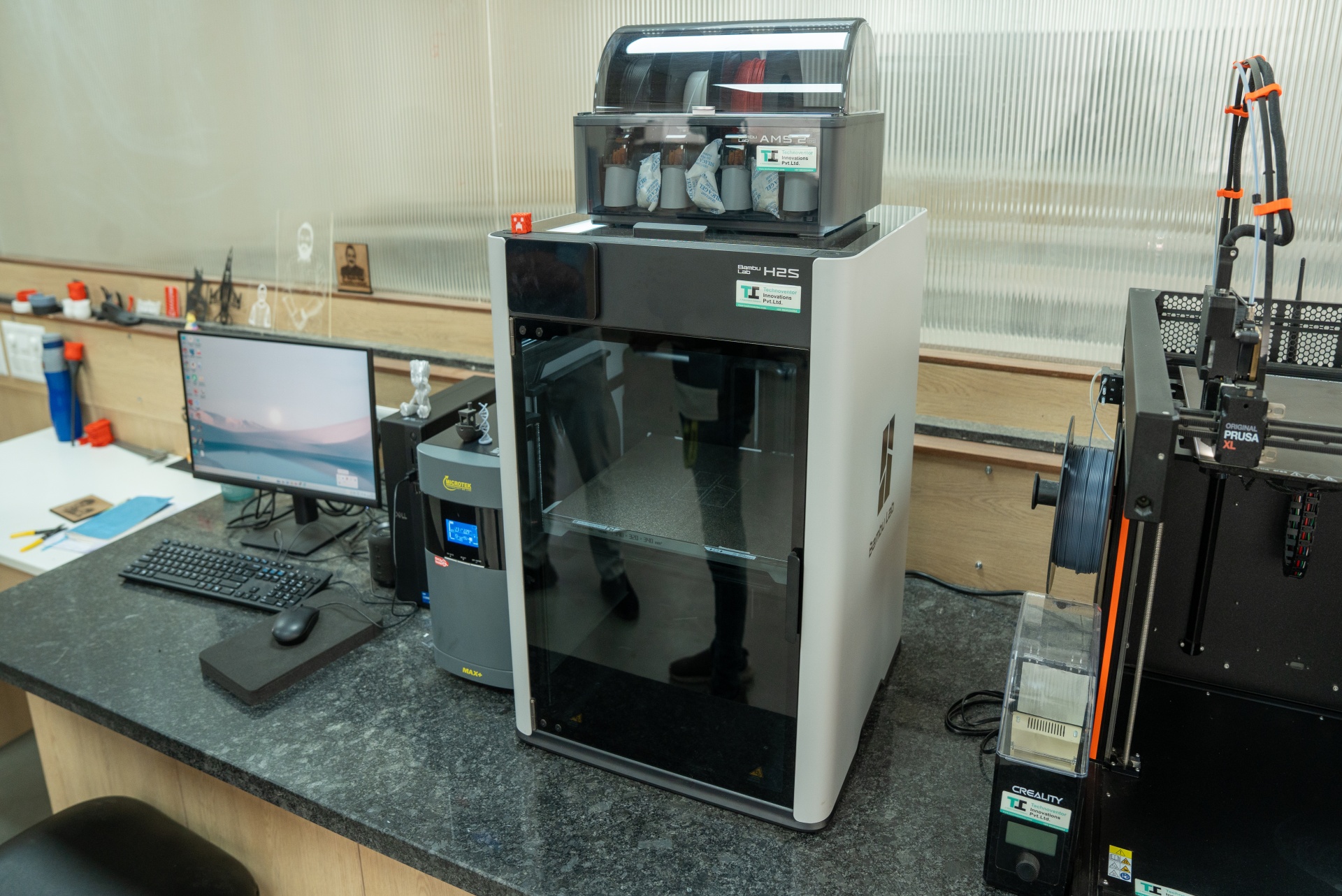
- Operational workflow. Failed prints and plastic scrap go into the Shredder Machine. Shredded material is processed through the extrusion system that heats and forms it into continuous filament strands at the correct diameter (typically 1.75 mm or 2.85 mm for standard FDM printers). The continuous filament is wound onto spools by the EVI Filfil Spooler. The finished spools go back to the Bambu Lab, PRUSA XL, and other FDM 3D printers in the lab for new prints. The cycle completes.
- Educational and operational integration. Students learn the complete manufacturing workflow behind filament production rather than only consuming ready-made filament. The system provides practical exposure to material processing, temperature control, and extrusion mechanisms used in modern manufacturing industries. The recycling discipline transfers to broader sustainable manufacturing practices.
Why this is the most distinctive sustainability story in the centre
The Filament Extrusion System is a small infrastructure but represents a substantively different operational philosophy from typical university 3D printing facilities.
Most university 3D printing labs operate on a linear consumption model. Filament is purchased, used in prints, and the failed prints plus print waste become disposable trash. The economic and environmental cost of this model is substantial when scaled across a university’s annual print volume, but the inefficiency is rarely visible because each print is cheap. The Lakshya 2047 Centre’s Filament Extrusion System inverts this model. Filament is purchased, used in prints, and the failed prints plus waste become feedstock for new filament production. The cycle reduces both purchased filament cost and waste output.
The operational thesis matters beyond the equipment itself because it positions Parul University inside the broader circular economy narrative that increasingly shapes how organisations evaluate institutional credibility. Recruiter ESG screening, investor sustainability evaluation, government scheme alignment with sustainable development goals, and broader institutional positioning all increasingly value demonstrated circular economy practice rather than just stated commitment. The Filament Extrusion System is operational evidence rather than rhetorical commitment. This is the kind of evidence that complements Parul University’s THE Impact Rankings positioning, which includes Top 20 India for SDG 4 (Quality Education), Top 30 for SDG 5 (Gender Equality), Top 40 for SDG 3 (Good Health and Well-Being), and Top 50 for SDG 17 (Partnerships).
The cross-lab sustainability architecture across Lakshya 2047
The Filament Extrusion System is the most visible sustainability infrastructure, but is not the only sustainability dimension across the centre. Multiple labs contribute different operational angles to a broader sustainability framework.
- Material Synthesis Zone – Energy Storage Research. Students working on battery research, supercapacitor development, and electrochemical applications inside the Material Synthesis Zone contribute to the energy transition that sustainability ambitions require. The Techinstro Hydrothermal Autoclave (operating at 100 bars and 300 Celsius for 8-10-hour synthesis runs), the Autolab PGSTAT204N electrochemical workstation, and the broader research-grade infrastructure support work on next-generation energy storage materials.
- Material Synthesis Zone – Food Preservation and Agricultural Applications. DC Plasma System surface activation for seed treatment, biosensor development for food safety, and food preservation nanomaterials research contribute to reducing agricultural waste and improving food system efficiency. The agricultural sustainability dimension is treated in cross-references with the Drone Ecosystem’s precision agriculture applications.
- Home Automation Lab – Energy Efficiency Programming. Building Management System programming inside the Home Automation Lab focuses substantially on energy optimisation: turning off lighting in unoccupied rooms, minimising cooling when natural cooling is sufficient, predictive engineering to pre-condition buildings before storms or heat waves. The energy savings across a smart-building portfolio compound substantially, and the workforce capacity to design and operate this efficiency is what the Schneider Electric EcoXpert Building Automation certification develops.
- Drone Ecosystem – Precision Agriculture. Agricultural drone applications (crop spraying with reduced input volume, field monitoring for targeted intervention, yield estimation for optimised harvest timing) reduce the input-to-output ratio in agricultural operations. Less water, fertiliser, and pesticide waste for the same agricultural output is the sustainability outcome. The Drone Ecosystem’s RPTO-certified pilot training enables this efficiency in agricultural service delivery.
- Industrial Drives and Control Lab – Variable Frequency Drives. VFDs let factories set exact current to industrial motors based on actual demand rather than running at maximum capacity. The cumulative energy savings across modern industrial operations are substantial, with VFD competence becoming standard infrastructure in cost-conscious and sustainability-focused manufacturing operations.
Sustainable Development Goals alignment across the centre's training
Parul University’s THE Impact Rankings positioning across multiple SDGs is operationally reflected in Lakshya 2047 training. The connections are specific:
- SDG 4 – Quality Education. The centre’s core mission of multi-disciplinary skill development directly supports SDG 4. The 25+ industry certifications across 18 labs, the cross-faculty access model, and the broader credential portfolio approach all contribute to the quality education dimension.
- SDG 5 – Gender Equality. Cross-faculty access means equipment-intensive labs are not gendered by departmental boundaries. Female students from Commerce, Design, Arts, Medicine, and other programmes engage labs traditionally associated with male-dominated Engineering fields, contributing to the gender equality dimension of the centre’s positioning.
- SDG 7 – Affordable and Clean Energy. The Material Synthesis Zone’s energy storage research, the Industrial Drives and Control Lab’s VFD work, the Home Automation Lab’s energy efficiency programming, and the NVIDIA Lab’s GPU efficiency improvements all contribute to clean energy workforce capacity development.
- SDG 8 – Decent Work and Economic Growth. The credential architecture and PIERC startup pipeline together contribute to sustainable employment generation and entrepreneurship that the SDG 8 framework prioritises.
- SDG 9 – Industry, Innovation and Infrastructure. The centre is operationally an SDG 9 implementation: research-grade infrastructure supporting industry innovation across multiple emerging technology domains.
- SDG 12 – Responsible Consumption and Production. The Filament Extrusion System is a direct operational implementation. Cross-lab sustainability practices broadly contribute to the SDG 12 framework.
- SDG 17 – Partnerships for the Goals. The partnership architecture (NSDC, Cambridge University Press and Assessment, industry vendor partnerships across the 18 labs) is a structural SDG 17 implementation.
Career pathways the sustainability framework opens
- Sustainability Engineer. Specialised role across manufacturing, infrastructure, and product companies where sustainability competence is becoming a hiring requirement. The cross-lab competence across energy storage, building automation, precision agriculture, and circular economy practice positions graduates for these roles.
- Circular Economy Specialist. Emerging role at organisations implementing circular economy practices. Demand is concentrated at consumer goods companies, packaging firms, electronics manufacturers, and the broader materials economy, where waste-to-feedstock transitions are operationally significant.
- Building Energy Manager. The Home Automation Lab‘s energy efficiency programming combined with broader sustainability competence positions graduates for energy management roles at large commercial real estate operators, smart cities projects, and ESG-focused organisations.
- Precision Agriculture Specialist. Drone ecosystem training combined with the agricultural and environmental sustainability framework prepares graduates for precision agriculture services, entrepreneurship and roles at agricultural technology firms.
- ESG Reporting Analyst. Increasingly required role at large corporates as ESG reporting requirements expand globally. Engineering graduates with operational sustainability training are positioned to provide the technical depth that pure-finance ESG analysts often lack.
- Renewable Energy and Energy Storage Engineer. The Material Synthesis Zone’s energy storage research, combined with industrial automation competence, positions graduates for the renewable energy workforce that is expanding under India’s energy transition policies.
How the sustainability framework connects to broader national priorities
The sustainability architecture aligns with multiple national priorities beyond NEP 2020. Viksit Bharat 2047 includes substantial sustainability dimensions: clean energy transition, sustainable manufacturing, climate-resilient infrastructure, and the broader environmental dimensions of developed-nation status. Make in India increasingly emphasises green manufacturing as a competitive differentiator for Indian production in international markets. Atmanirbhar Bharat includes self-reliance in clean energy infrastructure, sustainable agricultural practices, and circular-economy capabilities. Lakshya 2047 contributes workforce capacity to all three of these national priorities through the sustainability dimension that the Filament Extrusion System exemplifies operationally.
FAQs
What is the Filament Extrusion System and how does it work?
The Filament Extrusion System is a small but operationally significant piece of infrastructure inside Parul University's Lakshya 2047 AICTE IDEA Lab Prototyping Zone. It converts waste plastic and failed 3D prints back into usable filament for FDM 3D printers. The workflow has three stages. First, the Shredder Machine breaks waste plastic and failed prints into smaller pieces. Second, the shredded material is processed through extrusion equipment that heats and forms it into continuous filament strands at the standard diameter (typically 1.75 mm or 2.85 mm) for FDM printers. Third, the EVI Filfil Spooler collects and winds the extruded filament into spools with proper alignment and thickness consistency. The spools go back to the Bambu Lab, PRUSA XL, and other FDM 3D printers for new prints, completing the cycle.
Why does this small piece of infrastructure represent the most distinctive sustainability story in Lakshya 2047?
Because it is operational evidence rather than rhetorical commitment. Most university 3D printing labs operate on a linear consumption model where filament is purchased, used in prints, and waste becomes disposable trash. The economic and environmental cost compounds across annual print volume, but is rarely visible per print. The Filament Extrusion System inverts this model into a circular economy practice that reduces both purchased filament cost and waste output. Recruiter ESG screening, investor sustainability evaluation, government scheme alignment with SDGs, and broader institutional positioning increasingly value demonstrated circular economy practice over stated commitment. The Filament Extrusion System is exactly this kind of operational evidence.
How does the cross-lab sustainability framework extend beyond the Filament Extrusion System?
Multiple labs contribute distinct operational dimensions. The Material Synthesis Zone supports energy storage and food preservation research. The Home Automation Lab focuses on energy efficiency through Building Management System programming. The Drone Ecosystem enables precision agriculture with reduced agricultural input waste. The Industrial Drives and Control Lab trains on Variable Frequency Drives that reduce industrial energy consumption. Together, these labs cover materials sustainability, energy efficiency, agricultural sustainability, and industrial efficiency dimensions of the broader sustainability framework.
Which Sustainable Development Goals does the Lakshya 2047 sustainability framework address?
The framework intersects with seven SDGs. SDG 4 (Quality Education) through the centre's multi-disciplinary skill development mission. SDG 5 (Gender Equality) through cross-faculty access, removing departmental gender barriers. SDG 7 (Affordable and Clean Energy) through energy storage research, VFD efficiency work, and energy management programming. SDG 8 (Decent Work and Economic Growth) through the credential architecture and PIERC startup pipeline. SDG 9 (Industry, Innovation and Infrastructure) through the research-grade infrastructure itself. SDG 12 (Responsible Consumption and Production) through the Filament Extrusion System and broader circular economy practice. SDG 17 (Partnerships for the Goals) through the NSDC, Cambridge University Press and Assessment, and industry vendor partnership architecture.
What career pathways open from the sustainability framework training?
Multiple emerging-field career pathways. Sustainability Engineer at manufacturing, infrastructure, and product companies. Circular Economy Specialist at consumer goods firms, packaging companies, and the materials economy. Building Energy Manager at smart cities projects and large commercial real estate operators. Precision Agriculture Specialist at agricultural technology firms and as independent entrepreneurs. ESG Reporting Analyst at large corporates expanding ESG reporting infrastructure. Renewable Energy and Energy Storage Engineer at firms in the energy transition workforce. The combination of operational sustainability training across multiple labs is what positions Lakshya 2047 graduates for these emerging roles rather than just for traditional engineering careers.