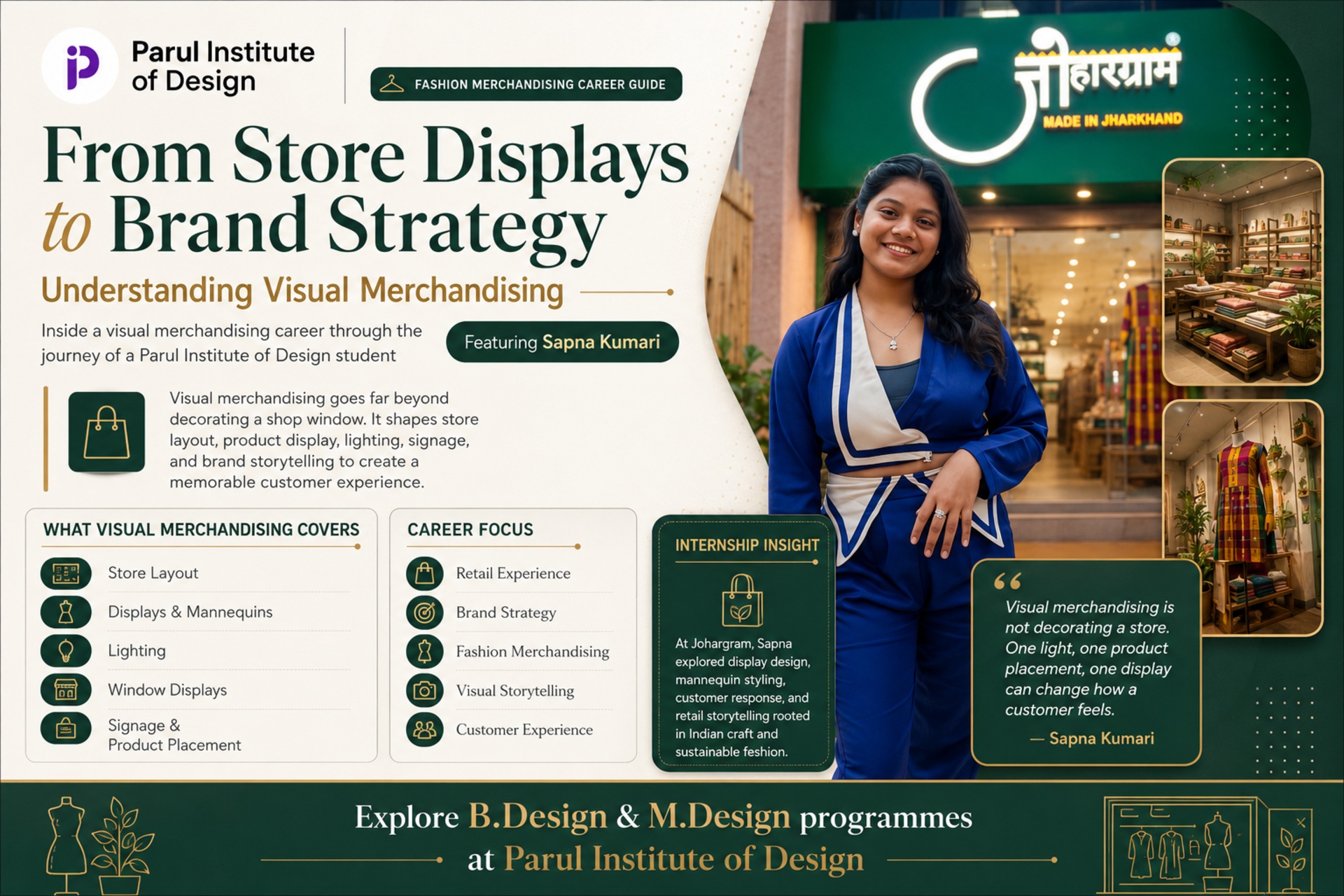
Ask most people what visual merchandising is, and they will say arranging a shop window. That is a fragment of it. Visual merchandising is the discipline of designing the entire in-store experience: how products are displayed, how a store is laid out, how lighting, mannequins and signage are used, so that customers notice the right things and a brand tells its story without saying a word. It sits on the business side of fashion, and it is a genuine career. Sapna Kumari, an M.Des Fashion Merchandising graduate of Parul Institute of Design, shared her views!
Sapna came to it by choice rather than default. After a bachelor’s in fashion design, she realised that fashion is not only about making clothes; it is also about retail, branding, and how a customer experiences a product. She wanted the creative and the business sides together, which is exactly what fashion merchandising combines.
Designing India’s Heritage – A Career in Ethnic Wear Design!
Explore Visual Merchandising, Precisely!
Visual merchandising is not decorating a store. One light, one product placement, one display can change how a customer feels.
– Sapna Kumari
At its core, visual merchandising is the practice of presenting products in a physical space to maximise both appeal and sales. It works through a set of levers a merchandiser controls deliberately:
- Store layout: How customers move through a space and what they encounter in what order.
- Displays and mannequins: How products are grouped and styled to suggest use and aspiration.
- Lighting: Directing attention and setting mood, one of the most underestimated tools.
- Window and focal displays: The first impression that draws a customer in.
- Signage and product placement: Guiding the eye and the decision, right down to which product sits at eye level.
The point that separates a professional from an amateur is that none of this is decoration for its own sake. Every choice is made to influence how a customer feels and behaves, which is why visual merchandising is studied as part of retail and brand strategy rather than as styling.
Visual Merchandising Versus Fashion Design
These are different careers, and confusing them is common. Fashion design is about creating the garment. Visual merchandising and the wider field of fashion merchandising are about selling it: planning what a retailer buys, how it is priced and presented, and how the brand experience is built around it. A fashion designer needs to understand what you study in a fashion design degree; a merchandiser needs to understand customers, retail, and brand. Both are creative, but one creates the product, and the other creates the conditions in which it sells.
The Core Curriculum of Fashion Merchandising!
A master’s in fashion merchandising is built around the retail and brand side. Sapna’s core subjects, Visual Merchandising, Retail Design, Fashion Communication, and Design Research, are the working toolkit of the field, and they are taught through projects, studio work, and industry visits rather than theory alone.
A Delhi study tour took her class through Dilli Haat’s artisan markets and the luxury retail of DLF Emporio, including the stores of designers such as Rahul Mishra and Manish Malhotra, so students could study how high-end retail arranges product and attracts customers. Faculty including Prof. Dhara Parmar and Prof. Anand Bhargava guided the work.
The Internship That Made It Real: Tribal Craft Meets Retail
The clearest proof of the field came in Sapna’s internship at Johargram, the Ranchi-based sustainable brand, founded by designer Ashish Satyavrat Sahu and recognised nationally, including a mention in the Prime Minister Shri Narendra Modi Ji’s Mann Ki Baat, for bringing Jharkhand’s tribal textiles and Sohrai art into mainstream fashion.
Working in visual merchandising and buying, she designed store displays, helped create mannequin displays themed on traditional Sohrai tribal art, worked on store-launch invitations, studied how customers responded inside the store, and researched tribal textiles and the artisans behind them.
It taught her the field’s central lesson: a store is not only a place to sell products; it is where a brand’s story is told, and small choices in display and placement change how that story lands. Turn your creativity into a successful design career by joining B.Design & M.Design programmes at the Parul Institute of Design. These exclusive courses are designed to develop a techno-creative mindset for aspiring designers!
The Progressive Graph of Visual Merchandising
Visual merchandising opens roles across retail and brand: visual merchandiser, retail designer, brand experience specialist, buyer and merchandiser, and store-design consultant, across fashion, lifestyle, and beyond. Sapna’s own aim, to work in visual merchandising and brand experience and to bring Indian handicrafts into modern retail, is a good illustration of how the field lets someone combine commercial skill with cultural purpose. It is a career for people who are creative but also want to understand customers, brands, and business.
Sketches to Spaces – Become an Interior Designer with the guidance of Parul Institute of Design!
FAQs
Define Visual Merchandising?
Visual merchandising is the artistic discipline of designing how products are showcased in the retail industry. It covers the exact size of the layout, display, lighting, product placement, and mannequins to be decorated in a way to attract customers. Not an overnight job, though; it’s a perfect mix of artistic vision and execution!
Define the core difference between fashion design & visual merchandising?
Fashion design is more about curating garments, whereas visual merchandising is a prime part of the fashion merchandising domain - it’s mainly about showcasing & selling. Visual merchandising covers the entire process of retail display, store design, internal branding and holistic customer experience. Hence, a fashion designer creates the product, and a visual merchandiser ensures the sales strategy & overall presentation of it!
What career options are available after doing a fashion merchandising course?
A fashion merchandising degree can give you roles such as: visual merchandiser, overall brand specialist, retail designer, and merchandiser across lifestyle, fashion & retail brands. If you’re passionate about the business side of fashion, it can give you roles across retail strategy, branding and customer management!